- Researchers demonstrated two experimental attacks against Twin-Field Quantum Key Distribution (TF-QKD) using Optical Injection Locking, published as arXiv:2508.21763
- Fast intensity modulation of the untrusted reference laser lets attackers deterministically increase source mean photon number; embedded signals at unmonitored wavelengths bypass the decoy-state technique entirely
- Organizations running OIL-based TF-QKD for high-value key exchange must audit reference-beam handling — information-theoretic security guarantees do not survive these implementation flaws
The Attack That Breaks Quantum Key Distribution’s Core Promise
Twin-Field Quantum Key Distribution was supposed to be the answer to long-haul QKD’s distance problem. It promised secure key rates scaling with the square root of channel loss, enabling metropolitan and inter-city quantum links that standard BB84 could never reach. Banks, governments, and telecom carriers have been piloting TF-QKD precisely because its security reduces to the laws of physics rather than computational hardness.
A new paper on arXiv, Reference-Beam Attacks against Twin-Field Quantum Key Distribution using Optical Injection Locking, shows that promise has a loophole. The authors experimentally demonstrated two attacks that exploit a component nearly every practical TF-QKD deployment shares: the external reference laser used to synchronize phase and frequency between Alice and Bob.
For a CISO evaluating QKD for compliance-critical workloads — PCI key material, classified comms, long-lived signing keys that must survive the cryptographically relevant quantum computer — this matters immediately. The attack surface is not the protocol. It is the hardware you already bought.
Why Reference Beams Exist — And Why That Is the Problem
TF-QKD requires Alice and Bob to interfere weak coherent pulses at a central node. That interference only works if both parties’ lasers share phase and frequency coherence over tens or hundreds of kilometers of fiber. Free-running lasers drift. The economical fix is Optical Injection Locking: a master “reference laser” — typically controlled by the untrusted central node — seeds slave lasers at each endpoint, pulling them into lock.
That architecture hands an adversary the one thing quantum protocols assume they cannot have: a direct optical path into the source. The paper’s thesis is stark.
“These attacks can allow a potential eavesdropper to deterministically increase the mean photon number of the sources, or circumvent the decoy-state technique, respectively.” — arXiv:2508.21763v2
The decoy-state technique is the load-bearing countermeasure against photon-number-splitting attacks in every real-world QKD system. Circumventing it collapses the security proof.
Technical Deep-Dive: Two Attacks, One Optical Port
The authors demonstrated two distinct exploitation paths against OIL-based TF-QKD. Both target degrees of freedom of the reference beam that legitimate monitoring hardware does not inspect.
Attack 1: Fast Intensity Modulation of the Reference
By rapidly modulating the intensity of the injected reference light, the attacker perturbs the locking dynamics of the slave laser. The slave’s output — the quantum signal Alice actually sends to Bob — responds with a mean photon number higher than the nominal value Alice believes she is emitting. Because the decoy-state analysis uses Alice’s assumed photon statistics to bound Eve’s information, any deterministic deviation inflates Eve’s real knowledge beyond what the protocol accounts for. The privacy amplification step then fails to squeeze out enough of Eve’s information, and the “secure” final key contains exploitable correlations.
Attack 2: Embedded Signals at Monitoring-Blind Wavelengths
The second attack is more elegant and arguably harder to defend against with off-the-shelf equipment. The adversary injects additional optical signals alongside the reference beam, at wavelengths outside the passband of conventional monitoring detectors. Those hidden signals interact with Alice’s source to encode information the decoy-state analysis cannot see. The decoy-state assumption — that Eve’s side-information is bounded by what she can learn from the nominal signal and decoy intensities — is simply false when a covert channel rides on the reference path.
Comparison: Standard QKD Threat Model vs. Reference-Beam Reality
| Assumption | Standard TF-QKD Security Proof | Reality with OIL Reference Beam |
|---|---|---|
| Source photon statistics | Fixed, trusted, characterized by Alice | Perturbable by injected reference modulation |
| Decoy-state coverage | Bounds Eve’s PNS information | Bypassed by embedded out-of-band signals |
| Monitoring scope | Quantum channel output | Does not inspect reference-beam spectrum or modulation |
| Trust boundary | Alice’s lab is isolated | Untrusted optical port penetrates the lab |
| Attack detection | Elevated QBER, abort protocol | Attack leaves QBER nominal; key appears valid |
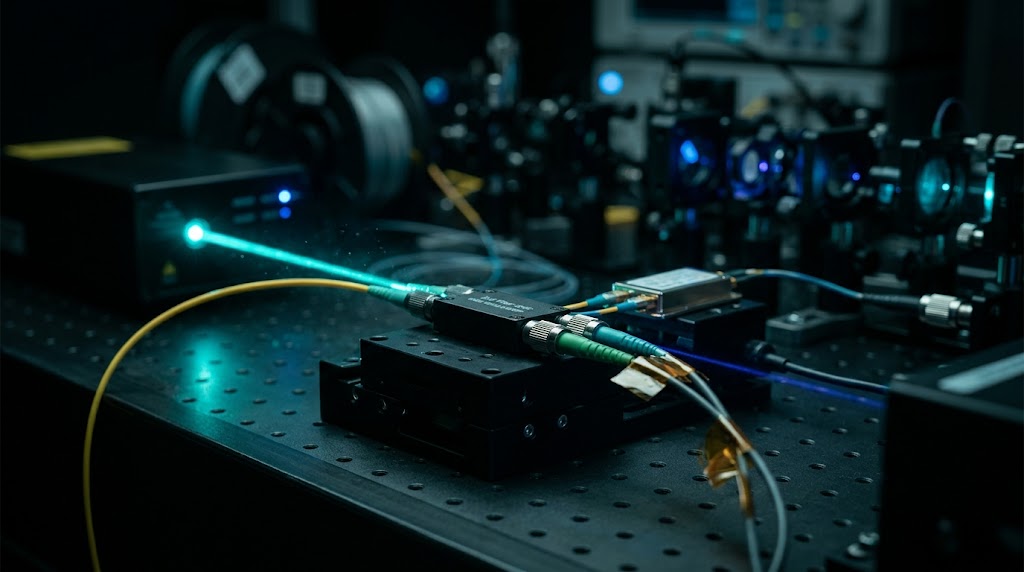
[IMAGE: laboratory optical bench showing fiber-coupled laser, injection-locking module, and a shadowed probe fiber intercepting the reference path]
The security shift here is qualitative, not quantitative. An attacker who succeeds does not degrade the key — they produce a key that looks valid to both endpoints while leaking to Eve.
Industry Context: QKD’s Implementation-Security Reckoning
This paper lands in the middle of a broader credibility debate. Agencies including the NSA and the UK’s NCSC have publicly advised against relying on QKD for national-security key exchange, citing implementation risk rather than protocol flaws. Reference-beam attacks are exactly the class of vulnerability those advisories anticipated.
Meanwhile, standards bodies are still catching up. ETSI’s Industry Specification Group on QKD has published implementation security specifications (GS QKD 011, 014), but side-channel certification of reference-laser subsystems is not yet a mandatory conformance criterion. Procurement teams at central banks and defense ministries writing QKD into ten-year infrastructure contracts are buying hardware whose threat model the research community is still mapping.
The economic calculus shifts accordingly. A TF-QKD metropolitan link costs six to seven figures to deploy. If the reference-beam port is exploitable, that investment protects against a passive fiber tap but not against an adversary with optical-injection access at the central node — which, by the protocol’s own architecture, is untrusted.
Regulatory Timeline Pressure
NIST finalized ML-KEM (FIPS 203), ML-DSA, and SLH-DSA in August 2024, and federal agencies are now executing migration plans under CNSA 2.0 with 2035 deadlines. Organizations evaluating QKD as a complement to post-quantum cryptography must now weigh a second implementation-security burden on top of PQC migration — not fewer moving parts, more.
The BeQuantum Perspective: Defense-in-Depth Beats Single-Primitive Trust
The reference-beam attack family reinforces a design principle we apply across BeQuantum’s PQC Layer and Digital Notary products: never let the security of a high-value key depend on a single cryptographic primitive or a single hardware trust assumption.
Concretely, for clients evaluating QKD integration, we recommend hybrid key establishment — combining ML-KEM-768 with the QKD-derived key via a KDF so that compromise of either input does not compromise the session key. This is the same composition pattern the IETF has standardized for TLS 1.3 hybrid key exchange. When the QKD layer suffers an implementation break like the one arXiv:2508.21763 describes, the ML-KEM contribution preserves confidentiality. When a future cryptanalytic result weakens ML-KEM, the QKD contribution holds.
For IceCase hardware deployments that interface with optical key-distribution systems, we enforce spectral monitoring on every optical input port — including reference and synchronization channels — at a bandwidth wider than the nominal signal. That is exactly the countermeasure class the paper recommends: wavelength filtering and intensity monitoring of the reference beam, extended to detect out-of-band injection.
What You Should Do Next
Within 30 days: Inventory any QKD or quantum-safe key-distribution hardware in your environment. Identify whether reference-laser injection or optical-injection-locking architectures are present. Request side-channel test reports from your vendor specifically covering reference-beam manipulation.
Within 90 days: If you operate TF-QKD links for production key material, deploy hybrid key establishment combining QKD output with ML-KEM-768 under a standard KDF. This removes single-point-of-failure risk regardless of which side-channel paper publishes next.
Within 12 months: Update procurement specifications to require ETSI GS QKD 011-aligned implementation-security evidence and independent side-channel evaluation covering reference-beam and synchronization ports. Push vendors for firmware support for spectral monitoring with configurable alarm thresholds.
FAQ
Q: Does this break all QKD, or only Twin-Field QKD? A: The demonstrated attacks target TF-QKD implementations that use Optical Injection Locking for phase and frequency reference sharing. BB84 and measurement-device-independent QKD variants without an untrusted reference-beam port are not directly affected, though side-channel research against those systems is active and ongoing.
Q: Should we abandon QKD and move purely to post-quantum cryptography? A: Not necessarily, but QKD should not be your sole defense. Hybrid constructions combining QKD with NIST-standardized PQC (ML-KEM, ML-DSA) let you benefit from physical-layer security where it works while retaining mathematical security guarantees when implementations fail. Standalone QKD for high-value keys now carries documented implementation risk that procurement teams must weigh.
Q: Are the proposed countermeasures sufficient, and are they deployable today? A: The authors state their countermeasures reinforce security “without significant additional complexity or performance degradation,” centered on wavelength filtering and intensity monitoring of the reference beam. Specific filter bandwidths and monitoring thresholds are not detailed in the available abstract, so vendor engagement is required to translate the research into deployable firmware and optical filters.
Last updated: 2026-04-24. Primary source: arXiv:2508.21763v2.