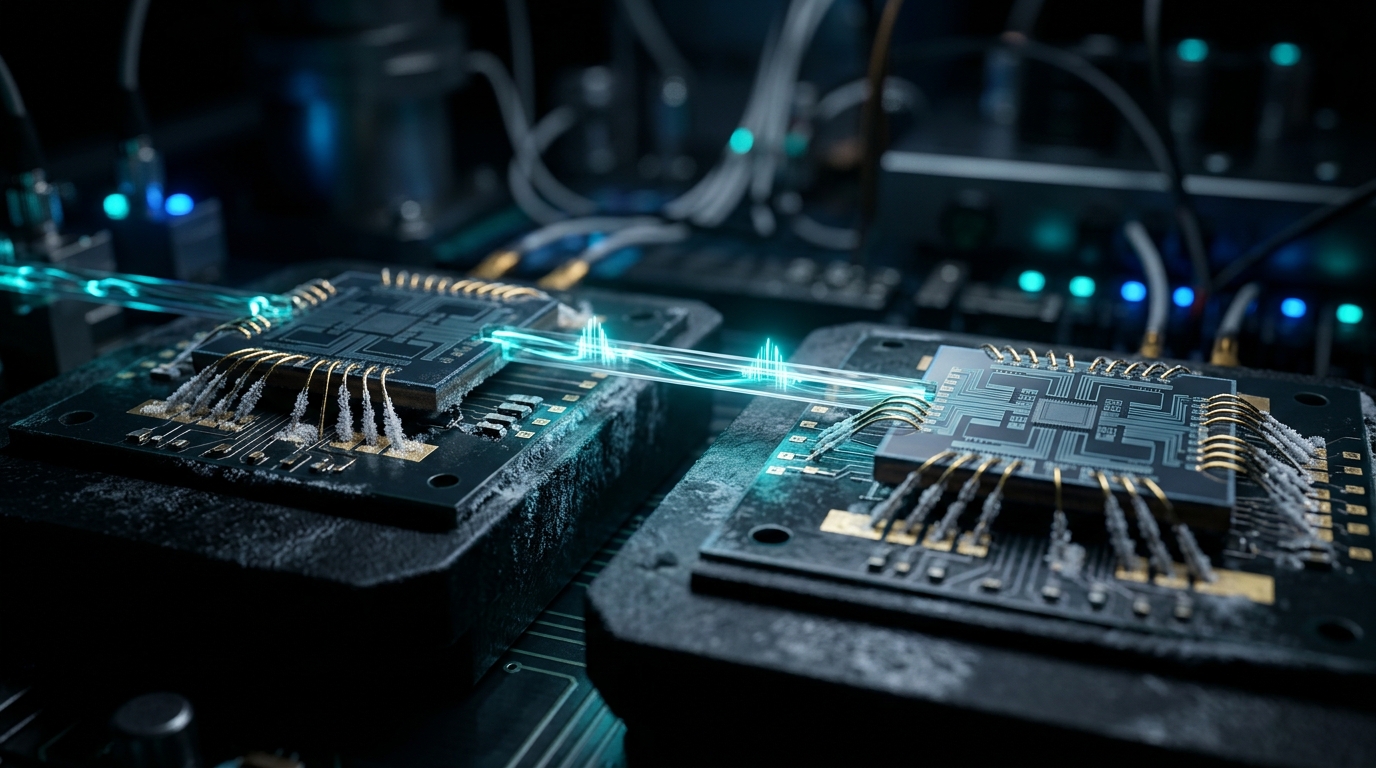

- A new framework (arXiv:2603.18381v2) proves that standard device-level benchmarks — T_1, T_2, readout assignment error, and pairwise crosstalk — are operationally incomplete for multiscale dynamic circuits.
- The A6 synthetic hardware harness injects a pure higher-order context dependence invisible to singles-and-pairs diagnostics, demonstrating that proxy-only null models miss entire classes of measurement backaction.
- Organizations estimating post-quantum threat timelines from vendor-published qubit metrics are working with underspecified error budgets — your migration clock may be faster than you think.
The Problem With Trusting Vendor Qubit Metrics
A CISO reviewing quantum readiness reads a hardware vendor’s spec sheet: T_1 coherence of 150 microseconds, readout assignment error of 1.2%, pairwise crosstalk below 0.3%. The numbers look defensible. The internal risk register updates: cryptographically relevant quantum computers remain 8-12 years out. Migration budget allocations follow.
That calculation is built on a foundation the physics community now openly questions.
Mid-circuit measurements — the primitive that makes dynamic circuits and quantum error correction (QEC) possible — introduce a form of disturbance that conventional benchmarks do not capture. Research posted as arXiv:2603.18381v2 argues that device-level characterization compresses backaction into low-order proxy metrics, and those proxies fail to represent higher-order, context-dependent errors that surface only when circuits get deep enough to matter.
For enterprise security teams tracking , this is not an academic footnote. It means the error budgets quoted by hardware vendors may systematically underestimate what fault-tolerant quantum computers can actually execute once dynamic-circuit primitives mature.
Technical Deep-Dive: The Context-Conditioned Kernel
The paper introduces a formal decomposition of effective disturbance:
Γ_eff[Y, O] = Γ_loc[O] + Γ_proxy[O] + Γ_rel[Y, O]
Where Y is a global context label (the broader circuit state, including correlations invisible at the local level) and O is a local observable. The three terms separate disturbance into:
- Γ_loc[O] — local, observable-intrinsic contribution
- Γ_proxy[O] — what conventional metrics (T_1, T_2, readout, crosstalk) capture
- Γ_rel[Y, O] — the residual context dependence that proxies miss entirely
The third term is the load-bearing contribution. It is defined through a phenomenological compression ansatz using Möbius weights evaluated on classical measurement outcomes — a deliberate architectural choice, because quantum partial-information decompositions on non-commuting algebras run into impossibility issues.
Why Standard Benchmarks Go Blind
To demonstrate the compression is not merely theoretical, the authors built the A6 synthetic hardware harness. A6 programs a conditional interaction encoding a three-qubit parity context (C_0, C_1, C_2) that is, by construction, invisible to one-qubit and two-qubit diagnostics.
“We argue that these proxies can be operationally incomplete for multiscale dynamic circuits.” — arXiv:2603.18381v2
In plain language: a qubit device could pass every standard characterization test and still harbor a disturbance channel that activates only when specific three-body correlations appear in the workload. Error correction codes, which by design manipulate multi-qubit parity, are exactly where those correlations live.
Benchmark Coverage: Proxy vs. Context-Conditioned
| Characterization Approach | Captures Local Noise | Captures Pairwise Crosstalk | Captures Higher-Order Context | Suitable for QEC Certification |
|---|---|---|---|---|
| T_1 / T_2 coherence | Yes | No | No | Insufficient |
| Readout assignment error | Partial | No | No | Insufficient |
| Pairwise crosstalk matrix | No | Yes | No | Insufficient |
| Context-conditioned kernel (Γ_eff) | Yes | Yes | Yes | Designed for it |
The Quantum-Eraser Validation
The A6.2 experiment closes the argument. Using programmable MARK interactions, the authors demonstrate coherent controllability: unconditional measurement fringes are suppressed, and eraser-basis conditioning restores them — behavior consistent with complementarity bounds. A proxy-only null model cannot reproduce this structure. The context-conditioned kernel does.
The result validates a context-conditioned description of backaction against proxy-only null models, establishing that the missing-information term is not a mathematical artifact but an operationally accessible physical channel.
Industry Context: What This Means for PQC Timelines
NIST finalized the first three post-quantum standards (ML-KEM, ML-DSA, SLH-DSA) in August 2024 and is actively tracking migration. Federal agencies received a 2035 deadline under CNSA 2.0. These timelines were constructed on assumptions about when fault-tolerant quantum computers become cryptographically relevant — assumptions anchored in hardware vendor roadmaps.
Those roadmaps are paced by benchmark results. If benchmark results systematically under-represent backaction in the circuit depths required for Shor’s algorithm on RSA-2048 or ECC-256, the industry’s confidence interval on “quantum advantage arrives by year X” is wider than the published numbers suggest — in either direction.
It cuts two ways. Optimistic read: fault-tolerance is harder than quoted, giving migration programs more runway. Pessimistic read: current hardware has capabilities that proxy benchmarks are failing to surface, including capabilities that could be weaponized by adversaries already harvesting encrypted traffic under a "" strategy.
The prudent posture: treat vendor benchmark data as a lower bound on device complexity, not an upper bound on threat capability.
The BeQuantum Perspective
Organizations building crypto-agility programs typically anchor threat models to publicly reported qubit counts and error rates. That approach inherits the incompleteness the paper identifies.
The BeQuantum PQC Layer treats this explicitly. Rather than tying migration triggers to vendor milestones, it sequences cryptographic transitions against observable-class splits — the same conceptual move the context-conditioned kernel makes at the physics level. Where the paper separates Γ_loc, Γ_proxy, and Γ_rel to isolate what standard diagnostics miss, a defensible enterprise PQC roadmap separates data-at-rest, data-in-transit, and long-lived signature assets, then prioritizes migration by residual exposure rather than by average-case threat modeling.
The applies the same principle to content authenticity: anchor to blockchain-verified commitments so that even if a higher-order disturbance channel turns out to compromise a cryptographic primitive earlier than the benchmark consensus predicts, the provenance layer remains independently verifiable.
What You Should Do Next
Within 90 days, audit your quantum-threat risk register. If timeline assumptions cite T_1/T_2 coherence or gate fidelity as the primary input, document that the underlying metrics have known operational incompleteness for circuits with three-body or higher correlations. Flag this in your next board-level cyber risk review.
Within 6 months, map your cryptographic inventory by residual exposure class. Separate assets by how long their confidentiality must hold. Anything requiring confidentiality beyond 2035 moves to the front of the migration queue regardless of benchmark-derived threat estimates — the uncertainty band on those estimates just widened.
Before your next vendor review, ask hardware providers whether their characterization suite includes synthetic-harness testing for context-conditioned disturbance, or only proxy metrics. If only proxies, treat published error budgets as preliminary.
FAQ
Q: Does this research mean current quantum computers are more powerful than reported?
A: Not directly. It means the benchmarks used to characterize them may miss specific classes of disturbance relevant to dynamic circuits and QEC. The capability implications run in both directions — hardware may be further from fault tolerance than quoted, or it may harbor workload-dependent behaviors that proxy tests never surface.
Q: Should we accelerate our PQC migration based on this paper?
A: Accelerate the audit and inventory phases. Migration sequencing should already be underway for any asset requiring confidentiality past the 2030s. This research strengthens the case against using vendor benchmark improvements as a trigger to slow migration pace.
Q: Is the context-conditioned kernel approach something vendors will adopt?
A: It addresses a real gap in QEC certification, so expect adoption pressure from large-scale quantum computing customers — national labs, financial infrastructure, cloud providers — within 3-5 years. Enterprise security teams should ask for it before it becomes standard.
Last updated: 2026-04-25. Source: arXiv:2603.18381v2.