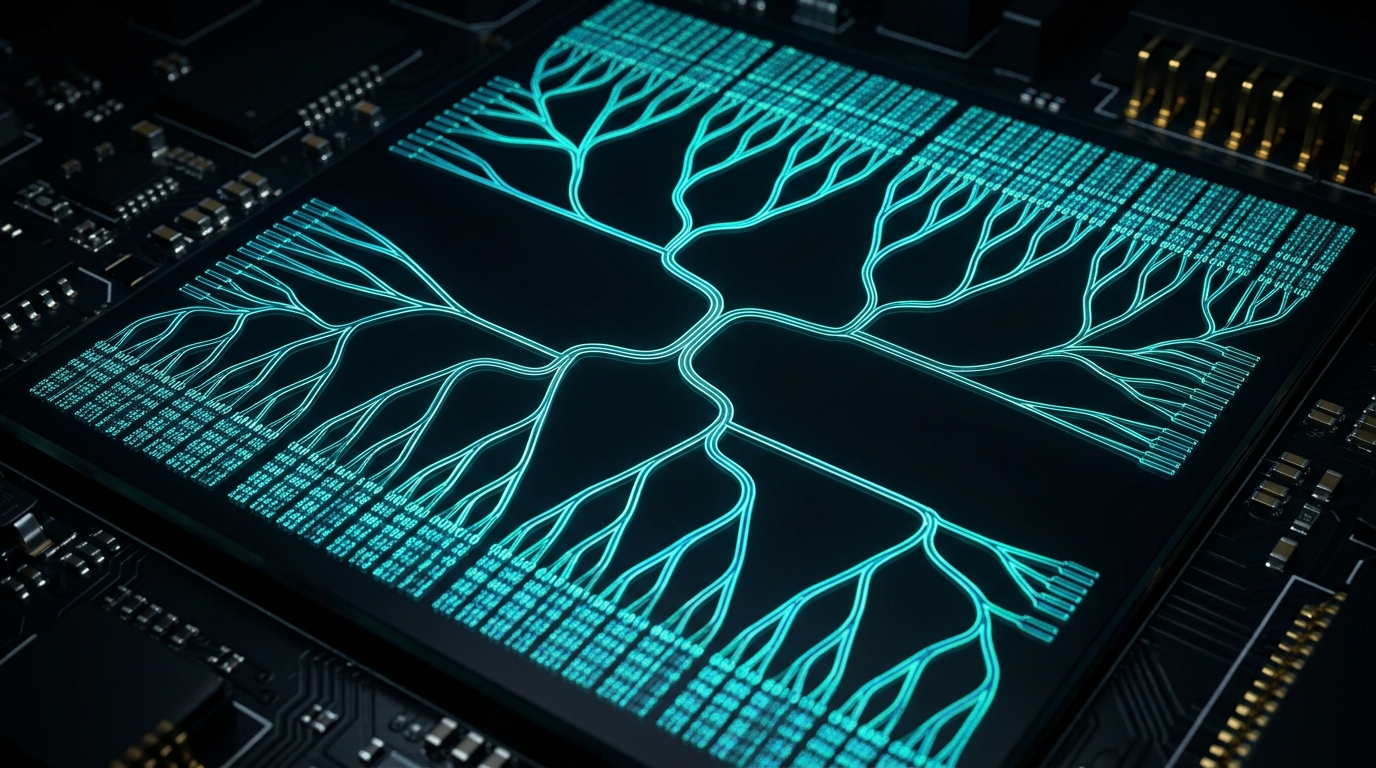

- A new framework (arXiv:2510.15223) rediscovers the [[15,7,3]] CSS quantum Hamming code from competing objectives alone — no predetermined algebraic structure required.
- At n=100 qubits, the method synthesizes a novel [[100,50,4]] code with a 50% encoding rate in under one hour, with O(n³) per-iteration complexity.
- Automated code discovery compresses the timeline to fault-tolerant quantum computing — which compresses the timeline security architects have to finish post-quantum migration.
Why This Research Changes Your Quantum Risk Calendar
Security architects currently plan post-quantum migration against a rough assumption: cryptographically-relevant quantum computers arrive in the early-to-mid 2030s. That assumption rests on how fast fault-tolerant quantum hardware matures. Fault tolerance, in turn, depends on quantum error-correcting codes (QECC) — the hand-crafted algebraic structures that let noisy physical qubits simulate stable logical ones.
A preprint posted to arXiv in October 2025 (ID 2510.15223, version 3) just removed a structural bottleneck in that pipeline. Instead of hand-designing codes from group theory or stabilizer formalism, the authors recast code discovery as a game between competing design objectives. Nash equilibria of that game correspond to codes with the desired properties. The framework reproduces the 1996 Calderbank-Shor-Steane [[15,7,3]] quantum Hamming code without being told its algebraic structure, then scales to discover a previously uncatalogued [[100,50,4]] code in under an hour.
For CISOs, the operational implication is blunt: if code synthesis stops being a decade-scale research bottleneck and becomes a commodity design step, your 2030s migration window tightens.
The Problem: Why QECC Design Has Gated Quantum Progress
A single physical qubit decoheres in microseconds. Running Shor’s algorithm against RSA-2048 requires a logical qubit stable for hours. Bridging that gap takes a QECC that encodes one logical qubit across thousands of physical qubits, plus a decoder that identifies errors faster than they accumulate.
Historically, two approaches dominated:
- Algebraic construction — Codes like CSS, surface codes, and LDPC variants derive from classical coding theory and group structure. They are interpretable but rigid; adapting them to a specific hardware topology (e.g., IBM’s heavy-hex lattice or neutral-atom connectivity) requires manual rederivation.
- Computational search — Brute-force or ML-driven exploration of stabilizer generators. Scales better but produces opaque codes that researchers cannot easily reason about, slowing peer review and hardware qualification.
Both approaches share a constraint: each new hardware generation or error model effectively restarts the design process. That repeated cost — not the number of physical qubits — has been the pacing item for fault tolerance.
Technical Deep-Dive: Nash Equilibria as Code Generators
The framework treats QECC design as a non-cooperative game. Each “player” represents an objective — minimize weight, maximize distance, match hardware connectivity, maximize Fisher information, and so on. The strategy space is the set of candidate code parameters. At a Nash equilibrium, no objective can unilaterally improve without violating another. The equilibrium configuration is the code.
We introduce a game-theoretic framework recasting code optimization as strategic interactions between competing objectives, where Nash equilibria systematically generate codes with desired properties. (arXiv:2510.15223)
The authors evaluate seven objectives: distance maximization, hardware adaptation, rate-distance optimization, cluster-state generation, surface-like topology, connectivity enhancement, and Fisher information maximization. Reconfiguring which objectives compete — rather than rewriting the algorithm — produces entirely different code families.
Validation Against a Known Benchmark
When the objectives are tuned to replicate the design constraints of the 1996 CSS construction, the framework converges to the [[15,7,3]] quantum Hamming code. Equilibrium analysis explains why that topology emerges — a property absent from black-box ML search methods.
Scaling to New Territory
At n=100 qubits, the same machinery synthesizes a [[100,50,4]] code. The per-iteration cost is O(n³); total discovery completes in under one hour on unspecified hardware.
Comparison: Traditional vs. Game-Theoretic QECC Design
| Dimension | Algebraic Construction | Computational Search | Game-Theoretic (Nash) |
|---|---|---|---|
| Interpretability | High — derives from group theory | Low — opaque output | High — equilibrium explains structure |
| Hardware adaptation | Manual rederivation | Retraining required | Reconfigure objectives |
| Scaling to n=100 | Weeks of theorist time | Variable, often days | Under 1 hour, O(n³) per iteration |
| Rediscovers [[15,7,3]]? | Original source | Sometimes | Yes, without being told its structure |
| New code families | Rare breakthroughs | Narrow families | Reconfigured per objective set |
The framework replaces algebraic constructions with predetermined structure and computational search lacking mechanistic interpretability — merging the transparency of the former with the scale of the latter.
[IMAGE: Abstract visualization of a quantum lattice with competing coloured light beams converging at a single equilibrium point, representing Nash equilibrium in code discovery]
What the Paper Does Not Yet Prove
The preprint leaves several engineering questions open. There are no reported pseudo-threshold benchmarks against surface or LDPC codes under realistic noise models, no hardware implementation on physical quantum devices, and no decoder-complexity figures. Convergence guarantees and uniqueness of the Nash equilibria are not detailed. Security teams should treat the result as a design methodology breakthrough, not a deployment-ready stack.
Industry Context: Why This Pressures PQC Timelines
NIST finalized its first three post-quantum cryptography standards — FIPS 203 (ML-KEM), FIPS 204 (ML-DSA), and FIPS 205 (SLH-DSA) — in August 2024. CNSA 2.0 mandates full PQC transition for U.S. national security systems by 2035, with software and firmware signing migrated by 2030. Most enterprise migration plans trail those deadlines by a comfortable margin, assuming quantum hardware will not reach cryptographic relevance first.
Automated QECC synthesis disturbs that assumption on two fronts:
- Vendor differentiation compresses. If IBM, Google, IonQ, and Quantinuum can run game-theoretic code synthesis against each new device generation’s error model, they no longer wait on academic groups to hand-deliver adapted codes. Device-specific fault-tolerance stacks become a standard engineering deliverable rather than a multi-year research program.
- Threat-model resets become cheaper. Competitors (nation-state or commercial) can reconfigure objectives to target hardware-specific constants — connectivity, T1/T2 times, crosstalk patterns — without redesigning their search algorithm. The marginal cost of exploring a new code family drops from months to hours.
The economic frame is straightforward: migrating early costs budget; migrating late costs data. A harvested ciphertext recorded in 2026 and decrypted in 2032 is indistinguishable from one decrypted in 2035 for most regulated data classes — healthcare records, financial identity, long-lived intellectual property.
The BeQuantum Perspective
Two threads of our platform map directly onto this research.
PQC Layer. Automated QECC synthesis accelerates quantum hardware; the defensive counterweight is accelerating deployment of NIST-standardized PQC primitives. Our PQC Layer wraps ML-KEM and ML-DSA around existing TLS and signing workflows without requiring application rewrites. The faster the fault-tolerance timeline compresses, the larger the premium on migration paths that swap primitives without refactoring the call sites that depend on them.
Digital Notary and IceCase. When threat models reset, verifiable provenance matters more than the underlying algorithm surviving forever. The Digital Notary records content and credential attestations on a blockchain-anchored ledger signed with PQC primitives, so the audit trail remains verifiable after a cryptographic transition. IceCase provides the hardware root-of-trust that binds those attestations to a tamper-evident physical boundary — the layer that survives even if a protocol layer is retired.
The point is not that this paper breaks any deployed cryptosystem today. It is that the speed of capability growth on the offensive side is no longer gated by the slowest manual step. Your architecture should assume that gating disappears.
What You Should Do Next
- Within 90 days: Inventory long-lived signing keys and TLS certificates whose confidentiality or authenticity must survive past 2032. Treat any key class without a scheduled rotation to PQC primitives as a harvest-now-decrypt-later liability.
- Within 180 days: Require PQC migration roadmaps from critical vendors — identity providers, HSM suppliers, code-signing CAs, document repositories. Reject “monitoring NIST” as a roadmap; ask for scheduled FIPS 203/204/205 support dates.
- Within 12 months: Pilot hybrid PQC deployment (classical + ML-KEM) on at least one production TLS endpoint and one signing pipeline. Measure latency impact, certificate-chain size, and operational load before you need to cut over under deadline pressure.
FAQ
Q: Does this paper mean quantum computers can break RSA now? A: No. It accelerates the design of error-correcting codes that fault-tolerant quantum computers need. Cryptographically-relevant fault tolerance still requires millions of physical qubits operating below threshold. What changed is the pace at which one of the rate-limiting research steps can be iterated.
Q: Is the [[100,50,4]] code ready for production use? A: No. The preprint demonstrates synthesis, not benchmarking against realistic noise, decoder complexity, or hardware implementation. Treat it as evidence that automated code discovery works at scale — not as a deployable stack. Hardware validation and threshold analysis remain open work.
Q: Should we wait for NIST to issue guidance before adjusting our PQC timeline? A: NIST has already issued guidance — FIPS 203, 204, and 205 were finalized in August 2024, and CNSA 2.0 sets the migration schedule for national security systems. Waiting for additional guidance typically means waiting for an incident report. The defensive position is hybrid deployment now, full cutover ahead of mandate.
Last updated: 2026-04-24. Based on arXiv:2510.15223v3, “Game-Theoretic Discovery of Quantum Error-Correcting Codes Through Nash Equilibria.”