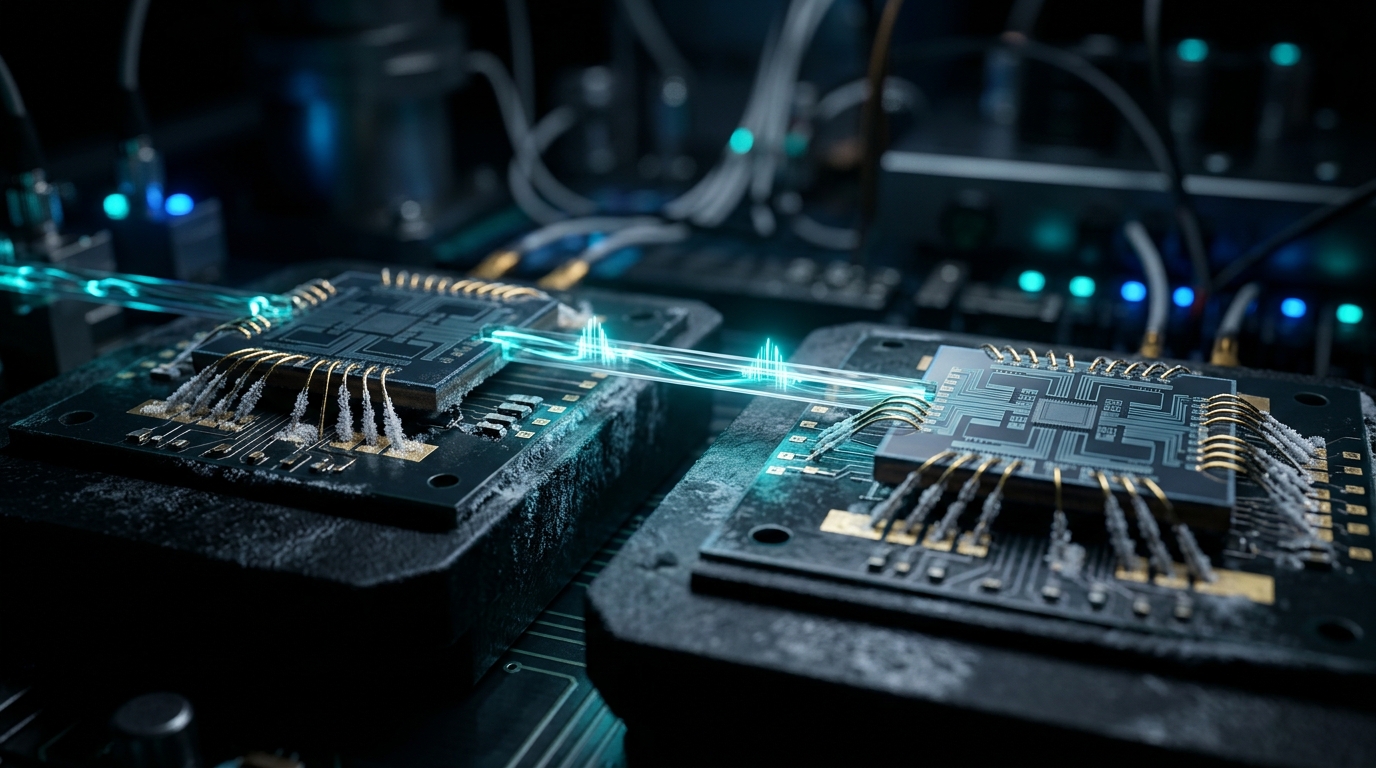

- A new randomized benchmarking framework (arXiv:2412.18578) delivers a sample complexity advantage of more than two orders of magnitude (>100x) versus character RB for high-spin systems
- The technique extends practical noise characterization to qudits and bosonic modes — the building blocks of next-generation fault-tolerant quantum hardware
- Faster validation of high-dimensional quantum systems compresses the runway for post-quantum cryptography migration. CISOs treating PQC as a 2030 problem need to recalibrate.
The Quiet Acceleration of Quantum Hardware Validation
Most CISO threat models still treat cryptographically relevant quantum computers (CRQCs) as a 2030+ concern. That assumption rests on a chain of bottlenecks: physical qubit fidelity, error correction overhead, and — critically — the engineering time required to prove that a quantum processor behaves as designed.
That last bottleneck just shrank by two orders of magnitude.
A paper indexed as arXiv:2412.18578, “Randomized Benchmarking with Synthetic Quantum Circuits,” introduces a benchmarking strategy that makes noise characterization of high-dimensional quantum systems — qudits and bosonic modes — practical for the first time. The work matters to security leaders for one reason: every efficiency gain in quantum hardware validation pulls the harvest-now-decrypt-later threat closer to the present.
Why Benchmarking Is the Hidden Critical Path
Before a quantum processor can run Shor’s algorithm against RSA-2048, engineers must measure its error rates with statistical rigor. Randomized Benchmarking (RB) is the dominant protocol for this. Modern RB techniques work by exploiting the mathematical structure of the group representation generated by the operations being tested.
The problem: existing RB methods break down for representations that are highly reducible but decompose into high-dimensional irreducible subspaces. That sounds abstract until you realize it describes exactly the systems vendors are racing to commercialize.
Where current RB stalls:
- Qudits — d-level quantum systems (d > 2) that pack more information per physical resource than qubits
- Bosonic modes — continuous-variable systems used in cat codes, GKP codes, and other leading error-correction schemes
- High-spin systems — natural platforms for rotationally symmetric error-correcting codes
In each case, experimental control is restricted to a small subset of all possible unitary operations. Standard RB demands sample counts that scale unfavorably with subspace dimension, making characterization “prohibitively inefficient,” in the authors’ language.
For a security architect, the translation is simple: until now, the most promising paths to fault-tolerant quantum computing carried a hidden tax — months of experimental sampling to validate each generation of hardware. That tax just got cut.
Technical Deep-Dive: What “Synthetic” Means Here
The new framework restructures how benchmarking data is generated and analyzed. Rather than running the natural circuits and measuring outputs directly, the protocol uses synthetic quantum circuits combined with classical post-processing of both input and output data. The strategy applies to any benchmarking group and leverages the full structure of reducible superoperator representations — the parts of the system’s mathematical description that prior protocols left on the table.
The authors develop the framework in detail for systems carrying a natural action of SU(2) — the symmetry group underlying rotationally invariant codes.
Sample Complexity: Standard RB vs. Synthetic RB
| Dimension | Character RB (Standard) | Synthetic RB (New) | Advantage |
|---|---|---|---|
| Target system | Multi-qubit, low-dim irreps | Qudits, bosonic modes, high-spin | Extends practical reach |
| Reducible representation handling | Partial (character-level) | Full superoperator structure | Higher information yield per shot |
| Control requirements | Broad gate sets needed | Works with restricted unitary subsets | Matches real hardware constraints |
| Sample complexity for high-spin systems | Baseline | >100x reduction | Two orders of magnitude |
| Post-processing | Output-side only | Input + output classical processing | Extracts more signal per circuit |
“For measuring rotationally invariant error rates of experimentally accessible high-spin systems, our synthetic RB protocols offer a sample complexity advantage of more than two orders of magnitude relative to standard approaches such as character RB.” — arXiv:2412.18578v2
A 100x reduction in samples is not an academic curiosity. If a benchmarking run that previously consumed three months of cryostat time can complete in under a day, hardware iteration cycles compress proportionally. Every iteration cycle saved is one closer to a working CRQC.
Industry Context: The Compression of the PQC Migration Window
NIST finalized its first post-quantum cryptography standards — ML-KEM (FIPS 203), ML-DSA (FIPS 204), and SLH-DSA (FIPS 205) — in August 2024. CISA’s guidance recommends inventory completion by 2026 and full migration by 2035. Those dates were calibrated against a particular assumption about quantum hardware progress.
That assumption is under pressure on multiple fronts:
- Bosonic and qudit codes are the leading candidates for resource-efficient fault tolerance. AWS’s cat-qubit work, Yale’s GKP demonstrations, and Quantinuum’s qudit research all rely on high-dimensional system validation.
- Validation efficiency has historically been a rate limiter. Faster benchmarking removes one constraint from the hardware development loop.
- Threat actor patience is asymmetric. Adversaries running harvest-now-decrypt-later operations against TLS traffic, signed firmware, and long-lived secrets benefit from any acceleration of the timeline.
The cost of inaction is not measured in 2035 dollars. It is measured in the value of every encrypted asset captured today that retains sensitivity past the CRQC arrival date.
For an enterprise with 15-year data retention obligations — financial services, healthcare, government contractors — every piece of TLS traffic flowing today over classical key exchange is already at risk if it gets harvested. Hardware validation breakthroughs do not change that math; they only confirm that the deadline is not soft.
The BeQuantum Perspective
This paper is a benchmarking result, not a cryptographic break. But security architecture must respond to trajectory, not just current state. When the engineering effort to validate next-generation quantum hardware drops by 100x for a critical class of systems, the prudent response is to assume the broader timeline accelerates correspondingly.
Three principles inform how organizations should architect against this trajectory:
- Cryptographic agility before cryptographic perfection. The PQC Layer pattern — where key exchange and signature algorithms are abstracted behind a policy-driven control plane — lets you swap ML-KEM for whatever survives the next round of cryptanalysis without re-architecting applications.
- Notarization of high-value assets today. A digital notary that anchors document hashes to a hash-based signature scheme (SLH-DSA, for example) creates a quantum-resistant integrity record for assets created now, before migration is complete elsewhere in the stack.
- Hardware-rooted trust for long-lived secrets. Software-only PQC implementations inherit the security of the host. Hardware-rooted implementations isolate the migration surface.
These are not BeQuantum-specific principles — they are the architectural patterns the field is converging on. The implementation details matter, but the strategic move is recognizing that quantum hardware progress is a continuous variable, not a step function arriving in 2035.
What You Should Do Next
Within 90 days: Complete a cryptographic inventory across all systems handling data with retention requirements beyond 2030. Tag every TLS endpoint, code-signing pipeline, and document signature workflow. The NSA’s CNSA 2.0 inventory framework is a workable starting template.
Within 6 months: Pilot a hybrid key exchange (classical + ML-KEM) on at least one production-adjacent path. The goal is operational learning, not full cutover. You want to discover the integration friction before it becomes an emergency.
Within 12 months: Establish a cryptographic agility review as a standing item in your architecture review board. Any new system handling sensitive data should be evaluated for algorithm swap-ability before approval.
FAQ
Q: Does this paper mean quantum computers can break RSA now? A: No. The work is a benchmarking technique, not a cryptanalytic attack. It accelerates how efficiently engineers can validate quantum hardware noise properties, particularly for high-dimensional systems that underpin leading error-correction approaches. The cryptanalytic risk timeline is shaped by many factors; this is one input that pushes in the direction of acceleration rather than delay.
Q: Why should a CISO care about randomized benchmarking specifically? A: Because hardware validation has been a hidden bottleneck in the quantum development loop. Improvements that compress validation cycles by 100x reduce the engineering friction between today’s hardware and a cryptographically relevant quantum computer. Threat-model timelines built on assumptions of slow validation cycles need recalibration.
Q: Is qudit-based quantum computing actually a near-term threat? A: Qudit and bosonic architectures are leading candidates for resource-efficient fault tolerance precisely because they pack more logical capacity per physical resource. Faster characterization of these systems shortens the path to demonstrating fault-tolerant logical operations — the prerequisite for running Shor’s algorithm at cryptographically relevant scales.
Last updated: April 25, 2026
[IMAGE: A high-spin quantum system rendered as concentric rings of luminous SU(2) symmetry, with synthetic circuit traces threading between dimensions]