- An FPGA-resident machine learning classifier discriminates superconducting qubit and qutrit states in 40 nanoseconds, against the millisecond-scale round trip required when readout data ships to a host computer for post-processing (arXiv:2406.18807v4).
- That is roughly a 25,000x latency reduction — a figure derived from the paper’s own numbers, not stated in it — and it moves state discrimination from outside the coherence window into it. Coherence typically lasts hundreds of microseconds; 40 ns consumes under 0.05% of a 100 µs budget.
- This is a quantum control-electronics result, not a cryptanalysis result. It shifts no RSA-breaking date. It does remove one of the engineering blockers standing between today’s noisy machines and error-corrected ones — the single variable in your “harvest now, decrypt later” exposure that your organization does not control.
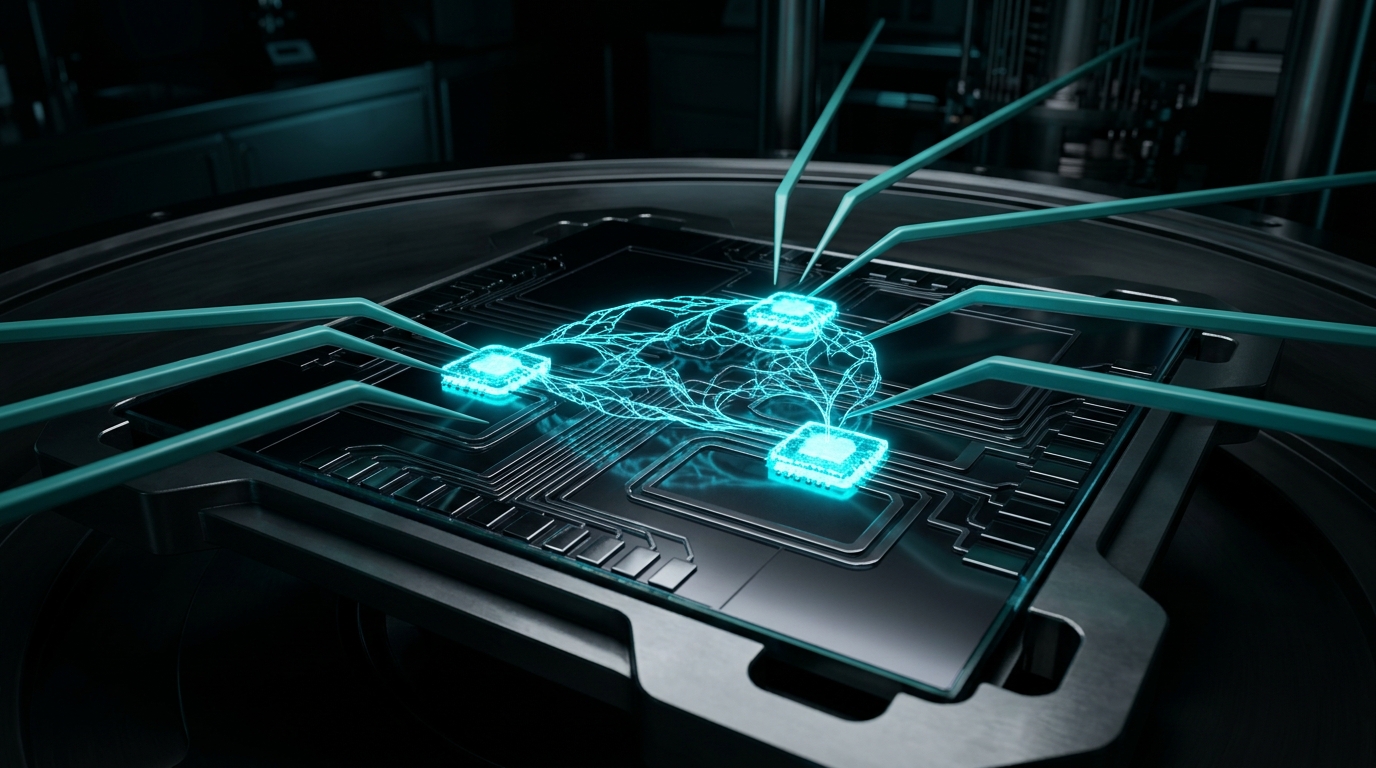
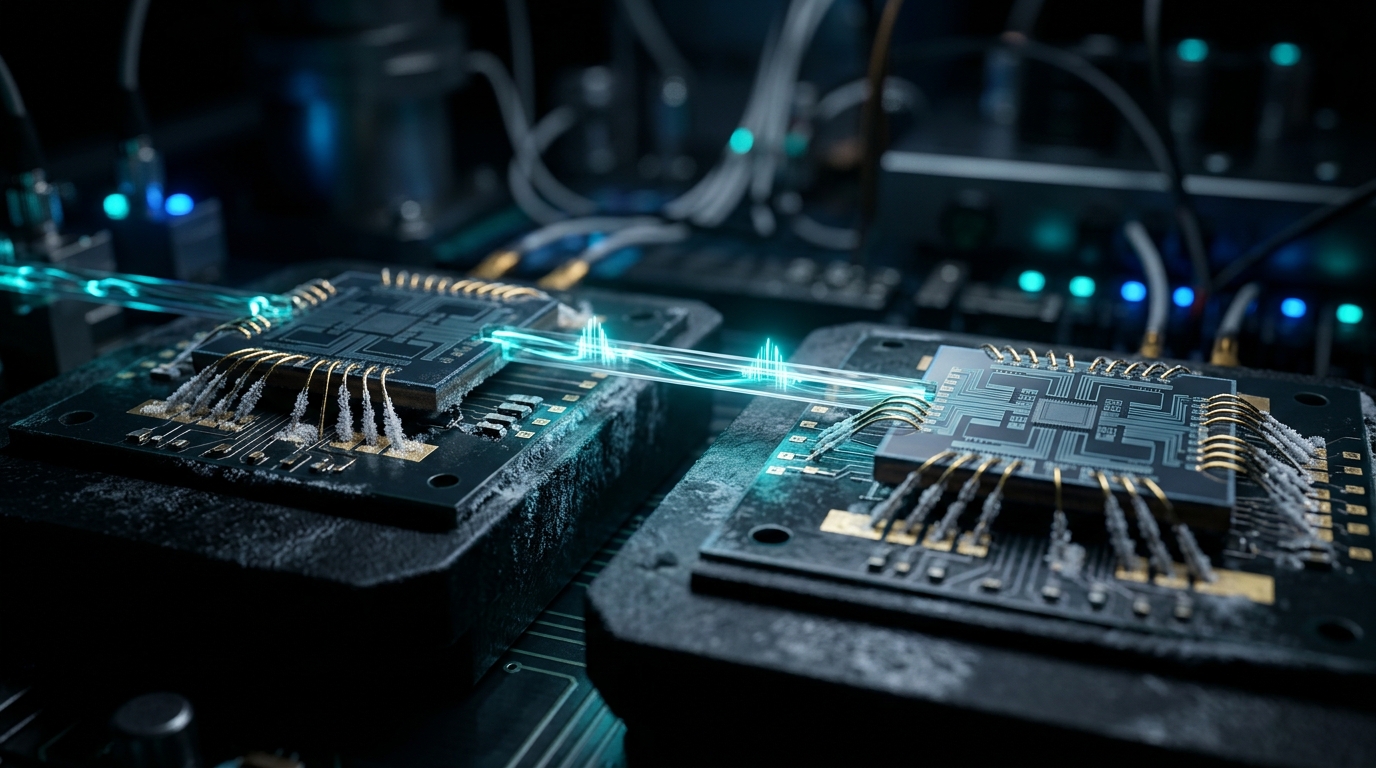
[IMAGE: A field-programmable gate array board wired by coaxial readout lines to a superconducting quantum processor inside a dilution refrigerator]
The Readout Bottleneck Stalling Quantum Error Correction
Picture the measurement path on a superconducting quantum processor today. A microwave pulse probes a qubit mid-circuit. The reflected signal gets digitized, then travels off the control rack to a host computer, where a software classifier decides whether the qubit landed in |0⟩ or |1⟩. The verdict returns milliseconds later.
The qubit it was meant to condition is already gone. Coherence on the transmon devices referenced in this work lasts hundreds of microseconds. A millisecond round trip does not merely miss the window — it arrives after the quantum information has decayed, which makes the classification result useless for anything happening inside the same circuit.
That gap is why quantum error correction remains a demonstration rather than a deployed capability. Error correction is not a post-mortem: it requires detecting and correcting errors within a single circuit cycle to preserve logical state coherence. If your syndrome extraction depends on a host computer’s answer, you have no correction loop at all — you have a very expensive logging system.
The authors of arXiv:2406.18807v4 frame the asymmetry bluntly. Reading the state of a classical transistor is near-instantaneous. Identifying the state of a superconducting qubit is still latency-limited and error-prone. Every architecture proposal for fault-tolerant quantum computing quietly assumes that asymmetry gets closed.
Inside the 40-Nanosecond Quantum State Classifier
What in-situ inference means
Quantum state discrimination is the classification step that converts an analog readout trace into a discrete label — deciding, from a noisy microwave signal, which energy level the qubit occupied at measurement time. In-situ inference means running that classifier inside the control electronics themselves, on the FPGA that already handles digitization and pulse sequencing, rather than exporting samples to a general-purpose host. The distinction is architectural: one design treats classification as an offline analytics problem, the other treats it as part of the control loop.
The paper’s engine performs inference directly on digitized readout signals with no host-side intervention, and it handles both two-level qubit systems and three-level qutrit systems.
“To bridge this latency gap, we present an in-situ machine learning (ML) inference engine implemented on a field-programmable gate array (FPGA), enabling real-time quantum state discrimination within 40 ns.” — Abstract, arXiv:2406.18807v4, “ML-Powered FPGA-based Real-Time Quantum State Discrimination Enabling Mid-circuit Measurements”
Host post-processing versus FPGA in-situ inference
| Dimension | Host-side post-processing (incumbent) | FPGA in-situ ML inference |
|---|---|---|
| Where classification runs | General-purpose host computer, off-rack | On the FPGA in the control stack |
| Reported latency | Order of milliseconds | 40 ns |
| Fraction of a 100 µs coherence window | Exceeds it entirely — result arrives after decay | Under 0.05% |
| Mid-circuit measurement | Not viable within a single circuit | Supported |
| Conditional feed-forward | Not viable | Demonstrated (conditional qutrit logic protocol) |
| Levels supported | Implementation-dependent | 2-level (qubit) and 3-level (qutrit) |
| Validation platform | — | Superconducting transmon devices |
| Discrimination fidelity | — | Described as “robust”; no numbers published |
Qutrits are the part worth noticing
Support for three-level systems is not a footnote. Qutrit-based protocols compress more information per physical device and open error-correction encodings that qubit-only hardware cannot express — but they have been gated on readout electronics able to distinguish three states fast enough to act on. The authors implemented a conditional qutrit logic protocol driven entirely by FPGA-resident state classification, meaning the branch decision never left the control hardware.
What this paper does not establish
Depth requires saying where the evidence stops. Four gaps matter for anyone reading this as a signal about hardware timelines:
The accuracy half of the problem is unquantified. The abstract calls existing readout “latency-limited and error-prone,” yet every number offered addresses latency. Discrimination fidelity is described as “robust” with no per-state fidelity, no assignment error rate, and no baseline comparison against a matched filter, Gaussian mixture model, or linear discriminant. Half the stated problem has no reported solution.
The 40 ns boundary is undefined. It is not stated whether that window covers ADC digitization and demodulation and feed-forward signaling, or only classifier inference. End-to-end mid-circuit measurement latency — the number that actually determines whether an error-correction cycle closes — is not given.
No error-correction cycle was demonstrated. Quantum error correction is the stated motivation, but the paper reports no syndrome extraction rounds and no logical error rate. It delivers an enabling component, not the capability.
Reproducibility inputs are missing. FPGA part number, clock frequency, and resource utilization are absent, so cost and scale cannot be assessed. The ML model class, size, and quantization are unspecified. Training data, retraining cadence as devices drift, and any comparison against existing low-latency control stacks — QICK, Quantum Machines OPX, Zurich Instruments — are not addressed. The record available is a v4 revision of a preprint; peer-review status is not indicated.
None of that invalidates the 40 ns result. It does mean the honest reading is “a credible enabling component with an unpublished accuracy profile,” not “error correction is solved.”
Why Control Electronics Set the Confidence Interval, Not the Deadline
Here is the trap for security teams reading quantum hardware news: treating each result as an input to a countdown. This paper contains no cryptographically relevant qubit count, no factoring estimate, and no claim about any cryptosystem. Anyone citing it as evidence that RSA falls sooner is asserting a connection the source does not make.
The regulatory clock runs on its own schedule regardless. NIST finalized the first post-quantum standards — FIPS 203 (ML-KEM), FIPS 204 (ML-DSA), and FIPS 205 (SLH-DSA) — in August 2024, and its draft NIST IR 8547 sets out deprecating RSA-2048 and 256-bit elliptic curve cryptography after 2030 and disallowing them after 2035. The NSA’s CNSA 2.0 suite pushes national-security systems toward quantum-resistant algorithms on comparable dates. Those deadlines were published before this paper and are unaffected by it.
Your migration deadline is not set by when a quantum computer works. It is set by the confidentiality lifetime of the data you are encrypting today. Traffic captured in 2026 under classical key exchange, holding data that must stay secret through 2040, is already compromised on any timeline where fault tolerance arrives at all.
What results like this one legitimately change is the confidence interval around fault tolerance. Fast in-situ discrimination is a prerequisite for repeated syndrome extraction, so its arrival makes indefinite deferral a weaker position than it was. The practical near-term effect lands on quantum hardware vendors and national labs: readout classification migrates from host software into control firmware, and procurement shifts toward control systems with on-board inference. Over three to five years, expect qutrit readout to move from research curiosity to a supported feature in commercial control stacks, with standardization pressure on control-hardware latency budgets.
The economics for enterprises are unchanged by any of this, and that is the point. Migration cost is dominated by discovery — finding embedded cryptography in long-lived hardware, third-party libraries, code-signing chains, and firmware update mechanisms you cannot patch remotely. That inventory work takes quarters and does not accelerate because a deadline arrives.
The BeQuantum Perspective: Verification Belongs Inside the Latency Budget
The transferable lesson here is architectural, not quantum. The paper’s contribution is refusing to send a time-critical decision to a remote host and instead running it where the deadline is. We apply the same constraint to cryptographic verification.
Our Digital Notary anchors a content hash and its ML-DSA signature at capture time, in the capture path, rather than reconstructing provenance after the fact from logs held elsewhere. Post-hoc attestation has the same defect as host-side readout classification: by the time the answer returns, the state it described has already moved.
The PQC Layer runs hybrid key agreement — a classical X25519 exchange composed with ML-KEM — so session confidentiality does not depend on a future migration event that may slip. Hybrid construction means a break in either component alone does not expose the session, which is the right posture while the confidence interval on fault tolerance is still this wide. Signature chains carry dual algorithms specifically to make rollover a configuration change rather than a re-architecture.
IceCase hardware keeps root private keys on air-gapped custody so they never traverse a network path an adversary could be recording today. That is a direct answer to harvest-now-decrypt-later: material that never crosses a capturable link cannot be captured.
None of this assumes a date for cryptographically relevant quantum computing. It assumes the date is unknown and designs so that being wrong about it is survivable.
What You Should Do Next
Within 30 days — inventory, not strategy. Enumerate every place your systems negotiate a key or verify a signature: TLS termination points, VPN concentrators, code-signing pipelines, database encryption, HSM-backed roots, and firmware update chains. Record algorithm, key size, and the confidentiality lifetime of the data each protects. Anything with a lifetime past 2035 is a priority item, not a future one.
Within 90 days — deploy hybrid on your longest-lived channels. Enable hybrid key exchange (X25519 + ML-KEM) on external TLS endpoints carrying long-retention data. Measure the handshake size and latency delta in your own environment before you argue about it. Most stacks absorb it; you want your own numbers when a business owner asks.
Within 12 months — make agility contractual and testable. Add algorithm-agility clauses to vendor agreements covering hardware with a service life past 2030, particularly anything with cryptography in firmware you cannot update remotely. Then run one rollover exercise: swap a signature algorithm in a non-production chain end to end. Teams that have never done it consistently discover hardcoded assumptions that no inventory catches.
FAQ
Q: Does a 40 ns quantum readout classifier mean RSA falls sooner? A: No. This is a quantum control-electronics result with no cryptanalytic content — no qubit counts, no factoring estimates, no claims about any cryptosystem. It improves one component needed for quantum error correction, which is itself a prerequisite for fault-tolerant machines. Treat it as evidence that indefinite deferral of post-quantum migration is a weakening position, not as a new date.
Q: Why does mid-circuit measurement matter more than raw qubit count? A: Qubit count without error correction produces larger noisy machines, not more capable ones. Error correction requires measuring ancilla qubits mid-circuit and acting on the result within one circuit cycle, which is impossible when classification takes milliseconds and coherence lasts hundreds of microseconds. Fast in-situ discrimination is what turns a physical qubit count into a logical one.
Q: Should we wait for clearer hardware timelines before starting PQC migration? A: Waiting optimizes the wrong variable. Migration duration is driven by cryptographic discovery across your estate, which runs on quarters regardless of hardware news, and your exposure is set by data confidentiality lifetime rather than by any future announcement. Data encrypted today under classical key exchange and captured today is decrypted whenever the capability arrives.
Last updated: September 7, 2026. Primary source: “ML-Powered FPGA-based Real-Time Quantum State Discrimination Enabling Mid-circuit Measurements,” arXiv:2406.18807v4. Fidelity figures, FPGA specifications, and error-correction cycle results are not reported in that preprint; this analysis marks derived figures where they appear.