
- A proposed post-quantum multivariate identity-based signature scheme (PQ-MISS) integrates blockchain and zero-knowledge proofs to secure fog-enabled UAV networks, with NS-3 simulations showing reduced communication overhead (arXiv:2604.18819)
- Flying Ad-Hoc Networks currently rely on ECC-based authentication — a cryptographic foundation that Shor’s algorithm will break once cryptographically relevant quantum computers arrive
- Organizations deploying drone fleets for logistics, surveillance, or critical infrastructure inspection face a narrow window to architect quantum-resistant identity layers before harvest-now-decrypt-later attacks compromise multi-year telemetry archives
The Drone Fleet Your Adversary Is Already Recording
A logistics company operates 4,000 delivery UAVs across three continents. Each drone transmits GPS coordinates, payload manifests, route optimization data, and operator credentials back through fog nodes to central cloud infrastructure. The authentication layer uses ECDSA with P-256 curves — the same elliptic curve cryptography protecting most drone command-and-control links deployed since 2015.
A nation-state adversary has been passively recording this encrypted traffic for 18 months. They cannot decrypt it today. But the captured signatures, key exchanges, and authentication handshakes sit in cold storage, waiting for a cryptographically relevant quantum computer capable of running Shor’s algorithm at scale.
This is the harvest-now-decrypt-later threat model, and it applies with unusual severity to Flying Ad-Hoc Networks (FANETs). Unlike ephemeral web traffic, drone telemetry often describes infrastructure that remains sensitive for decades: pipeline inspection routes, power grid topology, agricultural patterns revealing food security vulnerabilities, and military reconnaissance corridors.
A new research proposal published on arXiv, “Blockchain-Driven AI-Enhanced Post-Quantum Multivariate Identity-based Signature and Privacy-Preserving Data Aggregation Scheme for Fog-enabled Flying Ad-Hoc Networks”, attempts to close this exposure window with a layered approach combining post-quantum signatures, blockchain verification, and zero-knowledge proofs.
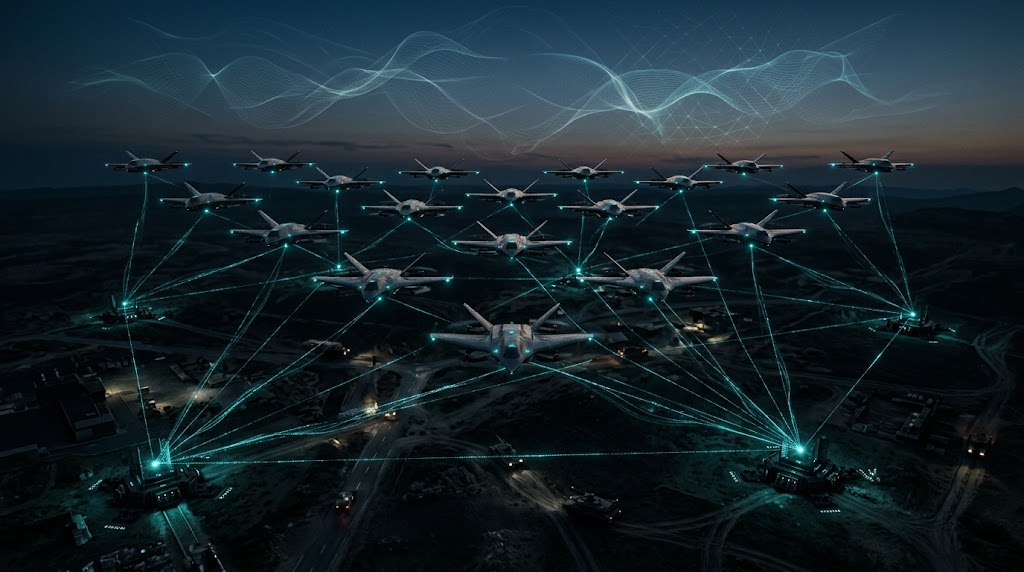
[IMAGE: Military drone swarm over a dark digital battlefield, cyan telemetry streams flowing between aircraft and fog nodes, quantum entanglement patterns in the sky]
Why FANETs Break Classical Security Models
A Flying Ad-Hoc Network is a dynamically reconfiguring mesh of unmanned aerial vehicles that communicate peer-to-peer, route data through neighbor nodes, and periodically offload aggregated telemetry to ground-based fog servers. The architecture inherits every security challenge of traditional wireless sensor networks — then multiplies them.
The Four-Dimensional Attack Surface
UAV fleets present security architects with threat vectors that terrestrial networks rarely combine:
Topology volatility. Nodes enter and exit the network at velocities exceeding 100 km/h. Trust anchors established in the previous minute may reference drones that have since crashed, been captured, or moved out of range. Session key rotation must happen faster than attackers can complete a man-in-the-middle handshake.
Resource asymmetry. A quadcopter carrying a camera payload cannot execute the same cryptographic operations as a data center. Signature schemes must fit within tight CPU, memory, and battery envelopes while still resisting quantum cryptanalysis.
Physical capture risk. Unlike a server locked in a cage, a drone can be shot down, recovered, and reverse-engineered. Every cryptographic key stored on the device must be assumed compromised within days of deployment in contested airspace.
Quantum timeline pressure. NIST finalized the first post-quantum cryptography standards in August 2024 — ML-KEM, ML-DSA, and SLH-DSA. The replacement of ECC across drone fleets deployed today cannot wait for firmware end-of-life.
Inside PQ-MISS: The Technical Architecture
The proposed scheme, which the authors call PQ-MISS, combines three cryptographic primitives into a single key management framework. The design targets fog-enabled FANETs specifically — architectures where UAVs aggregate data through intermediate fog servers before final delivery to cloud infrastructure.
Layer 1: Multivariate Identity-Based Signatures
Identity-based signatures (IBS) eliminate the certificate authority bottleneck that plagues traditional PKI in dynamic networks. A drone’s identity string — its tail number, MAC address, or fleet ID — functions directly as its public key, removing the need for certificate distribution across a mesh where nodes constantly join and leave.
The “multivariate” qualifier identifies the hard problem underlying the signature: solving systems of multivariate polynomial equations over finite fields. Unlike lattice problems or hash-based constructions, multivariate cryptography produces signatures with small verification keys and fast verification operations, though typically at the cost of larger signing keys.
The scheme uses a polynomial composition-based encryption mechanism combined with an aggregate signature model — allowing a fog server to verify signatures from dozens of UAVs in a single operation rather than one-by-one. For a swarm of 50 drones checking in every second, aggregate verification can collapse 50 pairing operations into one.
Layer 2: Zero-Knowledge Proofs for Privacy-Preserving Aggregation
Zero-knowledge proofs allow a drone to prove it possesses valid sensor data satisfying certain properties — for instance, that a temperature reading falls within expected bounds — without revealing the underlying value. In surveillance or military contexts, this prevents fog servers from reconstructing raw telemetry even if they are themselves compromised.
Layer 3: Blockchain Anchoring
The architecture splits ledger responsibilities: fog servers construct partial blockchain blocks from validated UAV data, while cloud servers complete and mine those blocks. This reduces the computational burden on edge infrastructure while preserving tamper-evidence guarantees.
AI algorithms then analyze the verified, on-chain data to generate operational predictions — flight path optimization, anomaly detection, maintenance forecasting — with confidence that the inputs have not been manipulated in transit.
Classical FANET Security vs. PQ-MISS
| Property | ECC-Based FANET Security (Current) | PQ-MISS (Proposed) |
|---|---|---|
| Signature foundation | ECDSA over P-256 | Multivariate polynomial systems |
| Quantum resistance | Broken by Shor’s algorithm | Resistant to known quantum attacks |
| Certificate model | X.509 PKI with CA distribution | Identity-based (no certificates) |
| Multi-device verification | Sequential, one signature at a time | Aggregate signature verification |
| Data privacy during aggregation | Encrypted point-to-point | Zero-knowledge proofs over aggregates |
| Tamper evidence | Server-side logging | Distributed blockchain anchoring |
| Fog/cloud workload split | Monolithic validation | Partial blocks at fog, mining at cloud |
| Validation method | Real-world deployment common | NS-3 simulation only |
Industry Context: The PQC Migration Clock
NIST’s post-quantum cryptography standardization process concluded its first round with the August 2024 publication of FIPS 203 (ML-KEM), FIPS 204 (ML-DSA), and FIPS 205 (SLH-DSA). The agency’s broader migration guidance, CNSA 2.0, mandates that U.S. national security systems complete their transition by 2035, with specific component deadlines starting in 2027.
The FANET industry sits awkwardly in this timeline. Commercial drone deployments rarely factor into national security PQC mandates directly, but they frequently carry data that does — infrastructure inspection footage shared with utilities, logistics manifests moving through regulated supply chains, agricultural survey data underlying commodity markets.
Market Adoption Signals
Google migrated internal communications to hybrid X25519+Kyber key exchange in 2023. Apple deployed PQ3 for iMessage in February 2024. Cloudflare enabled post-quantum TLS by default across its network in 2024. Drone manufacturers have, by comparison, remained publicly silent on PQC roadmaps — a gap that PQ-MISS and similar research proposals aim to close.
The BeQuantum Perspective
The arXiv paper validates an architectural direction we have been advocating: cryptographic agility must be designed into edge fleets before fleet expansion, not retrofitted afterward. Retrofitting PQC across thousands of deployed drones is not a firmware update — it is a fleet-wide recertification program spanning months.
Organizations building fog-enabled UAV deployments today should treat three design decisions as load-bearing:
Identity as a first-class cryptographic primitive. Identity-based schemes like the one described in PQ-MISS eliminate the certificate distribution problem that makes traditional PKI brittle in dynamic networks.
Ledger anchoring for telemetry integrity. The fog-partial / cloud-mined blockchain split mirrors the architecture underlying our Digital Notary service — edge devices produce cryptographic commitments that downstream infrastructure finalizes, distributing trust without demanding edge compute parity.
Hardware-rooted key custody. Signatures are only as trustworthy as the keys generating them. For captured or recovered drones, the difference between a compromised fleet and a contained incident is whether signing keys lived in tamper-evident hardware — the design principle behind our IceCase hardware line.
The PQ-MISS proposal remains a research artifact. NS-3 simulations do not substitute for real-world validation, and the paper leaves critical parameters — security level, specific multivariate problem, ZKP system — unspecified. But the architectural pattern is the point. Enterprises cannot wait for academic completeness before beginning migration planning.
What You Should Do Next
Within 30 days: Inventory every UAV, fog node, and cloud service in your fleet that terminates TLS or performs signature verification. Document the exact cryptographic algorithms, key sizes, and certificate chains in use. You cannot migrate what you have not catalogued.
Within 90 days: Identify which telemetry data streams carry multi-year sensitivity — infrastructure topology, operator identities, operational patterns. These are your harvest-now-decrypt-later targets and should be prioritized for hybrid classical+PQC protection regardless of fleet-wide migration timelines.
Within 12 months: Evaluate at least two post-quantum signature schemes against your UAV compute and power budgets. Measure signature size, verification time, and energy draw on representative hardware. Publish results internally to feed procurement requirements for the next fleet refresh cycle.
FAQ
Q: Is PQ-MISS production-ready for drone fleet deployment today? A: No. The scheme described in arXiv:2604.18819 is a research proposal validated only through NS-3 simulation, with unspecified security parameters and no real-world hardware testing. Treat it as architectural guidance, not a deployable product.
Q: Why use multivariate cryptography instead of NIST’s standardized ML-DSA? A: Multivariate schemes offer smaller public keys and faster verification than lattice-based ML-DSA, which matters for resource-constrained UAVs verifying aggregate signatures from swarm peers. The tradeoff is larger signing keys and less standardization maturity. Most production deployments should start with NIST-standardized primitives.
Q: Does blockchain anchoring introduce unacceptable latency for real-time drone operations? A: The PQ-MISS architecture addresses this by separating block construction (at latency-sensitive fog servers) from block mining (at cloud servers). Flight-critical commands do not wait for consensus — only audit-trail finalization does.
Last updated: 2026-04-23