
Last updated: May 2025
Key Takeaways
- Researchers demonstrated Quantum Computational Sensing (QCS) achieving 15 percentage points higher classification accuracy than the best conventional quantum sensing approach on noisy superconducting hardware — using circuits with up to 24 entangling gates and 38 free parameters (arXiv:2604.13177)
- QCS collapses the traditional two-step pipeline — sense, then classpost-process classically — into a single quantum operation, extracting task-relevant information directly from physical signals
- For security architects: hardware that can classify encrypted signals with quantum-native accuracy, without classical intermediaries, expands the adversarial attack surface against side-channel and signal-intelligence threats your current threat models do not account for
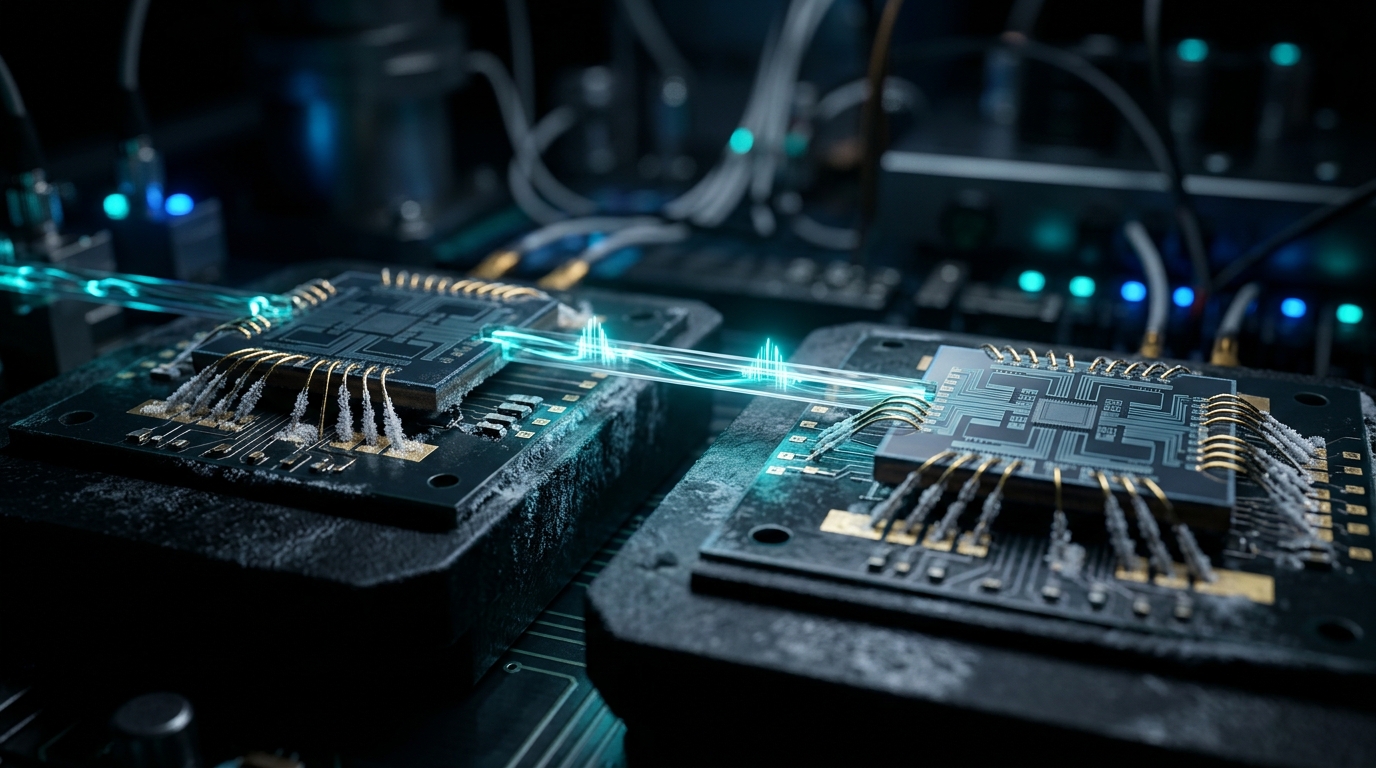
[IMAGE: A superconducting quantum processor chip with entangled cyan light beams radiating from qubit junctions, macro lens perspective, deep black background with teal circuit traces glowing, 8K cinematic lighting]
Why Quantum Sensing Accuracy Breaks Your Threat Model
Picture an adversary operating a quantum sensor array near a data center. Today, that adversary captures raw electromagnetic signals, exports them classically, and runs machine learning inference offline — a slow, noisy pipeline with multiple points of signal degradation. Your shielding and noise-floor assumptions are calibrated against exactly this workflow.
QCS eliminates that pipeline. A single qubit measurement, preceded and followed by parameterized quantum circuits, outputs a classification prediction directly. No classical postprocessing. No intermediate signal export. The sensing and the inference happen inside the same quantum coherence window.
The research published in arXiv:2604.13177 demonstrates this is not theoretical. On real, noisy superconducting hardware, QCS achieved a 15-percentage-point accuracy advantage over the best conventional approach for specific binary classification tasks. The conventional approach — estimate the displacement, then classify classically — is the baseline your threat models assume adversaries are limited to.
They will not be limited to it for long.
What Quantum Computational Sensing Actually Does
Definition: Quantum Computational Sensing (QCS) is a paradigm that integrates quantum sensing with quantum computation, using parameterized quantum circuits applied before and after a physical sensing interaction to extract task-relevant information directly — bypassing classical signal estimation and postprocessing entirely.
The experimental architecture in the arXiv:2604.13177 paper is precise and worth understanding at the component level:
- Physical system: A superconducting circuit coupling a qubit to an oscillator
- Sensing task: Binary classification of a single complex-valued displacement, sensed once by the oscillator
- Protocol structure: Parameterized quantum circuits execute before sensing (state preparation) and after sensing (information extraction)
- Output mechanism: The binary class label maps onto the ground or excited state of the qubit; a single qubit measurement delivers the prediction
- Circuit scale: Up to 24 entangling gates, up to 38 free parameters
- Training method: Circuits trained in silico — not on hardware during training — then deployed to noisy superconducting hardware
The critical finding: increasing circuit depth systematically improves expressivity and classification accuracy. This is a scalability signal. As hardware noise floors drop and qubit counts rise, the accuracy advantage over classical approaches will widen, not narrow.
“For certain tasks, our protocol achieves a 15-percentage-points higher classification accuracy than the best conventional approach considered.” — arXiv:2604.13177v1
QCS vs. Conventional Quantum Sensing: The Architecture Gap
The table below maps the structural differences between conventional quantum sensing with classical postprocessing and the QCS approach demonstrated in arXiv:2604.13177. Security architects should read the “Adversarial Implication” column carefully.
| Dimension | Conventional Quantum Sensing | Quantum Computational Sensing (QCS) |
|---|---|---|
| Pipeline stages | Sense → Estimate classically → Classify classically | Sense + Compute (single coherent operation) |
| Classical exposure | Signal exported to classical layer for inference | No classical intermediary required |
| Accuracy (binary classification) | Baseline | +15 percentage points for specific tasks |
| Circuit complexity | N/A (classical postprocessing) | Up to 24 entangling gates, 38 free parameters |
| Hardware requirement | Quantum sensor + classical compute | Superconducting qubit-oscillator system |
| Training location | Classical ML on estimated signals | In silico, deployed to quantum hardware |
| Scalability signal | Accuracy bounded by classical ML ceiling | Improves systematically with circuit depth |
| Adversarial implication | Detectable via classical signal interception | Inference occurs inside quantum coherence — no classical intercept point |
The adversarial implication row is where CISOs need to focus. Classical signal intelligence relies on intercepting the postprocessing stage. QCS removes that stage. Your TEMPEST shielding, RF isolation, and signal-monitoring controls address a threat model that QCS-equipped adversaries will have moved past.
The Regulatory and Compliance Dimension
NIST finalized its first three post-quantum cryptographic standards in August 2024 — ML-KEM, ML-DSA, and SLH-DSA — with a mandate for federal agencies to begin migration. The QCS research does not directly attack these algorithms. What it does is demonstrate that quantum hardware can perform classification tasks on physical signals with accuracy that classical hardware cannot match, on noisy near-term devices.
The compliance burden this creates is indirect but real:
Side-channel compliance gaps: Current FIPS 140-3 validation processes test cryptographic implementations against classical side-channel attack models. QCS-class sensing could extract timing, power, or electromagnetic side-channel signals with higher fidelity than classical sensors, potentially invalidating assumptions baked into existing validations.
Threat model documentation: NIST SP 800-53 Rev 5 requires organizations to document their threat models. A threat model that does not account for quantum-native signal classification is incomplete. Security architects should flag this gap in their next control assessment cycle.
Supply chain risk: The arXiv:2604.13177 research demonstrates feasibility on existing superconducting hardware platforms. No custom quantum sensing hardware is required — the same qubit-oscillator architecture used in quantum computing research is sufficient. This means the capability diffusion timeline is tied to quantum computing hardware availability, not specialized sensor development.
The 15-percentage-point accuracy advantage was demonstrated on noisy superconducting hardware. As error correction matures and noise floors drop, this advantage will compound — making the 3-5 year window the critical period for updating threat models and compliance documentation.
What the QCS Feasibility Proof Means for PQC Migration Timelines
The arXiv:2604.13177 result is a feasibility demonstration, not a deployed capability. The research team used circuits trained in silico and deployed to noisy hardware — a workflow that requires significant quantum computing expertise and infrastructure. Today, this is a nation-state and well-funded research lab capability.
The medium-term picture (3-5 years) is different. The same trajectory that moved quantum computing from theoretical to cloud-accessible in under a decade applies here. Superconducting hardware platforms are commercially available. Parameterized quantum circuit training is a documented, reproducible methodology. The gap between “demonstrated in a lab” and “accessible to sophisticated adversaries” is closing.
For organizations currently planning PQC migrations, this research adds one concrete input to the timeline calculus: the threat is not only to cryptographic algorithms — it is to the physical signal environment your cryptographic hardware operates in. A quantum-resistant algorithm running on hardware that leaks exploitable side-channel signals to a QCS-equipped adversary provides weaker protection than its cryptographic specification implies.
Market adoption data reinforces urgency. IBM, Google, and IonQ have all published roadmaps projecting fault-tolerant quantum systems within this decade. Each generation of hardware improvement increases the practical accuracy of QCS-class attacks. Organizations that complete PQC migration and side-channel hardening before fault-tolerant hardware arrives close their window of exposure. Those that lag carry compounding risk.
The BeQuantum Perspective: Sensing the Signal Before the Adversary Does
At BeQuantum, our PQC Layer and Digital Notary infrastructure are designed around a core principle: cryptographic security is only as strong as the physical and logical environment it operates in. The QCS research validates an assumption we have built into our threat modeling since 2023 — that quantum-native sensing will reach adversarial capability before most enterprise security teams update their control frameworks.
Here is how organizations working with our platform are addressing the QCS threat vector specifically:
Hardware attestation at the physical layer: BeQuantum’s Digital Notary uses continuous hardware attestation to detect anomalous signal patterns around cryptographic processing units. This does not stop QCS-class sensing, but it creates an audit trail that supports incident response and compliance documentation.
Side-channel hardened key management: Our PQC Layer implements ML-KEM key exchange with explicit side-channel countermeasures — constant-time execution, power-consumption normalization — that reduce the signal fidelity available to any external sensor, quantum or classical.
IceCase physical isolation: For customers handling classified or high-value cryptographic operations, our IceCase hardware module provides RF and electromagnetic isolation rated against current sensing threat models, with a documented upgrade path as QCS threat characterization matures.
The QCS research does not change our fundamental architecture. It confirms that the architecture we built — layered physical and cryptographic controls, not cryptographic algorithms alone — is the correct response to a threat landscape where sensing and computation are converging.
Three Actions to Take Within 90 Days
1. Audit your side-channel exposure surface (Days 1-30) Identify every location where cryptographic key material is processed — HSMs, TLS termination points, key management servers. For each, document the physical isolation controls in place and whether those controls were validated against quantum-class sensing threats. Flag gaps for remediation prioritization.
2. Update your threat model documentation (Days 30-60) Add QCS-class signal intelligence as a named threat actor capability in your NIST SP 800-53 threat model documentation. Assign it a likelihood rating of “emerging” with a 3-5 year window to “credible.” This positions your organization to demonstrate proactive compliance posture in your next audit cycle without requiring immediate capital expenditure.
3. Engage your HSM and cryptographic hardware vendors (Days 60-90) Request their roadmap for side-channel countermeasures against quantum-native sensing. Vendors without a documented position on this threat vector represent a supply chain risk. Require written responses and incorporate them into your vendor risk assessments.
Frequently Asked Questions
Q: Does QCS break post-quantum cryptographic algorithms like ML-KEM or ML-DSA? A: No — QCS does not attack the mathematical hardness assumptions underlying NIST-standardized PQC algorithms. What QCS threatens is the physical implementation layer: if a quantum sensor can classify side-channel signals from cryptographic hardware with higher accuracy than classical sensors, it can potentially extract key material from implementations that are not side-channel hardened, regardless of the underlying algorithm’s theoretical security.
Q: How close is QCS to being an operational adversarial capability? A: The arXiv:2604.13177 research demonstrates feasibility on noisy superconducting hardware available today, but deploying it as an intelligence-collection capability requires significant quantum computing infrastructure and expertise. Current assessment: nation-state capability within 2-3 years, broader adversarial access within 5-7 years as quantum hardware becomes more accessible. Organizations should begin threat model updates now and complete side-channel hardening before the capability diffuses.
Q: Does in silico training mean QCS circuits can be trained without quantum hardware? A: Yes — the arXiv:2604.13177 protocol trains parameterized quantum circuits using classical simulation, then deploys the trained circuits to quantum hardware for execution. This significantly lowers the barrier to developing QCS capabilities, since the computationally expensive training phase does not require quantum hardware access. Only the inference phase — the actual sensing and classification — runs on quantum hardware.