
Last updated: July 2025
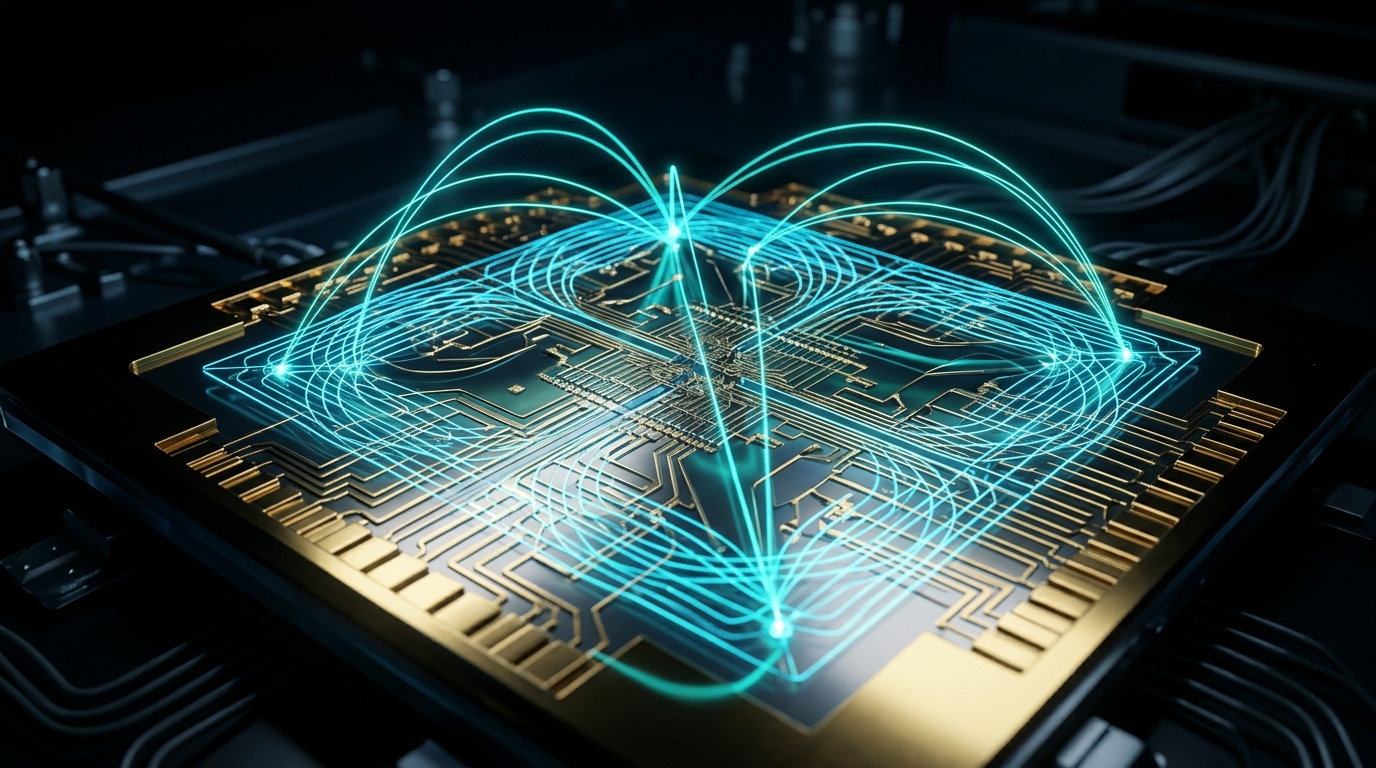
[IMAGE: A quantum processor suspended in a dark void, with entangled light beams forming sparse, geometric lattice connections between qubits — cyan and teal photon threads weaving through deep black space, macro lens perspective revealing the crystalline chip surface in cinematic 8K detail]
Key Takeaways
- Quantum Extreme Learning Machines (QELMs) achieve saturated classification performance using only moderate entanglement from a local, integrable XX Hamiltonian — not the maximal quantum complexity the field has long assumed is necessary
- QELM performance in the studied regime remains compatible with efficient classical simulation, meaning organizations may be able to replicate certain quantum ML results without quantum hardware investment
- For security architects evaluating quantum ML roadmaps: the assumption that quantum hardware delivers automatic ML advantage is not supported by this evidence — your procurement and migration timelines deserve a second look
The Assumption Your Quantum ML Budget Is Built On May Be Wrong
Picture your organization’s five-year roadmap. Somewhere in it, there is a line item for quantum machine learning infrastructure — justified by the premise that quantum systems generate computational complexity that classical hardware simply cannot replicate, and that this complexity is what makes quantum ML powerful.
A paper published on arXiv (arXiv:2509.06873v3), “Entanglement and Classical Simulability in Quantum Extreme Learning Machines,” directly challenges that premise. The researchers studied Quantum Extreme Learning Machines — a class of quantum ML models where only the output layer is trained, and the quantum circuit does the heavy lifting of feature generation — and found that the performance gains do not require the exotic, maximally complex quantum dynamics that justify expensive quantum hardware.
For CISOs and security architects who are being asked to sign off on quantum ML investments, this finding reframes the core question: not whether quantum ML works, but whether it requires quantum hardware to work.
What Quantum Extreme Learning Machines Actually Do
A Quantum Extreme Learning Machine (QELM) is a hybrid classical-quantum model that uses a fixed quantum circuit as a feature extractor, feeding its outputs into a classical single-layer classifier that is the only component trained during learning. The quantum layer is not optimized — it evolves under a fixed Hamiltonian, and the training burden falls entirely on the lightweight classical output layer.
The architecture studied in arXiv:2509.06873v3 follows four sequential stages:
- Dimensionality reduction — raw image data (from MNIST, Fashion-MNIST, or CIFAR-10) is compressed using either PCA (Principal Component Analysis) or Autoencoders
- Quantum state encoding — the compressed data is encoded into a quantum state
- Hamiltonian evolution — the state evolves under an XX Hamiltonian, a model that is both integrable and local
- Projective measurement — measurement outcomes form the feature vector passed to the classical classifier
This design is deliberately near-term friendly. Because only the output layer trains, QELMs sidestep the barren plateau problem that plagues variational quantum circuits. The quantum component is a fixed physical process, not a parameterized circuit requiring thousands of gradient evaluations.
Why the XX Hamiltonian Choice Matters
The XX Hamiltonian is integrable and local — meaning it generates structured, constrained dynamics rather than the chaotic, maximally scrambling behavior associated with quantum computational advantage claims. This is not a limitation of the experimental setup; it is the point. The researchers deliberately chose a physically realistic, near-term implementable system to test whether quantum advantage narratives hold under practical conditions.
The Technical Finding That Changes the Calculus
The research identifies a sharp transition in classification accuracy as a function of evolution time. Performance starts low, crosses a threshold, and then saturates. That saturation point is the critical finding.
“Moderate entanglement can contribute positively to the structure of the data representation, improving learnability without necessarily implying quantum computational advantage.” — arXiv:2509.06873v3, “Entanglement and Classical Simulability in Quantum Extreme Learning Machines”
At saturation, QELM performance is comparable to that achieved using Haar-random unitaries — unitaries that generate maximally complex, highly scrambled quantum dynamics. The integrable, local XX model reaches the same performance ceiling as the most complex quantum dynamics available, using only moderate entanglement.
The mechanism is concrete: entanglement improves how classical data embeds into Hilbert space, producing more separable clusters in the measurement probability space. The classifier’s job becomes easier not because the quantum system is doing something classically impossible, but because moderate quantum correlations restructure the feature space in a geometrically useful way.
Critically, the relevant evolution time for this performance gain is consistent with information exchange over short distances and does not show evidence of scaling with the full system size within the explored parameter range. The quantum resource required is bounded and local — not a system-spanning quantum phenomenon.
Comparison: Assumed vs. Observed QELM Behavior
| Property | Common QML Assumption | Observed in arXiv:2509.06873v3 |
|---|---|---|
| Dynamics required for performance | Maximal complexity (Haar-random) | Moderate entanglement from local XX model |
| Entanglement regime | High / maximal | Moderate — not maximal |
| Classical simulability | Not classically simulable | Compatible with efficient classical simulation |
| Evolution time scaling | Scales with system size | Consistent with short-distance information exchange |
| Hardware requirement implication | Quantum hardware necessary | Classical simulation may suffice |
| Training scope | Full circuit optimization | Output layer only |
The Classical Simulability Implication
QELM performance in the studied regime relies only on limited entanglement and remains compatible with efficient classical simulation. — arXiv:2509.06873v3
This is the sentence that should appear in your next quantum hardware procurement review. If the entanglement regime driving QELM performance is moderate and local, classical tensor network methods — which efficiently simulate low-entanglement quantum systems — can potentially reproduce the same feature representations without quantum hardware. The paper does not claim classical simulation is definitively equivalent, but the compatibility finding shifts the burden of proof onto quantum hardware advocates.
Industry Context: What This Means for Quantum ML Roadmaps
Near-Term (1–2 Years): Procurement Pressure Meets Scrutiny
Enterprise quantum ML investment has accelerated on the back of advantage narratives. The QELM findings introduce a specific, testable challenge: before committing to quantum ML hardware for classification workloads, organizations should demand classical simulation benchmarks on the same tasks. If a classical simulation of the low-entanglement quantum circuit achieves equivalent accuracy on MNIST, Fashion-MNIST, or CIFAR-10 analogs of your target task, the hardware premium is not justified by performance data.
This does not mean quantum ML hardware has no value — it means the value claim requires more rigorous evidence than the field has typically provided.
Medium-Term (3–5 Years): Benchmark Standards Will Shift
The finding that an integrable, local Hamiltonian matches Haar-random performance forces a reckoning with how quantum ML benchmarks are designed. If maximally complex dynamics and moderate local dynamics produce the same classification accuracy, then accuracy on standard datasets is not a valid benchmark for quantum advantage. The field will need new metrics — likely focused on tasks where entanglement structure is provably necessary, not just present.
For security architects, this matters because quantum ML is increasingly proposed for anomaly detection, threat classification, and behavioral analysis in security operations. Vendor claims in this space should now be evaluated against the QELM simulability finding as a baseline challenge.
Long-Term (5+ Years): Reframing Quantum Advantage Theory
The deeper implication is theoretical. If moderate entanglement — not maximal quantum complexity — is sufficient for useful ML performance, then the theoretical basis for quantum advantage in machine learning needs revision. The standard argument runs: quantum systems access exponentially large Hilbert spaces, generating feature representations classical systems cannot efficiently compute. The QELM evidence suggests that for practical classification tasks, you do not need to access that full exponential space. A small, structured corner of it is enough — and that corner may be classically simulable.
This does not close the door on quantum advantage in ML. It closes the door on a specific, widely-cited argument for it.
The BeQuantum Perspective: Separating Signal from Noise in Quantum Claims
At BeQuantum, our work on post-quantum cryptography and AI-driven content authenticity puts us at the intersection of two fields where quantum claims carry real operational weight. The QELM findings reinforce a principle we apply across our Digital Notary and PQC Layer work: extraordinary claims require extraordinary evidence, and “quantum” is not a substitute for evidence.
The NIST post-quantum cryptography standardization process — which finalized ML-KEM (CRYSTALS-Kyber), ML-DSA (CRYSTALS-Dilithium), and SLH-DSA (SPHINCS+) in 2024 — succeeded precisely because it demanded concrete security proofs, not theoretical advantage narratives. The same standard should apply to quantum ML claims entering enterprise security stacks.
Where the QELM research is directly actionable for our approach: the finding that classical simulation may replicate QELM performance means that hybrid classical-quantum pipelines — which our PQC Layer architecture already supports — remain viable and potentially sufficient for near-term ML security applications. Organizations do not need to wait for fault-tolerant quantum hardware to explore quantum-inspired feature extraction. But they do need to validate that the quantum component is earning its place in the pipeline.
For IceCase hardware deployments, the simulability finding also informs threat modeling. If an adversary can classically simulate the quantum ML component of a system, any security property derived from assumed quantum unforgeability of that component is invalidated. This is a concrete attack surface consideration, not a theoretical one.
What You Should Do Next
Within 30 days: Audit your quantum ML vendor claims against the simulability test. For any quantum ML product in your stack or pipeline, request the vendor’s classical simulation benchmark. Specifically ask: what is the entanglement entropy of the quantum circuit at the performance-relevant evolution time, and has classical tensor network simulation been attempted on equivalent tasks? A vendor who cannot answer this question is selling you a narrative, not a result.
Within 90 days: Revise your quantum hardware procurement criteria. Add a mandatory benchmark requirement: any quantum ML hardware investment must demonstrate performance on your target task that exceeds the best available classical simulation of an equivalent low-entanglement circuit. This single criterion will filter out a significant fraction of current quantum ML hardware proposals that rely on advantage assumptions the QELM research now challenges.
Within 6 months: Engage your security operations team on quantum ML anomaly detection pilots. If you are evaluating quantum ML for threat detection or behavioral classification, run a controlled pilot that includes a classical simulation baseline. The QELM architecture — PCA or autoencoder compression, fixed quantum evolution, classical output layer — is implementable today and provides a concrete comparison point. The goal is not to prove quantum ML wrong; it is to establish an evidence baseline before scaling investment.
Frequently Asked Questions
Q: Does this research mean quantum machine learning has no advantage over classical ML?
A: No — but it narrows the claim significantly. The QELM findings show that for image classification tasks using a local, integrable quantum system, performance is compatible with efficient classical simulation. This does not rule out quantum advantage in other ML regimes, particularly those requiring high entanglement or tasks where the full Hilbert space structure is provably necessary. It does mean that “quantum” alone is not sufficient justification for hardware investment in classification workloads.
Q: Should my organization stop evaluating quantum ML for security applications?
A: No — but evaluation criteria need to change. The QELM research provides a concrete benchmark challenge: any quantum ML system proposed for security use cases should be tested against classical simulation of an equivalent low-entanglement circuit. If the quantum system outperforms that baseline on your specific task, the hardware investment has an evidence-based justification. If it does not, you are paying a quantum premium for classical-equivalent performance.
Q: How does this relate to post-quantum cryptography timelines?
A: Post-quantum cryptography and quantum ML are distinct domains. PQC addresses the threat that fault-tolerant quantum computers will break current asymmetric encryption — a threat with a well-defined timeline tied to qubit error correction progress. The QELM findings are about quantum ML performance, not cryptographic security. NIST’s 2024 PQC standards (ML-KEM, ML-DSA, SLH-DSA) remain the correct migration target for cryptographic infrastructure regardless of quantum ML developments.
Sources: “Entanglement and Classical Simulability in Quantum Extreme Learning Machines,” arXiv:2509.06873v3