
Key Takeaways
- ID Quantique’s Clavis XGR maintained visibility above 97% and QBER below 1% on average across two distinct fiber links in Brazil’s Rio Quantum Network — under both unregulated tropical ambient conditions and active thermal stress testing.
- Thermal management emerged as the primary operational bottleneck for commercial QKD systems in field deployments, not optical loss or protocol limitations.
- Enterprises evaluating quantum-safe infrastructure in thermally variable or tropical environments now have real-world baseline data to anchor procurement decisions and performance SLAs.
Last updated: June 2025
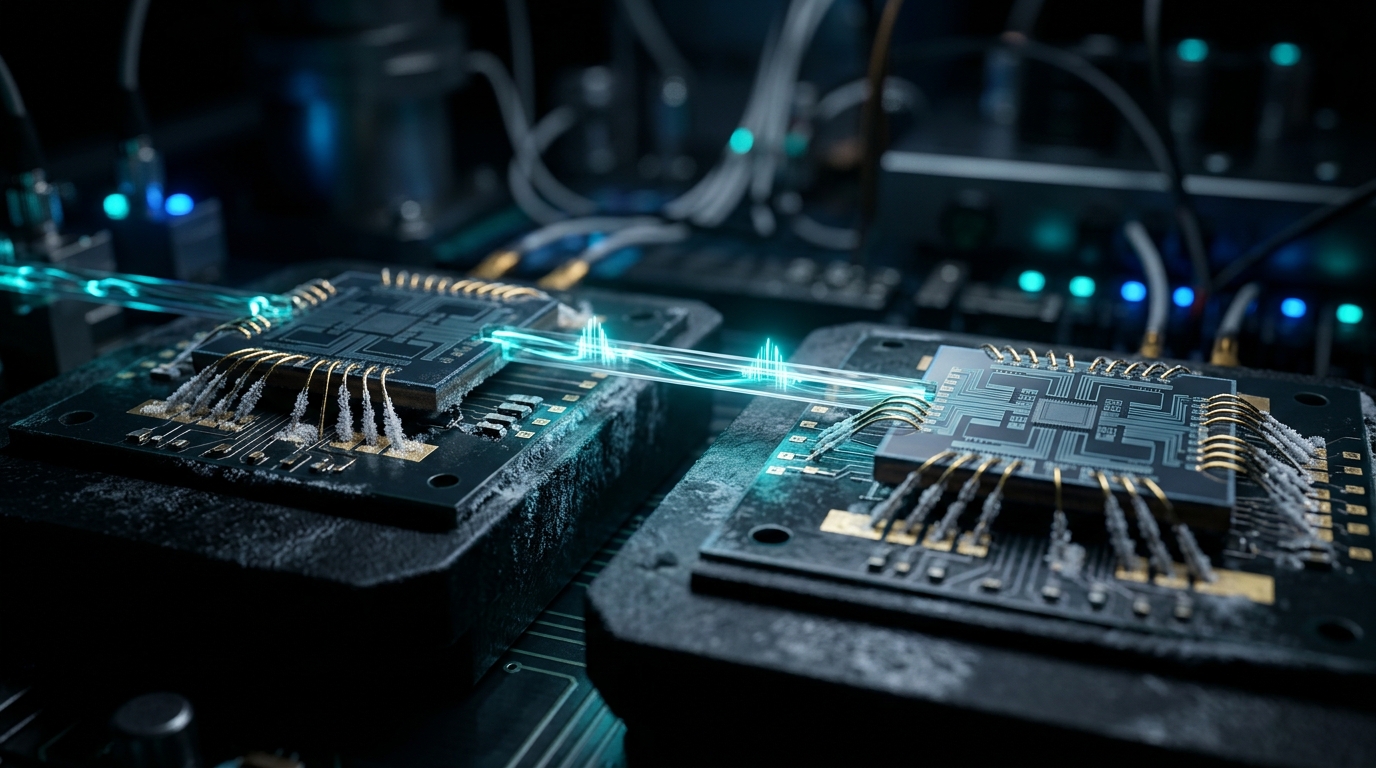
[IMAGE: A quantum fiber optic cable cross-section glowing with entangled photon streams, running through a dark underground conduit with cyan light refracting through the glass core, cinematic macro perspective with deep blacks and teal accents]
Why Thermal Stress Is the Hidden Risk in QKD Deployments
Your security team has modeled the cryptographic threat. You’ve reviewed NIST’s post-quantum standards. You’ve mapped your migration path. But here’s the operational scenario most QKD procurement evaluations miss: your fiber runs through a Brazilian data center where ambient temperature swings 15°C between day and night, and nobody has tested whether your quantum key distribution hardware survives that without degrading key rates.
That gap — between lab-certified performance and real-world field resilience — is exactly what a new long-term study published on arXiv (arXiv:2604.16236v1) closes for one of the most widely deployed commercial QKD platforms.
Researchers analyzed ID Quantique’s Clavis XGR operating continuously within the Rio Quantum Network in Brazil, across two physically distinct optical links: a 40 km indoor spooled fiber and a 3.5 km outdoor deployed underground fiber. The study monitored four key operational metrics — secret key rate, Quantum Bit Error Rate (QBER), visibility, and detection counts — under both unregulated tropical ambient fluctuations and deliberately applied thermal stress.
The primary keyword here for security architects is thermal bottleneck: the study is the first long-term characterization of how thermal variability degrades commercial QKD system performance in a live, non-laboratory network.
What QKD Performance Metrics Actually Mean for Your Security Posture
Defining the Metrics That Matter
Quantum Key Distribution (QKD) is a cryptographic key exchange method that uses quantum mechanical properties — specifically the behavior of individual photons — to detect any eavesdropping attempt on the key exchange channel. Unlike classical key exchange protocols vulnerable to harvest-now-decrypt-later attacks, QKD’s security derives from physics, not computational hardness.
The four metrics the Rio Quantum Network study tracked map directly to operational security guarantees:
- QBER (Quantum Bit Error Rate): The percentage of received quantum bits that are erroneous. A QBER above roughly 11% (for BB84-class protocols) signals either eavesdropping or hardware degradation — both of which terminate key generation. Keeping QBER below 1% means the channel is operating with a wide margin from the security threshold.
- Visibility: Measures the interference contrast of the quantum optical system. High visibility (above 97%) confirms the photon source and detectors are aligned and stable — a prerequisite for generating usable secret keys.
- Secret key rate: The throughput of cryptographically usable key material, measured in bits per second. This determines how many encrypted sessions your infrastructure can sustain simultaneously.
- Detection counts: Raw photon detection events, which inform whether optical loss or detector efficiency is degrading system performance.
The 97% / Sub-1% Baseline: What It Means in Practice
The Clavis XGR maintained visibility above 97% and QBER below 1% on average across the full deployment period. For a security architect writing performance requirements into a vendor contract, these numbers provide a concrete anchor.
“Our results demonstrate excellent overall baseline resilience, with the system maintaining visibility above 97% and QBER below 1% on average.” — Long-term Performance Analysis of a Commercial QKD Device Under Real-world Deployment Conditions, arXiv:2604.16236v1
A QBER consistently below 1% means the system operates with more than a 10x safety margin below the eavesdropping-detection threshold. That margin absorbs real-world noise — fiber vibration, temperature-induced refractive index changes, connector aging — without triggering false security alerts or key generation shutdowns.
Technical Deep-Dive: Two Links, One Thermal Problem
Link Architecture and Test Conditions
The study’s two-link design is methodologically significant because it separates controlled-environment performance from field-environment performance:
| Parameter | Indoor Spooled Fiber | Outdoor Underground Fiber |
|---|---|---|
| Length | 40 km | 3.5 km |
| Environment | Indoor, spooled | Outdoor, underground deployed |
| Thermal exposure | Controlled + ambient fluctuations | Unregulated tropical ambient |
| Primary stress variable | Thermal stress (active) | Tropical ambient fluctuations |
| Operational context | Baseline characterization | Real-world field conditions |
The 40 km indoor link provides a longer optical path — which amplifies photon loss and timing jitter — while allowing researchers to apply controlled thermal stress. The 3.5 km outdoor link represents the messier reality: buried infrastructure subject to soil temperature gradients, seasonal variation, and the thermal mass of Brazilian urban ground.
The fact that the system maintained its performance envelope across both configurations matters for enterprise procurement. A 40 km link covers most metropolitan area network (MAN) deployments. A 3.5 km link covers campus-to-campus or data-center interconnect scenarios. Both are within the operational range your security architecture likely requires.
Thermal Bottlenecks: The Operational Risk You’re Not Modeling
The study’s most actionable finding for security architects isn’t the headline performance numbers — it’s the identification of thermal management as the primary operational bottleneck for commercial QKD systems in field deployments.
QKD hardware relies on single-photon detectors (typically superconducting nanowire or avalanche photodiode-based) and precision optical interferometers. Both are sensitive to temperature. When ambient temperature shifts, fiber refractive indices change, interferometer path lengths drift, and detector dark count rates fluctuate — all of which push QBER upward.
The study characterizes thermal bottlenecks of commercial QKD systems in field deployments — the first long-term analysis of this failure mode under real tropical operating conditions.
For enterprises deploying QKD in regions without stable data center thermal control — or running fiber through outdoor conduits subject to seasonal temperature swings — this means active thermal management isn’t optional. It’s a design requirement that belongs in your infrastructure specification before you sign a deployment contract.
Industry Context: Where QKD Adoption Stands in 2025
Regulatory Pressure Is Accelerating the Timeline
NIST finalized its first three post-quantum cryptographic standards in August 2024 (FIPS 203, 204, and 205), covering key encapsulation and digital signatures. These standards address the software-layer migration path — replacing RSA and elliptic curve cryptography in protocols like TLS and SSH.
QKD addresses a different layer: the physical key exchange channel itself. Regulatory frameworks in the EU (through ENISA’s quantum-safe communications roadmap) and emerging guidance from national cybersecurity agencies in Asia and South America are beginning to treat QKD as a complementary control for high-assurance environments — government communications, financial clearing infrastructure, and critical national infrastructure.
The Rio Quantum Network deployment is significant beyond its technical findings: it represents operational QKD infrastructure in South America, a region where quantum-safe communications investment has lagged North America and Europe. Long-term field data from this deployment will directly inform regulatory frameworks and procurement standards for the region.
Who’s Moving and Who’s Lagging
Telecom operators in South Korea, Japan, and China have deployed QKD across metropolitan fiber networks at scale. European financial institutions — particularly in Switzerland and Germany — have integrated QKD into interbank communication links. North American enterprise adoption remains concentrated in defense and intelligence-adjacent sectors.
The gap is infrastructure maturity and field performance data. Studies like the Rio Quantum Network analysis close that gap by giving procurement teams and CISOs the evidence base to justify capital expenditure on QKD infrastructure outside traditional early-adopter geographies.
The Cost of Waiting
The harvest-now-decrypt-later threat model is not theoretical. Nation-state adversaries are collecting encrypted traffic today with the explicit intent to decrypt it once cryptographically relevant quantum computers become available. CISA and NSA have both published guidance stating that organizations handling data with a 10+ year sensitivity horizon should treat this as an active threat, not a future one.
For organizations in that category — financial records, healthcare data, intellectual property, classified communications — the cost of delaying quantum-safe infrastructure investment compounds annually as the volume of harvested encrypted data grows.
The BeQuantum Perspective: Field Data Changes the Procurement Calculus
At BeQuantum, our Digital Notary and PQC Layer implementations work alongside physical-layer quantum security controls — and the question we hear most from enterprise security architects isn’t “should we deploy QKD” but “how do we know it will actually work in our environment.”
The Rio Quantum Network study answers that question with the kind of evidence that moves procurement committees: long-term continuous operation data, two distinct link configurations, and performance metrics that held above operational thresholds under real tropical thermal stress.
Here’s what this means for organizations evaluating QKD as part of a layered quantum-safe architecture:
First, the Clavis XGR’s sub-1% QBER performance under field conditions means the device’s security margin is operationally robust — not just lab-certified. When you’re writing SLAs for quantum-safe key exchange infrastructure, 97% visibility and sub-1% QBER are defensible numbers to anchor those agreements.
Second, the thermal bottleneck finding validates what our infrastructure team has observed in deployment planning: thermal management specifications need to appear in your QKD procurement RFP, not as an afterthought in the installation guide. Active temperature control for QKD hardware enclosures should be treated as a security control, not just a hardware maintenance consideration.
Third, the Rio deployment demonstrates that commercial QKD is operationally viable in emerging market infrastructure — with all the variability that implies. Organizations expanding quantum-safe communications infrastructure into regions without mature data center ecosystems now have a reference deployment to cite.
What You Should Do Next
Within 30 days: Audit your current key exchange infrastructure for links that traverse thermally variable environments — outdoor conduits, cross-regional fiber, or facilities without active HVAC control. Flag these as priority candidates for QKD deployment planning or enhanced monitoring.
Within 90 days: If you’re evaluating commercial QKD hardware, add thermal performance specifications to your RFP. Request vendor data on QBER and visibility stability across the temperature range your deployment environment will experience. Use the Rio Quantum Network study’s 97% visibility / sub-1% QBER benchmarks as minimum acceptable performance thresholds for tropical or thermally variable deployments.
Within 12 months: Map your data sensitivity horizon. Any data your organization generates today with a 10+ year confidentiality requirement is already exposed to harvest-now-decrypt-later collection. Prioritize quantum-safe key exchange for those data flows — whether through QKD for high-assurance physical links or NIST-standardized PQC algorithms for software-layer key exchange.
Frequently Asked Questions
Q: How does QKD differ from post-quantum cryptography (PQC), and do I need both?
A: PQC replaces classical mathematical algorithms (RSA, ECC) with new algorithms designed to resist quantum computer attacks — it runs in software and protects key exchange and digital signatures at the protocol layer. QKD uses quantum physics to distribute cryptographic keys over a dedicated optical channel, with eavesdropping detection built into the physics of the transmission. High-assurance environments — government, financial clearing, critical infrastructure — increasingly treat them as complementary controls: PQC for software-layer protocol security, QKD for physical-layer key exchange on sensitive links.
Q: What does a QBER below 1% actually mean for my security team?
A: QBER measures the error rate in the quantum channel. Most QKD protocols (including BB84-class protocols used in commercial systems) set the eavesdropping-detection threshold at approximately 11% QBER — above that, the system assumes the channel is compromised and halts key generation. A QBER below 1% means the Clavis XGR operated with more than a 10x margin below that threshold throughout the Rio Quantum Network deployment, absorbing real-world noise sources without triggering security alerts or key generation failures.
Q: Is commercial QKD ready for enterprise deployment outside major tech hubs?
A: The Rio Quantum Network study provides the strongest field evidence to date that it is. The Clavis XGR maintained operational performance thresholds across a 40 km indoor link and a 3.5 km outdoor underground link in Brazil — a thermally challenging environment with tropical ambient fluctuations — over a long-term continuous operation period. The primary operational requirement the study identifies is active thermal management, which is a solvable infrastructure problem, not a fundamental technology limitation.