Key Takeaways
- A Spatiotemporal Graph Neural Network (STGNN) decoder identifies more than 90% of qubit loss locations by analyzing ten rounds of stabilizer measurements — outperforming both standard MWPM and delayed-erasure MWPM algorithms on logical accuracy
- The STGNN matches modified AlphaQubit performance on error correction while gaining a structural inference-speed advantage through parallel (vs. recurrent) input processing
- Faster, more accurate qubit loss correction compresses the timeline to cryptographically relevant quantum computers — meaning your post-quantum migration window is shorter than your 2027 roadmap assumes
Last updated: June 2025
The Qubit Loss Problem That Breaks Standard Error Correction
Picture your organization’s quantum-safe encryption strategy built around a five-year runway. That runway assumes fault-tolerant quantum computers remain years away from threatening RSA-2048 or ECDH key exchanges. That assumption depends, in part, on quantum hardware struggling with a specific and stubborn problem: qubit loss.
When a physical qubit disappears — absorbed by the environment, lost to measurement error, or simply dropped from the computational register — it doesn’t just introduce noise. It invalidates the algebraic structure of the standard stabilizer formalism for quantum error-correcting codes. The entire mathematical scaffolding that error correction relies on breaks down at the point of loss. Traditional decoders, including the widely deployed minimum-weight perfect matching (MWPM) algorithm, were not designed to handle this failure mode gracefully.
Researchers publishing on arXiv (arXiv:2604.14269v1) have now demonstrated that a Spatiotemporal Graph Neural Network decoder can simultaneously correct standard Pauli errors and locate lost qubits — a dual-head capability that neither MWPM nor delayed-erasure MWPM decoders achieve with comparable accuracy. For security architects tracking the quantum threat timeline, this matters.
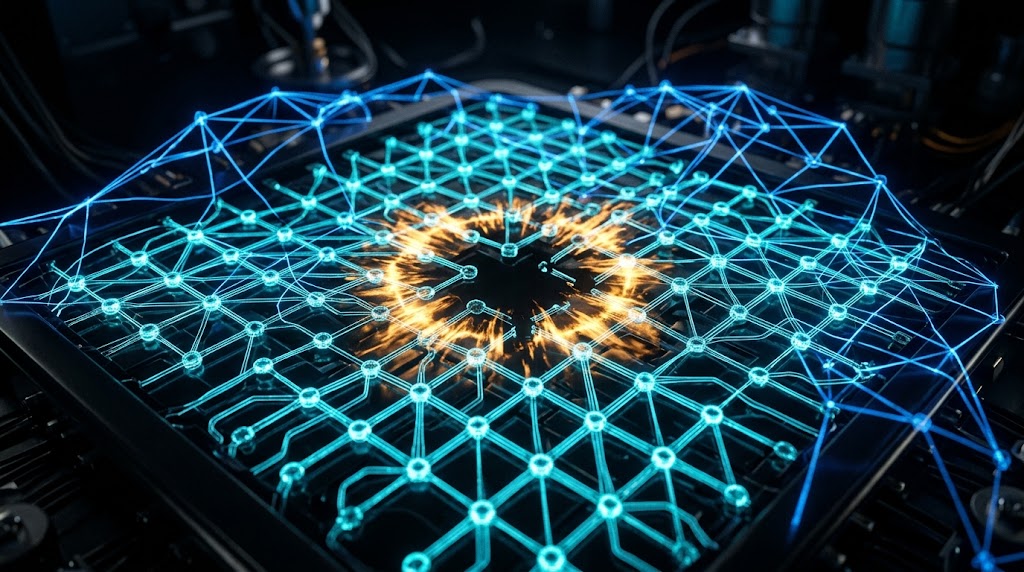
[IMAGE: A quantum processor array with glowing cyan stabilizer measurement cycles flowing across a dark lattice, one node visibly absent with a red void, representing qubit loss in a surface code]
What Qubit Loss Actually Does to Error-Correcting Codes
Quantum error correction works by encoding logical qubits across many physical qubits and measuring stabilizer operators — parity checks that reveal errors without collapsing the quantum state. The decoder reads these syndrome patterns and infers what corrections to apply.
Qubit loss breaks this process in a specific way: it introduces stochastic flicker patterns in stabilizers. A lost qubit causes adjacent stabilizer measurements to behave erratically across time — flickering between outcomes in a pattern that looks superficially like ordinary Pauli errors but carries a distinct spatiotemporal signature. Standard decoders misread this signature, applying incorrect corrections and degrading logical qubit fidelity.
Delayed-erasure MWPM decoders represent the current best practice for handling known loss events. They ingest qubit loss information from the final measurement round and adjust their matching accordingly. The limitation is structural: they only act on loss information available at the end of a code cycle, missing the temporal evolution of loss signatures across intermediate rounds.
“Our decoder can also identify more than 90% of loss locations after accumulating stabilizer measurements over the subsequent ten rounds, thereby facilitating qubit reinitialization, for instance, via the continuous loading technique on the atom array platform.” — arXiv:2604.14269v1
This is the critical distinction. The STGNN doesn’t wait for a final-round snapshot. It extracts spatial and temporal correlations from the full syndrome history, building a richer picture of where loss occurred and when.
Technical Deep-Dive: How the STGNN Decoder Works
Dual-Head Architecture
The STGNN decoder performs two tasks in a single forward pass. The first head corrects standard Pauli errors — the bit-flips and phase-flips that conventional decoders handle. The second head identifies qubit loss locations by learning to recognize the flicker patterns that lost qubits imprint on neighboring stabilizer measurements.
This joint training is architecturally significant. Rather than running a loss-detection module as a preprocessing step before error correction, the STGNN learns that loss detection and error correction are coupled problems. A lost qubit changes the error landscape around it; a decoder that handles both simultaneously can exploit that coupling rather than treating it as noise.
Parallel vs. Recurrent Input Structure
The research compares STGNN directly against a modified version of AlphaQubit — Google’s neural network decoder — adapted to handle qubit loss. Both achieve nearly identical logical accuracy on the dual task. The architectural difference that matters for deployment is input structure.
AlphaQubit uses a recurrent input structure, processing syndrome history sequentially. The STGNN uses a parallel input structure, ingesting the full spatiotemporal syndrome graph simultaneously. In inference-time terms, parallel processing eliminates the sequential dependency bottleneck. For real-time decoding pipelines where correction must keep pace with physical qubit cycles, this latency difference is operationally relevant.
Performance Comparison
| Decoder | Handles Qubit Loss | Loss Location ID | Logical Accuracy vs. MWPM | Inference Structure |
|---|---|---|---|---|
| Standard MWPM | No | No | Baseline | Sequential |
| Delayed-Erasure MWPM | Partial (final round only) | Final round only | Higher than MWPM | Sequential |
| Modified AlphaQubit | Yes | >90% (10 rounds) | Significantly higher | Recurrent (sequential) |
| STGNN (arXiv:2604.14269v1) | Yes | >90% (10 rounds) | Significantly higher | Parallel |
Note: Specific logical error rate values and code distances were not reported in the source paper. “Significantly higher” reflects the paper’s comparative framing against MWPM baselines.
The 90% Loss Identification Threshold
The 90% figure deserves unpacking. After a qubit is lost, the STGNN accumulates stabilizer measurements from the ten subsequent rounds and uses the spatiotemporal flicker signature to localize the loss event. Identifying the loss location enables qubit reinitialization — on atom array platforms, this maps directly to the continuous loading technique, where fresh atoms replace lost ones without halting the computation.
Ninety percent identification accuracy means one in ten loss events goes undetected per ten-round window. For near-term hardware with moderate loss rates, this represents a substantial improvement over decoders that cannot identify loss locations at all. For fault-tolerant thresholds, the residual 10% undetected loss remains an active research problem.
[IMAGE: A dark cinematic close-up of a spatiotemporal graph neural network processing glowing syndrome measurement nodes across a quantum lattice, with cyan data flows connecting spatial and temporal layers]
Industry Context: What This Means for the Cryptographic Threat Timeline
The Fault-Tolerance Bottleneck Is Narrowing
The primary reason cryptographically relevant quantum computers — machines capable of running Shor’s algorithm against RSA-2048 at scale — remain years away is fault tolerance. Physical qubits have error rates orders of magnitude too high for useful computation without error correction. Qubit loss is one of the dominant error channels on leading hardware platforms, including atom arrays.
Research like arXiv:2604.14269v1 directly attacks this bottleneck. Better decoders mean higher logical qubit fidelity at the same physical error rates, which means fault-tolerant thresholds become achievable with fewer physical qubits per logical qubit. Fewer physical qubits per logical qubit means scalable fault-tolerant hardware arrives sooner.
The near-term implication (1-2 years): enterprise quantum computing systems may adopt AI-enabled decoders like STGNN to improve fault-tolerant qubit management, reducing error rates from qubit loss in early quantum hardware deployments. The medium-term implication (3-5 years): spatiotemporal GNN-based decoders could replace or augment MWPM algorithms across quantum error correction pipelines, improving logical qubit fidelity at scale. The long-term implication (5+ years): robust qubit loss correction frameworks could enable scalable fault-tolerant quantum computation, accelerating the timeline for cryptographically relevant quantum computers.
NIST’s PQC Timeline Assumes a Window — That Window Is Compressing
NIST finalized its first three post-quantum cryptographic standards in August 2024: ML-KEM (CRYSTALS-Kyber), ML-DSA (CRYSTALS-Dilithium), and SLH-DSA (SPHINCS+). NIST has set 2030 as the target for deprecating RSA and ECC in federal systems, with full migration expected by 2035.
Those timelines were calibrated against quantum hardware progress as of 2023-2024. Each incremental advance in error correction — including AI-enabled decoders that handle qubit loss — applies pressure to the right side of that timeline. Organizations treating 2030 as a comfortable deadline should treat decoder research like this as a leading indicator, not an academic curiosity.
Who Is Moving and Who Is Lagging
Google, IBM, and Microsoft have all announced roadmaps targeting fault-tolerant quantum computing within this decade. Google’s AlphaQubit work — directly referenced in arXiv:2604.14269v1 as a performance benchmark — signals that leading hardware vendors are investing in neural network decoders as a production capability, not a research prototype. The STGNN paper’s ability to match AlphaQubit performance while improving inference speed suggests the decoder research community is converging on AI-based approaches as the successor to MWPM.
On the enterprise security side, a 2024 survey by the Cloud Security Alliance found that fewer than 40% of organizations had begun formal PQC migration planning. That gap between quantum hardware progress and enterprise security response is where cryptographic risk accumulates.
The BeQuantum Perspective: Decoding Research Into Security Posture
At BeQuantum, we track decoder research precisely because it is a leading indicator for the cryptographic threat timeline — not because it is immediately actionable for most enterprise security teams. The STGNN paper represents a meaningful step toward fault-tolerant quantum computation, and that step has a direct analog in how we think about PQC migration urgency.
Our Digital Notary infrastructure, for example, uses ML-KEM and ML-DSA to sign and verify content authenticity at the protocol level. The design assumption is that RSA-based verification becomes cryptographically vulnerable before 2035. Research like arXiv:2604.14269v1 reinforces that assumption and argues against treating 2035 as a hard boundary.
The parallel input structure advantage of STGNN over recurrent decoders also maps to a principle we apply in our PQC Layer: latency in cryptographic operations compounds at scale. A key encapsulation mechanism that adds 2ms per handshake is acceptable at 1,000 connections per second; it becomes a bottleneck at 500,000. Decoder research that prioritizes inference speed alongside accuracy reflects the same engineering discipline that PQC deployment requires.
For organizations evaluating IceCase hardware security modules for PQC key storage, the relevant question is not whether quantum computers can break your keys today — it is whether your key lifecycle management can complete a full migration before they can. Decoder advances like STGNN tighten that window.
What You Should Do Next
Within 30 days: Audit your current TLS certificate chain and identify every RSA or ECDH key exchange endpoint. Map which systems handle data with a confidentiality requirement extending beyond 2030. These are your highest-priority migration targets under a harvest-now-decrypt-later threat model.
Within 90 days: Evaluate your organization’s decoder research monitoring process. If your threat intelligence function does not track quantum hardware progress — including error correction advances — you are missing a leading indicator for your PQC migration timeline. Assign ownership of quantum threat monitoring to a named role in your security architecture team.
Within 12 months: Begin hybrid PQC deployment on at least one production system. ML-KEM supports hybrid key exchange alongside ECDH, allowing you to add quantum resistance without breaking existing compatibility. This is not a full migration — it is a risk reduction step that buys time and builds operational familiarity with PQC tooling before the deadline pressure intensifies.
Frequently Asked Questions
Q: Does the STGNN decoder mean quantum computers can break encryption now? A: No. The STGNN decoder improves error correction on near-term quantum hardware, but cryptographically relevant quantum computers require fault-tolerant systems with millions of physical qubits operating below specific error thresholds. Current hardware operates at scales orders of magnitude below that requirement. The decoder advance compresses the timeline — it does not collapse it.
Q: How does qubit loss differ from standard quantum errors, and why does it matter for decoder design? A: Standard Pauli errors (bit-flips and phase-flips) preserve the physical qubit while corrupting its state. Qubit loss removes the physical qubit entirely, invalidating the stabilizer measurements that adjacent qubits rely on. This creates a distinct flicker pattern in syndrome histories that standard decoders misinterpret as ordinary errors. Decoders designed to recognize and localize this pattern — like the STGNN — can trigger qubit reinitialization rather than applying incorrect corrections.
Q: Should my organization wait for quantum computers to be closer before starting PQC migration? A: No, for two reasons. First, harvest-now-decrypt-later attacks are active today — adversaries collect encrypted traffic now and decrypt it when quantum capability arrives. Data with long confidentiality requirements is already at risk. Second, PQC migration at enterprise scale takes 3-7 years when accounting for legacy system dependencies, certificate lifecycle management, and vendor support timelines. Starting in 2028 to meet a 2030 deadline is not a viable strategy.