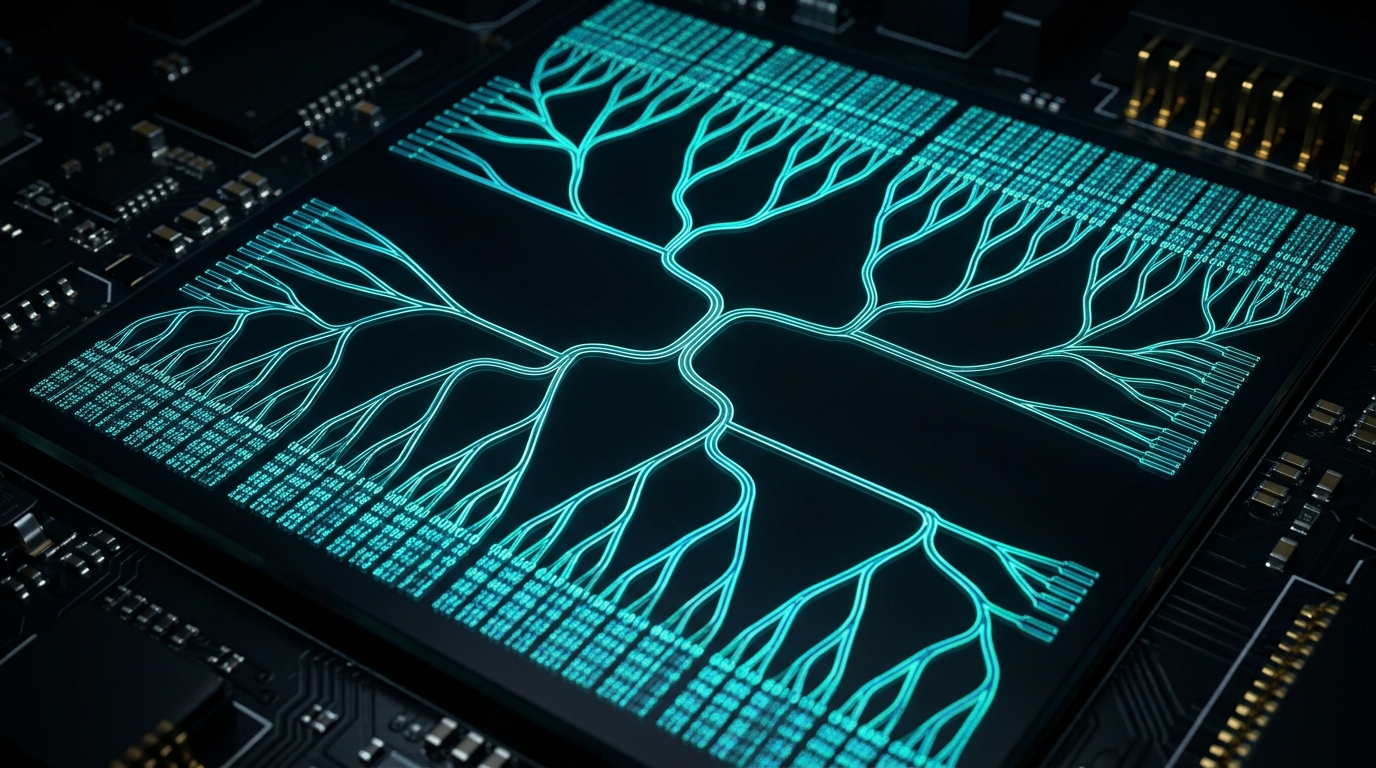

- A new Parallelized Amplitude Estimation (PAE) algorithm achieves near-Heisenberg-limited query complexity while reducing circuit depth to logarithmic scaling — a combination previously considered impossible
- The algorithm uses a GHZ state combined with shallow Grover circuits optimized via Quantum Signal Processing, creating a tunable depth-versus-qubit trade-off proven nearly optimal by the parallel quantum adversary method
- Security teams must reassess quantum threat timelines: distributable, shallow-circuit quantum algorithms accelerate the path to practical quantum advantage in cryptanalysis
Why Shallow Quantum Circuits Change Your Threat Model
Every quantum-safe migration plan rests on an assumption: large-scale quantum computation requires deep circuits, and deep circuits require long coherence times that hardware cannot yet deliver. That assumption just lost critical support.
Researchers posted an updated preprint (arXiv:2508.06121v2) describing a Parallelized Amplitude Estimation (PAE) algorithm that simultaneously achieves near-optimal query counts and logarithmic circuit depth. The significance for security architects is direct. Amplitude estimation underpins Grover’s search algorithm, which threatens symmetric key cryptography and hash functions. An algorithm that makes amplitude estimation distributable across shallow-depth processors compresses the timeline between “theoretical quantum threat” and “deployable quantum attack.”
For organizations still treating post-quantum migration as a 2030 problem, this paper is a calibration event.
What Parallelized Amplitude Estimation Actually Does
Amplitude estimation is the quantum subroutine that extracts the probability of a target outcome from a quantum state. It powers Grover’s algorithm, quantum Monte Carlo methods, and a class of optimization problems relevant to both cryptanalysis and financial modeling.
Definition: Parallelized Amplitude Estimation (PAE) is an algorithmic framework that distributes amplitude estimation across multiple quantum processors using a global entangled state (GHZ state) followed by independent, shallow-depth Grover circuits. Each circuit is optimized through Quantum Signal Processing (QSP) techniques, and the number of qubits in the GHZ state trades off against individual circuit depth — both parameters are tunable by the operator.
The core breakthrough is simultaneous optimization of two metrics that were believed to be in tension:
- Query complexity: Near-Heisenberg scaling, meaning the total number of oracle queries approaches the theoretical minimum (optimal up to logarithmic factors)
- Circuit depth: Logarithmic scaling with respect to estimation precision, down from the linear or polynomial depth required by standard approaches
“We prove that this trade-off scaling is nearly optimal with use of the parallel quantum adversary method, against folklore on the impossibility of efficient parallelization in amplitude estimation.” — Authors, arXiv:2508.06121v2
The authors did not merely propose a heuristic. They proved near-optimality using the parallel quantum adversary method — a lower-bound technique that establishes fundamental limits on what any parallel quantum algorithm can achieve. The trade-off between GHZ state size and circuit depth is not just practical engineering; it is close to the best any algorithm can do.
Technical Architecture of the PAE Algorithm
The PAE algorithm operates in three stages:
Stage 1 — Global Entanglement: A GHZ (Greenberger-Horne-Zeilinger) state is prepared across all participating qubits. This is a maximally entangled state of the form |000…0⟩ + |111…1⟩, which serves as the coordination mechanism across parallel processors.
Stage 2 — Distributed Grover Circuits: Each processor executes an independent, low-depth Grover circuit. These circuits are not generic — they are optimized using Quantum Signal Processing techniques that reshape the amplitude amplification profile to extract maximum information per query within the depth budget.
Stage 3 — Classical Post-Processing: Results from all circuits are combined classically to produce the final amplitude estimate.
The Depth-Qubit Trade-Off
The operator chooses where to sit on a continuum:
| Configuration | GHZ Qubits | Circuit Depth | Query Complexity | Use Case |
|---|---|---|---|---|
| Depth-minimized | Higher | Logarithmic in 1/ε | Near-Heisenberg | Near-term hardware with short coherence |
| Qubit-minimized | Lower | Higher (sub-linear) | Near-Heisenberg | Systems with fewer qubits but longer coherence |
| Balanced | Moderate | Moderate | Near-Heisenberg | General-purpose distributed quantum computing |
Here, ε represents the target estimation precision. The critical observation is that query complexity remains near-Heisenberg across the entire trade-off curve — you do not sacrifice total work to gain parallelism.
How This Differs from Standard Amplitude Estimation
| Property | Standard (Quantum Phase Estimation) | PAE Algorithm |
|---|---|---|
| Circuit depth | O(1/ε) — linear in precision | O(log(1/ε)) — logarithmic |
| Query complexity | O(1/ε) — Heisenberg limit | Near-O(1/ε) — up to log factors |
| Parallelizable | No (sequential oracle calls) | Yes (distributed Grover circuits) |
| Hardware requirement | Single deep-circuit processor | Multiple shallow-circuit processors |
| Entanglement structure | Local phase kickback | Global GHZ + local Grover |
The architectural form — global entanglement followed by local computation — maps directly onto distributed quantum computing topologies. This is not a theoretical convenience. Hardware teams at IBM, Google, and startups building modular quantum processors are already designing interconnects for exactly this communication pattern.
What This Means for Quantum Threat Timelines
The standard argument for extended migration timelines runs: “Cryptographically relevant quantum computers need millions of physical qubits running deep circuits. Current hardware has hundreds of qubits and limited depth. We have time.”
PAE weakens the second clause. If amplitude estimation — the engine inside Grover’s algorithm — can run on distributed shallow circuits, then the relevant hardware milestone shifts from “one giant processor with deep coherence” to “a network of smaller processors with modest coherence.”
Concrete Implications by Timeframe
Near-term (1-2 years): The PAE blueprint validates distributing amplitude estimation across lower-depth quantum processors. Hardware teams working on modular quantum architectures now have a theoretically optimal target to implement. Expect proof-of-concept demonstrations on 10-50 qubit systems.
Medium-term (3-5 years): Practical quantum advantage in Monte Carlo integration, option pricing, and structured search problems could arrive earlier than consensus estimates. These are the same subroutines that, scaled further, enable Grover-class attacks on symmetric cryptography. NIST’s post-quantum standards timeline assumes a certain pace of quantum hardware progress; PAE’s logarithmic depth scaling could compress that pace.
Long-term (5+ years): The paper overturns a longstanding assumption — the “folklore” that efficient parallelization in amplitude estimation is impossible. This is not an incremental improvement. It reshapes how quantum algorithms will be designed for massively parallel, fault-tolerant quantum computers. Every algorithm that uses amplitude estimation as a subroutine inherits the option of logarithmic-depth parallelization.
For enterprise security planning, the operational takeaway is clear: threat models that assume quantum attacks require monolithic deep-circuit processors are no longer conservative estimates — they are optimistic ones.
Industry Context: The Parallelization Race
This paper arrives at a specific moment in quantum computing. IBM published its quantum roadmap targeting 100,000+ qubit systems through modular architectures. Google demonstrated quantum error correction milestones on its Willow processor. PsiQuantum is building photonic quantum computers designed from the ground up for networked operation.
All of these approaches benefit disproportionately from algorithms that trade circuit depth for parallelism. PAE is not the only proposal in this space, but it carries a uniquely strong theoretical guarantee: provably near-optimal scaling via the parallel quantum adversary method.
What Remains Unknown
The paper, as a preprint on arXiv (version 2, replacing an earlier submission), carries important caveats:
- No empirical benchmarks: The abstract provides no specific qubit counts, gate counts, or wall-clock comparisons against alternative approaches
- No noise analysis: Resilience to decoherence and gate errors — the dominant constraints on near-term hardware — is not addressed
- No peer review confirmation: The paper has not yet passed through formal journal peer review
- Single-source claim: The assertion that prior “folklore” deemed efficient parallelization impossible has not been independently cross-verified in the provided materials
These gaps do not diminish the theoretical contribution, but they do mean that enterprise planning should treat PAE as a validated direction rather than a deployment-ready capability.
The BeQuantum Perspective
BeQuantum’s architecture was designed for exactly this class of threat acceleration. Our Digital Notary system anchors document authenticity to post-quantum cryptographic signatures that remain secure regardless of how amplitude estimation algorithms evolve. The PQC Layer implements NIST-standardized algorithms (ML-KEM, ML-DSA, SLH-DSA) across all verification pathways, ensuring that improvements in quantum parallelism do not create a window of vulnerability between “quantum threat becomes real” and “migration is complete.”
The PAE paper reinforces a design principle we apply across our stack: never assume a single hardware bottleneck will persist. Logarithmic-depth amplitude estimation means quantum threats can scale horizontally before they scale vertically. Our IceCase hardware security modules enforce crypto-agility at the firmware level, enabling algorithm rotation without infrastructure replacement — the operational response to a world where quantum capability milestones arrive unevenly and faster than linear projections suggest.
Organizations building quantum-safe architectures today should prioritize crypto-agility over point-in-time algorithm selection. The specific algorithms matter less than the ability to swap them when threat models shift.
What You Should Do Next
Within 30 days — Audit your amplitude-estimation exposure: Identify which of your cryptographic primitives (symmetric keys, hash-based signatures, key derivation functions) rely on hardness assumptions that Grover-class attacks degrade. Map these to specific systems and data classification levels.
Within 90 days — Stress-test your migration timeline: Take your current post-quantum migration plan and compress the “quantum threat becomes practical” milestone by 3-5 years. Determine which systems break first under that scenario. Prioritize those for early migration to NIST PQC standards.
Within 180 days — Implement crypto-agility at the TLS layer: Ensure your certificate infrastructure supports hybrid classical/post-quantum key exchange (e.g., X25519+ML-KEM-768). This is not a future requirement — Chrome, Firefox, and Cloudflare already support hybrid key exchange in production. If your infrastructure cannot negotiate post-quantum cipher suites today, you are already behind the deployment curve.
Frequently Asked Questions
Q: Does the PAE algorithm directly threaten current encryption standards?
A: Not immediately. PAE is a theoretical framework for distributing amplitude estimation, not a ready-to-deploy attack tool. However, it removes a key assumption — that amplitude estimation requires deep circuits — from quantum threat timeline models. Organizations using AES-128 or SHA-256 should note that Grover’s algorithm, powered by more efficient amplitude estimation, reduces their effective security level. AES-256 and SHA-384 or higher provide adequate margins under current projections.
Q: How does PAE affect NIST post-quantum cryptography standards?
A: NIST’s selected PQC algorithms (ML-KEM, ML-DSA, SLH-DSA) are designed to resist both Shor’s and Grover’s algorithms. PAE does not break these standards. What PAE does is compress the timeline by which Grover-class attacks become practical, reinforcing the urgency of migrating away from pre-quantum primitives. Organizations that have not begun PQC migration should treat PAE as additional evidence that starting now is not premature.
Q: Should we wait for peer review before acting on this paper?
A: No. The theoretical framework is built on established techniques (GHZ states, QSP, quantum adversary method), and the near-optimality proof provides strong internal validation. Enterprise security planning operates on risk management, not publication status. Use PAE to update threat model assumptions while monitoring for empirical validation results over the next 12-18 months.
Last updated: April 2026. Based on analysis of arXiv:2508.06121v2.
[IMAGE: A quantum processor chip viewed from above with branching pathways of entangled cyan light splitting into parallel shallow circuits, each circuit glowing with decreasing intensity to represent logarithmic depth scaling, set against a dark matte background with faint grid lines suggesting distributed networked architecture]