- Clifford-deformed compass codes achieve better error thresholds and lower logical error rates than the XZZX surface code at moderate dephasing biases under code capacity noise
- These codes exploit hardware noise asymmetry — producing thresholds that increase with bias — without requiring physical hardware changes
- Organizations planning quantum-safe infrastructure must track QEC advances that shrink the timeline to fault-tolerant quantum computers capable of breaking classical encryption
Why Biased-Noise Quantum Error Correction Threatens Your Encryption Timeline
Every post-quantum migration plan rests on a single assumption: how soon fault-tolerant quantum computers arrive. That timeline depends directly on quantum error correction (QEC) overhead — the number of physical qubits required to protect one logical qubit. A breakthrough that cuts that overhead accelerates the threat window.
Researchers at arXiv have published a revised study (arXiv:2412.03808v2) demonstrating that Clifford-deformed compass codes produce QEC codes with improved performance under dephasing-biased noise — the dominant error type in superconducting and bosonic qubit architectures. The practical consequence: hardware teams can suppress errors more effectively without changing their physical qubits, potentially shaving years off the fault-tolerance timeline.
For CISOs operating under NIST’s post-quantum transition deadlines, this is a calibration signal. The quantum threat is not static. Every QEC efficiency gain compresses the window you have to complete cryptographic migration.
What Are Clifford-Deformed Compass Codes?
Definition: Clifford-deformed compass codes are a family of quantum error correction codes created by applying Clifford deformations — specific unitary transformations from the Clifford group — to elongated compass codes. These deformations introduce symmetries that enhance decoder performance and allow stabilizer selection tuned to extract more information about high-rate errors, particularly in noise environments where dephasing errors dominate over bit-flip errors.
Compass codes generalize the surface code by allowing rectangular stabilizer geometries rather than square ones. Elongating these stabilizers along one axis already provides some bias-handling capability. Clifford deformations go further: they reshape the code’s error-correction properties at the algebraic level, matching the code structure to the asymmetric noise profile of the physical hardware.
The XZZX surface code has served as the primary benchmark for bias-tailored QEC since its introduction. It applies a site-dependent Clifford rotation to the standard surface code, converting Z-biased noise into an effectively symmetric noise channel that the code handles efficiently. The Clifford-deformed compass codes build on this principle but exploit the additional geometric freedom of compass codes to achieve superior performance at moderate bias levels.
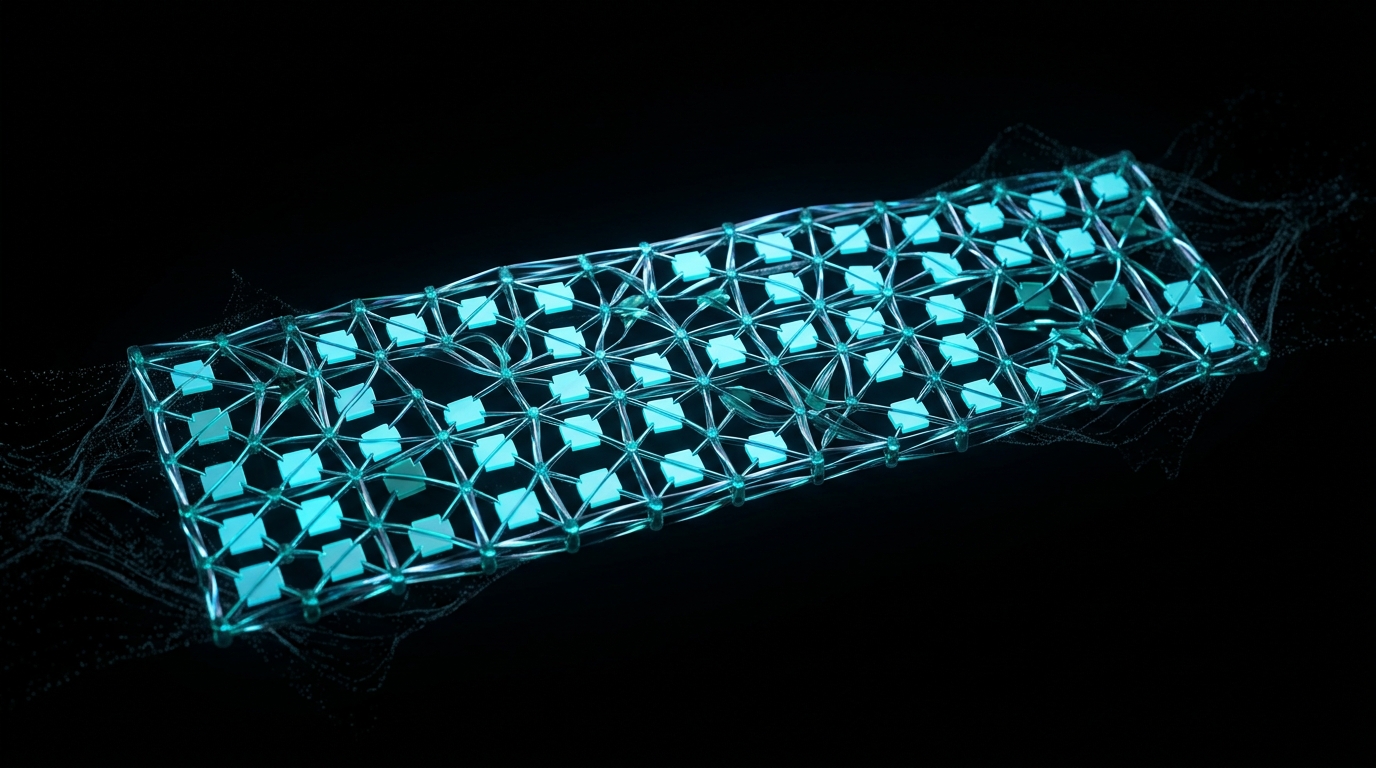
[IMAGE: A lattice grid of interconnected quantum stabilizers rendered in cyan and dark blue, with elongated rectangular cells visually deformed along one axis, photorealistic quantum processor aesthetic with entangled light paths tracing error correction cycles]
Technical Deep-Dive: How Clifford Deformations Improve Threshold Performance
Mechanism: Symmetry Injection and Stabilizer Selection
The core technical insight operates on two levels:
-
Clifford deformations introduce symmetries into the code’s stabilizer group. These symmetries allow minimum-weight perfect matching (MWPM) and union-find decoders to disambiguate error chains more effectively, reducing decoder failure rates without increasing computational overhead.
-
Stabilizer selection in compass codes provides a degree of freedom absent in standard surface codes. By choosing stabilizers that extract maximum information about the dominant error type (dephasing), the code allocates its error-correction budget where the noise actually concentrates.
The combination produces codes whose error thresholds — the physical error rate below which logical error rates decrease with increasing code distance — increase with bias. As the hardware’s noise asymmetry grows, the code becomes more effective, not less.
“One of the Clifford deformations we explore yields QEC codes with better thresholds and logical error rates than those of the XZZX surface code at moderate biases under code capacity noise.” — arXiv:2412.03808v2 authors
Performance Comparison: Clifford-Deformed Compass Codes vs. XZZX Surface Code
| Property | XZZX Surface Code | Clifford-Deformed Compass Codes |
|---|---|---|
| Noise model adaptation | Site-dependent Clifford rotation | Clifford deformations + stabilizer selection |
| Geometric freedom | Fixed square lattice | Elongated rectangular lattice |
| Threshold behavior under bias | Increases with bias | Increases with bias; exceeds XZZX at moderate bias |
| Logical error rate (moderate bias) | Baseline | Lower than XZZX under code capacity noise |
| Noise models validated | Code capacity, phenomenological | Code capacity, phenomenological |
| Decoder enhancement mechanism | Noise symmetrization | Symmetry injection + targeted stabilizer information |
| Hardware modification required | None | None |
The study validated these results under both code capacity noise (idealized, no measurement errors) and phenomenological noise (includes measurement errors). Under code capacity noise at moderate biases, at least one Clifford deformation produced strictly better thresholds and logical error rates than the XZZX surface code.
What the Data Gaps Tell Us
The published abstract (arXiv:2412.03808v2) does not specify exact threshold values, bias ratios defining “moderate,” or decoder algorithms used. It also does not report results under circuit-level noise — the most realistic noise model that includes gate errors, idle errors, and correlated measurement faults. Until circuit-level benchmarks confirm these advantages, production deployment remains premature. However, the code capacity and phenomenological results establish a strong theoretical foundation.
Industry Context: Why QEC Efficiency Reshapes the PQC Timeline
The Qubit Overhead Problem
Current estimates for breaking RSA-2048 with Shor’s algorithm on a surface-code quantum computer require roughly 20 million physical qubits. Every QEC advance that lowers the physical-to-logical qubit ratio compresses this number. Noise-tailored codes like Clifford-deformed compass codes attack the problem from the code design side: match the QEC code to the hardware’s actual noise profile, and you extract more logical protection per physical qubit.
Hardware Alignment
Superconducting qubits — the architecture pursued by IBM, Google, and numerous startups — exhibit significant dephasing bias. T2 (dephasing) times are typically shorter than T1 (relaxation) times, creating exactly the asymmetric noise environment where these codes excel. Bosonic qubits (cat qubits, GKP states) show even stronger bias ratios, sometimes exceeding 100:1.
This means the codes demonstrated in arXiv:2412.03808v2 are not theoretical curiosities. They target the noise profiles of hardware that major quantum computing programs are actively scaling.
Hardware teams building superconducting or bosonic qubit architectures with known dephasing bias can adopt Clifford-deformed compass codes for better error suppression without changing physical hardware — potentially lowering overhead for near-term fault-tolerant demonstrations.
Regulatory Pressure Compounds the Risk
NIST finalized its first post-quantum cryptographic standards (FIPS 203, 204, 205) in 2024 and set 2035 as the deprecation target for classical algorithms vulnerable to quantum attack. The implicit assumption: fault-tolerant quantum computers remain a decade away. QEC advances that reduce qubit overhead challenge that assumption. If noise-tailored codes become standard in quantum computing stacks within 3-5 years — as the medium-term implications suggest — the fault-tolerance timeline could compress significantly.
Organizations that calibrated their PQC migration to a 2035 threat horizon should treat QEC research as an early-warning system, not an academic abstraction.
The BeQuantum Perspective: Noise-Aware QEC and Cryptographic Resilience
BeQuantum’s architecture addresses the quantum threat from both sides of the equation: deploying post-quantum cryptographic algorithms today while monitoring the advances that determine when classical cryptography fails.
Clifford-deformed compass codes represent exactly the class of QEC innovation that our threat modeling tracks. The pattern — exploiting hardware-specific noise asymmetry to reduce fault-tolerance overhead — is consistent across multiple recent research directions (XZZX surface codes, XY codes, tailored color codes). Each iteration brings fault-tolerant quantum computing closer.
BeQuantum’s PQC Layer implements lattice-based and hash-based algorithms from NIST’s finalized standards, providing cryptographic protection independent of quantum computing timelines. Our Digital Notary service timestamps and cryptographically binds document integrity proofs using quantum-resistant signatures, ensuring that records authenticated today remain verifiable even if quantum computers arrive ahead of current projections.
The security posture we recommend to clients: migrate cryptography now, monitor QEC advances continuously, and treat every threshold improvement as a signal to accelerate — not a reason to wait.
What You Should Do Next
-
Within 30 days: Audit your cryptographic inventory. Identify every system using RSA, ECDSA, or ECDH key exchange. Map dependencies, certificate chains, and hardware security modules. You cannot migrate what you have not catalogued.
-
Within 90 days: Initiate hybrid deployments. Deploy hybrid TLS configurations (classical + post-quantum KEM) on your highest-value endpoints. NIST’s ML-KEM (FIPS 203) is finalized and supported in OpenSSL 3.5 and BoringSSL. Start with internal APIs where compatibility risk is lowest.
-
Continuously: Monitor QEC research as a threat signal. Subscribe to arXiv categories quant-ph and cs.CR. Track qubit overhead estimates quarterly. When noise-tailored codes like Clifford-deformed compass codes move from theoretical benchmarks to circuit-level validation, the fault-tolerance timeline will compress materially.
Frequently Asked Questions
Q: Do Clifford-deformed compass codes make quantum computers an immediate threat to current encryption?
A: No. These codes improve the theoretical efficiency of quantum error correction under specific noise conditions, but fault-tolerant quantum computers capable of breaking RSA-2048 still require millions of physical qubits — far beyond current hardware. The significance is directional: each QEC efficiency gain reduces the qubit count required, compressing the timeline from “decades away” toward “years away.” Organizations should treat this as acceleration of an existing threat, not emergence of a new one.
Q: How do Clifford-deformed compass codes differ from the XZZX surface code?
A: Both codes exploit Clifford transformations to handle biased noise, but they start from different base codes. The XZZX surface code applies site-dependent rotations to the standard surface code on a fixed square lattice. Clifford-deformed compass codes apply Clifford deformations to elongated compass codes, which have rectangular stabilizer geometries providing additional degrees of freedom. This extra geometric flexibility allows better threshold performance at moderate bias levels under code capacity noise, as demonstrated in arXiv:2412.03808v2.
Q: Should my organization change its PQC migration timeline based on this research?
A: Not based on this single paper, but based on the trend it represents. Noise-tailored QEC codes are maturing rapidly across multiple research groups. If your migration plan assumes fault-tolerant quantum computers arrive after 2035, build in a margin of safety. NIST’s own guidance recommends completing migration to quantum-resistant algorithms well before the threat materializes — the “harvest now, decrypt later” attack means sensitive data encrypted today is already at risk from future quantum computers.
Last updated: April 2026. Based on arXiv:2412.03808v2.