Last updated: 2025
Key Takeaways
- Research published as arXiv:2206.07731 derives analytical bounds on localizable entanglement for generalized GHZ, W, Dicke, and generalized Dicke states — foundational state classes that underpin quantum communication protocol design
- In one-dimensional spin models (transverse-field XY and XXZ), localized entanglement shows a cubic dependence on lost entanglement, and this relationship holds even under external-field disorder
- For enterprise security architects: this foundational work will shape the quantum error correction and quantum network designs that post-quantum cryptography infrastructure must eventually interoperate with — understanding it now shortens your future migration path
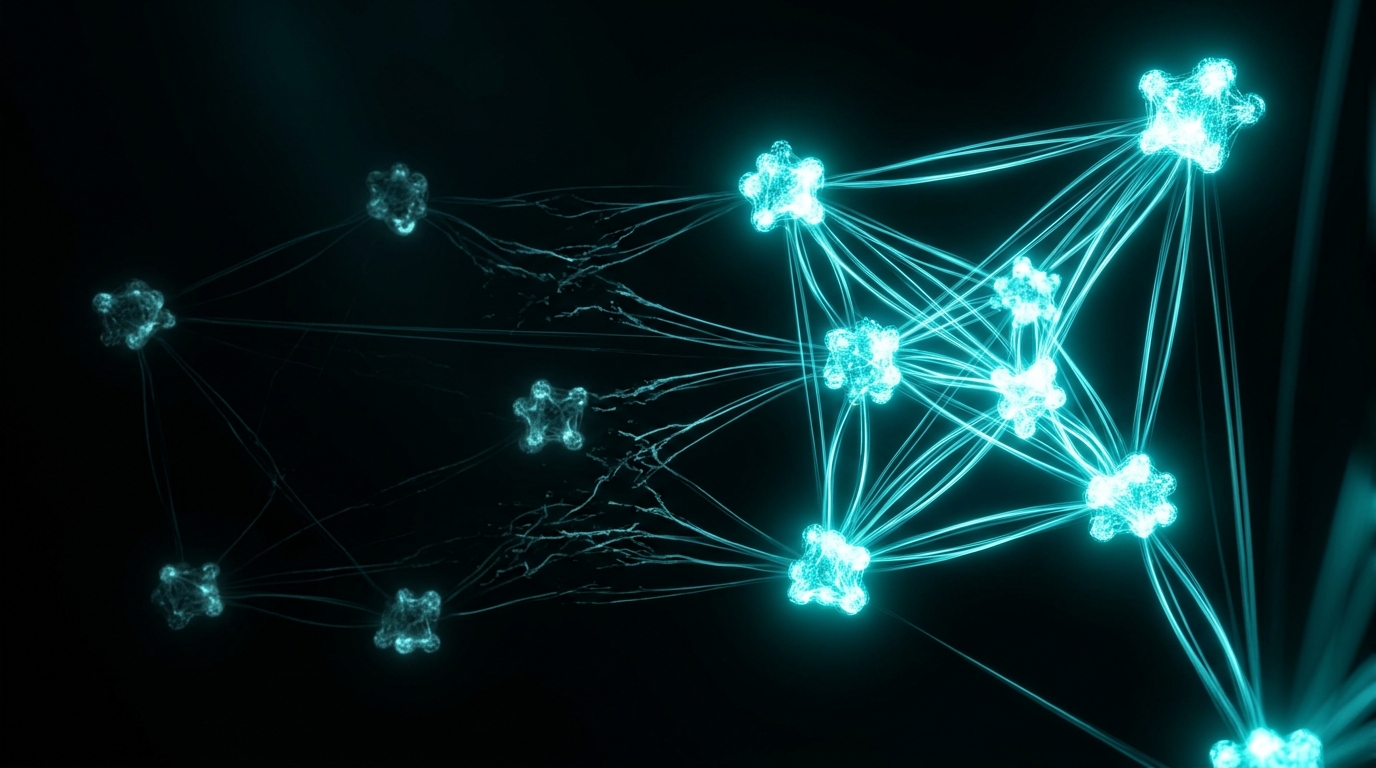
[IMAGE: A macro-scale visualization of entangled quantum states as luminous teal and cyan node clusters connected by glowing filaments against a deep black background, with some nodes dimming to represent measurement-induced entanglement loss, cinematic 8K lighting]
Why Entanglement Research Belongs in Your Security Briefing
Your TLS handshake does not care about quantum physics — until it does. The moment a cryptographically relevant quantum computer executes Shor’s algorithm against RSA-2048 at scale, every assumption baked into your current key exchange infrastructure collapses. NIST finalized its first post-quantum cryptography standards in August 2024 precisely because that moment is no longer theoretical.
But post-quantum cryptography is not the end of the story. Quantum networks — systems that distribute entangled qubits across nodes to enable quantum key distribution (QKD) and distributed quantum computing — represent the next layer of the security stack. The protocols that will govern those networks depend critically on one question: when you perform a local measurement on a multi-qubit system, how much entanglement can you localize between the remaining parties, and how much do you irreversibly lose?
Research published on arXiv (identifier: 2206.07731, “Controlling gain with loss: Bounds on localizable entanglement in multi-qubit systems”) addresses exactly that question. This is foundational quantum information theory — no enterprise deployment timelines attached. But the analytical bounds it establishes will feed directly into the quantum error correction and quantum network architectures that your organization will need to evaluate within the next five years.
What Localizable Entanglement Actually Measures
Localizable entanglement is a measure of how much bipartite entanglement two specific parties in a multi-qubit system can concentrate between themselves by performing local measurements on all other qubits in the system. The central tension: every measurement you perform to localize entanglement also destroys some of the global entanglement that existed before the measurement. The research question is whether — and by how much — you can bound what you recover versus what you lose.
This matters for quantum network design because any quantum repeater node, any entanglement-swapping relay, and any distributed quantum key distribution protocol performs exactly this operation: local measurements on intermediate qubits to push entanglement toward the endpoints that need it.
The State Classes Under Investigation
The paper examines four families of multi-qubit states that serve as canonical benchmarks in quantum information research:
- Generalized GHZ states: maximally entangled across all qubits; highly sensitive to local noise
- Generalized W states: entanglement distributed more robustly across the system
- Dicke states: symmetric superpositions with fixed excitation number; relevant to quantum optical systems
- Generalized Dicke states: the broader class encompassing asymmetric excitation distributions
For GHZ and W states, the researchers derive analytical bounds — closed-form expressions relating localizable entanglement to the bipartite entanglement present before measurement. For Dicke and generalized Dicke states, a different pattern emerges: as system size increases, localizable entanglement converges toward the bipartite entanglement present over a specific partition before measurement. The research then extends numerically to arbitrary multi-qubit pure states, broadening the applicability beyond these canonical families.
The Noise Finding That Changes Protocol Design Assumptions
The most operationally significant result in arXiv:2206.07731 is not the bounds themselves — it is what happens to those bounds under noise.
The researchers apply single-qubit phase-flip noise to all qubits and derive analytical modifications of the pure-state results. Phase-flip noise is not an exotic adversarial model. It is a standard decoherence channel that any physical qubit implementation — superconducting, trapped ion, photonic — experiences in real operating conditions.
For the one-dimensional transverse-field XY model and the XXZ model in an external field, the relationship between localized entanglement and lost entanglement follows a cubic dependence. The researchers confirm that this cubic relationship is robust even when disorder is introduced into the strength of the external field.
“We show that this relation is robust even in the presence of disorder in the strength of the external field.” — arXiv:2206.07731
For protocol designers, robustness under disorder is the critical property. A bound that holds only in idealized, uniform-field conditions has limited engineering value. A bound that survives field disorder translates into a design constraint you can actually build against.
Comparing Entanglement Behavior Across State Classes
| State Class | Bound Type | Behavior Under Increasing System Size | Noise Robustness Studied |
|---|---|---|---|
| Generalized GHZ | Analytical | Bounds derived; does not converge to pre-measurement bipartite entanglement | Yes — phase-flip noise applied |
| Generalized W | Analytical | Bounds derived; does not converge to pre-measurement bipartite entanglement | Yes — phase-flip noise applied |
| Dicke | Analytical + Numerical | Localizable entanglement → pre-measurement bipartite entanglement as N increases | Yes — phase-flip noise applied |
| Generalized Dicke | Analytical + Numerical | Same convergence behavior as Dicke states | Yes — phase-flip noise applied |
| Arbitrary pure states | Numerical only | General numerical investigation; no closed-form bound | Partial |
| 1D XY / XXZ spin models | Numerical + Analytical | Cubic dependence on lost entanglement; robust under field disorder | Yes — disorder in external field strength |
This table reflects the scope of arXiv:2206.07731 as published. Specific numerical values for the derived bounds are not disclosed in the abstract; the full paper contains the explicit expressions.
What This Means for Quantum-Safe Infrastructure Planning
Near-Term (0–2 Years): No Direct Action Required
This research does not change your firewall rules, your certificate rotation schedule, or your NIST PQC migration timeline. The work is foundational quantum information theory. Organizations currently auditing their TLS certificate chains for quantum vulnerability — which you should be doing — do not need to factor localizable entanglement bounds into that audit.
Medium-Term (3–5 Years): Protocol Selection Will Reference This Work
Quantum key distribution vendors and quantum network equipment manufacturers will use analytical results like these to specify the entanglement fidelity requirements of their repeater nodes and measurement stations. When your organization evaluates QKD infrastructure — whether as a complement to or replacement for classical key exchange — the protocol specifications will embed assumptions derived from research in this lineage.
Security architects who understand why a vendor specifies a minimum localizable entanglement threshold of, say, 0.85 ebits over a given partition will make better procurement decisions than those who treat it as an opaque number.
Long-Term (5+ Years): Fault-Tolerant Quantum Computing Architecture
Fault-tolerant quantum computers require quantum error correction codes that themselves depend on entanglement distribution across physical qubits. The bounds on localizable entanglement under noise — particularly the phase-flip channel results in this paper — feed into the theoretical foundations of those codes. Organizations building quantum-safe cryptographic infrastructure that must eventually interoperate with quantum computing environments need this layer of understanding in their architecture teams.
The BeQuantum Perspective: Foundational Research and the PQC Migration Stack
At BeQuantum, we track foundational quantum information research not because it changes tomorrow’s threat model, but because it defines the design space of the quantum infrastructure your organization will need to secure in the medium term.
Our PQC Layer currently focuses on the NIST-standardized algorithms — ML-KEM (formerly KYBER), ML-DSA (formerly DILITHIUM), and SLH-DSA (formerly SPHINCS+) — because these address the immediate threat: classical systems vulnerable to quantum-enabled cryptanalysis. That migration is urgent and measurable.
But the organizations that will navigate the next transition — from classical-plus-PQC to hybrid quantum networks — are the ones building institutional knowledge now. Research like arXiv:2206.07731 is part of that knowledge base.
The cubic dependence of localized entanglement on lost entanglement, robust under field disorder, is precisely the kind of noise-resilient analytical result that quantum network protocol designers need to move from theoretical constructs to engineering specifications.
Our Digital Notary service already addresses one dimension of this future: cryptographic timestamping and content authenticity verification that must remain valid across cryptographic transitions. As quantum networks mature, the verification chain — from content creation through transmission to storage — will need to account for entanglement-based authentication primitives. Understanding the entanglement bounds that constrain those primitives is not academic overhead. It is architectural due diligence.
What You Should Do Next
Within 30 days: Assign a member of your security architecture team to track NIST’s post-quantum cryptography migration guidance and the parallel development of quantum networking standards through ITU-T Study Group 13 and ETSI QKD specifications. These bodies will operationalize research like arXiv:2206.07731 into procurement-relevant standards.
Within 90 days: Audit your current TLS certificate chain and key exchange mechanisms for quantum vulnerability. Specifically, identify any RSA or ECC key exchange in your critical infrastructure and map it against your organization’s estimated exposure window — the gap between now and when cryptographically relevant quantum computers reach operational scale. NIST’s 2024 finalized standards give you the replacement algorithms; the audit tells you the scope of work.
Within 12 months: Evaluate whether any of your high-value communication channels — executive communications, financial transaction signing, regulated data transmission — warrant a QKD pilot. When you issue that RFP, you will encounter entanglement fidelity specifications. The conceptual foundation in this article is your starting point for evaluating those claims critically rather than accepting vendor assertions at face value.
Frequently Asked Questions
Q: Does localizable entanglement research directly affect my organization’s post-quantum cryptography migration?
A: Not directly, and not on a near-term timeline. NIST’s finalized PQC standards — ML-KEM, ML-DSA, SLH-DSA — address the immediate threat to classical cryptographic systems and should drive your current migration planning. Localizable entanglement research is foundational work that will influence quantum network protocol design over a 3–7 year horizon, which is relevant context for organizations building long-term quantum-safe architecture strategies.
Q: What is the practical difference between GHZ and W states in terms of entanglement robustness, and why does it matter for security protocols?
A: GHZ states concentrate entanglement globally — a single qubit loss destroys the entanglement across the entire system. W states distribute entanglement more redundantly — losing one qubit degrades but does not eliminate the entanglement shared by the remaining parties. For quantum key distribution protocols, this distinction affects how repeater nodes must be designed to maintain key fidelity across lossy channels. The analytical bounds in arXiv:2206.07731 quantify exactly how much entanglement each state class can localize after measurement, giving protocol designers concrete parameters to work with.
Q: How does phase-flip noise in this research relate to real-world quantum hardware decoherence?
A: Phase-flip noise is a standard single-qubit error channel that models the loss of phase coherence in physical qubits — a dominant decoherence mechanism in superconducting and photonic qubit implementations. The fact that the cubic dependence relationship between localized and lost entanglement survives both phase-flip noise and external-field disorder means the bound is not a laboratory artifact. It reflects behavior that physical quantum systems will exhibit under realistic operating conditions, which is the prerequisite for any result to be useful in engineering quantum network hardware.
Source: “Controlling gain with loss: Bounds on localizable entanglement in multi-qubit systems”, arXiv:2206.07731v2