
Key Takeaways
- TZAP, a new linear-time T-gate optimizer, processes quantum circuits with millions of gates in seconds on a laptop — a capability that outpaces state-of-the-art tools (PyZX, VOQC, Feynman) by multiple orders of magnitude
- T-count minimization has been the central bottleneck preventing fault-tolerant quantum computers from reaching practical scale; TZAP directly attacks that bottleneck
- If T-gate resource costs drop faster than the cryptographic community’s current migration models assume, your 2030 PQC deadline may need to move to 2027
Last updated: June 2025
The Bottleneck That Was Protecting Your Encryption Just Got Smaller
Picture your organization’s RSA-2048 infrastructure — TLS certificates, VPN tunnels, code-signing keys. The standard threat model says a cryptographically relevant quantum computer (CRQC) capable of running Shor’s algorithm at scale is at least a decade away. That estimate rests on a specific assumption: that building fault-tolerant quantum circuits is prohibitively expensive because of one particular gate type.
That gate type is the T gate. And a paper published on arXiv (arXiv:2605.13929v1) just demonstrated a tool called TZAP that makes optimizing T gates dramatically cheaper and faster than anything previously available.
This is not a theoretical curiosity. This is a supply-chain event for quantum computing infrastructure — and it has direct implications for how aggressively your organization needs to pursue post-quantum cryptography migration.
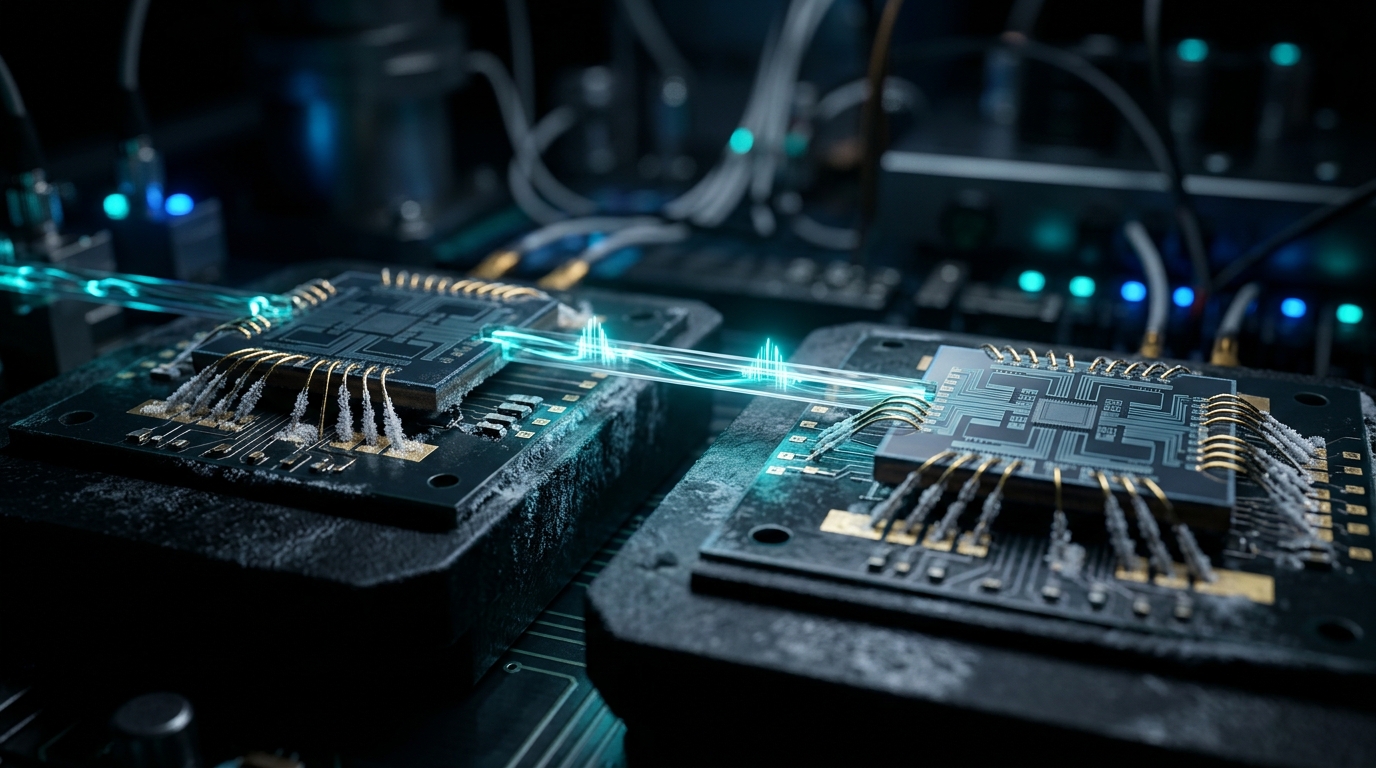
[IMAGE: A quantum processor chip under extreme macro photography, with entangled cyan light beams threading between gate structures, deep black background, cinematic teal accent lighting, 8K detail on the chip’s circuit pathways]
Why T Gates Are the Scarcest Resource in Quantum Computing
To understand why TZAP matters, you need to understand why T gates are expensive in the first place.
A definition for clarity: A T gate is a single-qubit rotation gate that applies a π/8 phase shift. Unlike simpler gates (Clifford gates such as CNOT, Hadamard, and Pauli operations), T gates cannot be implemented transversally in most practical fault-tolerance schemes. Transversal implementation means applying a gate simultaneously across all physical qubits encoding a logical qubit — a technique that prevents errors from spreading. T gates break this property.
Because T gates cannot be implemented transversally, quantum hardware must instead use magic-state distillation: a complex, resource-intensive protocol that consumes many physical qubits and many error-correction cycles just to produce a single reliable T gate. In large-scale quantum computations, the T-gate count can dominate the entire resource budget — more than any other factor.
The practical consequence: a quantum algorithm’s feasibility on near-term fault-tolerant hardware is often determined not by its qubit count, but by its T count. Reduce the T count, and you reduce the physical qubit overhead, the runtime, and the engineering cost of building the machine that runs it.
“T-count minimization is a central bottleneck on the path to quantum advantage. Existing T-count optimization tools do not scale to the circuits that quantum advantage demands.” — arXiv:2605.13929v1
This is the gap TZAP was built to close.
TZAP’s Technical Architecture: How Linear-Time Phase Folding Works
The Core Algorithm
TZAP implements T-gate optimization through a technique called phase folding — identifying redundant T gates whose phase contributions cancel or combine, then eliminating or merging them. Phase folding is not new. What is new is how TZAP executes it.
Existing tools like PyZX (which uses ZX-calculus graph rewriting), VOQC (a verified optimizer written in Coq), and Feynman (a path-sum based optimizer) all track symbolic expressions through the circuit to determine which T gates are redundant. As circuit size grows, this symbolic tracking becomes computationally expensive — scaling poorly with circuit depth and width.
TZAP replaces symbolic tracking with a randomized static analysis that propagates constant-width bitstrings down the circuit rather than tracking symbolic expressions. Instead of asking “what is the exact quantum state at this point in the circuit?”, TZAP asks “what is the set of reachable states, approximated with high probability?” The approximation is sound — meaning it never incorrectly identifies a T gate as redundant when it isn’t — and the probability of a correct answer can be made arbitrarily high.
The result is an algorithm that runs in linear time relative to circuit size.
Performance Comparison
| Tool | Optimization Approach | Scalability | Time to Optimize 1M-Gate Circuit | T-Count Reduction Quality |
|---|---|---|---|---|
| PyZX | ZX-calculus graph rewriting | Poor at large scale | Hours to intractable | High (benchmark standard) |
| VOQC | Verified symbolic optimization | Poor at large scale | Hours to intractable | High (formally verified) |
| Feynman | Path-sum analysis | Poor at large scale | Hours to intractable | High (benchmark standard) |
| TZAP | Randomized static analysis (linear-time) | Scales to millions of gates | Seconds on a laptop | Closely matches PyZX/VOQC/Feynman |
Sources: arXiv:2605.13929v1; tool capabilities from respective published benchmarks
What “Constant-Width Bitstrings” Actually Means for Scalability
The key architectural insight in TZAP is that it avoids the exponential state-space explosion that plagues symbolic methods. By propagating fixed-width bitstring abstractions — rather than growing symbolic expressions — TZAP’s memory and compute requirements stay bounded regardless of circuit depth. A circuit with 10 million gates costs roughly 10x more to process than one with 1 million gates, not 100x or 1000x more.
This is the property that makes TZAP’s laptop-scale performance claim credible. The authors of arXiv:2605.13929v1 report that TZAP optimizes circuits with millions of gates within seconds on a standard laptop computer while closely matching the T-count reductions achieved by PyZX, VOQC, and Feynman on standard benchmarks.
TZAP is “multiple orders of magnitude faster than state-of-the-art tools — such as PyZX, VOQC, and Feynman — closely matches their T-count reductions on standard benchmarks, and within seconds on a laptop computer can optimize circuits with millions of gates.” — arXiv:2605.13929v1
What TZAP Means for Your Cryptographic Risk Model
The Harvest-Now, Decrypt-Later Threat Gets a Tighter Timeline
The “harvest now, decrypt later” (HNDL) attack model assumes adversaries are already exfiltrating encrypted data today, storing it until a CRQC becomes available to decrypt it. The question your security team should be asking is not “when will quantum computers break RSA?” but “when will the data I’m protecting today still be sensitive?”
If that answer is “five or more years,” TZAP is directly relevant to your threat model.
Here’s the mechanism: fault-tolerant quantum computers require enormous T-gate budgets to run Shor’s algorithm at cryptographically relevant scales. The engineering challenge of producing those T gates through magic-state distillation has been one of the primary arguments for why CRQCs remain distant. TZAP reduces the T-gate count needed to run a given quantum algorithm — which means the same physical hardware can now execute more complex computations, or the same computation can be executed on less hardware.
Regulatory Timelines Were Calibrated on Old Assumptions
NIST finalized its first three post-quantum cryptography standards in August 2024: ML-KEM (FIPS 203), ML-DSA (FIPS 204), and SLH-DSA (FIPS 205). NIST’s guidance recommends organizations complete migration away from RSA and ECC by 2030 for most use cases, with classified systems facing earlier deadlines under NSA CNSA 2.0.
Those timelines were set against a threat landscape that assumed T-gate optimization would remain a significant barrier. TZAP does not eliminate that barrier — magic-state distillation still requires substantial physical qubit overhead, and no specific qubit counts for breaking RSA-2048 are provided in the TZAP paper — but it removes one of the scaling obstacles that made large fault-tolerant circuits impractical.
Organizations that planned a 2028-2030 migration completion should treat TZAP as a signal to audit whether their timeline still reflects current risk.
Who Is Moving and Who Is Exposed
Google, IBM, and Microsoft have all announced active PQC integration programs. Google reported migrating internal systems to hybrid classical/PQC key exchange in 2023. The financial sector, under pressure from DORA in the EU and FFIEC guidance in the US, has begun PQC readiness assessments. Healthcare and critical infrastructure lag significantly — sectors where long-lived data (patient records, grid control systems) faces the highest HNDL exposure.
The cost of inaction compounds annually. Every TLS certificate renewed today on RSA or ECC extends your exposure window. Every long-lived signing key generated without a PQC migration plan is a liability that TZAP-class advances make more urgent.
The BeQuantum Perspective: Scaling Threats Require Scalable Defenses
At BeQuantum, we track quantum computing advances specifically for their cryptographic implications — not their computer science elegance. TZAP is significant not because it solves quantum computing, but because it removes a scaling friction point that security planners have been quietly relying on.
The pattern here mirrors what we saw with GPU-accelerated lattice attacks in 2022: a computational barrier that seemed stable suddenly became tractable because of an algorithmic improvement, not a hardware breakthrough. TZAP is an algorithmic improvement to quantum circuit compilation. Hardware breakthroughs are still required for a CRQC — but the software stack just got meaningfully more capable.
BeQuantum’s Digital Notary service uses ML-DSA (FIPS 204) signatures for content authenticity verification, specifically because NIST-standardized lattice-based signatures provide a migration path that doesn’t require predicting exactly when quantum advantage arrives. The approach is: assume the timeline is shorter than the consensus estimate, and build accordingly.
For organizations evaluating PQC deployment, the relevant question TZAP raises is not “should we migrate?” — that answer has been yes since NIST’s 2022 draft standards. The question is “how much runway do we actually have?” TZAP compresses that runway estimate.
Our PQC Layer integrates ML-KEM for key encapsulation and ML-DSA for digital signatures across API endpoints, replacing RSA-2048 and ECDSA P-256 respectively. The migration path is incremental: hybrid mode (classical + PQC in parallel) first, then full PQC cutover once compatibility is confirmed across your certificate chain and dependent services.
What Your Security Team Should Do in the Next 90 Days
Step 1: Audit your long-lived cryptographic assets (Days 1-30) Inventory every RSA and ECC key with a validity period extending past 2027. Focus on: TLS certificates for internal services, code-signing certificates, VPN authentication keys, and any keys protecting data with multi-year sensitivity requirements. Tools like Venafi, Keyfactor, or a manual OpenSSL scan of your certificate stores can produce this inventory. The output should be a prioritized list sorted by data sensitivity and key expiration date.
Step 2: Classify your HNDL exposure (Days 31-60) For each asset class identified in Step 1, assess whether the data it protects is sensitive beyond a 5-year horizon. Patient health records, intellectual property, financial transaction histories, and government communications all qualify. For these assets, accelerate your PQC migration timeline regardless of your current 2030 plan. NIST’s FIPS 203/204/205 standards are final — there is no standards risk in beginning migration now.
Step 3: Deploy hybrid PQC for your highest-risk endpoints (Days 61-90) Implement hybrid key exchange (X25519 + ML-KEM-768) on your highest-traffic, highest-sensitivity TLS endpoints. Most major TLS libraries — OpenSSL 3.x with the OQS provider, BoringSSL, and wolfSSL — support hybrid PQC in production configurations. This provides immediate quantum resistance without breaking compatibility with clients that don’t yet support PQC-only negotiation. Document the performance delta: ML-KEM-768 key encapsulation adds approximately 0.1-0.3ms of latency in most enterprise network configurations — a cost your organization should measure directly rather than estimate.
Frequently Asked Questions
Q: Does TZAP mean quantum computers can now break RSA or ECC? A: No — not directly or imminently. TZAP optimizes the T-gate count in quantum circuits, which reduces one of the resource costs of fault-tolerant quantum computing. However, a cryptographically relevant quantum computer still requires millions of physical qubits with low error rates, and TZAP does not change that hardware requirement. What TZAP does is remove a software-layer obstacle that made large fault-tolerant circuits impractical to compile efficiently, which modestly accelerates the overall engineering trajectory toward a CRQC.
Q: Should we wait for more quantum computing advances before investing in PQC migration? A: No. NIST’s PQC standards (ML-KEM, ML-DSA, SLH-DSA) are finalized. The migration cost does not decrease by waiting — it increases, because your exposure window grows and your technical debt accumulates. The harvest-now, decrypt-later threat means adversaries may already be collecting your encrypted traffic. The correct posture is to begin migration now, starting with your highest-sensitivity, longest-lived data assets, regardless of where quantum hardware development stands.
Q: How does TZAP compare to previous T-gate optimization tools in practice? A: TZAP’s primary advantage is scalability, not optimization quality. Tools like PyZX, VOQC, and Feynman achieve comparable T-count reductions on standard benchmarks, but they cannot process circuits with millions of gates in practical timeframes. TZAP processes those same circuits in seconds on a laptop by using a randomized static analysis that runs in linear time. For quantum algorithm developers, this means optimization that was previously reserved for small research circuits can now be applied to production-scale quantum programs.
Sources: “Linear-Time T-Gate Optimization via Random Abstraction” — arXiv:2605.13929v1