Last updated: June 2025
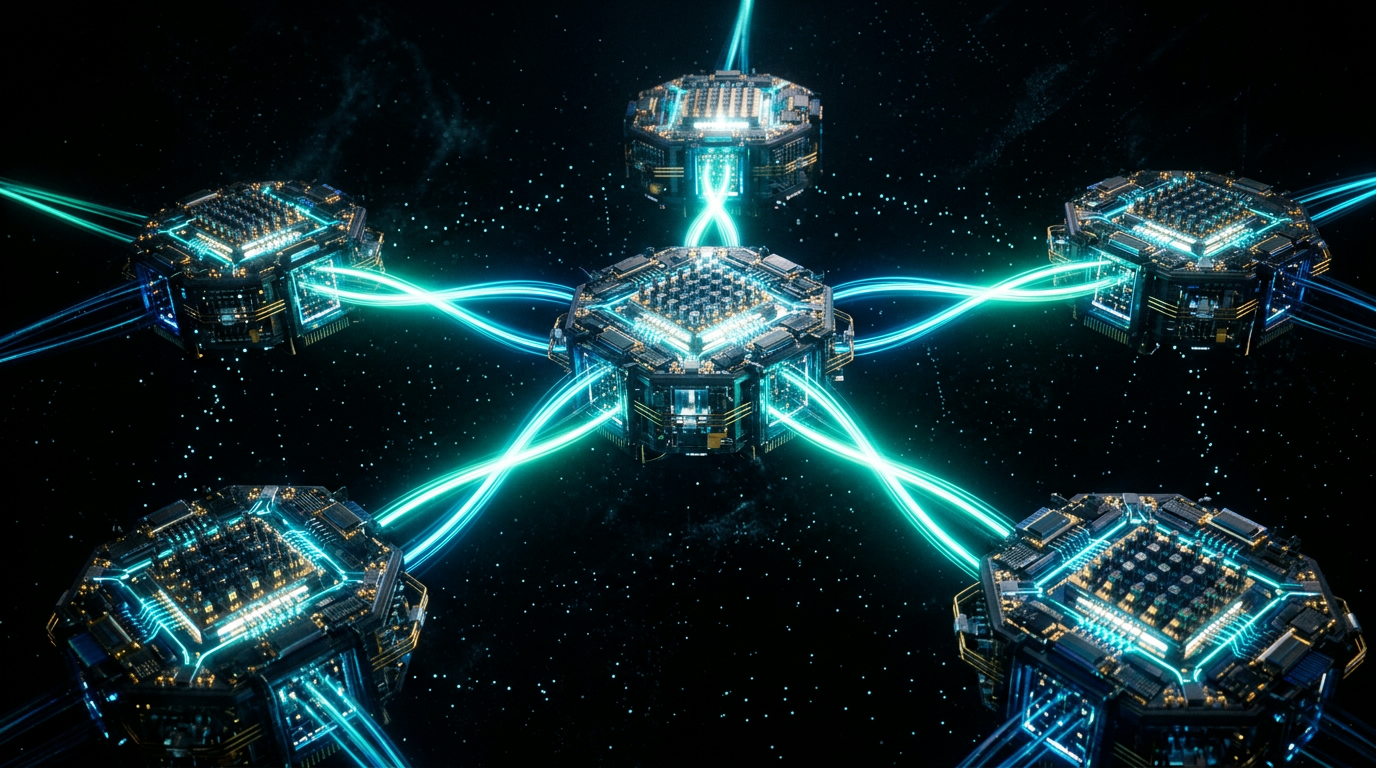
[IMAGE: A macro-perspective render of multiple quantum processor nodes interconnected by luminous entangled photon beams in a star network topology, set against a deep black background with cyan and teal light refractions, 8K cinematic quality, no text or human figures]
Key Takeaways
- The [[144,12,12]] bivariate bicycle (BB) code encodes 12 logical qubits at distance 12 using only 144 physical qubits — a dramatically higher encoding rate than planar surface codes of comparable distance
- Researchers have demonstrated that BB code qubits can be partitioned across 4, 6, or 12 networked quantum processors using shared Bell pairs, removing the monolithic-device bottleneck that previously constrained qLDPC deployment
- Modular quantum architectures using trapped ion or neutral atom platforms could accelerate fault-tolerant quantum computing timelines by 2–4 years beyond monolithic-device projections, compressing your window for post-quantum migration
Why Modular Quantum Computing Changes Your Threat Model
Your current post-quantum migration roadmap almost certainly assumes a specific timeline: fault-tolerant quantum computers capable of running Shor’s algorithm at cryptographically relevant scale remain 10–15 years away, gated by the engineering challenge of building monolithic devices with millions of low-error physical qubits. That assumption is now under pressure.
A June 2025 paper on arXiv (arXiv:2605.04663v1) demonstrates that bivariate bicycle (BB) codes — a class of quantum low density parity check (qLDPC) codes — can be distributed across a network of smaller, interconnected quantum processors without sacrificing the error-correction properties that make them attractive. If networked processors running distributed error correction can substitute for a single large monolithic device, the hardware engineering problem changes shape entirely. Smaller, near-term processors on trapped ion or neutral atom platforms become viable building blocks for fault-tolerant quantum computing sooner than current roadmaps anticipate.
For a CISO planning a 5-year PQC migration, “sooner than anticipated” is not an abstraction — it is a direct threat to the validity of your current timeline assumptions.
What Bivariate Bicycle Codes Actually Are
Definition: Bivariate bicycle (BB) codes are a family of quantum low density parity check (qLDPC) codes defined by a two-variable polynomial structure over a finite group. Unlike planar surface codes — where each physical qubit participates in only local stabilizer checks with its nearest neighbors — BB codes have stabilizers that connect physically distant qubits. This long-range structure is precisely what gives BB codes their high encoding rate, but it also makes them difficult to implement on monolithic hardware with nearest-neighbor connectivity constraints.
The encoding rate advantage is significant. The [[144,12,12]] BB code encodes 12 logical qubits with a code distance of 12 using 144 physical qubits. A planar surface code achieving the same distance-12 protection encodes only 1 logical qubit and requires approximately 288 physical qubits. The BB code therefore delivers 12× the logical qubit yield at roughly half the physical qubit cost per logical qubit — a resource efficiency that directly affects how many physical qubits a fault-tolerant quantum computer needs to threaten RSA-2048 or elliptic curve cryptography.
“Quantum low density parity check (qLDPC) codes, particularly bivariate bicycle (BB) codes, achieve competitive fault tolerance thresholds while offering substantially higher encoding rates than planar surface codes.” — arXiv:2605.04663v1
The Distributed Architecture: How It Works
The core engineering barrier to BB codes has always been their long-range stabilizer structure. A monolithic quantum processor with nearest-neighbor connectivity — the dominant architecture in superconducting qubit systems — cannot natively implement the nonlocal gates that BB code stabilizers require without expensive SWAP overhead that degrades logical error rates.
The research at arXiv:2605.04663 resolves this by distributing the BB code across multiple quantum processors connected through a star network architecture. Each processor handles a local subset of the code’s physical qubits. Nonlocal stabilizer operations — the ones that cross processor boundaries — are mediated by pre-shared Bell pairs, the standard resource for distributed quantum computation.
Star Network Architecture
In the star topology described, a central node coordinates entanglement distribution to peripheral processor nodes. Each peripheral processor maintains all-to-all internal connectivity, a property feasible on trapped ion platforms (where laser pulses can address any qubit pair) and neutral atom platforms (where optical tweezers enable reconfigurable connectivity). The [[144,12,12]] BB code’s physical qubits are partitioned across 4, 6, or 12 such processors, with the research analyzing logical error rates and pseudo-threshold performance under circuit-level noise for each configuration.
Noise Model and Nonlocal Operations
The analysis applies a scaling factor to capture the additional noise introduced by nonlocal inter-processor gates relative to local gates. This is the critical engineering variable: the fidelity and generation rate of the shared Bell pairs determine how much the distributed architecture degrades logical error performance compared to an ideal monolithic implementation. The paper uses Monte Carlo simulations with BP+OSD (belief propagation plus ordered statistics decoding) to evaluate performance under circuit-level noise — the most realistic noise model for near-term hardware.
[IMAGE: Diagram-style render of a star network of glowing quantum processor nodes exchanging entangled photon pairs, deep black background, teal accent lighting, macro cinematic perspective]
Comparison: Surface Codes vs. BB Codes in Distributed Settings
| Property | Planar Surface Code | [[144,12,12]] BB Code |
|---|---|---|
| Physical qubits per logical qubit (distance 12) | ~288 | 12 |
| Logical qubits encoded | 1 | 12 |
| Stabilizer locality | Nearest-neighbor (local) | Long-range (nonlocal) |
| Monolithic hardware compatibility | High | Low |
| Distributed architecture compatibility | Moderate | High (with Bell pair mediation) |
| Decoding algorithm | Minimum weight matching | BP+OSD |
| Target hardware platforms | Superconducting qubits | Trapped ion, neutral atom |
| Encoding rate | Low | Substantially higher |
The table makes the trade-off explicit: surface codes are easier to build on today’s dominant superconducting hardware but require far more physical qubits per logical qubit. BB codes demand a distributed or all-to-all-connected architecture but deliver dramatically better resource efficiency. The distributed BB code work closes the implementation gap.
The distributed BB code architecture transforms a hardware incompatibility problem into a networking problem — and networking problems have known engineering solutions.
Regulatory and Industry Implications
NIST Timelines Are Built on Monolithic Assumptions
NIST finalized its first three post-quantum cryptographic standards in August 2024 — ML-KEM (CRYSTALS-Kyber), ML-DSA (CRYSTALS-Dilithium), and SLH-DSA (SPHINCS+) — with migration guidance targeting completion by 2030 for most federal systems. That guidance implicitly assumes that cryptographically relevant quantum computers remain beyond the 2030 horizon on monolithic-device timelines.
Distributed qLDPC architectures introduce a variable that NIST’s timeline models did not fully account for: the possibility that networked smaller processors, each individually buildable with near-term technology, could collectively achieve fault-tolerant computation earlier than a single large monolithic device. Organizations treating 2030 as a comfortable deadline should reassess that assumption.
Who Is Moving and Who Is Lagging
Trapped ion quantum computing companies — including IonQ and Quantinuum — already operate processors with all-to-all internal connectivity, the exact property the distributed BB code architecture requires. Neutral atom platforms from companies such as QuEra and Pasqal offer reconfigurable connectivity suited to the same approach. These are not theoretical future platforms; they are commercially available today, albeit at qubit counts below what cryptographically relevant computation requires.
The distributed BB code research provides a concrete architectural path for scaling these platforms toward fault tolerance without waiting for monolithic qubit count milestones. Enterprises in financial services, defense contracting, and critical infrastructure — sectors where encrypted data has long shelf-life value — face the highest exposure from an accelerated timeline.
The Cost of Waiting
Organizations that delay PQC migration until quantum hardware milestones become undeniable face two compounding costs. First, the technical migration cost itself: auditing TLS certificate chains, replacing RSA and ECC key exchange in every application, updating HSM firmware, and renegotiating vendor contracts for PQC-compatible cryptographic libraries. Second, the compliance cost: regulators in the EU (under DORA and NIS2) and the US (under CISA’s PQC guidance) are already issuing migration mandates with enforcement teeth. Late movers pay both costs simultaneously under time pressure.
The BeQuantum Perspective
The distributed BB code architecture is architecturally significant for a specific reason that goes beyond academic interest: it converts the quantum threat from a single-point hardware milestone into a distributed systems engineering problem. Security teams that have been monitoring qubit count announcements from IBM, Google, and others as their primary threat indicator now need to add a second monitoring track — the maturation of quantum networking infrastructure, specifically Bell pair generation fidelity and distribution rates across multi-node architectures.
At BeQuantum, our PQC Layer is designed to operate independently of assumptions about quantum hardware timelines. Rather than betting on a specific “Q-Day” date, the architecture assumes that cryptographically relevant quantum capability could emerge from unexpected directions — including modular approaches like distributed BB codes — and maintains continuous cryptographic agility as the default posture.
For organizations using BeQuantum’s Digital Notary for document and transaction verification, the distributed qLDPC development reinforces the case for hybrid classical-PQC signature schemes today. A document notarized with a hybrid ML-DSA plus classical ECDSA signature remains verifiable and legally defensible regardless of which quantum hardware architecture matures first. The IceCase hardware security module supports ML-KEM and ML-DSA natively, enabling organizations to begin issuing PQC-protected credentials without waiting for full infrastructure migration.
The practical question for security architects is not “when will quantum computers break RSA?” but “how do I ensure my cryptographic infrastructure remains valid across a range of quantum hardware timelines, including accelerated ones?” Distributed BB code research moves the accelerated scenario from speculative to technically grounded.
What Your Security Team Should Do in the Next 90 Days
Step 1: Audit your cryptographic inventory for long-lived data (within 30 days) Identify all data encrypted with RSA or ECC that must remain confidential beyond 2030. This includes archived communications, long-term contracts, patient records, and any data subject to regulatory retention requirements. These are your highest-priority migration targets because adversaries can harvest ciphertext today and decrypt it when quantum capability arrives — a “harvest now, decrypt later” attack that is already underway against high-value targets.
Step 2: Accelerate TLS and key exchange migration to ML-KEM (within 60 days) ML-KEM (CRYSTALS-Kyber) is NIST-standardized and supported in OpenSSL 3.x, BoringSSL, and major cloud TLS termination services. Migrating key exchange first protects forward secrecy for data in transit without requiring full PKI overhaul. Prioritize external-facing APIs, VPN gateways, and any service that handles authentication tokens.
Step 3: Establish a quantum threat intelligence feed that monitors hardware milestones across modular architectures (within 90 days) Your threat model needs to track not just qubit count announcements but also Bell pair fidelity benchmarks, quantum networking demonstrations, and distributed error correction results — the leading indicators of modular quantum computing progress. The distributed BB code research is exactly the type of development that should trigger a timeline reassessment in your security roadmap.
Frequently Asked Questions
Q: Does distributed quantum error correction mean fault-tolerant quantum computers are imminent? A: No — the research demonstrates architectural feasibility, not near-term deployment. Significant engineering challenges remain, including achieving sufficient Bell pair fidelity at scale, managing classical decoding latency for BP+OSD in real time, and building quantum networks with the required connectivity and throughput. However, the research removes a previously assumed fundamental barrier, which is why it matters for long-range security planning.
Q: If my organization has already started PQC migration, does this change my priorities? A: It reinforces rather than changes them. Organizations already migrating to ML-KEM and ML-DSA are on the right path. The distributed BB code development strengthens the case for completing migration faster and for prioritizing hybrid schemes — classical plus PQC — that remain secure regardless of which quantum hardware timeline materializes. It also argues for not treating 2030 as a hard deadline with comfortable slack.
Q: Are trapped ion and neutral atom platforms the only hardware that can implement distributed BB codes? A: They are the most natural fit because they offer all-to-all internal connectivity within a single processor, which the distributed BB code architecture assumes. Superconducting qubit processors with nearest-neighbor connectivity could potentially participate in a distributed BB code network, but would require additional SWAP overhead for intra-processor nonlocal operations, degrading performance. The research specifically targets trapped ion and neutral atom platforms as the feasible near-term implementation path.