Key Takeaways
- An FPGA-integrated neural-network decoder achieves 550 ns deterministic closed-loop latency — with the NN decode step alone completing in 124 ns — enabling real-time surface-code error correction within a 1.25 µs QEC cycle (arXiv:2605.04892)
- Real-time decoding on a superconducting quantum processor at distance-3 surface code now matches the logical performance of offline decoding, removing a critical bottleneck on the path to fault-tolerant quantum computing
- For security architects: this research compresses the timeline to cryptographically relevant quantum computers, making 2025 the last comfortable year to begin a post-quantum cryptography migration — not the year to plan one
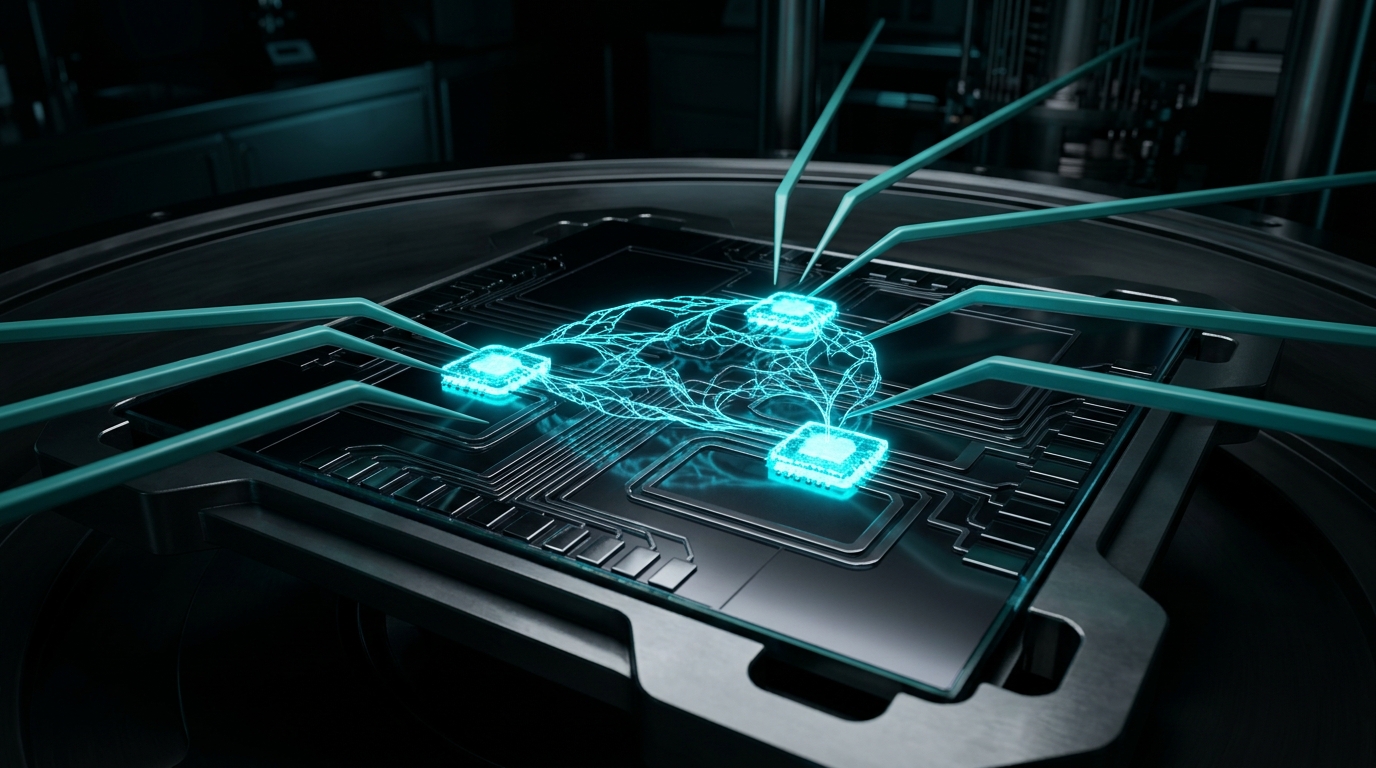
[IMAGE: Macro shot of a superconducting quantum processor chip with entangled cyan light beams threading between qubit nodes, FPGA circuit board visible beneath in deep shadow, cinematic teal accent lighting, 8K dark futuristic aesthetic]
Last updated: June 2025
The Bottleneck That Was Keeping Quantum Computers Theoretical
Picture your organization’s PKI infrastructure — every TLS handshake, every code-signing certificate, every VPN tunnel — protected by RSA-2048 or ECDSA. The standard assumption baked into most enterprise security roadmaps is that cryptographically relevant quantum computers remain a decade away. That assumption rests, in part, on one stubborn engineering problem: quantum error correction has been too slow to run in real time.
Quantum processors make errors constantly. Without correcting those errors faster than they accumulate, a quantum computer cannot sustain the coherent computation needed to run Shor’s algorithm at scale. Classical decoders — the software that infers errors from syndrome measurements and issues corrections — have historically lagged behind the quantum hardware’s operating cycle. The result: researchers ran decoding offline, after the fact, which works for experiments but not for the sustained, fault-tolerant computation that threatens public-key cryptography.
Researchers publishing on arXiv (2605.04892) have now closed that gap. Their FPGA-integrated neural-network decoder operates with a deterministic closed-loop latency of 550 ns, fitting comfortably inside a 1.25 µs QEC cycle on a superconducting quantum processor. The neural-network decode step itself completes in 124 ns. Real-time performance now matches offline decoding quality — and that changes the threat calculus for every CISO still treating post-quantum migration as a future-budget problem.
Technical Deep-Dive: How 124 Nanoseconds Changes Everything
Surface Codes and the Decoding Problem
Quantum error correction (QEC) is the discipline of detecting and correcting errors in quantum systems without directly measuring — and thereby collapsing — the quantum state being protected. In stabilizer-based codes such as the surface code, qubits are arranged in a lattice. Ancilla qubits measure syndromes — parity checks that reveal whether errors have occurred on neighboring data qubits — without revealing the underlying quantum information itself.
The decoder’s job: take a stream of syndrome measurements, infer the most likely error pattern, and issue a correction before the next syndrome round begins. At a 1.25 µs QEC cycle, the decoder has less than one microsecond to complete this inference loop. Miss the window, and errors accumulate faster than corrections can suppress them — a condition called decoder backlog that causes logical error rates to diverge.
The FPGA Neural-Network Architecture
The research team embedded a trained neural network directly onto an FPGA, creating a hardware-integrated control architecture that eliminates the latency penalty of CPU-based or GPU-based decoding. Key performance parameters:
| Parameter | Value |
|---|---|
| Closed-loop deterministic latency | 550 ns |
| Neural-network decode step | 124 ns |
| QEC cycle duration | 1.25 µs |
| Surface code distance | 3 (distance-3) |
| Target processor type | Superconducting quantum processor |
| Correction mechanism | Pauli-frame updating + mid-circuit feedback |
The 550 ns total latency budget covers syndrome acquisition, NN inference, and issuing the correction back to the quantum processor — all deterministically, with no jitter that would invalidate timing guarantees.
Clifford vs. Non-Clifford Circuits: Why Mid-Circuit Feedback Matters
For Clifford logical circuits, Pauli-frame updating — tracking corrections in classical software without physically applying gates — suffices. The correction is applied conceptually and reconciled at readout. This is computationally cheap and well-understood.
Non-Clifford logical circuits break this assumption. Operations like the T-gate cannot be absorbed into a Pauli frame; the correction must be physically applied to the quantum state mid-computation before the next non-Clifford gate executes. The research demonstrates exactly this: mid-circuit feedback correction in non-Clifford logical circuits, with the FPGA decoder issuing physical corrections within the 1.25 µs cycle.
“Our results establish a low-latency hardware architecture for embedded QEC control and provide a pathway towards scalable fault-tolerant quantum computing systems.” — arXiv:2605.04892
This is the critical distinction. Previous demonstrations of real-time QEC were limited to Clifford circuits, where Pauli-frame tricks masked the latency problem. Non-Clifford capability means the architecture supports the full gate set required for universal fault-tolerant quantum computation — including the algorithms that break RSA and elliptic-curve cryptography.
Comparison: Offline Decoding vs. Real-Time FPGA-NN Decoding
| Capability | Offline Decoding | FPGA Neural-Network (arXiv:2605.04892) |
|---|---|---|
| Decode latency | Post-hoc (unbounded) | 124 ns (deterministic) |
| Closed-loop latency | N/A | 550 ns |
| Fits within QEC cycle | No | Yes (1.25 µs cycle) |
| Non-Clifford circuit support | Limited | Demonstrated |
| Logical error rate vs. offline | Baseline | Comparable |
| Scalability path | Research only | Hardware-integrated |
| Deployment context | Lab experiments | Embedded control systems |
The logical performance parity with offline decoding is the headline result. It means the neural network is not trading accuracy for speed — it achieves both simultaneously.
Industry Context: What This Compresses
The NIST Timeline Just Got More Urgent
NIST finalized its first three post-quantum cryptographic standards in August 2024: ML-KEM (CRYSTALS-Kyber), ML-DSA (CRYSTALS-Dilithium), and SLH-DSA (SPHINCS+). NIST has set a deprecation target for RSA and ECC in federal systems by 2030, with a hard cutoff recommended by 2035.
Those timelines were calibrated against estimates of when fault-tolerant quantum computers would become practical. Each engineering milestone — like real-time QEC with sub-microsecond latency — pulls that estimate forward. Organizations that planned to begin migration in 2027 or 2028 are now operating with less margin than their roadmaps assumed.
Who Is Moving and Who Is Lagging
Google, IBM, and Microsoft have each published quantum error correction milestones in the past 18 months, signaling that the race to fault tolerance is accelerating across the industry. Financial services and defense contractors — sectors with the longest cryptographic asset lifetimes — face the highest exposure from delayed migration. A certificate issued today with a 10-year validity window could be decrypted by a fault-tolerant quantum computer before it expires.
The FPGA-NN decoder research does not represent a commercial quantum computer. Distance-3 surface codes protect a single logical qubit with limited error suppression. Scaling to the thousands of logical qubits needed for cryptographically relevant computation requires solving additional engineering challenges the paper does not address — including decoder performance at distance-5, distance-7, and beyond, and the absence of benchmarks against minimum-weight perfect matching decoders.
But the trajectory is unambiguous. Each paper like this one removes a previously cited reason why fault-tolerant quantum computing remains impractical.
The Economic Case for Acting Now
A 2024 analysis by the Global Risk Institute estimated that organizations with large cryptographic estates — financial institutions, healthcare networks, critical infrastructure operators — face migration costs that scale nonlinearly with delay. Migrating TLS infrastructure across 10,000 endpoints in 2025 costs roughly the same as migrating 2,000 endpoints in 2029, because late-stage migrations require emergency procurement, compressed testing cycles, and regulatory penalty exposure.
The cost of inaction is not hypothetical future breach risk alone. It includes the compliance burden of demonstrating cryptographic agility to auditors under frameworks like CMMC 2.0, FedRAMP, and the EU’s NIS2 Directive — all of which are beginning to reference NIST PQC standards explicitly.
The BeQuantum Perspective: Embedded QEC as a Migration Accelerant
The FPGA-NN decoder paper matters to BeQuantum’s clients not because quantum computers are here, but because the engineering gap between “experimental” and “cryptographically relevant” is narrowing faster than enterprise migration programs are moving.
BeQuantum’s PQC Layer is designed around exactly this threat model: the assumption that the migration window is measured in years, not decades, and that cryptographic agility — the ability to swap algorithms without re-architecting systems — is a first-order requirement, not a nice-to-have.
The specific lesson from arXiv:2605.04892 is architectural: the researchers solved a hard real-time constraint by moving the decoder into the hardware control loop, eliminating the latency penalty of external processing. Security architects face an analogous challenge when integrating PQC into existing systems — the temptation is to bolt post-quantum algorithms onto existing TLS stacks as an external layer, which introduces latency, complexity, and new attack surface.
BeQuantum’s approach mirrors the embedded architecture philosophy: PQC primitives integrated at the protocol layer, not appended above it. The Digital Notary service applies this to content authenticity — ML-DSA signatures are generated and verified within the signing pipeline, not as a post-processing step that can be bypassed or delayed.
For organizations evaluating hardware security modules for long-lived key material, the IceCase hardware platform provides a migration path that supports both classical and post-quantum key storage simultaneously — critical for hybrid deployment periods where both algorithm families must coexist.
The embedded QEC control architecture demonstrated in this research is a template for how security infrastructure must evolve: latency-sensitive operations belong in hardware, not in software layers that introduce unpredictable delays and failure modes.
What You Should Do in the Next 90 Days
Step 1: Audit your cryptographic asset inventory for algorithm and validity-period exposure. Within 30 days, identify every certificate, key exchange mechanism, and signing operation in your environment that relies on RSA or ECC. Flag any asset with a validity period extending beyond 2030. These are your highest-priority migration targets. Tools like NIST’s National Cybersecurity Center of Excellence (NCCoE) migration guides provide structured inventory frameworks.
Step 2: Test ML-KEM hybrid key exchange in your TLS 1.3 deployment. Within 60 days, deploy ML-KEM + ECDH hybrid key exchange on a non-production TLS endpoint. Measure the latency delta — ML-KEM key encapsulation adds approximately 0.1–0.3 ms to handshake time in software implementations, which is acceptable for most enterprise workloads. Identify any middleware or load balancers that reject extended ClientHello messages, as these represent hidden migration blockers.
Step 3: Establish a cryptographic agility policy before your next audit cycle. Within 90 days, document a formal cryptographic agility standard that specifies algorithm selection criteria, deprecation triggers, and migration SLAs. Regulators under CMMC 2.0 and NIS2 are beginning to request evidence of cryptographic governance, not just algorithm compliance. A written policy with version history demonstrates proactive posture.
Frequently Asked Questions
Q: Does a distance-3 surface code demonstration mean quantum computers can already break RSA?
A: No. A distance-3 surface code protects a single logical qubit with modest error suppression. Breaking RSA-2048 requires thousands of error-corrected logical qubits operating for extended periods — a scale that demands distance-7 or higher surface codes and engineering advances not yet demonstrated. The significance of this research is directional: it removes a specific latency bottleneck that previously made real-time QEC impractical, advancing the overall engineering trajectory toward fault tolerance.
Q: How does real-time QEC latency relate to post-quantum cryptography adoption timelines?
A: Each engineering milestone in quantum error correction reduces the uncertainty range around when fault-tolerant quantum computers will become practical. Security architects should treat these milestones as evidence that the lower bound of the threat window is moving earlier, not that the threat is imminent. The prudent response is to accelerate PQC migration programs already underway and initiate ones that have not yet started — particularly for systems with long cryptographic asset lifetimes.
Q: Can FPGA-based neural-network decoders scale beyond distance-3 surface codes?
A: The research does not provide data on scalability beyond distance-3. As surface code distance increases, the syndrome measurement volume grows quadratically, and the decoder must process proportionally more data within the same latency budget. Whether the FPGA-NN architecture scales to distance-5 or distance-7 — the thresholds relevant for practical fault tolerance — remains an open research question. The absence of this data is a meaningful gap in the current results.