- QuIKS achieves near-zero key supply latency on a live QKD testbed while cutting buffer size more than 10x versus state-of-the-art heuristic schemes (arXiv:2604.09144v1)
- A two-phase adaptive control algorithm probes real-time application patterns and network conditions to size buffers dynamically, replacing static over-provisioning
- For CISOs, this directly addresses the cost and latency blockers that have kept information-theoretically secure QKD out of mainstream enterprise deployment
Why QKD Key Supply Latency Is Suddenly a Board-Level Issue
Your trading platform needs to encrypt a wire transfer. The QKD endpoint requests a fresh shared secret. The key buffer is empty because the last burst of traffic drained it, and the photonic layer is still regenerating material at its physical rate. The transaction stalls. Multiply that across thousands of sessions per second, and information-theoretically secure communication collapses into an operational liability.
That scenario is the central obstacle between Quantum Key Distribution (QKD) and real enterprise adoption. QKD guarantees keys whose security rests on physics rather than computational hardness — a genuinely distinct threat model from lattice-based PQC. But physics has a cost: key generation rates are bounded, and when applications demand keys faster than photons can deliver them, something has to absorb the mismatch.
That something is the key buffer. And until now, buffering has been the dirty secret holding QKD back.
The Buffering Trilemma
Operators have faced three bad options:
- Over-provision the buffer: guarantees availability but burns staggering volumes of precious key material sitting idle
- Under-provision: saves key resources but produces latency spikes when demand exceeds supply
- Use heuristic rules: the current state-of-the-art, and still prohibitively wasteful according to the QuIKS research team
For a CISO modeling quantum-safe migration, this trilemma translates to a hard budget question: how much QKD hardware do you need to provision to sustain a given application workload? Under heuristic buffering, the answer has been “uncomfortably much.”
Technical Deep-Dive: How QuIKS Reshapes Key Supply
QuIKS (Quantum Instant Key Supply) is documented in arXiv:2604.09144v1 as an instant key supply scheme built specifically for QKD networks. Its contribution is not a new quantum protocol — the underlying key generation remains whatever BB84, E91, or CV-QKD variant the hardware implements. What QuIKS changes is the orchestration layer above the photonic stack.
The Analytical Model
The paper introduces a novel analytical model that determines the minimum buffer size required to guarantee near-zero-latency key supply performance. This matters because prior work treated buffer sizing as an empirical tuning problem. QuIKS reframes it as a solvable optimization with a provable lower bound.
The practical consequence: you can now provision exactly the buffer you need, not the buffer you fear you might need.
The Two-Phase Control Algorithm
On top of the analytical model sits a lightweight two-phase control algorithm that:
- Probes real-time application patterns — observes the actual cadence and volume of key requests from encryption workloads
- Adjusts key relaying requests and buffer size dynamically — reshapes the buffer envelope based on current network conditions rather than worst-case assumptions
This is the architectural shift. Static heuristics assume pessimistic steady state. Adaptive control responds to what the network is actually doing right now.
QuIKS vs. Heuristic Buffering: The Numbers
| Dimension | Heuristic State-of-the-Art | QuIKS |
|---|---|---|
| Buffer sizing approach | Static, rule-based | Adaptive, model-driven |
| Key buffer size | Baseline (1x) | >10x reduction |
| Key supply latency | Variable, workload-dependent | Near-zero |
| Application awareness | None | Real-time probing |
| Network condition adaptation | Manual retuning | Continuous, automatic |
| Resource efficiency | Prohibitive key consumption | Ultra-low key resources |
“Experiments on a real QKD network testbed demonstrate that QuIKS achieves near-zero key supply latency while providing a more than 10-fold reduction in key buffer size compared to state-of-the-art schemes.” — QuIKS research team, arXiv:2604.09144v1
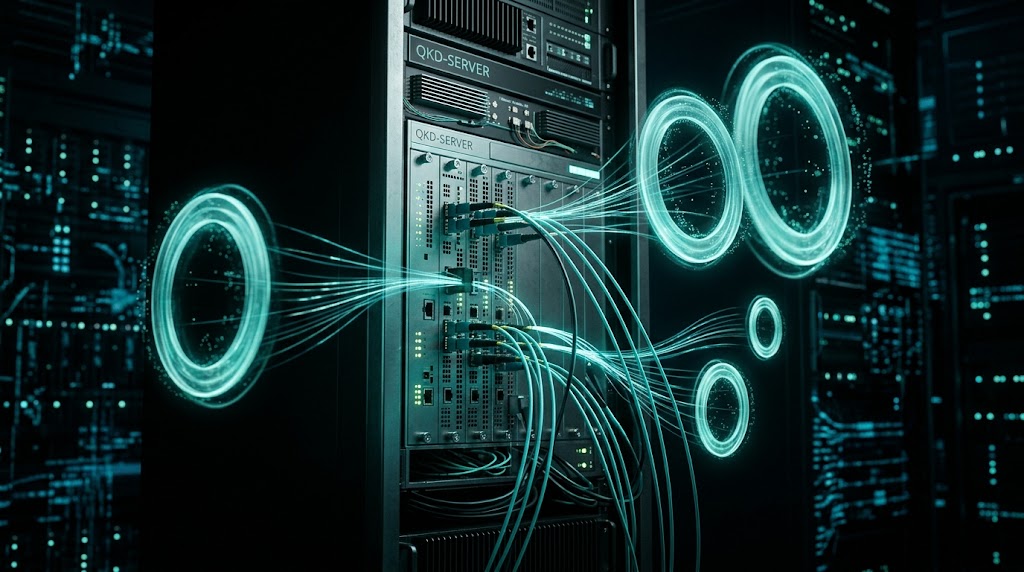
[IMAGE: macro photograph of a quantum key distribution rack with fiber optic cables glowing cyan, adaptive buffer visualization overlaid as translucent luminous rings, deep black background]
A caveat worth flagging: the preprint reports the 10x ratio but does not publish absolute buffer sizes in bits, exact latency figures in microseconds, or testbed topology details. Enterprises evaluating QKD procurement should request those specifics directly from vendors claiming QuIKS-style adaptive buffering.
Industry Context: Where This Lands in the Quantum-Safe Timeline
NIST finalized its initial post-quantum standards (ML-KEM, ML-DSA, SLH-DSA) in August 2024, and the migration guidance expects enterprise rollouts to accelerate through 2027-2030. That timeline dominates current CISO planning.
But PQC and QKD solve overlapping yet distinct problems. PQC gives you drop-in replacements for RSA and ECC with computational security assumptions. QKD gives you information-theoretic security for the narrow case of establishing shared secrets between two points connected by quantum-capable infrastructure. For high-value links — intra-datacenter, government backhaul, financial settlement rails — the two are complementary, not competitive.
The economic barrier to QKD adoption has always been the infrastructure-per-bit-of-security ratio. If QuIKS-style adaptive buffering genuinely cuts required buffer resources by an order of magnitude, the unit economics of QKD links shift materially. A bank that previously needed four QKD appliances per site to sustain its transaction load might need one.
The strategic implication: QKD stops being a research-grade novelty and starts being a line item on serious quantum-safe architecture reviews — particularly for organizations whose threat model includes “harvest now, decrypt later” against computationally-secure PQC.
The BeQuantum Perspective: Why Adaptive Orchestration Matters
At BeQuantum AI, our PQC Layer and Digital Notary stack are built on a simple observation: cryptographic primitives are only as useful as the orchestration around them. ML-KEM keys that can’t be delivered on time, QKD material that sits idle in over-provisioned buffers, hardware roots of trust that aren’t wired into application flow — all represent wasted cryptographic capacity.
QuIKS validates this orchestration thesis from the QKD side. The raw physics of photon-based key generation hasn’t changed. What changed is the control plane that sits between the photons and the application. That is exactly the design pattern we apply in hybrid deployments where classical TLS, PQC key encapsulation, and QKD-sourced keys need to coexist on the same data path.
Organizations planning quantum-safe architectures should scrutinize the orchestration layer of every vendor pitch. The question is not “do you support ML-KEM?” or “do you support QKD?” — it is “how does your control plane adapt key supply to real application patterns without over-consuming key material?”
What You Should Do Next
Within 90 days:
- Audit any existing QKD pilots for their buffering strategy. Ask vendors whether their key management system uses adaptive or heuristic buffer sizing, and request measured key-resource-per-session figures.
- Map your application portfolio against latency-sensitivity classes. Workloads that burst (settlement systems, trading) punish static buffering far worse than steady workloads (backup replication, logging).
Within 12 months:
- Incorporate adaptive key supply into QKD procurement requirements. Vendors shipping QuIKS-style controllers should be able to demonstrate sub-linear buffer growth under burst load.
- Run hybrid pilots that combine PQC (ML-KEM) at the application layer with QKD on critical trunk links, using orchestration layers that can fail over cleanly between sources.
FAQ
Q: Does QuIKS replace post-quantum cryptography like ML-KEM? A: No. QuIKS is a key supply optimization for QKD networks, not a cryptographic algorithm. QKD and PQC address different threat models — QKD provides information-theoretic security over quantum channels, while PQC provides computational security for general-purpose software. Most serious quantum-safe architectures will use both.
Q: Can QuIKS be retrofitted to existing QKD deployments? A: The arXiv preprint describes QuIKS as a control-layer scheme that sits above the photonic hardware, which suggests it could be deployed as a software or firmware upgrade to existing key management systems rather than requiring hardware replacement. Vendor-specific implementation details will determine actual retrofit feasibility.
Q: What’s the catch with a 10x buffer reduction? A: The paper does not publish absolute numbers, testbed topology, or scalability limits of the two-phase control algorithm. The 10x figure is measured against heuristic baselines that the paper characterizes as over-provisioned — so part of the improvement reflects how wasteful prior schemes were, not only how efficient QuIKS is. Independent benchmarking on diverse workloads is still needed.
Last updated: April 20, 2026