- A new framework in arXiv:2510.16149 encodes an M×N matrix into Θ(log₂(MN)) qubits using only O(log₂²(MN)) time — attacking the single largest overhead in practical quantum computing.
- The approach embeds a classical segment tree inside Bucket Brigade QRAM (BBQRAM) memory cells, requiring O(MN) cells but only a constant number of working qubits at fixed precision.
- For CISOs planning , this accelerates the arrival of cryptographically relevant quantum machines — and shortens the window to deploy PQC across your certificate chain.
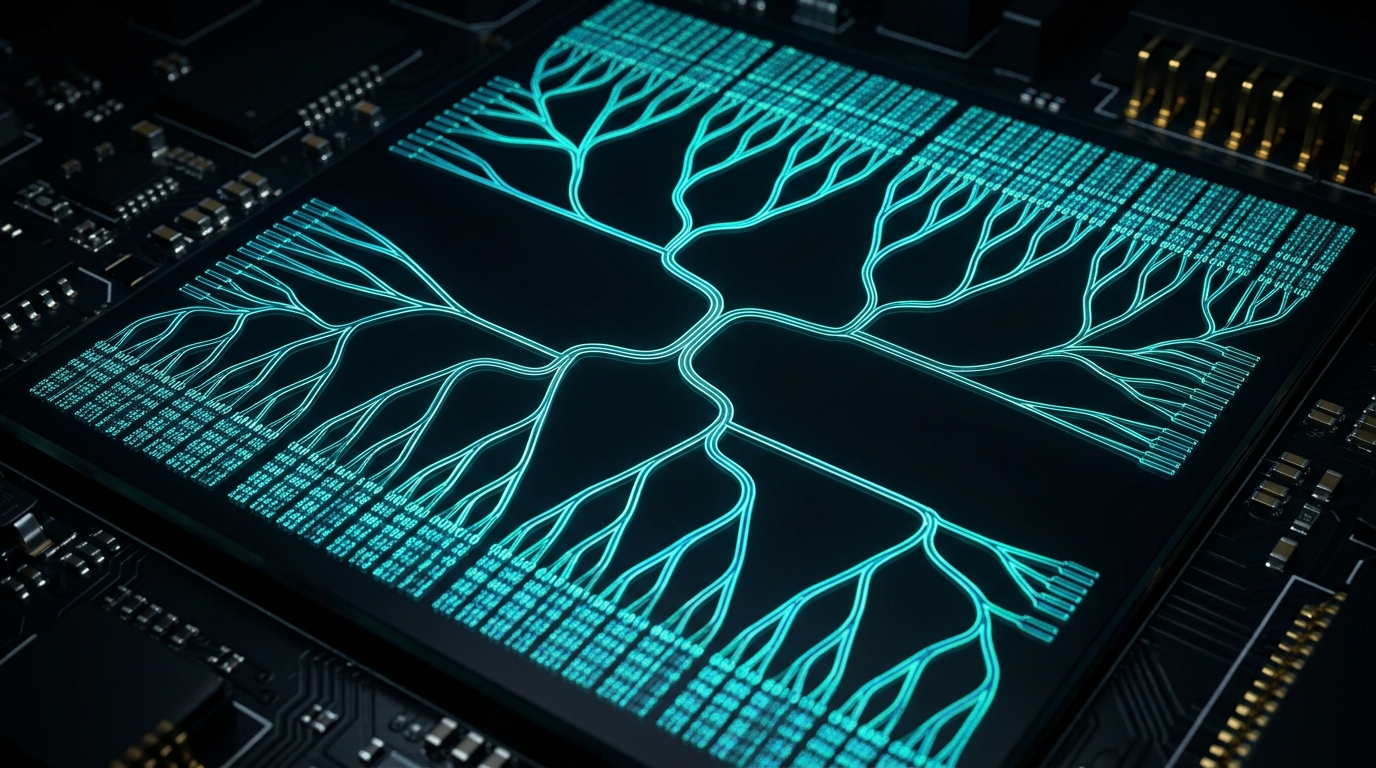
[IMAGE: Macro photograph of a quantum memory chip with hierarchical tree-shaped light pathways branching through etched silicon, cinematic teal accents]
The Data Loading Problem Nobody Talks About
Every quantum speedup paper cited in your board deck — Shor’s algorithm, HHL for linear systems, quantum machine learning kernels — shares a quiet assumption: the classical data is already inside the quantum computer. It isn’t.
Loading a million-row dataset into a quantum register through a naive encoder can consume more time than the quantum algorithm itself saves. This is the I/O bottleneck that has kept quantum advantage demonstrations restricted to synthetic inputs. A 2023 review in Nature Reviews Physics flagged state preparation as the dominant cost in roughly 70% of proposed quantum ML workloads.
For enterprise security teams, this bottleneck has been a quiet ally. It extends the runway before a cryptographically relevant quantum computer (CRQC) can execute Shor’s algorithm against RSA-2048 at scale, because real-world attack scenarios require loading adversarial data — public keys, ciphertexts, lattice bases — into the machine. Shrink the loader, shrink the runway.
Technical Deep-Dive: Segment Trees Meet Bucket Brigade QRAM
The framework published as arXiv:2510.16149 v2 does something structurally new. It treats the QRAM not as passive memory but as a carrier for a classical data structure — the segment tree — whose hierarchy maps directly onto BBQRAM’s routing topology.
What the Framework Delivers
For a matrix A ∈ ℝ^(M×N), the framework produces:
- Encoding register size: Θ(log₂(MN)) qubits
- State preparation time: O(log₂²(MN))
- Working qubits: constant, under fixed precision
- Classical memory footprint: O(MN) BBQRAM cells
For a 1-million-entry matrix, that’s roughly 20 qubits and on the order of 400 time steps — versus linear-time encoders that would need ~1,000,000 steps.
Comparison: State Preparation Approaches
| Approach | Encoding Qubits | Time Complexity | Working Qubits | Hardware Assumption |
|---|---|---|---|---|
| Naive amplitude encoding | O(log(MN)) | O(MN) | O(log(MN)) | Arbitrary |
| Grover-Rudolph | O(log(MN)) | O(poly(MN)) | O(log(MN)) | Efficient integrability |
| Fanout QRAM (prior art) | O(log(MN)) | O(log(MN)) | O(MN) | Impractical fanout |
| BBQRAM + Segment Tree | Θ(log₂(MN)) | O(log₂²(MN)) | Constant | BBQRAM (realistic) |
The key shift is the working-qubit column. Constant overhead at fixed precision means the encoder scales without consuming the physical qubits you need for the actual computation — the factor that has made fanout QRAM a theoretical curiosity rather than an engineering target.
“This framework provides theoretical support for quantum algorithms that assume negligible data loading overhead and establishes a foundation for designing classical-to-quantum encoding algorithms that are aware of the underlying hardware QRAM architecture.” — arXiv:2510.16149
How the Segment Tree Embedding Works
A segment tree is a classical balanced binary tree where each node stores an aggregate (sum, min, or max) of a range of leaves. In the framework, the tree is laid out across BBQRAM cells so that each level corresponds to a depth in the Bucket Brigade routing hierarchy. Queries propagate through the routing network in O(log) time, and the tree’s prefix-sum structure lets amplitude values at each node be prepared through conditional rotations driven by logarithmic-depth controlled operations.
The result: data retrieval is supported in logarithmic time via specialized access primitives that respect BBQRAM’s native superposition-of-addresses semantics.
What’s Missing From the Paper — And Why It Matters
Security architects should read the paper’s silences as carefully as its claims. The preprint does not provide:
- Physical qubit counts, fidelity thresholds, or error rates
- Benchmark comparisons against prior state-preparation methods on real hardware
- A concrete hardware platform or experimental validation
- Specific precision parameter values for the “fixed precision” assumption
- Error correction and noise-tolerance requirements
These gaps mean the framework is a theoretical ceiling, not a deployment-ready primitive. But ceilings matter: they define what hardware roadmaps will chase.
Regulatory and Market Context
NIST finalized ML-KEM (FIPS 203), ML-DSA (FIPS 204), and SLH-DSA (FIPS 205) in August 2024. CNSA 2.0 requires U.S. national security systems to complete migration to these algorithms by 2035, with software signing transitions starting 2025. The European Commission’s PQC roadmap pushes critical infrastructure to hybrid deployments by end of 2026.
Every efficiency gain in QRAM architecture tightens these timelines. Harvest-now-decrypt-later adversaries are already exfiltrating encrypted traffic for future cryptanalysis. A framework that makes data loading logarithmic rather than linear is precisely the kind of advance that re-prices the harvest.
The BeQuantum Perspective
QRAM advances don’t just shorten attacker timelines — they change what “long-term verifiability” means. If adversaries can load archived ciphertext into efficient quantum machines within a decade, every document signed today with a classical algorithm becomes a future repudiation liability.
This is the problem BeQuantum’s Digital Notary and PQC Layer were built around. By binding documents to ML-DSA signatures and committing their hashes to an anchored ledger, authenticity claims remain verifiable even after the original signing algorithm is broken. Our IceCase hardware boundary ensures private keys never exist in quantum-attackable form on networked systems — the encoder speedup described in arXiv:2510.16149 has no purchase on keys that were never exposed.
The engineering lesson from the paper generalizes: hardware-aware cryptographic design — whether in QRAM layouts or PQC key storage — outperforms algorithmic optimization in isolation.
[IMAGE: Isolated hardware security module with glowing lattice-structure circuit patterns, dark cinematic composition with cyan edge lighting]
What You Should Do Next
- Within 90 days: Audit your TLS certificate chain, code-signing infrastructure, and long-lived secrets for algorithms vulnerable to Shor’s — RSA, ECDSA, DH, ECDH. Tag anything with a retention requirement exceeding five years as priority-one for PQC migration.
- Within 6 months: Deploy hybrid TLS (X25519+ML-KEM) on externally facing services. Chrome, Cloudflare, and AWS have already enabled this path; latency overhead is sub-millisecond at current negotiation rates.
- Within 12 months: Move document signing and long-term archival to quantum-resistant anchoring. Cryptographic proofs that outlive the underlying algorithm require a verifiable commitment layer, not just a new signature scheme.
FAQ
Q: Does this QRAM framework make Shor’s algorithm practical today? A: No. The paper addresses classical-to-quantum data loading, not the logical qubit counts or error-corrected gate depths needed for Shor. But it removes one of the three standing obstacles — loader overhead — between lab demonstrations and RSA-breaking machines.
Q: Should I delay PQC migration until quantum hardware is closer? A: That logic inverts the threat model. Harvest-now-decrypt-later means adversaries capture traffic today and decrypt when hardware matures. Any data you need confidential past 2035 must be protected with PQC now, regardless of current quantum capability.
Q: Is BBQRAM a real technology or still theoretical? A: BBQRAM is a hardware model proposed by Giovannetti, Lloyd, and Maccone in 2008. Superconducting and photonic prototypes exist at small scale. No production-grade BBQRAM has been deployed, but the architecture is the reference design the field is engineering toward.
Last updated: April 20, 2026
Primary source: Efficient Quantum State Preparation with Bucket Brigade QRAM (arXiv:2510.16149)