Key Takeaways
- A simulation-only study (arXiv:2605.00026) benchmarked four organic-material qubit paths across five quantum algorithms, finding statistically significant CQEC fidelity gains (p < 10⁻⁵) for all 16 path×algorithm pairs — including a peak fidelity improvement of ΔF = +0.303 for the Shor–Regev algorithm at code distance d = 64.
- Organic qubit platforms project 10–40× lower manufacturing costs and 10–200× lower power consumption than five unnamed competing platforms, with magnetic-field-free operation that could simplify data center integration — but zero laboratory fabrication data exists yet.
- If these projections survive experimental validation, your post-quantum cryptography migration timeline may compress: a lower-cost, lower-power path to cryptographically relevant quantum scale would accelerate the threat to RSA and ECC infrastructure still in production today.
Why This Research Lands on a CISO’s Desk
Your organization’s TLS certificates, VPN tunnels, and code-signing infrastructure almost certainly rely on RSA-2048 or ECC-256. Both are vulnerable to Shor’s algorithm running on a sufficiently large, fault-tolerant quantum computer. The open question — the one that drives every PQC migration timeline — is when that machine arrives and how much it costs to build.
A preprint published May 2025 (arXiv:2605.00026) proposes a framework for quantum computing in engineered organic materials that, if experimentally validated, could answer both questions in ways that compress your planning window. The paper benchmarks four material paths against five quantum algorithms, including the Shor–Regev algorithm — a variant of the algorithm that breaks RSA — and reports provable quantum advantage for the Bernstein–Vazirani algorithm at 7.6–31× over classical baselines.
This is simulation data, not a working machine. The distinction matters enormously, and we will be precise about what is proven versus projected throughout this analysis. But the directional signal is clear enough that security architects need to understand the mechanics now, before hardware validation forces a reactive scramble.
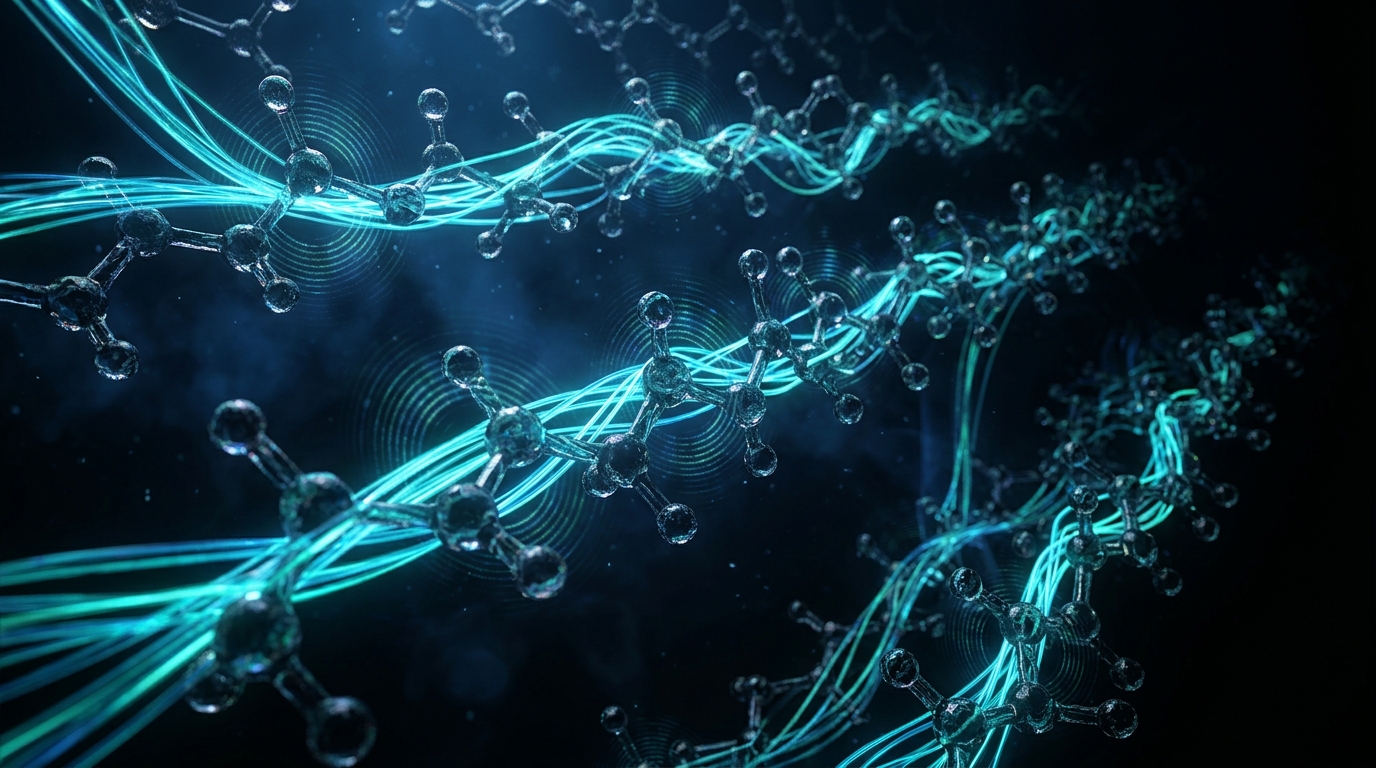
[IMAGE: Macro photograph of an organic molecular lattice structure with entangled cyan light beams threading through crystalline nodes, deep black background, cinematic lighting, 8K, no text]
What the Organic Qubit Framework Actually Proposes
Post-quantum cryptography (PQC) is the discipline of designing and deploying cryptographic algorithms that resist attacks from both classical and quantum computers. The threat model assumes an adversary with access to a fault-tolerant quantum computer capable of running Shor’s algorithm at cryptographically relevant scale — typically estimated to require thousands to millions of physical qubits depending on error correction overhead.
The arXiv:2605.00026 framework, built on the “3-Layer Quantum Brain Hypothesis” and the spin-vortex-induced loop-current (SVILC) qubit concept from Wakaura (2017), proposes four engineered organic material paths toward quantum computing:
- P1: Flavin–nitroxide radical-pair reservoir
- P2: Perchlorotriphenylmethyl (PTM) radical array in a covalent organic framework (COF)
- P3: SVILC analogue on κ-(BEDT-TTF)₂Cu[N(CN)₂]Br — conditional on experimental SVILC confirmation
- P4: Su–Schrieffer–Heeger soliton on trans-polyacetylene
All four paths are designed to operate without any applied magnetic field. The authors verify eight SVILC conditions across all four paths using a covariant-purification CQEC (Covariant Quantum Error Correction) simulator.
The Shor–Regev Result and What It Means for RSA
The most security-relevant finding: at code distance d = 64 and noise parameter γ = 0.5, the CQEC simulator produces a fidelity improvement of ΔF = +0.303 for the Shor–Regev algorithm. The authors state this directly confirms Petz recovery beyond the entanglement-breaking threshold — a theoretical milestone indicating the error correction framework can preserve quantum information through the noise levels relevant to this algorithm.
“Bernstein–Vazirani yields a provable quantum advantage: P2–P4 reach CQEC-corrected one-query success rates ≥0.95 versus classical 2⁻ⁿ, a 7.6–31× advantage for n=3–5 (toy-scale benchmark).” — arXiv:2605.00026
The Bernstein–Vazirani result is provable but toy-scale: n = 3–5 qubits, with a classical baseline of 2⁻ⁿ. Extrapolating this to RSA-2048 requires n in the thousands with full fault tolerance — a gap the paper does not bridge. No decoherence times (T1, T2), no qubit count roadmap, and no scalability analysis beyond n = 3–5 appear in the preprint.
Simulation vs. Reality: What the Data Actually Proves
Before any procurement or timeline decision, security architects need a clear map of what this research establishes versus what it projects.
| Claim | Status | Evidence Basis |
|---|---|---|
| CQEC gains statistically significant (p < 10⁻⁵) for all 16 path×algorithm pairs | Simulation-confirmed | Paired Wilcoxon tests, Bonferroni correction at α = 0.05/44, up to 100 trials |
| ΔF = +0.303 for Shor–Regev at d = 64 | Simulation-confirmed | CQEC simulator output |
| Bernstein–Vazirani quantum advantage 7.6–31× (n = 3–5) | Simulation-confirmed, toy-scale | One-query success rate ≥ 0.95 vs. classical 2⁻ⁿ |
| CZ gate fidelity F_CZ ≥ 0.987 for P2–P4 | Simulation-confirmed | Diarylethene photoswitch model |
| 10–40× lower manufacturing cost vs. competitors | Projected, unvalidated | No absolute cost figures; five competing platforms unnamed |
| 10–200× lower power consumption vs. competitors | Projected, unvalidated | No operating temperature data provided |
| P3 path functional | Conditional | Requires independent SVILC experimental confirmation — unresolved, no timeline |
| Magnetic-field-free operation | Framework claim | Undermined for P3 by unresolved SVILC status |
The statistical methodology is rigorous for a simulation study: Bonferroni-corrected Wilcoxon tests across 44 comparisons at α = 0.05/44 is a conservative threshold. The problem is that simulation fidelity and physical fabrication fidelity are different quantities. No laboratory has fabricated any of these four material paths. No T1 or T2 measurements exist. The MNIST and spike-prediction ML benchmarks are listed as tasks but no accuracy figures or comparison baselines appear in the extracted data.
The P3 path — the SVILC analogue on κ-(BEDT-TTF)₂Cu[N(CN)₂]Br — is included in the 16 statistically significant path×algorithm pairs despite being explicitly conditional on a phenomenon (SVILC) that has not been independently verified. Security teams should treat P3 projections as theoretical scaffolding, not near-term hardware.
Regulatory and Compliance Implications
NIST finalized its first three post-quantum cryptographic standards in August 2024: ML-KEM (CRYSTALS-Kyber), ML-DSA (CRYSTALS-Dilithium), and SLH-DSA (SPHINCS+). The U.S. Office of Management and Budget directed federal agencies to begin PQC migration inventories by 2025, with full migration targets extending to 2035 for most systems.
The organic qubit research does not change these deadlines — NIST’s timeline is driven by the possibility of cryptographically relevant quantum computers, not their confirmed existence. What the research does affect is the probability distribution over when that possibility becomes reality.
If manufacturing cost reductions of 10–40× and power reductions of 10–200× are experimentally validated over the next 3–5 years, the economic barrier to building large-scale quantum hardware drops substantially. More actors — including nation-state adversaries with constrained budgets — could reach cryptographic relevance faster than the 2030–2035 window most enterprise security roadmaps assume.
The compliance burden for organizations still running RSA-2048 or ECC-256 in long-lived certificates, encrypted archives, or hardware security modules (HSMs) is already real under current NIST guidance. This research adds a tail-risk argument for accelerating that migration rather than waiting for the 2035 deadline.
Who Is Moving and Who Is Lagging
Google reported migrating Chrome’s TLS stack to support X25519Kyber768 (a hybrid classical-PQC key exchange) in 2023. Cloudflare enabled post-quantum key exchange for all customers by default in 2024. Signal Protocol added PQXDH (Post-Quantum Extended Diffie-Hellman) in 2023.
Enterprise adoption lags consumer-facing infrastructure significantly. Organizations with large PKI estates, legacy VPN concentrators, or custom TLS implementations face migration paths measured in years, not months. The cost of inaction is not hypothetical: encrypted traffic captured today under “harvest now, decrypt later” strategies becomes readable the moment a sufficiently capable quantum computer exists.
The BeQuantum Perspective: What Organic Qubits Mean for Digital Notarization
At BeQuantum, our Digital Notary service timestamps and cryptographically anchors content authenticity records to blockchain infrastructure using ML-KEM and ML-DSA — the NIST-standardized algorithms. The organic qubit research is relevant to our threat model in two specific ways.
First, the Shor–Regev benchmark at d = 64 with ΔF = +0.303 demonstrates that CQEC frameworks can sustain the error correction fidelity needed for this algorithm class in simulation. When physical hardware reaches this fidelity at cryptographically relevant qubit counts, any content authenticity record anchored with classical cryptography becomes retroactively vulnerable. Our PQC Layer addresses this by ensuring all notarization operations use NIST-standardized post-quantum algorithms from day one — not as a future migration, but as the current default.
Second, the projected 10–200× power reduction for organic qubit platforms matters for the adversary model. Lower power consumption means quantum attacks become feasible in more deployment environments, including edge and mobile contexts. Our IceCase hardware security module is designed with this adversary capability expansion in mind, isolating key material in tamper-resistant hardware regardless of the cryptographic algorithm in use.
The honest assessment: organic qubit platforms are 3–7 years from experimental validation of even the most optimistic projections in this paper. But the security architecture decisions your organization makes in the next 90 days will still be in production when that validation arrives.
What Your Organization Should Do in the Next 90 Days
Step 1: Inventory your cryptographic attack surface (Days 1–30) Audit every TLS certificate, code-signing certificate, VPN configuration, and HSM key policy in your environment. Flag any RSA or ECC key material with a validity period extending past 2030. This inventory is required under current NIST guidance regardless of organic qubit developments — start now.
Step 2: Prioritize “harvest now, decrypt later” exposure (Days 30–60) Identify data classifications where confidentiality must hold for 10+ years: M&A communications, patient records, classified contracts, long-lived API credentials. These are your highest-priority migration targets. Encrypted archives from 2020–2024 are already potentially captured by adversaries with long-term decryption strategies.
Step 3: Pilot hybrid PQC key exchange on one external-facing service (Days 60–90) Deploy ML-KEM in hybrid mode (classical + post-quantum) on one TLS endpoint. Hybrid mode preserves classical security while adding post-quantum protection — it is the lowest-risk entry point for PQC migration and generates real operational data on performance overhead before you commit to full rollout.
FAQ
Q: Does the organic qubit research mean RSA is broken now? A: No. The Shor–Regev benchmark in arXiv:2605.00026 is a simulation result at code distance d = 64 with no physical hardware fabricated. Breaking RSA-2048 requires thousands of logical qubits with fault tolerance that no existing or near-term system provides. The research is a directional signal about the cost trajectory of future quantum hardware, not evidence of an immediate threat.
Q: Should we wait for experimental validation before starting PQC migration? A: No. NIST finalized ML-KEM, ML-DSA, and SLH-DSA in August 2024. Federal agencies face mandatory migration timelines. More importantly, “harvest now, decrypt later” attacks mean adversaries may already be collecting your encrypted traffic for future decryption. Migration should begin with your highest-sensitivity, longest-lived data assets immediately — organic qubit timelines are irrelevant to that calculus.
Q: What is the biggest gap in this organic qubit research that security teams should track? A: The absence of any decoherence time (T1, T2) data or scalability roadmap beyond n = 3–5 qubits. Quantum advantage at toy scale does not extrapolate linearly to cryptographic scale. Watch for peer-reviewed experimental fabrication results for P1 (flavin–nitroxide) or P2 (PTM radical array in COF) — those are the two paths without the SVILC confirmation dependency and therefore the most likely to yield near-term laboratory results.