
Key Takeaways
- A new channel-wise separable framework (arXiv:2604.03951) decouples surface chemistry from device geometry in superconducting transmon qubit decoherence — enabling independent optimization of each loss pathway for the first time
- Five prescriptor classes now define the dominant loss pathways in transmon-class devices, with falsifiability enforced through a pre-committed 2×2 experimental protocol and independent ratio checks within propagated uncertainty
- For organizations building quantum-safe infrastructure, qubit coherence time directly determines the viability of quantum key distribution (QKD) hardware and the attack surface of future cryptanalytic systems — making this framework a material input to your 3–5 year PQC migration planning
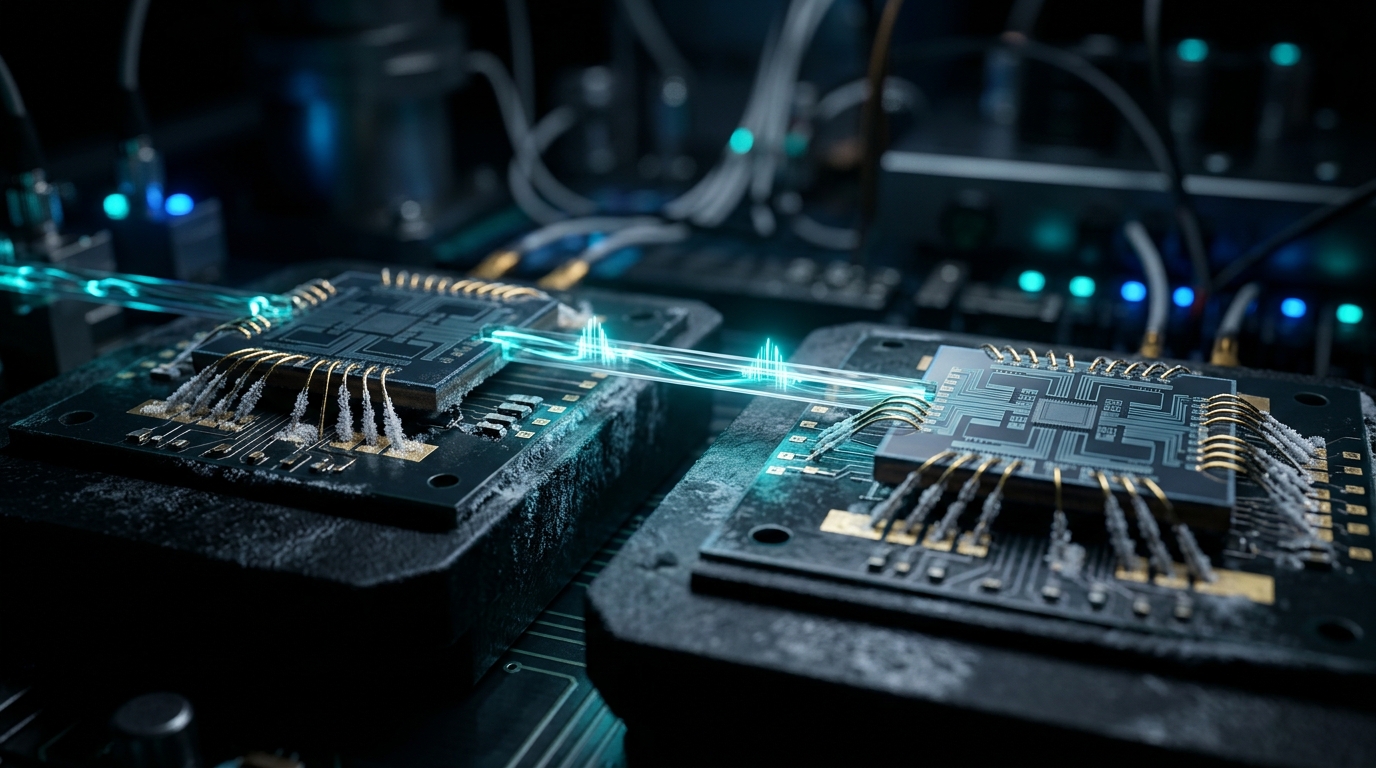
[IMAGE: Macro photograph of a superconducting transmon qubit chip with entangled cyan light beams emanating from junction points, set against a deep black background with teal circuit traces, cinematic 8K lighting revealing microstructural surface topology]
Why Qubit Decoherence Is a Security Architecture Problem
Consider this scenario: your organization deploys a quantum key distribution node in 2027, sourced from a hardware vendor whose qubits achieve T1 coherence times of 50 microseconds under lab conditions. Six months into production, cross-talk between loss channels — surface chemistry degradation interacting with geometric coupling — drops effective coherence to 18 microseconds. Your QKD link error rate climbs past the threshold where eavesdropping becomes statistically undetectable. You have not been breached by a cryptographic attack. You have been breached by materials science.
This is not a hypothetical edge case. It reflects a structural problem that researchers publishing under arXiv:2604.03951 describe as mechanistic attribution in current decoherence research being structurally underdetermined. When process interventions simultaneously modify surface chemistry, microstructural topology, and device geometry, no existing framework can isolate which variable drove the coherence change. Security architects cannot audit what engineers cannot measure.
For CISOs planning quantum-safe infrastructure, this ambiguity is a compliance and procurement risk — not just a physics problem.
The Technical Problem: Why Decoherence Has Been Unmeasurable
Entangled Variables, Unauditable Outcomes
Superconducting transmon qubits lose coherence through multiple simultaneous channels: dielectric loss at material interfaces, two-level system (TLS) defects in surface oxides, quasiparticle poisoning, and radiative coupling to the electromagnetic environment. The challenge is not that these channels are unknown — it is that every fabrication intervention that improves one channel typically perturbs the others.
A team that etches a substrate surface to reduce TLS density also changes the geometric profile of the junction, altering how electromagnetic fields couple to residual loss sites. The resulting coherence improvement is real, but its cause is ambiguous. Reproduce the experiment at a different institution with nominally identical parameters and you may get a different result — because “identical parameters” does not mean identical microstructural topology.
This is what the authors of arXiv:2604.03951 mean by structurally underdetermined attribution: the experimental design cannot distinguish between competing mechanistic explanations, so knowledge does not accumulate reliably across laboratories.
The Separable Framework: Decoupling What Was Previously Coupled
The framework introduced in arXiv:2604.03951 — formally titled Microstructural Topology as a Prescriptor for Quantum Coherence: Towards A Unified Framework for Decoherence in Superconducting Qubits — addresses this by establishing a channel-wise separable representation of decoherence.
The core architectural decision is a product form: each loss channel is expressed as the product of two independently computable quantities.
“Predictive materials engineering requires measurable structural statistics to be separated from geometry-dependent coupling coefficients into independently testable factors.” — arXiv:2604.03951v1
In operational terms:
- The prescriptor: a reduced state variable capturing the channel-specific microstructural condition (surface chemistry, defect density, interface topology) — determined independently of device geometry
- The coupling functional: a geometry-dependent coefficient computable from electromagnetic field solutions, without reference to surface chemistry
The product form is derived from a spatially resolved kernel representation, and the framework establishes a perturbative separability criterion that defines the regime where independent variation of these two variables remains valid. Outside that regime, the separation breaks down and the framework flags the condition — a critical feature for experimental integrity.
Five Prescriptor Classes for Transmon-Class Devices
The framework specifies five prescriptor classes covering the dominant loss pathways in transmon-class devices. While the paper reserves the specific mathematical forms of each class for coordinated experimental validation in Part II, the classification itself enables a structured audit of loss contributions — analogous to how a CVE taxonomy enables structured audit of software vulnerabilities.
| Loss Channel Attribute | Current Practice | Separable Framework Approach |
|---|---|---|
| Attribution method | Post-hoc correlation of process changes to T1 shifts | Pre-committed prescriptor class assignment per channel |
| Cross-laboratory reproducibility | Low — geometry and chemistry co-vary | Higher — prescriptor and coupling functional vary independently |
| Falsifiability | Weak — no pre-registered prediction | Enforced — 2×2 protocol with ratio checks within propagated uncertainty |
| Materials optimization path | Empirical trial-and-error | Predictive — target prescriptor value for desired coupling outcome |
| Reporting standard | Institution-specific | Minimum-Dataset Specification (MDS) proposed |
The Minimum-Dataset Specification
The framework operationalizes reproducibility through a Minimum-Dataset Specification (MDS) — a pre-committed reporting standard that requires experimenters to document both the prescriptor state and the coupling functional independently before reporting coherence outcomes. This is the hardware equivalent of requiring cryptographic implementations to publish their parameter choices before publishing benchmark results.
Falsifiability is enforced through a 2×2 experimental protocol: variables must satisfy independent ratio checks within propagated uncertainty. If the ratios are inconsistent, the separability criterion has been violated and the result cannot be attributed to a single channel — a hard stop that prevents the kind of post-hoc rationalization that currently plagues decoherence literature.
Industry Context: What This Means for PQC Timelines
NIST Standardization and the Hardware Dependency
NIST finalized its first three post-quantum cryptographic standards in August 2024 — ML-KEM (CRYSTALS-Kyber), ML-DSA (CRYSTALS-Dilithium), and SLH-DSA (SPHINCS+). The compliance mandate for federal agencies to migrate critical systems is accelerating, with OMB guidance pushing agencies toward PQC-capable infrastructure by 2030.
What the compliance timeline does not address is the hardware layer beneath the cryptographic algorithms. Quantum computers capable of running Shor’s algorithm at cryptographically relevant scale require qubits with coherence times and gate fidelities that current superconducting hardware does not consistently achieve. The gap between laboratory demonstrations and production-grade quantum hardware is precisely the gap that decoherence attribution frameworks like arXiv:2604.03951 are designed to close.
For security architects, this creates a two-sided exposure:
- Offensive timeline uncertainty: If qubit coherence improvements accelerate due to better materials engineering frameworks, the timeline for cryptographically relevant quantum computers compresses. Organizations that planned a 2030 migration may face a 2028 threat.
- Defensive hardware risk: Organizations deploying QKD or quantum-random-number-generation (QRNG) hardware today are purchasing devices whose coherence characteristics may degrade in ways that current vendor specifications cannot predict — because vendors themselves lack the attribution framework to make reliable predictions.
Who Is Moving and Who Is Lagging
IBM’s quantum roadmap targets 100,000-qubit systems by 2033, with coherence improvements as a stated dependency. Google’s Willow chip demonstrated below-threshold error correction in December 2024, a milestone that implicitly depends on coherence times exceeding the error correction threshold. Neither announcement included a public framework for attributing coherence improvements to specific material or geometric interventions — which is precisely the gap arXiv:2604.03951 addresses.
Across the supply chain, semiconductor fabrication facilities producing superconducting qubit substrates operate without a standardized decoherence reporting protocol. The MDS proposed in this framework could become the basis for procurement specifications — analogous to how Common Criteria evaluation assurance levels (EAL) standardized security claims for hardware security modules.
The Cost of Inaction
Organizations that defer quantum hardware literacy face compounding costs:
- Procurement risk: Purchasing QKD hardware without coherence attribution standards means accepting vendor claims that cannot be independently verified or compared
- Migration path opacity: Without predictive materials engineering, coherence improvements remain empirical — meaning hardware refresh cycles are unpredictable and budget planning is unreliable
- Compliance exposure: As NIST and CISA develop quantum-safe hardware guidance, organizations without internal expertise to evaluate decoherence claims will face the same compliance burden they faced with cryptographic agility in 2016 — except the technical depth required is significantly higher
The BeQuantum Perspective: Coherence Attribution as a Trust Layer
At BeQuantum, our PQC Layer and Digital Notary infrastructure operate on an assumption that most enterprise security teams have not yet made explicit: the trustworthiness of quantum-safe cryptographic operations depends on the physical integrity of the hardware executing them.
A digital signature produced by a QKD-seeded key is only as trustworthy as the entropy source. An entropy source is only as trustworthy as the qubit coherence that generates it. And qubit coherence is only as trustworthy as the attribution framework that characterizes it.
The channel-wise separable framework in arXiv:2604.03951 represents the kind of foundational work that makes hardware trust chains auditable. When the Minimum-Dataset Specification matures into a cross-laboratory standard — which the authors project as a near-term outcome within 1–2 years — it will become possible to specify coherence requirements in hardware procurement contracts with the same precision that we currently specify AES key lengths or RSA modulus sizes.
The five prescriptor classes defined in this framework give procurement teams a structured vocabulary for evaluating qubit hardware claims — moving from “the vendor reports T1 = 80μs” to “the vendor’s dielectric loss prescriptor satisfies Class II criteria under the MDS protocol at the specified junction geometry.”
For organizations using BeQuantum’s IceCase hardware security modules in conjunction with quantum entropy sources, this framework directly informs how we evaluate and certify the coherence characteristics of integrated quantum components. We are tracking Part II of this research — the coordinated experimental validation — as a material input to our hardware certification roadmap.
What Your Organization Should Do in the Next 90 Days
Step 1: Audit your quantum hardware vendor claims against coherence attribution standards (Days 1–30)
Request that any current or prospective QKD or QRNG hardware vendor document their coherence improvement methodology. Specifically, ask whether their process interventions independently vary surface chemistry and device geometry, or whether these co-vary in their fabrication process. Vendors who cannot answer this question are operating without mechanistic attribution — which means their T1 and T2 specifications are empirical observations, not engineered guarantees.
Step 2: Map your PQC migration timeline against quantum hardware maturity milestones (Days 30–60)
If your current PQC roadmap assumes quantum computers capable of breaking RSA-2048 are more than 10 years away, stress-test that assumption against the coherence improvement trajectory implied by frameworks like arXiv:2604.03951. A predictive materials engineering capability — which this framework enables — could compress hardware maturity timelines by 2–3 years. Update your threat model accordingly.
Step 3: Establish internal quantum hardware literacy as a security competency (Days 60–90)
Assign a member of your security architecture team to track the publication of Part II of arXiv:2604.03951 and the development of the Minimum-Dataset Specification as a cross-laboratory standard. This is not academic monitoring — it is supply chain intelligence. The MDS, if adopted, will become a procurement and compliance reference within 3–5 years.
Frequently Asked Questions
Q: Does this decoherence framework directly affect post-quantum cryptographic algorithms like ML-KEM or ML-DSA?
A: Not directly — ML-KEM and ML-DSA are software-layer standards that run on classical hardware and are not affected by qubit coherence. The relevance is indirect but material: this framework affects the timeline and reliability of quantum hardware that could eventually run Shor’s algorithm against RSA and ECC, and it affects the trustworthiness of quantum hardware used in QKD and QRNG systems that feed entropy into classical cryptographic infrastructure. Organizations deploying quantum-assisted security hardware should treat coherence attribution as a trust chain requirement.
Q: What is the Minimum-Dataset Specification and when will it be available as a standard?
A: The Minimum-Dataset Specification (MDS) is a pre-committed reporting protocol proposed in arXiv:2604.03951 that requires experimenters to document prescriptor state and coupling functional values independently before reporting coherence outcomes. It is currently a proposed framework — Part I establishes the conceptual and mathematical architecture, while Part II (not yet published) will provide coordinated experimental validation. Cross-laboratory adoption as a de facto standard is projected within 1–2 years if Part II validation is successful.
Q: How does the 2×2 experimental protocol enforce falsifiability in decoherence research?
A: The protocol requires that the two independently measured variables — the microstructural prescriptor and the geometry-dependent coupling functional — satisfy ratio checks within propagated measurement uncertainty. If the observed coherence outcome is inconsistent with the product of these independently measured quantities, the separability criterion has been violated. This means the result cannot be attributed to a single loss channel, and the experiment must be redesigned rather than reinterpreted post-hoc. It is a hard falsifiability gate, not a soft guideline.