- A new one-sided device-independent QKD scheme using two measurements per party remains provably secure against coherent attacks when detection efficiency exceeds 50.1% on the untrusted side (arXiv:2403.11850).
- The 50.1% threshold sits at almost the theoretical limit for any protocol restricted to two untrusted measurements — closing much of the gap that has kept device-independent QKD stuck at lab distances.
- For security architects: this is a path to QKD links whose security does not depend on trusting one endpoint’s hardware, deployable over distances comparable to standard QKD.
Why Trusting Your QKD Hardware Is an Attack Surface
A security architect evaluating quantum key distribution today faces an uncomfortable trade-off. Standard QKD protocols like BB84 deliver keys over metro and longer-haul fiber, but their security proofs assume the photon detectors and sources behave exactly as specified. That assumption is itself an attack surface. Hardware side channels — detector blinding, wavelength-dependent efficiency mismatch, calibration drift — have repeatedly broken commercial QKD systems in the lab without touching the underlying physics. The device, not the protocol, was the weak link.
Device-independent QKD (DI-QKD) was designed to remove that assumption entirely. It certifies security from the observed measurement statistics alone, treating the hardware as a black box that could have been built by your adversary. The catch: full DI-QKD demands near-perfect detection efficiency to close the locality loophole, which collapses the achievable distance to a few meters or tens of meters. You get a stronger trust model and lose the deployment range that made QKD attractive in the first place.
That distance penalty is why DI-QKD has remained a physics result rather than an infrastructure option. Organizations protecting long-lifetime secrets against harvest-now-decrypt-later collection need links that span real geography, not benchtops. A trust model you cannot deploy does not reduce your exposure.
Technical Deep-Dive: Two Measurements, One Untrusted Party
The scheme in arXiv:2403.11850 targets the middle ground: one-sided device-independent QKD (1sDI-QKD). One party’s device is trusted and characterized; the other party’s device is treated as an untrusted black box. This asymmetry is the lever. By relaxing the device assumption on only one side, the protocol keeps a meaningful security guarantee while dodging the efficiency wall that flattens full DI-QKD.
The core result concerns the hardest class of adversary. Many security proofs only cover collective attacks, where the eavesdropper applies the same operation to each signal independently. This protocol is proven secure against coherent attacks — the fully general case, where the adversary may entangle across the entire key-exchange session and process it jointly at the end.
“We consider a one-sided DI QKD scheme with two measurements per party and show that it is secure against coherent attacks up to detection efficiencies greater than 50.1% specifically on the untrusted side. This is almost the theoretical limit achievable for protocols with two untrusted measurements.” — arXiv:2403.11850 abstract
The 50.1% figure is the headline number. Detection efficiency measures how reliably the experimental setup registers an incoming quantum state. The lower this threshold, the cheaper and more forgiving the required detectors. A requirement just above 50% is dramatically more achievable than the >90% regime that constrains full DI-QKD, and it brings the protocol within reach of realistic single-photon detectors.
The second engineering move is geometric. By placing the source of entangled states close to the untrusted side, the protocol preserves the statistics needed for certification over long links — making it implementable over distances comparable to standard QKD protocols. Security comes from the protocol structure and the trusted side’s characterization, not from heroic detector performance across the full channel.
Where 1sDI-QKD Sits Between the Extremes
| Property | Standard QKD (e.g. BB84) | One-Sided DI-QKD | Full DI-QKD |
|---|---|---|---|
| Device trust required | Both endpoints trusted | One endpoint untrusted | No endpoint trusted |
| Detection efficiency needed | Moderate | > 50.1% (untrusted side) | Very high (≈ >90%) |
| Security against coherent attacks | Yes (mature proofs) | Yes (2403.11850) | Yes |
| Deployable distance | Metro / long-haul | Comparable to standard QKD | Lab-scale (short) |
| Hardware-side-channel exposure | Higher (trusted devices) | Reduced on untrusted side | Minimal |
The significance is not that 50.1% is low in absolute terms — it is that this threshold is almost the theoretical limit for protocols with two untrusted measurements. There is little headroom left to recover; this approach is near the best a two-measurement scheme can do.
Industry Context: A More Deployable Trust Model
QKD occupies a specific lane in the post-quantum landscape. It is not a drop-in replacement for post-quantum cryptography (PQC) — NIST’s lattice-based standards such as ML-KEM (FIPS 203) handle key establishment in software over today’s internet, and most enterprises will migrate there first. QKD instead serves point-to-point links where information-theoretic security and physical-layer key exchange justify dedicated fiber: government backbones, financial settlement corridors, and inter-datacenter trunks.
Within that lane, the device-trust question is the live debate. Regulators and standards bodies have flagged hardware assumptions as the soft underbelly of deployed QKD. A protocol that demotes one endpoint’s device to an untrusted black box — while still spanning realistic distance — directly narrows that critique. It means a compromised or mischaracterized detector on one side no longer silently undermines the key.
The economic framing for a CISO is the cost of trust. Full device characterization, certification, and ongoing recalibration of QKD endpoints is operational overhead that scales with every node you deploy. A trust model that removes the characterization burden from one side of each link lowers that recurring compliance cost across a network, not just at a single pair of nodes.
This remains a theoretical security proof, not a deployed product. The paper reports the efficiency threshold and the coherent-attack guarantee; it does not publish a key rate in bits per second, a maximum distance in kilometers, or an experimental implementation. Those numbers determine whether “comparable to standard QKD” means tens of kilometers or hundreds. Treat this as a maturing capability on the roadmap, not a procurement-ready spec.
The BeQuantum Perspective
We see results like this through the lens of defense-in-depth, not QKD-versus-PQC tribalism. The organizations BeQuantum works with are not choosing one quantum-safe technology; they are layering them so that a break in one layer does not expose the data. One-sided DI-QKD fits that posture precisely because it changes what you have to trust, which is the same question our Digital Notary and IceCase hardware are built to answer.
The through-line is minimizing trusted components. A security guarantee is only as strong as its weakest assumed-honest element. BeQuantum’s PQC Layer assumes the software endpoints could be targeted and composes algorithmic agility on top, so a single broken primitive does not force a re-architecture. A protocol that treats one QKD endpoint as adversarial is the physical-layer expression of the same principle: shrink the trusted base, and you shrink the attack surface a regulator or red team can point at.
For a link where information-theoretic key exchange is warranted, the architecture we would prototype against this research pairs a trusted, hardware-attested endpoint — the role our IceCase tamper-evident enclosure is designed for — with a black-box counterpart, then anchors the resulting key material with the Digital Notary for an auditable, tamper-evident record of when and how the key was established. That gives you both the relaxed-trust QKD link and the compliance-grade evidence trail that auditors increasingly demand. The point is not to sell a box; it is that the trust model in this paper maps cleanly onto an architecture you can actually audit.
What You Should Do Next
- Within 90 days, classify your long-lived secrets by trust-model sensitivity. Identify the point-to-point links carrying data with a confidentiality horizon beyond 10 years. These are the only places QKD economics make sense, and the only places a relaxed-device trust model changes your risk calculus. Everything else belongs on a PQC migration track.
- Add a device-trust column to your QKD vendor evaluation. When you assess QKD hardware, ask explicitly which security proofs the system relies on and what device assumptions they make. Distinguish vendors proving security against coherent attacks from those covering only collective attacks, and ask whether any one-sided or device-independent mode is on their roadmap.
- Do not pause your PQC migration. This research strengthens the QKD option for specialized links; it does not replace algorithmic migration for the bulk of your traffic. Continue auditing your TLS certificate chains and key-establishment dependencies toward NIST PQC standards, and treat QKD as a complementary layer for the few links that justify it.
FAQ
Q: Does one-sided DI-QKD replace post-quantum cryptography like ML-KEM? A: No. PQC standards such as ML-KEM (FIPS 203) secure key establishment in software across the existing internet and will carry the majority of enterprise traffic. One-sided DI-QKD is a physical-layer protocol for dedicated point-to-point links where information-theoretic security justifies the fiber. They are complementary layers in a defense-in-depth strategy, not competitors.
Q: What does the 50.1% detection efficiency threshold actually mean for deployment? A: Detection efficiency is how reliably the setup registers incoming quantum states. A threshold just above 50% is far more achievable than the >90% that full device-independent QKD demands, bringing the protocol within reach of realistic detectors. The paper notes 50.1% is almost the theoretical limit for two-untrusted-measurement schemes, so there is little room to push it lower — this is close to the best achievable for this protocol class (arXiv:2403.11850).
Q: Is this ready to buy and deploy today? A: Not yet. The result is a security proof establishing the efficiency threshold and coherent-attack resistance. It does not report a key rate, a specific maximum distance, or an experimental implementation. Track it as a maturing capability for your QKD roadmap rather than a procurement-ready product.
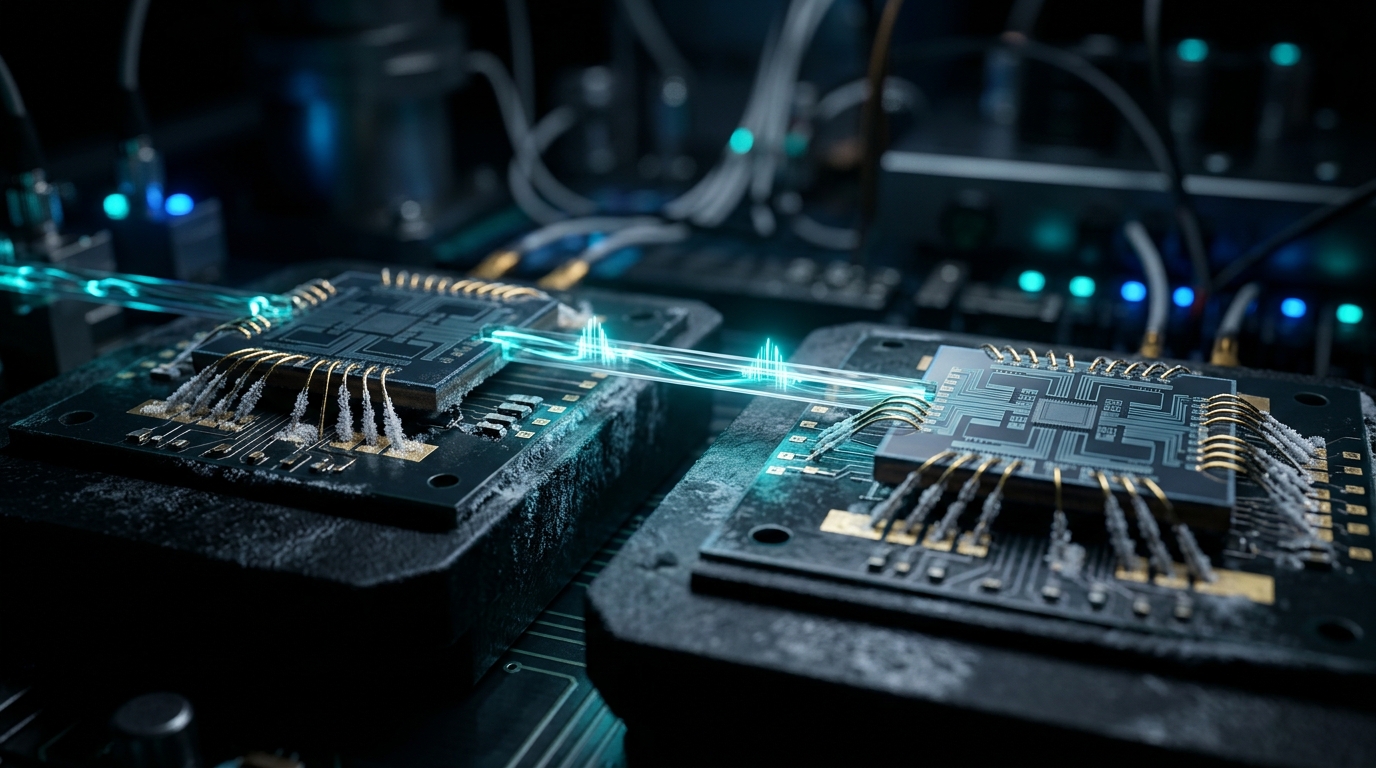
[IMAGE: A trusted quantum source node emitting entangled photon pairs along a fiber toward a black, featureless untrusted detector box, with the entanglement link glowing cyan over a long dark distance]
Last updated: 2026-06-19. Primary source: “One-sided DI-QKD secure against coherent attacks over long distances” (arXiv:2403.11850).