- A new construction (arXiv:2512.13777) realizes topologically protected phase gates at any level of the Clifford hierarchy using constant-depth, purely 2D circuits — sidestepping a 12-year-old scaling barrier.
- For the dihedral group D_{4N} where 8N = 2^n, the gate sits at the n-th level of the Clifford hierarchy using only n physical qubits per lattice edge, with a qubit-only realization.
- The work is theoretical, but it attacks the single biggest cost driver in fault-tolerant quantum computing — meaning your PQC migration deadline could compress, not extend.
Why a Quantum Circuit-Depth Result Belongs on Your Risk Register
The threat model that justifies post-quantum cryptography rests on one assumption: a large-scale, fault-tolerant quantum computer running Shor’s algorithm will eventually break RSA-2048 and ECC. Most CISOs have internalized the harvest-now-decrypt-later risk and started inventorying cryptographic assets. Fewer track why that machine doesn’t exist yet.
The answer is overhead. Today’s fault-tolerant designs spend the overwhelming majority of their physical qubits not on computation but on manufacturing the non-Clifford gates — the T-gates — that make a quantum computer universal. The dominant technique, magic-state distillation, can consume thousands of physical qubits and many cycles to produce a single reliable logical T-gate. That overhead is the moat between a lab demonstrator and a cryptographically relevant quantum computer (CRQC).
A result that erodes that moat is not academic trivia. It is a direct input to your migration timeline. If the resource cost of universal computation drops, the date on which RSA and ECC become indefensible moves left — and every certificate, VPN tunnel, and signed firmware image with a long validity window inherits that risk today.
The Bravyi–König Barrier — and How This Work Breaks It
Definition: The Clifford hierarchy and why depth matters
The Clifford hierarchy is a ranking of quantum gates by computational power. The first level is the Pauli group; the second is the Clifford group (cheap, classically simulable on stabilizer states); the third level introduces the T-gate, the first gate that delivers genuine quantum advantage. Higher levels enable finer-grained rotations. Constant-depth means the circuit’s length does not grow with the size of the code — a property prized because it limits how errors accumulate and keeps operations fast and local.
For over a decade, the Bravyi–König theorem has set the ceiling. On Pauli stabilizer codes — the family that includes the standard surface code underpinning most roadmaps from Google and IBM — a constant-depth circuit in D spatial dimensions can only reach the D-th level of the Clifford hierarchy. In flat 2D hardware, that caps you at the second level. The Clifford group. No native T-gate. Everything above must be imported through expensive distillation.
The construction
The paper encodes a logical qubit in the quantum double D(G) of a non-Abelian group G, laid out on a triangular spatial patch. The logical gate is then applied by stacking a symmetry-protected topological (SPT) phase — specified by a group 2-cocycle — onto that region, plus boundary counter-terms. The entire operation is a constant-depth circuit.
“We bypass this limitation, by constructing constant-depth unitary gates at arbitrary levels of the Clifford hierarchy purely in 2D, without sacrificing locality or fault tolerance, at the cost of using the quantum double of a non-Abelian group G.” — arXiv:2512.13777
The phrase without sacrificing locality or fault tolerance is the load-bearing one. Prior workarounds to Bravyi–König typically demanded extra spatial dimensions or non-local connectivity — neither of which maps cleanly onto fabricable 2D chips. This construction stays flat.
Worked example: the dihedral case
For the dihedral group D_{4N} (order 8N), the construction realizes the phase gate T^{1/N} = diag(1, e^{iπ/(4N)}) in the logical Z̄ basis. The structural payoff appears when 8N is a power of two:
- When 8N = 2^n, the logical gate lands at the n-th level of the Clifford hierarchy.
- That gate has a qubit-only realization — expressible via Clifford-hierarchy stabilizers.
- The code uses n physical qubits per edge of the lattice.
To reach the n-th level of the hierarchy, conventional 2D stabilizer codes would lean on distillation. Here, climbing one level costs one additional qubit per edge — a linear, local resource scaling for a capability that was previously gated behind a hard dimensional ceiling.
The authors also propose a non-Abelian stabilizer group formalism, worked out explicitly for dihedral groups, and discuss code-switching to the double surface-code D(Z_2 × Z_2) to complete a universal gate set — the remaining piece needed for a machine that can run arbitrary algorithms, Shor’s included.
Current Standard vs. Non-Abelian Surface Codes
| Dimension | Pauli stabilizer codes (today) | Non-Abelian surface codes (2512.13777) |
|---|---|---|
| Max gate level at constant depth in 2D | 2nd (Clifford only), per Bravyi–König | Arbitrary level of the Clifford hierarchy |
| Source of high-level gates | Magic-state distillation (high overhead) | Native constant-depth circuit |
| Spatial dimensions required | 2D, but capped at Clifford | 2D, no cap |
| Encoding | Abelian stabilizer group | Quantum double D(G) of non-Abelian G |
| Cost to reach n-th level (8N = 2^n) | Distillation factories | n physical qubits per edge |
| Fault tolerance / locality | Preserved | Preserved |
| Maturity | Hardware demonstrations underway | Theoretical; no experiment yet |
The strategic signal is not that quantum computers got faster — it’s that the most expensive subroutine in building one may have a cheaper structural alternative. Cost curves, not clock speeds, govern the CRQC arrival date.
Industry Context: What Moves Your Deadline
NIST finalized its first post-quantum standards — FIPS 203 (ML-KEM), 204 (ML-DSA), and 205 (SLH-DSA) — in August 2024, and federal guidance targets deprecation of RSA and ECC well before 2035. Those timelines were drawn against an assumed pace of fault-tolerant hardware progress. Any result that lowers the qubit overhead for universal computation pressures that assumption.
This is where crypto-agility stops being a best practice and becomes a hedge against timeline uncertainty. An organization that has abstracted its cryptographic primitives can absorb an accelerated CRQC date with a configuration change. One that has hardcoded RSA across microservices, embedded devices, and signed artifacts faces a multi-year engineering scramble at exactly the moment the threat materializes.
The honest framing: this paper does not break anything today. It contains no qubit-count estimate, no error threshold, no hardware demonstration, and no distillation-cost comparison (see Data Gaps below). But the direction of travel matters. Each result that converts a hard barrier into a linear cost shortens the half-life of the assumptions baked into your migration plan.
The BeQuantum Perspective
The operational lesson from non-Abelian surface codes is that the quantum threat timeline is a moving target driven by architectural breakthroughs you cannot forecast from the outside. You cannot manage that uncertainty by guessing the CRQC date. You manage it by making the date irrelevant to your exposure.
That is the principle behind BeQuantum’s PQC Layer: cryptographic primitives sit behind a policy-driven abstraction, so migrating from ECC to ML-KEM — or rotating again as standards evolve — is an operational change, not a code rewrite. The same logic drives our Digital Notary, which anchors verifiable, long-lived attestations whose integrity must survive whatever a future quantum machine can compute, and IceCase hardware, which keeps key material in a controlled boundary rather than scattered across application logic.
The through-line: when the underlying threat assumptions are volatile, durability comes from decoupling your security posture from any single algorithm or any single estimate of when the hardware arrives.
What You Should Do Next
- Within 90 days, complete a cryptographic asset inventory that maps every use of RSA and ECC — TLS certificate chains, code-signing keys, VPN configurations, and long-lived signed data — and tags each by validity window. Anything that must stay confidential or verifiable past 2030 is already exposed to harvest-now-decrypt-later.
- Pilot a NIST-standardized primitive in a non-production path this quarter. Stand up ML-KEM (FIPS 203) in a hybrid TLS handshake to surface integration friction now, while the stakes are low.
- Adopt a crypto-agility abstraction before you migrate, not after. Decouple application code from algorithm identity so the next transition — and there will be a next one — is a policy update rather than a rewrite.
FAQ
Q: Does arXiv:2512.13777 mean quantum computers can break RSA now? A: No. The paper is a theoretical construction for building gates more efficiently inside a fault-tolerant quantum computer. It provides no hardware, no qubit counts, and no error thresholds. Its relevance to cryptography is indirect: by lowering a key overhead in universal computation, it pressures the assumptions behind CRQC arrival estimates.
Q: Why does reducing circuit depth and gate overhead affect my PQC timeline? A: The chief obstacle to a cryptographically relevant quantum computer is the enormous physical-qubit overhead of producing non-Clifford gates, largely via magic-state distillation. A native, constant-depth path to high-level gates erodes that overhead. Lower overhead means a CRQC could arrive sooner, which compresses the window you have to migrate.
Q: What is the single most important step if I haven’t started PQC migration? A: Inventory and prioritize. You cannot protect what you have not catalogued. Map every RSA/ECC dependency, rank by data lifetime, and build crypto-agility into the architecture so future transitions are configuration changes rather than engineering projects.
Data gaps in the source: The paper reports no physical-qubit error or fault-tolerance thresholds, no total qubit-count or hardware-overhead estimate, no experimental demonstration or hardware platform, and no quantified comparison against magic-state distillation. The general construction for non-dihedral groups, decoding complexity, and the practical implementability of the proposed non-Abelian stabilizer formalism are not detailed in the abstract. Connections to breaking RSA/ECC and to PQC migration are analytical inferences, not claims made by the authors.
Source: “Constant-Depth Clifford-Hierarchy Gates via Non-Abelian Surface Codes,” arXiv:2512.13777 (v3).
Last updated: 2026-06-14
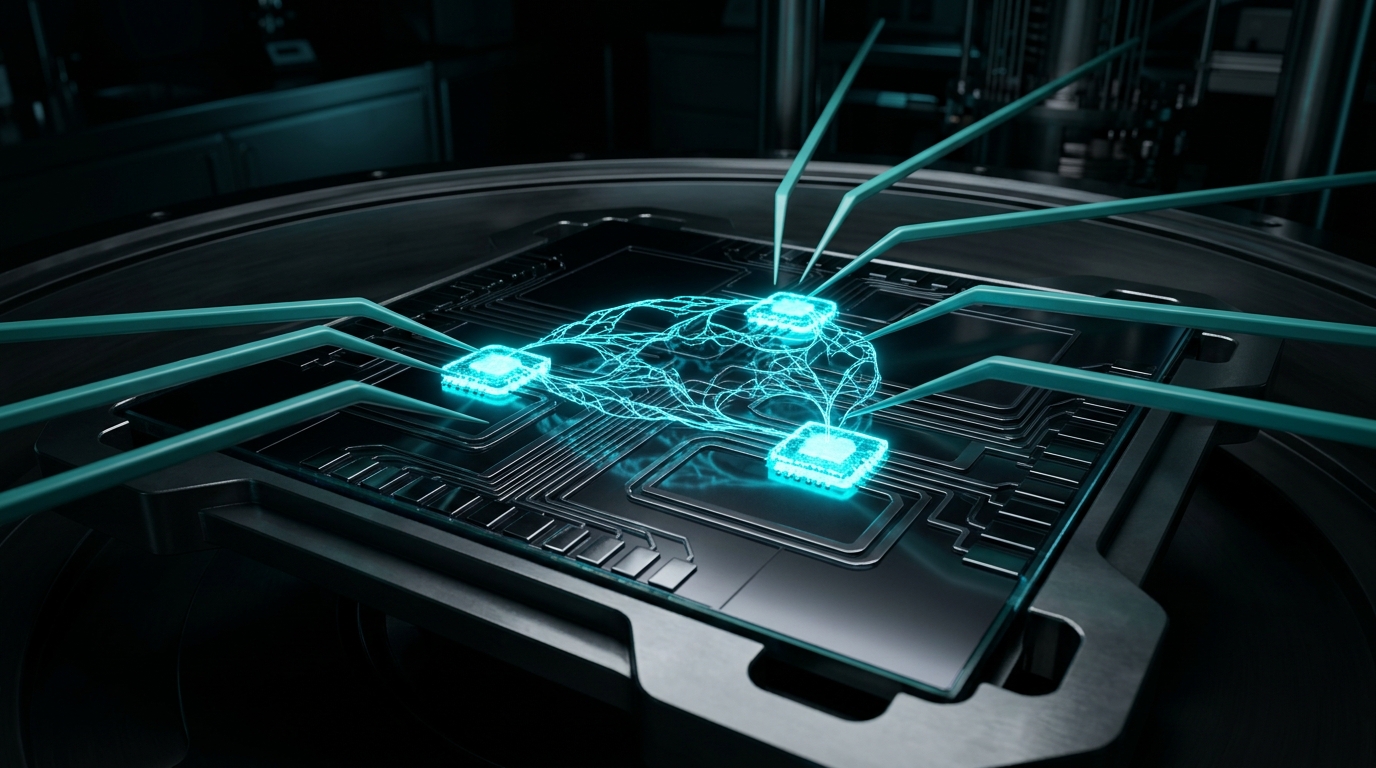
[IMAGE: A triangular lattice of glowing qubits on a flat 2D quantum chip, with a translucent symmetry-protected topological layer being stacked onto the surface, entangled light threads tracing constant-depth gate paths]