
Last updated: June 2025
Key Takeaways
- Researchers identified fault-tolerant quantum architectures capable of demonstrating quantum advantage with as few as 11,495 neutral atoms and a runtime of approximately 15 hours — a threshold far closer to current hardware than most enterprise security roadmaps assume
- A teleportation-based logical gate scheme achieves ~3x speedup over extractor architectures at zero additional space cost, compressing the timeline to cryptographically relevant quantum computing
- If your organization’s PQC migration plan assumes a 10+ year runway before quantum threats materialize, this research demands you revisit that assumption within the next 90 days
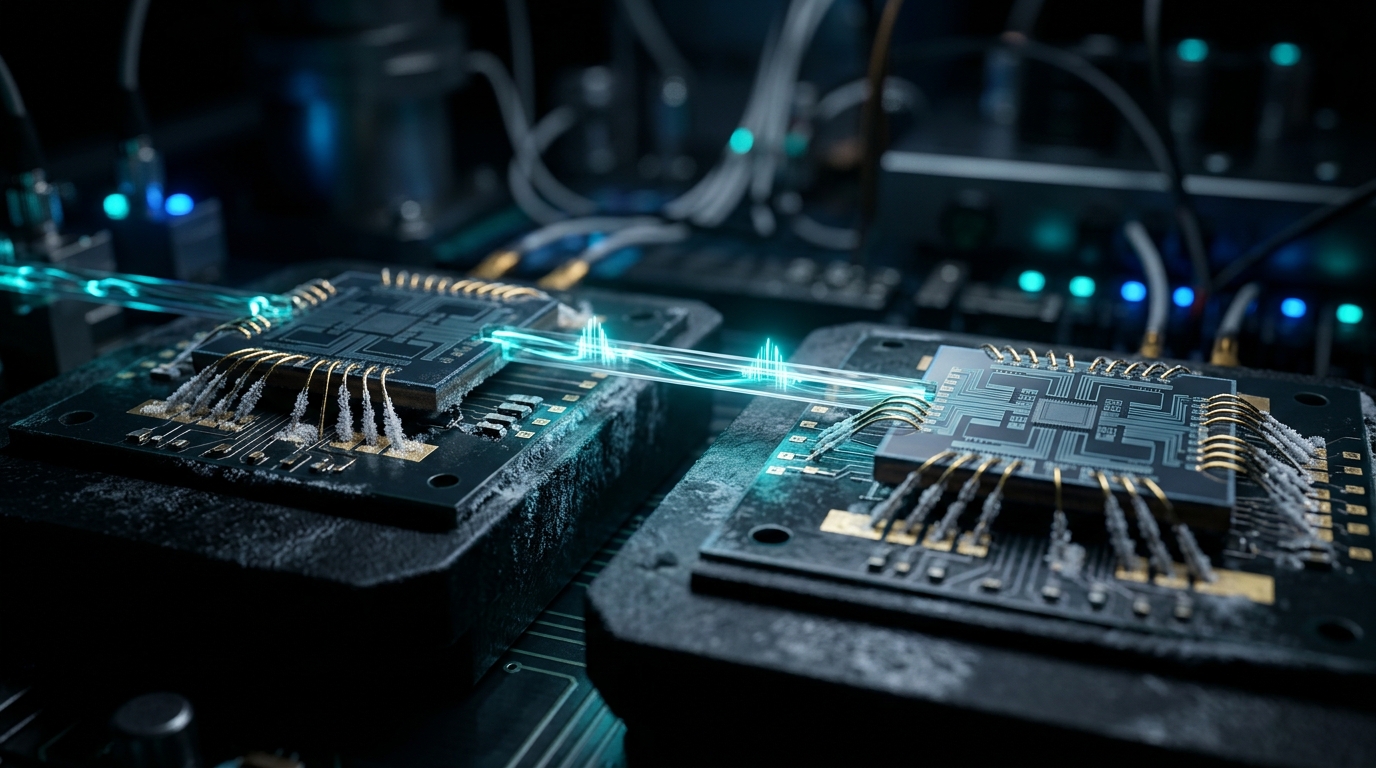
[IMAGE: A single neutral atom suspended in an optical tweezer array, glowing with cyan entanglement beams connecting to adjacent atoms in a dark lattice, macro photography style with deep blacks and teal light refractions, 8K cinematic quality]
The Clock Just Moved: Why 11,495 Atoms Changes Your Risk Model
Picture your organization’s CISO presenting the annual security roadmap to the board. The PQC migration is scheduled for 2031. The assumption baked into that timeline: cryptographically relevant quantum computers require millions of physical qubits and remain a decade away.
A preprint published on arXiv in April 2025 — “Architecting Early Fault Tolerant Neutral Atoms Systems with Quantum Advantage” — challenges that assumption with specific, simulated numbers. The researchers identified fault-tolerant architectures capable of achieving quantum advantage with as little as 11,495 atoms and a runtime of approximately 15 hours. That is not a theoretical lower bound. That is a compiled, scheduled, gate-level simulation result.
The distinction matters for your threat model. Quantum advantage in dynamics simulations is not the same as breaking RSA-2048. But it is the proof-of-concept milestone that historically precedes cryptographically relevant capability by a compressing margin. Organizations that waited for “quantum advantage” as their trigger to begin PQC migration are now watching that trigger get pulled.
What the Teleportation-Based Architecture Actually Does
Fault-tolerant quantum computing (FTQC) is the discipline of running quantum algorithms reliably despite physical qubit errors, using quantum error correction (QEC) codes to encode logical qubits across many physical qubits. The central engineering challenge is achieving this without the overhead — in qubits, time, and operations — becoming prohibitive.
Neutral atom platforms are particularly relevant here because their reconfigurable connectivity allows atoms to be physically shuttled and re-entangled mid-computation. Most competing approaches — superconducting qubits, for example — use fixed connectivity graphs that force logical operations into serial sequences.
The research at arXiv:2604.19735 exploits this mobility directly. The authors propose a teleportation-based scheme for logical gate execution that parallelizes operations across the available qubit array. The core insight: existing spatially efficient QEC schemes leave significant qubit real estate idle during serial gate execution. The teleportation scheme fills that idle space with parallel logical operations, extracting throughput that extractor-based and transversal-based gate architectures leave on the table.
“Our approach achieves up to ~3x speedup over extractor architectures at no extra space cost and achieves the best spacetime performance among other viable architectures before accounting for external resource-states… identifying architectures capable of achieving quantum advantage with as little as 11,495 atoms and a runtime of ~15 hours.” — arXiv:2604.19735v1
The authors validated this not with abstract circuit counts but with full compilation simulation: low-level gate scheduling, atom shuttling patterns, and resource-state nondeterminism were all modeled. The ~3x speedup held after accounting for these real-world compilation constraints.
Architecture Comparison: Where the Speedup Comes From
| Architecture Type | Relative Speed | Space Overhead | Parallelism Model | Compilation Realism |
|---|---|---|---|---|
| Transversal-based gates | Baseline | Low | Limited by code structure | Partial |
| Extractor-based gates | ~1x (reference) | Low | Serial-dominant | Full |
| Teleportation-based (proposed) | ~3x faster | No extra cost | Parallel via reconfigurable connectivity | Full (gate scheduling + shuttling + nondeterminism) |
The zero-extra-space-cost characteristic is operationally significant. Prior parallelization approaches in FTQC typically traded qubit count for speed. This scheme achieves throughput gains within the same spatial footprint — meaning the 11,495-atom threshold is not inflated by parallelization overhead.
Regulatory and Compliance Pressure Is Already Here
NIST finalized its first three post-quantum cryptographic standards in August 2024: ML-KEM (CRYSTALS-Kyber), ML-DSA (CRYSTALS-Dilithium), and SLH-DSA (SPHINCS+). The U.S. Office of Management and Budget subsequently directed federal agencies to begin inventorying cryptographic assets and prioritizing migration to these standards.
The compliance burden for enterprises operating in regulated sectors — financial services, healthcare, critical infrastructure — is not hypothetical. CISA’s 2024 guidance explicitly frames the migration timeline as urgent, not precautionary. The research at arXiv:2604.19735 provides the technical substrate for why that urgency is calibrated correctly.
Consider the attack surface exposure timeline:
- Harvest Now, Decrypt Later (HNDL) attacks are already underway. Adversaries with sufficient storage are capturing encrypted traffic today, betting on future quantum decryption capability.
- If neutral atom systems reach the 11,495-atom fault-tolerant threshold within 3-5 years — a plausible trajectory given current hardware scaling rates — data encrypted today under RSA or ECC becomes retrospectively vulnerable.
- Organizations with 18-24 month PQC migration cycles that haven’t started face a closing window.
The HNDL threat inverts the conventional security calculus: the vulnerability exists now, even though the decryption capability doesn’t yet. Every month of delayed PQC migration extends the exposure window backward in time, not just forward.
The economic framing is straightforward. A PQC migration for a mid-sized enterprise — certificate replacement, TLS stack updates, key management infrastructure — typically runs $500K to $2M depending on complexity. The cost of a successful retrospective decryption of five years of sensitive communications is not bounded by that figure.
Who Is Moving and Who Is Lagging
Google reported migrating Chrome’s TLS stack to include CRYSTALS-Kyber hybrid key exchange in 2023, covering hundreds of millions of connections. Cloudflare deployed post-quantum key agreement across its network in 2023. Signal updated its protocol to include post-quantum key encapsulation in September 2023.
The laggards are concentrated in sectors with long software lifecycle management cycles: industrial control systems, embedded medical devices, and legacy financial infrastructure running on COBOL-era cryptographic libraries. These are precisely the environments where a 3-5 year migration timeline is optimistic, not conservative.
The BeQuantum Perspective: What Early FTQC Milestones Mean for Verification Infrastructure
The research at arXiv:2604.19735 is a hardware architecture paper, not a cryptanalysis paper. It does not demonstrate Shor’s algorithm running on a neutral atom system. What it demonstrates is that the engineering pathway to fault-tolerant quantum computation is shorter than the security industry’s median assumption.
At BeQuantum, we track this distinction carefully. The threat model for PQC is not a binary switch — “quantum computers don’t exist” to “quantum computers break everything.” It is a gradient, and the gradient is steepening.
Our Digital Notary infrastructure uses ML-DSA (CRYSTALS-Dilithium) signatures for content timestamping and provenance verification. The design decision to build on NIST-standardized PQC from day one reflects exactly the threat model this research reinforces: the window between “quantum advantage demonstrated” and “cryptographically relevant quantum computing” is compressing, and organizations that treat PQC as a future problem are building on a depreciating foundation.
The PQC Layer we deploy for enterprise clients addresses the migration path problem directly — hybrid classical/post-quantum key exchange that maintains backward compatibility with existing TLS infrastructure while adding quantum-resistant key encapsulation. The hybrid approach is specifically designed for the current transition period, where the threat is probabilistic but the compliance requirement is immediate.
For organizations managing hardware security modules or air-gapped signing infrastructure, the IceCase hardware platform supports ML-KEM and ML-DSA natively, eliminating the firmware update cycle that creates vulnerability windows in conventional HSM deployments.
The 11,495-atom threshold identified in this research is a planning number, not a deployment date. But planning numbers are exactly what security architects need to build defensible roadmaps.
What You Should Do in the Next 90 Days
Step 1: Audit your cryptographic asset inventory (Days 1-30)
Map every system that uses RSA, ECDH, or ECDSA for key exchange or digital signatures. Prioritize by data sensitivity and retention period — systems protecting data with a 10+ year confidentiality requirement are your highest-risk exposure. Tools like CISA’s cryptographic inventory guidance and open-source scanners (e.g., pqc-inventory for TLS certificate chains) can accelerate this process.
Step 2: Classify your migration complexity (Days 30-60) Segment your inventory into three tiers: (1) systems with vendor-supported PQC migration paths available today, (2) systems requiring custom integration work, and (3) legacy systems with no viable migration path that require replacement planning. Tier 3 systems define your actual migration timeline — not Tier 1.
Step 3: Deploy hybrid PQC for your highest-value data flows (Days 60-90) Hybrid key exchange — combining classical ECDH with ML-KEM — provides immediate HNDL protection without requiring full infrastructure replacement. Prioritize external-facing TLS endpoints, VPN gateways, and any API endpoints transmitting regulated data. This step does not complete your PQC migration, but it closes the HNDL exposure window on your most sensitive traffic while the full migration proceeds.
Frequently Asked Questions
Q: Does the 11,495-atom result mean quantum computers can break encryption today? A: No. The research demonstrates a pathway to quantum advantage in quantum dynamics simulations — a specific computational task, not cryptographic key breaking. Shor’s algorithm, which threatens RSA and ECC, requires fault-tolerant quantum computers with significantly more logical qubits and lower error rates than current hardware provides. The significance of this research is that it compresses the engineering timeline to fault-tolerant quantum computing, which is the prerequisite for cryptographically relevant capability.
Q: If NIST already standardized PQC algorithms, why does this research matter for my organization? A: NIST standardization solved the “which algorithm” question. This research sharpens the “how urgently” question. Organizations that have deprioritized PQC migration based on long quantum computing timelines now have a more specific data point suggesting those timelines are optimistic. The HNDL threat means the urgency is not contingent on quantum computers existing today — it is contingent on them existing before your sensitive data loses its confidentiality value.
Q: What is the difference between quantum advantage and cryptographically relevant quantum computing? A: Quantum advantage means a quantum computer solves a specific problem faster than any classical computer. Cryptographically relevant quantum computing means a quantum computer can execute Shor’s algorithm at sufficient scale to factor the large integers or solve the discrete logarithm problems underlying RSA and ECC. The former is an engineering milestone; the latter is the security threat. This research advances the former, which historically precedes the latter by a compressing interval as hardware scales.