Last updated: July 2025
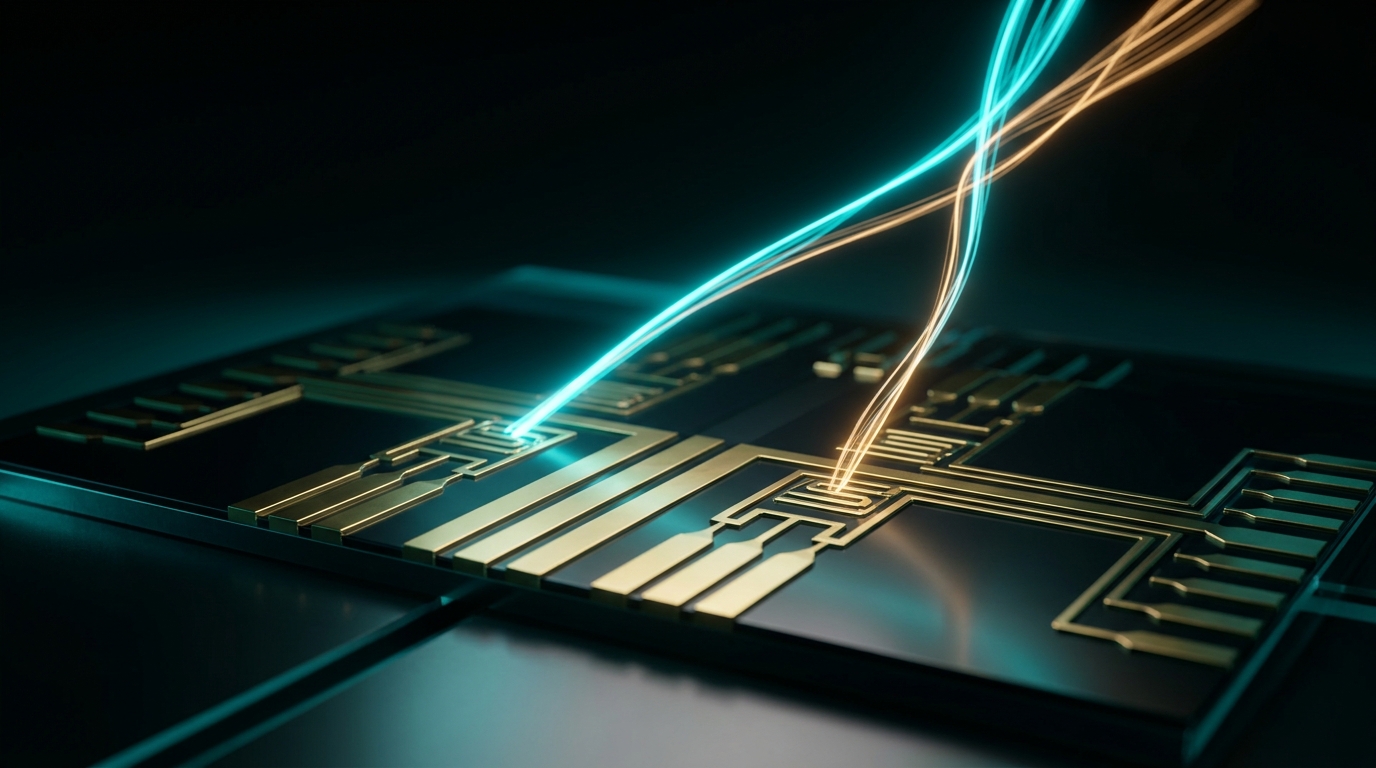
[IMAGE: Macro photograph of a superconducting quantum chip mounted in a flip-chip architecture, with coplanar waveguide resonators visible as gold traces on a dark substrate, illuminated by entangled cyan light beams suggesting quantum state transitions, cinematic deep-black background with teal accents, 8K detail]
Key Takeaways
- Researchers demonstrated unconditional qubit reset in 220 nanoseconds with residual excitation below 1%, using a single multimode coplanar waveguide resonator — no additional on-chip components required.
- A leakage reduction unit (LRU) selectively resets the dangerous second excited state (|f⟩) in just 62 nanoseconds, with 6.1% residual |f⟩ population after accounting for readout error.
- This hardware efficiency milestone compresses the timeline to fault-tolerant quantum computing — which means your organization’s window to complete a post-quantum cryptography migration is narrowing faster than most roadmaps assume.
Why Quantum Hardware Progress Is Your Cryptography Problem
Your current TLS 1.3 deployment, your RSA-2048 certificate chain, your ECDH key exchanges — none of these are broken today. But the threat model for post-quantum cryptography isn’t about today. It’s about the moment a cryptographically relevant quantum computer (CRQC) crosses the threshold of fault-tolerant operation at scale.
Every hardware efficiency gain in superconducting quantum circuits moves that threshold closer.
Consider the operational reality: a quantum processor running Shor’s algorithm against RSA-2048 requires not just raw qubit count, but qubits that reset fast, stay coherent, and correct errors efficiently. Qubit reset — the process of returning a qubit to its ground state between operations — is a fundamental bottleneck in quantum error correction cycles. Slow or imperfect reset degrades the entire error correction stack.
Researchers publishing on arXiv (paper ID: 2507.04676) have now demonstrated a multimode Purcell filter architecture that achieves unconditional qubit reset in 220 nanoseconds with residual excitation below 1%. That is a hardware-level result that directly accelerates quantum error correction cycle rates — and by extension, the path to the machines that will threaten your current cryptographic infrastructure.
The Technical Architecture: One Resonator, Two Jobs
The conventional approach to superconducting qubit design assigns separate on-chip components to separate functions: one element for qubit reset, another for readout, another for Purcell protection. Each additional component increases fabrication complexity, reduces yield, and introduces new failure modes.
The multimode Purcell filter demonstrated in arXiv:2507.04676 eliminates that tradeoff by exploiting the inherent multi-mode structure of a single coplanar waveguide resonator.
How the Multimode Architecture Works
A coplanar waveguide resonator supports multiple resonant modes at different frequencies. The research team assigned distinct quantum operations to distinct modes of the same physical resonator:
- Fundamental mode: drives unconditional qubit reset
- Second-order mode: handles qubit readout
- Auxiliary mode: provides intrinsic Purcell protection, preventing the qubit from losing energy into the readout channel at the wrong time
Qubits couple directly to the filter without degrading relaxation times — a critical result, because direct coupling typically introduces unwanted decay pathways. The Purcell protection from the auxiliary mode suppresses this.
The entire device is implemented in a flip-chip architecture, where two chips are bonded face-to-face, enabling denser integration than planar designs.
The Leakage Reduction Unit: Closing the |f⟩ Vulnerability
In superconducting transmon qubits, the computational space is the ground state |g⟩ and first excited state |e⟩. But transmons are weakly anharmonic — meaning the second excited state |f⟩ sits close enough in energy that gate operations can accidentally populate it. This leakage out of the computational subspace is a known error source that standard qubit reset protocols do not address.
The leakage reduction unit (LRU) in this architecture selectively resets the |f⟩ state in 62 nanoseconds, with a residual |f⟩ population of 6.1% after accounting for readout error. This is a targeted intervention at a specific error channel — not a general reset.
“To our knowledge, this is the first experimental trial that exploits different-order modes of a microwave resonator for distinct qubit operations, representing a new direction toward scalable, hardware-efficient quantum processor design.” — Authors, arXiv:2507.04676v2
[IMAGE: Diagram-style visualization of a coplanar waveguide resonator with color-coded frequency modes — cyan for fundamental reset mode, amber for second-order readout mode — on a dark superconducting chip substrate, macro lens perspective, no text or labels]
Comparison: Conventional vs. Multimode Purcell Filter Architecture
| Parameter | Conventional Multi-Component Design | Multimode Purcell Filter (arXiv:2507.04676) |
|---|---|---|
| On-chip components for reset + readout | Multiple discrete elements | Single coplanar waveguide resonator |
| Unconditional reset time | Typically 500ns–1µs (literature range) | 220 ns |
| Residual excitation after reset | Varies; often 1–5% | <1% |
| Leakage ( | f⟩) reset time | Not typically addressed separately |
| Purcell protection mechanism | Separate filter element | Intrinsic auxiliary mode |
| Fabrication complexity | Higher (more components) | Lower (single resonator) |
| Architecture | Planar or flip-chip | Flip-chip |
| First demonstration of mode-multiplexed operations | No | Yes |
Note: Conventional reset time ranges are drawn from published superconducting qubit literature; the source paper does not provide direct head-to-head benchmarks against specific prior designs.
Critical finding: Achieving sub-1% residual excitation in 220 nanoseconds without additional on-chip components is not an incremental improvement — it removes a fabrication complexity barrier that has constrained how densely quantum error correction circuits can be integrated on a single chip.
What This Means for Fault-Tolerant Quantum Computing Timelines
Fault-tolerant quantum computing requires quantum error correction (QEC) at scale. QEC cycles have a hard dependency on reset speed: you cannot begin the next error correction cycle until qubits have been reliably returned to their ground state. A reset that takes 220ns instead of 1µs means QEC cycles run roughly 4–5x faster for the reset-limited portion of the cycle.
Faster QEC cycles translate directly to more logical operations per second on a fault-tolerant processor — which translates to shorter runtimes for algorithms like Shor’s.
The hardware efficiency angle matters equally. By demonstrating that a single resonator can handle reset, readout, and Purcell protection simultaneously, this architecture reduces the per-qubit component count. Lower component count means:
- Higher fabrication yield at scale
- Denser qubit integration on a single chip
- Reduced crosstalk surface from fewer inter-component couplings
None of this means a CRQC is imminent. The paper demonstrates a single device; there is no published data on qubit count, T1/T2 relaxation times, gate fidelity, or how the 6.1% residual |f⟩ population compares to state-of-the-art LRU implementations. Scaling from a single demonstrated device to a fault-tolerant processor with millions of physical qubits remains an enormous engineering challenge.
But the direction of travel is clear. Hardware-efficient architectures that remove fabrication bottlenecks are exactly the class of advance that compresses timelines.
Regulatory and Compliance Context
NIST finalized its first three post-quantum cryptography standards in August 2024: ML-KEM (CRYSTALS-Kyber), ML-DSA (CRYSTALS-Dilithium), and SLH-DSA (SPHINCS+). The U.S. Office of Management and Budget (OMB) issued guidance requiring federal agencies to inventory cryptographic assets and begin migration planning. The NSA’s Commercial National Security Algorithm Suite 2.0 (CNSA 2.0) set 2030 as the target for PQC adoption across national security systems.
For enterprise organizations outside the federal sector, the compliance pressure is building through supply chain requirements, financial sector guidance from regulators including the BIS and ECB, and emerging cyber insurance underwriting criteria that increasingly ask about PQC readiness.
Hardware advances like the multimode Purcell filter are precisely the kind of development that regulators cite when justifying aggressive migration timelines. The argument is not that quantum computers are here — it is that the engineering trajectory makes the 2030 window credible, and that “harvest now, decrypt later” attacks are already underway against long-lived sensitive data.
The BeQuantum Perspective: Hardware Progress Demands Infrastructure Readiness
At BeQuantum, we track quantum hardware advances not as academic curiosities but as inputs to migration urgency calculations. The multimode Purcell filter result is significant precisely because it addresses a fabrication scalability constraint — not just a performance metric on a single device.
Our PQC Layer implements ML-KEM and ML-DSA across TLS handshakes, certificate issuance, and API authentication. When we advise organizations on migration sequencing, we use a risk-weighted asset inventory: long-lived data (medical records, financial contracts, intellectual property with 10+ year sensitivity windows) gets prioritized for immediate PQC protection, because that data is already at risk from harvest-now-decrypt-later adversaries regardless of where quantum hardware stands today.
The Digital Notary service addresses a related attack surface: content authenticity verification. As quantum-capable adversaries gain the ability to forge classical digital signatures, the integrity of signed documents, firmware updates, and software supply chain artifacts becomes a critical vulnerability. Migrating signing infrastructure to ML-DSA before classical signature schemes are broken is a tractable near-term action.
The IceCase hardware security module supports PQC key generation and storage in an air-gapped, tamper-evident form factor — relevant for organizations that need to protect PQC private keys from both classical and quantum-assisted side-channel attacks during the transition period.
The honest framing: no single hardware paper changes your migration deadline. But a consistent pattern of hardware efficiency breakthroughs — of which arXiv:2507.04676 is one data point — is exactly the signal that should prevent your organization from treating PQC migration as a 2028 problem.
Three Actions to Take Within 90 Days
1. Complete a cryptographic asset inventory with sensitivity-window tagging. Within 30 days, identify every system in your environment that uses RSA, ECDH, or ECDSA for key exchange or signing. Tag each asset with its data sensitivity window — how long the data it protects must remain confidential. Any asset protecting data with a 7+ year sensitivity window is already in the harvest-now-decrypt-later threat window.
2. Prioritize TLS certificate chain migration for external-facing services. Within 60 days, audit your TLS certificate chain for all external-facing endpoints. Work with your CA to understand their ML-KEM and ML-DSA issuance timeline. Hybrid certificates — combining classical and PQC algorithms — are available now and provide a migration path that maintains backward compatibility while adding quantum resistance.
3. Establish a quantum hardware monitoring cadence. Within 90 days, assign ownership for tracking quantum hardware milestones — specifically advances in qubit reset fidelity, error correction cycle rates, and logical qubit demonstrations. This is not a research function; it is a threat intelligence function. Hardware advances like the multimode Purcell filter are leading indicators for your migration urgency model.
Frequently Asked Questions
Q: Does this quantum hardware breakthrough mean RSA is broken now? A: No. The multimode Purcell filter paper demonstrates a single superconducting qubit device with improved reset and readout efficiency. Breaking RSA-2048 requires a fault-tolerant quantum computer with millions of physical qubits operating under full quantum error correction — a capability that does not exist today. What this research represents is progress on one of the fabrication scalability bottlenecks that stands between current hardware and that capability.
Q: If quantum computers are still years away, why does my organization need to act on PQC now? A: Two reasons. First, “harvest now, decrypt later” attacks are already occurring — adversaries are collecting encrypted traffic today with the intent to decrypt it once quantum hardware matures. Any data your organization encrypts today that must remain confidential for 7 or more years is already at risk. Second, PQC migration is not a switch you flip — it requires certificate replacement, protocol updates, HSM procurement, and application-layer changes that typically take 3–5 years to complete across a large enterprise. Starting in 2027 means finishing in 2032, which is past the credible risk window.
Q: What is a multimode Purcell filter and why does it matter for quantum computing scalability? A: A Purcell filter is a circuit element in superconducting quantum processors that prevents qubits from losing energy into readout channels at unintended times — a phenomenon called the Purcell effect. A multimode Purcell filter exploits multiple resonant frequencies of a single physical resonator to perform qubit reset, readout, and Purcell protection simultaneously, without requiring separate on-chip components for each function. This matters for scalability because reducing per-qubit component count improves fabrication yield and enables denser qubit integration — both prerequisites for building the large-scale processors that quantum error correction requires.