- A free-space Gaussian-modulated unidimensional CV-QKD system reached a maximum secret key rate of 270 kbps at an optimal modulation variance of 11.57, operating in a punishing 1.4 shot-noise-unit electronic-noise regime (arXiv:2606.07206).
- Under the untrusted-detector (UTD) model, the system produced no positive secret key rate at all; only the trusted-detector (TD) model yielded secure keys — a difference driven purely by a security assumption, not the hardware.
- For your security posture: any near-term quantum key distribution deployment over free-space links inherits a hard dependency on detector trust and low-loss channels. That assumption belongs in your threat model, not your footnotes.
Why Detector Trust Just Became a Procurement Question
Picture a security architect signing off on a quantum key distribution link between two corporate campuses. The vendor demo shows a healthy 270 kbps key stream. The contract gets signed. Six months later, an auditor asks a single question: “Does your security proof assume the receiver’s detector is trusted?” If the answer is yes — and for this class of system it must be — then the formal security guarantee depends on the integrity of a hardware component sitting at the far end of the link.
That is not a hypothetical. The free-space unidimensional CV-QKD experiment documented in arXiv:2606.07206 makes the dependency concrete. Run the identical optical setup under two different security models and you get two completely different outcomes: a usable 270 kbps channel under the trusted-detector assumption, and a dead link — zero positive key rate — under the untrusted-detector assumption.
The risk here is not that the physics fails. The risk is that the security model is a deployment-time decision with binary consequences, and most procurement processes are not equipped to evaluate it.
Technical Deep-Dive: How Free-Space UD-CVQKD Works
Continuous-variable QKD in one quadrature
Continuous-variable quantum key distribution (CV-QKD) encodes key information in the quadratures of the electromagnetic field, which lets it run on standard telecommunication components — the same coherent detectors, modulators, and photonics already deployed in fiber networks. That hardware reuse is the entire commercial argument for CV-QKD over discrete-variable approaches that demand exotic single-photon detectors.
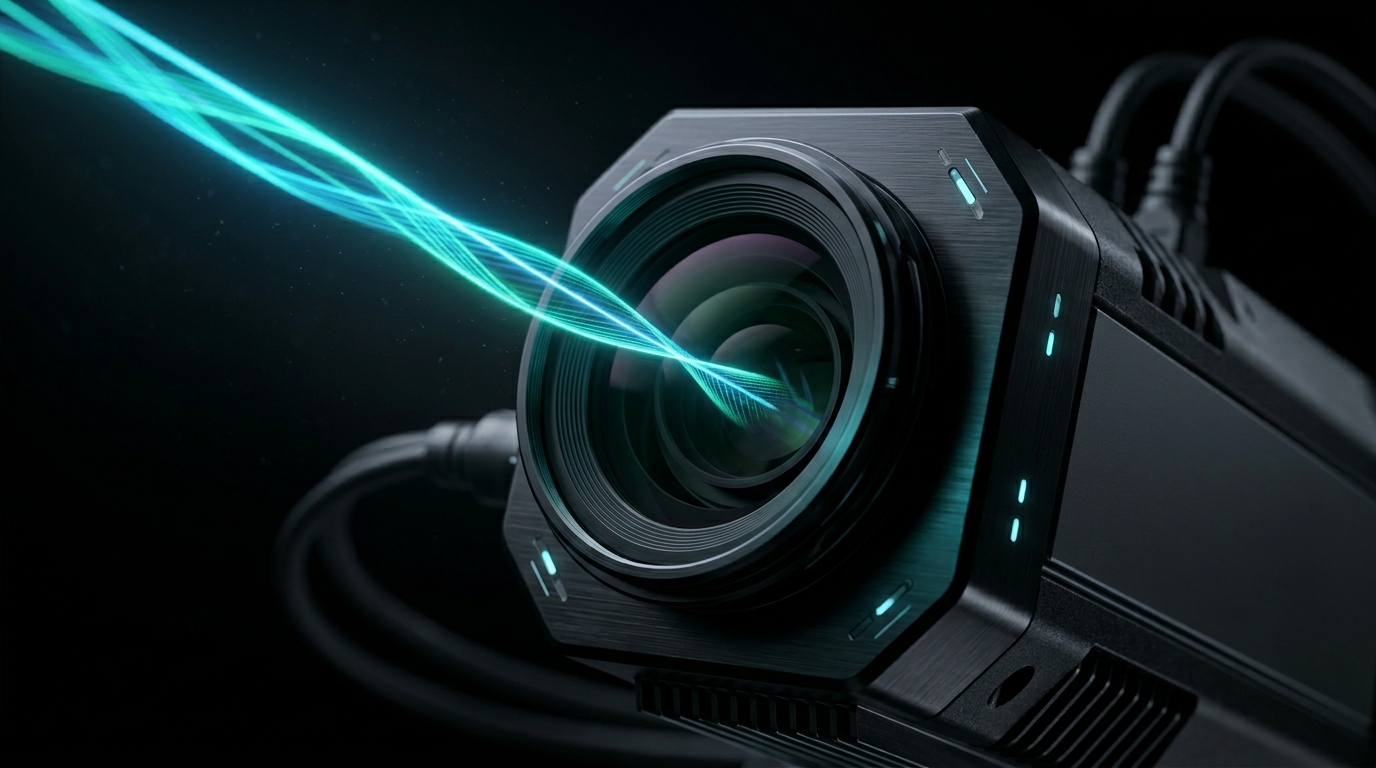
Unidimensional CV-QKD (UD-CVQKD) goes a step further on simplicity. Instead of modulating both quadratures, it restricts modulation to a single quadrature, cutting implementation complexity at the transmitter. The system studied here pairs that simplification with a free-space optical channel and a stabilization trick: it uses polarized coherent states where the signal and the local oscillator (LO) co-propagate in the same spatial mode but in orthogonal polarizations. Sending the LO alongside the signal in the same beam — rather than generating it locally — is what keeps the interference stable enough to measure quadratures reliably through open air.
The noise regime that breaks naive assumptions
The headline stress test is the noise floor. The system operates under a detector electronic-noise regime of 1.4 shot-noise units (SNU). For context, shot noise is the quantum-limited baseline; carrying 1.4 SNU of electronic noise means the detector’s own circuitry contributes more fluctuation than the quantum signal’s fundamental limit. This is precisely the regime where security collapses unless you account for where that noise lives.
The decisive finding is not the key rate — it is that the untrusted-detector model yields no positive secret key rate in this noise regime, while the trusted-detector model recovers a working channel. The hardware is identical; only the assumption about the detector changes. (arXiv:2606.07206)
The logic is straightforward once stated. In the untrusted-detector (UTD) model, all detector electronic noise is conservatively attributed to a potential eavesdropper — Eve could, in principle, be exploiting it. At 1.4 SNU, that conservative accounting leaves no margin for a secure key. In the trusted-detector (TD) model, the detector noise is assumed to originate locally and is excluded from Eve’s information budget. That single reallocation is what opens a finite range of modulation variances over which secure key generation becomes possible — peaking at 270 kbps when the modulation variance is tuned to 11.57.
UTD vs. TD: the comparison that matters
| Parameter | Untrusted Detector (UTD) | Trusted Detector (TD) |
|---|---|---|
| Detector electronic noise attribution | Assumed available to eavesdropper | Assumed local and trusted |
| Secret key rate at 1.4 SNU | 0 (no positive rate) | Up to 270 kbps |
| Optimal modulation variance | N/A (no secure region) | 11.57 |
| Secure operating window | None under high noise | Finite range of modulation variances |
| Channel requirement | — | High-transmittance (low-loss) |
| Trust boundary | Receiver hardware untrusted | Receiver hardware trusted |
Secure operation under these conditions is not unconditional. It requires high-transmittance, low-loss channels in addition to the trusted-detector assumption. Both conditions must hold simultaneously — drop either one and the secure region disappears. (arXiv:2606.07206)
[IMAGE: macro view of a free-space optical receiver aperture with two orthogonally polarized beams converging, signal and local oscillator visualized as entangled cyan and teal light threads against deep black]
Industry Context and Implications
Where this sits in the post-quantum landscape
CV-QKD and post-quantum cryptography (PQC) are complementary, not competing. PQC — the lattice-based and hash-based algorithms moving through NIST standardization — protects data in software against future quantum attack. QKD addresses key exchange at the physical layer. A free-space CV-QKD link like this one is a candidate for high-value, fixed point-to-point links: data-center interconnects, campus backbones, or ground-station links where running fiber is impractical.
The practical message for the next 1–2 years is sober: free-space UD-CVQKD demonstrates real feasibility on standard telecom hardware, but enterprise deployment is constrained to high-transmittance, low-loss channels and requires trusting the detector to obtain any positive key rate under realistic noise. This is a viable building block — with explicit, non-negotiable preconditions.
Over the 3–5 year horizon, the source points to a clear bottleneck: detector electronic noise is the dominant limiting factor for practical CV-QKD. Adoption will track two variables — how comfortable organizations are with the trusted-detector assumption, and how fast noise-tolerant detector hardware improves. Vendors who can lower the electronic-noise floor toward shot-noise-limited operation will be the ones able to offer the more defensible untrusted-detector security model.
The economics of the trust assumption
The cost of inaction on quantum-safe key exchange is the well-documented “harvest now, decrypt later” exposure: encrypted traffic captured today and decrypted once a cryptographically relevant quantum computer exists. But this research surfaces a subtler cost. Choosing a QKD system whose security rests on detector trust transfers risk from your cryptography to your physical supply chain and hardware integrity — a different audit discipline entirely. Budgeting for QKD without budgeting for detector assurance understates the true cost.
The BeQuantum Perspective
The pattern in this research — a security guarantee that silently depends on trusting one hardware component — is exactly the failure mode our architecture is built to surface rather than hide.
When organizations like ours evaluate a key-exchange link whose proof rests on a trusted-detector assumption, the question becomes: how do you prove, after the fact, that the trust boundary held? That is where the BeQuantum Digital Notary fits. Rather than treating “the detector was trusted” as an unverifiable axiom, the Notary timestamps and cryptographically anchors the operational parameters of a key-exchange session — modulation variance, measured noise level, channel transmittance — into a tamper-evident record. If a system is certified to operate only within a finite secure window (here, a bounded range of modulation variances around 11.57), the Notary gives you an auditable trail proving each session stayed inside it.
The BeQuantum PQC Layer addresses the complementary risk: it provides a NIST-aligned software fallback so that a link does not become a single point of cryptographic failure if its physical-layer assumptions degrade — for example, if channel loss rises and pushes the system out of its secure region. And for the detector-trust problem at its root, hardened receiver enclosures in the IceCase line are designed to make the trusted-detector assumption defensible: physical tamper-evidence and environmental control reduce the attack surface that the TD model implicitly assumes away.
The analytical point stands on its own: a 270 kbps key rate is only as strong as the weakest assumption behind it, and in high-noise regimes that assumption is detector trust.
What You Should Do Next
- Within 90 days, inventory every QKD or QKD-adjacent proof-of-concept in your environment and document its security model. For each link, record explicitly whether the security proof assumes a trusted or untrusted detector. If no one can answer, treat that as an open CRITICAL finding — you are relying on an assumption no one has examined.
- Add channel-loss and detector-noise thresholds to your operational monitoring. Because secure operation here requires both low channel loss and a tolerable noise floor, define the loss/transmittance budget your vendor certifies and alert when the link drifts outside it. A QKD link that has silently left its secure region is worse than no QKD link, because it carries false assurance.
- Do not deploy QKD as a standalone control — pair it with a PQC fallback. Given that physical-layer security can evaporate when channel or detector conditions change, maintain a post-quantum software layer so a degraded link fails safe rather than open.
Frequently Asked Questions
Q: Why does the same CV-QKD system produce 270 kbps under one model and zero under another? A: The difference is entirely in how detector electronic noise is attributed. The untrusted-detector model conservatively assigns that noise to a potential eavesdropper, which leaves no security margin at 1.4 shot-noise units. The trusted-detector model treats the noise as local and benign, recovering a secure operating window that peaks at 270 kbps. The optics are unchanged — only the assumption differs.
Q: Is free-space CV-QKD ready for enterprise production today? A: It is demonstrably feasible on standard telecom hardware, but with hard constraints. Near-term deployment is limited to high-transmittance, low-loss channels and requires accepting the trusted-detector assumption to obtain any positive key rate under realistic noise. Treat it as a viable component for specific fixed point-to-point links, not a general-purpose drop-in.
Q: Does this mean detector noise is the real obstacle for practical CV-QKD? A: Yes. The research identifies detector electronic noise as the key limiting factor in practical systems. Progress over the next several years will depend on driving the electronic-noise floor down toward the shot-noise limit, which would let systems rely on the more conservative untrusted-detector model instead of requiring detector trust.
Last updated: June 9, 2026. Primary source: Experimental Demonstration of Free-Space Unidimensional Continuous-Variable Quantum Key Distribution Under High Detector Noise (arXiv:2606.07206).