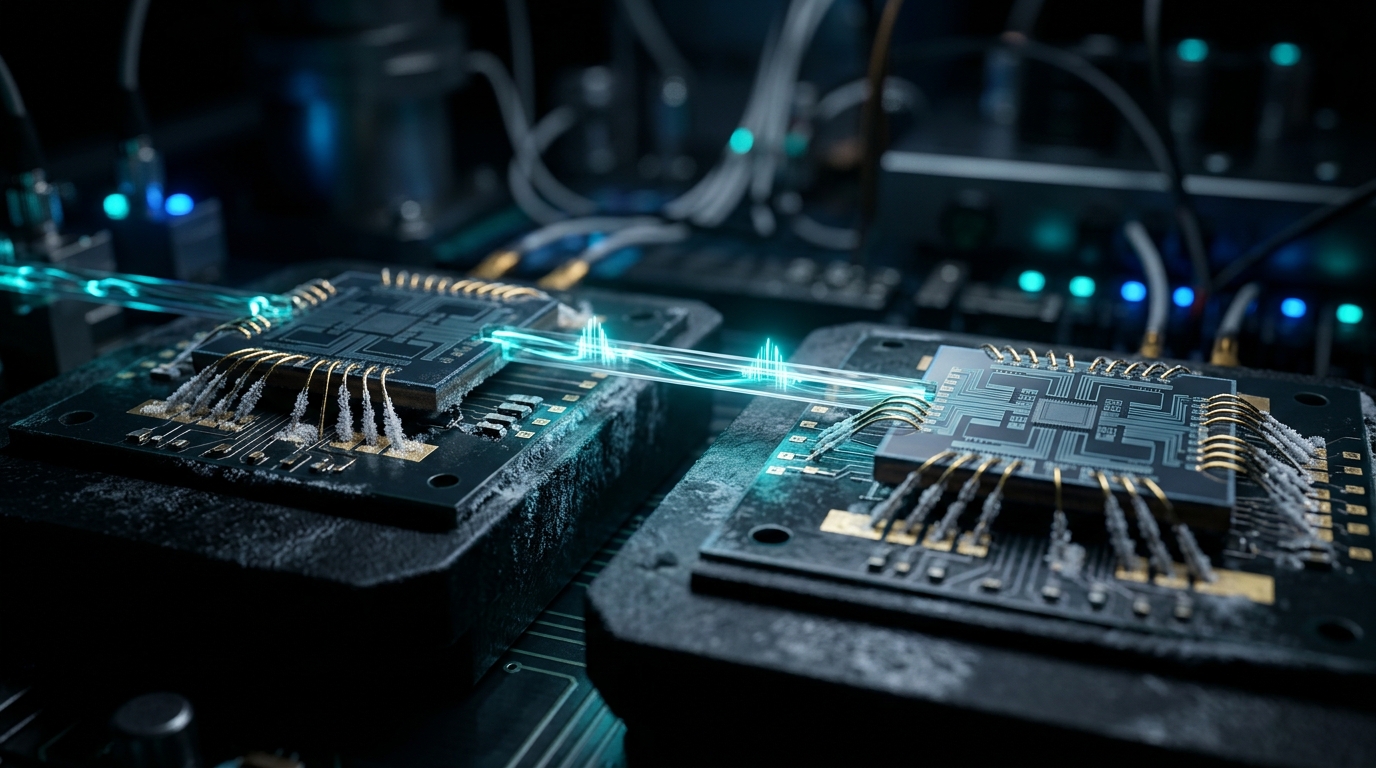

- A September 2025 arXiv preprint (2509.00438v3) demonstrates a fault-tolerant QKD protocol that allows low-cost modulators to operate above their rated bandwidth without opening security loopholes.
- The team reports the lowest correlated modulation deviation among comparable studies, sustaining a high secret key rate on bandwidth-limited hardware.
- For CISOs, this collapses the cost-versus-security tradeoff that has kept Quantum Key Distribution confined to government and finance pilots — making enterprise-scale deployment a procurement question, not a physics problem.
The Overclocking Problem That Has Stalled QKD Deployment
A bank in Frankfurt wants to protect its inter-data-center links against a future cryptographically-relevant quantum computer. The procurement team gets two quotes for a Quantum Key Distribution system. The cheap one uses commodity lithium niobate modulators and runs at a conservative rate that delivers key material too slowly to encrypt high-throughput VPN traffic. The expensive one uses ultra-high-bandwidth modulators that cost more than the rest of the rack combined. The CISO is told to pick one. Neither works.
This is the impossible triangle that has kept QKD out of mainstream enterprise networks for two decades: security, key rate, and cost — pick two. Push a low-cost modulator past its rated bandwidth and the optical pulses it produces start carrying correlations and misalignment artifacts. Those artifacts leak information to an eavesdropper, breaking the unconditional security guarantee that justifies deploying QKD in the first place. Operate the modulator conservatively and the secret key rate drops below what production traffic requires.
The September 2025 arXiv preprint Fault-Tolerant Quantum Key Distribution: Enabling Overclocked Modulation (v3, replacement announcement) attacks this problem head-on. The authors propose a protocol that tolerates the modulation imperfections introduced by overclocking — and they back it with an experimental setup that, by their measurement, achieves the lowest correlated deviation reported in comparable studies.
Why Modulation Bandwidth Is QKD’s Hidden Bottleneck
What “overclocking” means in a quantum context
In a discrete-variable QKD system, each transmitted bit corresponds to a precisely shaped optical pulse with a specific polarization or phase. The electro-optic modulator that imprints those quantum states onto the laser carrier has a manufacturer-specified bandwidth. Drive it within spec and each pulse is independent and indistinguishable from its neighbors in every dimension except the encoded bit. Drive it faster than spec — overclock it — and the pulses start to bleed into each other.
That bleeding takes two forms the paper specifically calls out:
- Inter-symbol correlations: the state of pulse N partially depends on pulse N-1, violating the independence assumption baked into every QKD security proof.
- Misalignment: the modulator can’t fully settle between symbols, so the encoded state drifts from its ideal Bloch-sphere position.
Both give an eavesdropper a side channel. In standard QKD security analysis, any deviation from the assumed source model is treated as potential information leakage — and the secret key rate is reduced accordingly, sometimes to zero.
Why the obvious fixes don’t work
The expensive fix is to buy modulators rated for the operating frequency. Ultra-high-bandwidth lithium niobate or thin-film modulators exist but, as the paper notes, are “expensive for practical implementation.” The cheap fix is to slow down, but then “operating at a conservative rate fails to exploit the system’s potential” — meaning the key rate falls below what enterprise applications need.
The protocol-level solution
The authors take a third path: keep the cheap modulator, run it fast, and change the protocol to characterize and compensate for the resulting imperfections. They develop two practical techniques to characterize and mitigate the detrimental correlations introduced by overclocking, then fold those measurements into the security proof. The result is a fault-tolerant protocol whose key rate accounts for — rather than is destroyed by — the modulator’s real behavior.
Comparison: Conventional QKD vs. Fault-Tolerant Overclocked QKD
| Dimension | Conventional QKD | Fault-Tolerant Overclocked QKD (arXiv:2509.00438v3) |
|---|---|---|
| Modulator cost | High — requires components rated above operating frequency | Low — commodity components driven beyond rated bandwidth |
| Modulation correlations | Assumed negligible; protocol fails if violated | Characterized and mitigated; folded into security proof |
| Secret key rate vs. hardware cost | Strict tradeoff | Decoupled — high rate on low-cost hardware |
| Security against source-side attacks | Vulnerable if modulator overclocked | Tolerant to characterized modulation imperfections |
| Path to higher performance | Buy more expensive modulators | Same protocol benefits when paired with high-bandwidth components |
| Reported correlated deviation | Varies; not always characterized | Lowest among comparable studies (per authors) |
“By simultaneously enhancing security, performance, and practicality, this work releases QKD systems from the traditional performance-cost trade-off in the near term, paving the way for widespread deployment.” — arXiv:2509.00438v3
Industry Context: Where This Lands in the Post-Quantum Roadmap
The regulatory clock is the forcing function
NIST finalized its first post-quantum cryptography standards (ML-KEM, ML-DSA, SLH-DSA) in August 2024, and U.S. federal agencies are operating under NSM-10 timelines that require cryptographic inventories and migration plans now. QKD is not a substitute for PQC — the NSA has been explicit that it does not recommend QKD for national-security systems on its own — but for organizations facing “harvest now, decrypt later” threats against long-lived secrets, layering QKD-derived key material with PQC algorithms is increasingly a defensible architecture.
The bottleneck for that layered approach has not been the algorithms. It has been the hardware economics of QKD itself.
Market adoption: who’s already moving
Telecoms in China, South Korea, and parts of the EU have stood up metropolitan QKD networks. The European Quantum Communication Infrastructure (EuroQCI) initiative is building a continent-wide QKD backbone. Financial institutions including JPMorgan Chase and Toshiba have run production pilots. What every one of these deployments has in common: per-link hardware costs that prevent scaling beyond a small number of high-value circuits.
The economic shift this preprint signals
If the protocol described in arXiv:2509.00438v3 generalizes — and the authors note it can be “integrated with high-bandwidth components to further push system performance boundaries” — then the optical bill of materials for a QKD link drops materially. That changes the question from “can we afford one QKD link between our two most critical sites?” to “can we afford to put QKD on every backbone link?”
The BeQuantum Perspective: Where Fault-Tolerant QKD Fits the Stack
Fault-tolerant overclocked QKD does not replace post-quantum cryptography. It complements it. The PQC algorithms standardized by NIST defend against quantum attacks at the computational layer. QKD defends key material at the physical layer with information-theoretic security. The two layers fail differently, which is why a defense-in-depth architecture wants both.
The practical question for security architects is how to verify and audit the key material flowing out of a QKD system into the rest of the enterprise key-management plane. This is where BeQuantum’s Digital Notary approach matters: every key-establishment event from a QKD link can be anchored to a tamper-evident blockchain record, so a compliance auditor can later prove that key K was generated at time T by device D operating within its certified parameters. Pair that with BeQuantum’s PQC Layer for the upper-stack key encapsulation and signature operations, and you get a system where the QKD hardware can be swapped, overclocked, or upgraded without breaking the audit trail.
The specific implication of the arXiv:2509.00438v3 work for that stack: the modulator characterization data the protocol requires is itself a useful audit artifact. If you’re going to measure correlated deviation to keep your security proof valid, you may as well notarize those measurements. That gives the CISO something they have never had with QKD before — a cryptographic record that the physical layer was operating in spec at the moment a given key was generated.
What You Should Do Next
-
Within 90 days — inventory long-lived secrets. Identify the data your organization encrypts today that must remain confidential for 10+ years (intellectual property, M&A records, regulated PII, source code signing keys). These are your harvest-now-decrypt-later exposure. The QKD economics shift in this paper only matters for assets on this list.
-
Within 6 months — talk to your QKD vendors about modulator specifications. If you have an active QKD pilot or are evaluating one, ask the vendor specifically: what is your modulator’s rated bandwidth, what repetition frequency are you driving it at, and how do you characterize modulation correlations in your security proof? Vendors who cannot answer cleanly are running on assumptions the field is now retiring.
-
Within 12 months — architect for hybrid PQC + QKD key material. Even if you don’t deploy QKD in 2026, design your key-management system so that key material from a future QKD link can be combined with PQC-derived keys without re-architecting the application layer. The cost of that flexibility is low today; retrofitting later is expensive.
FAQ
Q: Does fault-tolerant overclocked QKD replace post-quantum cryptography? A: No. PQC defends against quantum attacks on computational-security algorithms (key exchange, signatures) at the protocol layer. QKD defends key material at the physical layer with information-theoretic security. They address different failure modes and the strongest architectures use both.
Q: Is the arXiv:2509.00438 protocol production-ready? A: It is a v3 preprint with an experimental demonstration, not a productized system. The authors report the lowest correlated deviation in comparable studies but do not publish specific secret-key-rate figures, transmission distances, or commercial-deployment timelines. Treat it as a strong signal of where commercial QKD is heading, not a procurement spec.
Q: What should we do if our QKD vendor cannot characterize modulation correlations? A: Ask them in writing. Vendor inability to quantify modulator behavior at the operating frequency means their security proof depends on assumptions the published literature is now challenging. That is a procurement red flag worth escalating to the security-architecture review board.
Last updated: 2026-05-28
[IMAGE: macro photograph of an electro-optic modulator chip with overlaid blue and cyan light traces showing quantum pulse trains, dark background with deep blacks and teal accents]