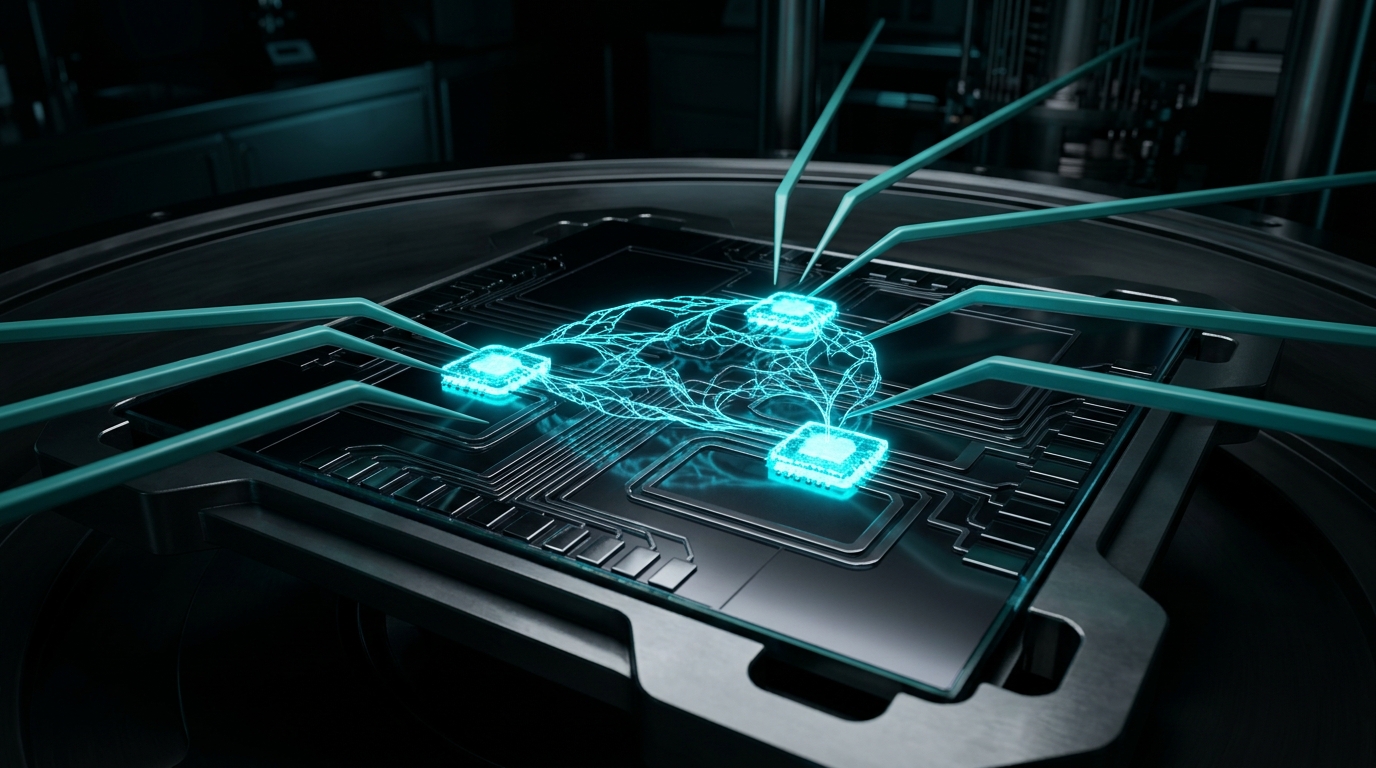
- A new arXiv preprint (2507.22112v2) demonstrates a purely geometric two-qubit swap gate in neutral atoms with a loss-corrected amplitude fidelity of 99.91(7)%, measured across more than 17,000 atom pairs.
- The gate exploits fermionic exchange anti-symmetry and qubit doublon states to suppress dynamical phase errors — protection intrinsic to the Hamiltonian, not bolted on by control engineering.
- For CISOs: another credible step toward cryptographically relevant quantum computers. If your harvest-now-decrypt-later threat model still assumes a 10-year runway, this paper is a reason to recheck the assumption.
The Problem: Your Encrypted Traffic Is Already Being Archived
Nation-state adversaries are recording TLS 1.3 handshakes today on the assumption they can break them later. Every RSA-2048 key exchange, every ECDH P-256 session, every long-lived signing certificate sitting in your PKI is on borrowed time. The only open variable is when a sufficiently large, sufficiently low-error quantum processor arrives.
The consensus answer used to be “sometime in the 2030s.” That estimate is being revised downward almost every quarter as gate fidelities climb past the surface-code threshold of ~99% on multiple hardware platforms. The arXiv preprint “Protected quantum gates using qubit doublons in dynamical optical lattices” (arXiv:2507.22112v2) is the latest data point in that revision.
The paper does not announce a cryptographically relevant machine. It announces something more structurally important: a gate whose error suppression comes from the physics of the system rather than from increasingly elaborate calibration. Geometric protection of this kind is precisely what scaling quantum computers to millions of physical qubits requires — and what shortens the timeline to RSA-breaking machines.
If your post-quantum migration plan still treats 2035 as a soft deadline, you are now planning against an evidence base that is roughly 18 months old.
Technical Deep-Dive: Geometry as a Resource, Not a Side Effect
What the paper actually proposes
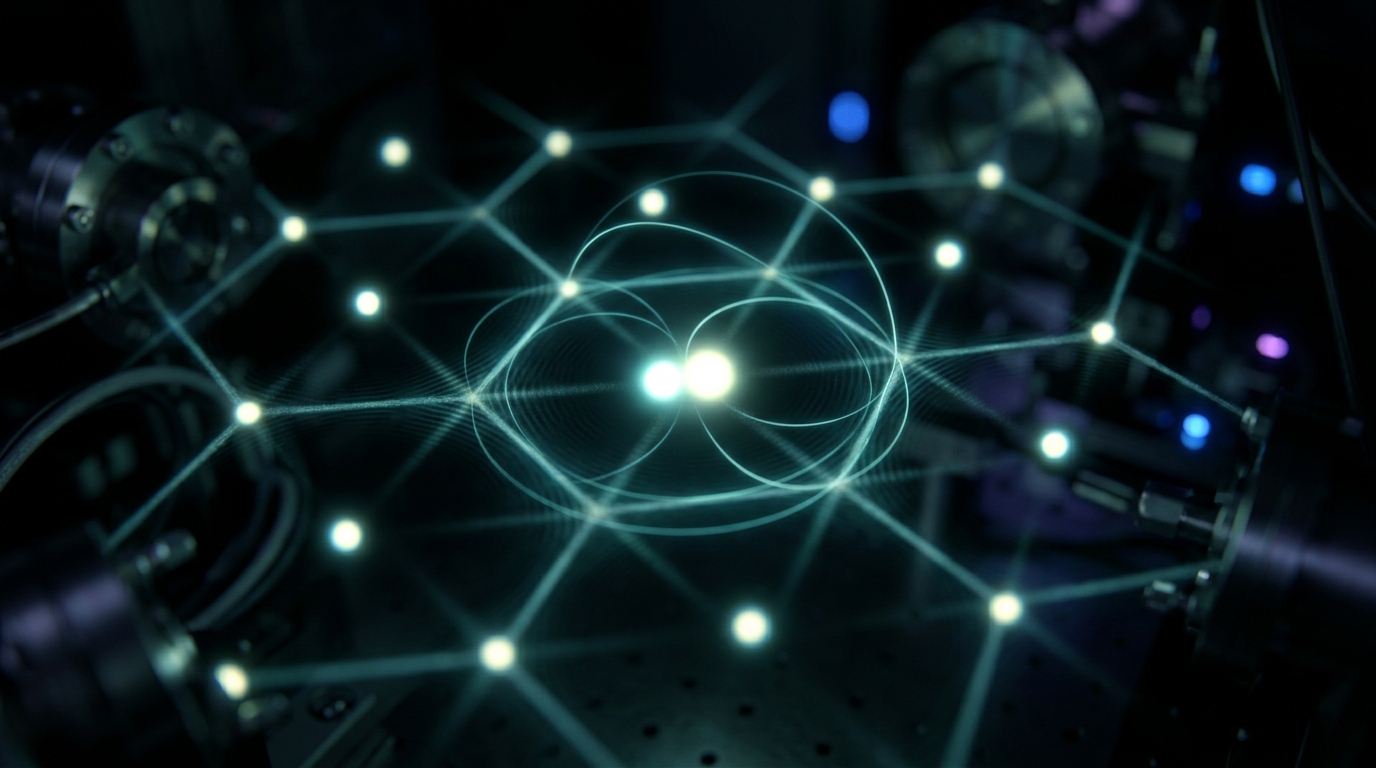
The authors implement a two-qubit swap gate by transiently populating qubit doublon states of fermionic neutral atoms confined in a dynamical optical lattice. A doublon is a configuration in which two fermions briefly occupy the same lattice site. Because the atoms are fermions, exchange anti-symmetry forces the system through a geometric trajectory in Hilbert space — a two-particle quantum holonomy — in which dynamical phases cancel out.
The practical consequence: the accumulated gate operation depends on the path through parameter space, not on the speed or precise shape of the path. Fluctuations in trap depth, lattice intensity, or atomic interaction strength — the dominant error sources in optical-lattice experiments — leave the holonomic phase untouched.
Why this differs from prior collisional gates
Previous ultracold-collision gates in optical lattices were treated as dynamically fine-tuned processes. Researchers swept interaction times and pulse amplitudes to land on a target unitary, with fidelity capped by the engineer’s ability to stabilize every Hamiltonian parameter. That approach buries the underlying quantum geometry and statistics under a calibration problem.
The doublon-based scheme inverts that. The geometric structure is the gate; calibration removes residual leakage rather than synthesizing the target operation.
The result: “We experimentally validate this exceptional protection, achieving a loss-corrected amplitude fidelity of 99.91(7)% measured across the entire system consisting of more than 17,000 atom pairs.” — arXiv:2507.22112v2
Fidelity stated at this precision across a 17,000-pair ensemble is a different claim than a single best-case gate. It implies that the protection mechanism is uniform across the lattice — exactly the property required for scalable, parallel gate operation.
Comparison: dynamical vs. geometric two-qubit gates
| Property | Conventional collisional gate | Doublon holonomic swap (this work) |
|---|---|---|
| Source of operation | Fine-tuned dynamical evolution | Geometric (holonomic) path |
| Sensitivity to trap inhomogeneity | High — requires per-site calibration | Suppressed by construction |
| Symmetry protection | Engineered externally | Intrinsic (time-reversal + chiral) |
| Demonstrated amplitude fidelity | Platform-dependent, typically <99.5% | 99.91(7)% loss-corrected |
| Ensemble size validated | Small sub-arrays | >17,000 atom pairs |
| Scaling enabler | Better control hardware | Better physics |
Symmetry as a second line of defense
The Hamiltonian governing the gate carries time-reversal and chiral symmetries. These constrain the spectrum and forbid certain error channels regardless of how noisy the control fields become. This is the same conceptual toolkit that underlies topological qubits — applied here as a hardening layer for a more conventional architecture.
For a CISO, the analogy is defense-in-depth: the gate is protected once by geometry, again by symmetry, and a third time by the standard error-correction layer that will sit on top.
Industry Context: Where the Quantum Timeline Is Moving
The threshold question
Fault-tolerant quantum computing requires physical gate error rates below the surface-code threshold (~1%, with practical targets closer to 0.1%). A 99.91% amplitude fidelity sits comfortably in that regime — though amplitude fidelity is not the same as full process fidelity, and the data gaps in the preprint matter (see below).
The neutral-atom platform is consolidating
Neutral-atom quantum computing — pioneered commercially by QuEra, Atom Computing, and Pasqal — has moved from “interesting alternative” to “credible contender” within roughly 24 months. Atom Computing announced a 1,180-qubit system in October 2023. QuEra committed to a 10,000-qubit roadmap by 2026. The doublon result strengthens the platform’s claim by adding a gate primitive whose protection scales with system size rather than degrading.
Combined with topological pumping methods for atom transport — a technique the paper explicitly identifies as the missing piece — neutral atoms acquire the two ingredients large-scale processors need: a protected gate and a way to route qubits between gate sites without losing them.
Regulatory pressure is already here
- NIST finalized FIPS 203 (ML-KEM), FIPS 204 (ML-DSA), and FIPS 205 (SLH-DSA) in August 2024. These are the production PQC standards. Migration is no longer a research project.
- CNSA 2.0 (NSA’s Commercial National Security Algorithm Suite) requires PQC for National Security Systems by 2035, with software/firmware signing transitions starting 2025.
- EU NIS2 and sector-specific guidance (financial services, critical infrastructure) increasingly reference cryptographic agility as an explicit control.
The enterprise calculus has shifted from whether to migrate to how fast the inventory, prioritization, and replacement cycles can run.
The BeQuantum Perspective: Geometric Protection Mirrors Cryptographic Layering
The doublon scheme works because it stacks defenses: geometric phase cancellation, time-reversal symmetry, chiral symmetry, and (eventually) error correction. Each layer assumes the others may fail. That is precisely the model post-quantum cryptography deployments need to adopt at the application layer.
In practice, this means treating the migration as an opportunity to introduce cryptographic agility as a permanent property — not as a one-time swap from RSA to ML-KEM. Organizations working with the BeQuantum PQC Layer structure deployments around three commitments:
- Hybrid key exchange by default. Classical (ECDH) + PQC (ML-KEM-768) in parallel during the transition window. If either primitive falls, the session survives.
- Notarized algorithm provenance. Every signing operation records the algorithm, parameter set, and key fingerprint to an append-only ledger via the Digital Notary, so a future audit can answer “which assets were signed with quantum-vulnerable keys, and when?” — a question most PKIs cannot currently answer.
- Hardware root of trust isolation. Long-lived signing keys (firmware, code-signing, root CAs) move into IceCase hardware modules with PQC-ready firmware update paths, because these are the keys with the longest harvest-now-decrypt-later exposure.
The doublon paper is not a BeQuantum customer story. It is a reminder that the physics side of the timeline keeps validating the same conclusion the cryptography side reached two years ago: protection has to be intrinsic, layered, and auditable.
What You Should Do Next
- Within 90 days: Inventory every TLS endpoint, code-signing certificate, and long-lived JWT signing key. Tag each by algorithm, key length, and remaining validity. Anything still on RSA-2048 with a >2030 expiry is the first migration target.
- Within 6 months: Pilot hybrid key exchange (X25519 + ML-KEM-768) on at least one production-adjacent service. Measure handshake latency, certificate chain size, and load-balancer compatibility. The operational surprises always exceed the cryptographic surprises.
- Within 12 months: Establish a cryptographic bill of materials (CBOM) process tied to your SBOM. Treat algorithm dependencies as first-class software dependencies with their own deprecation policy.
FAQ
Q: Does a 99.91% two-qubit gate mean RSA is broken? A: No. Breaking RSA-2048 requires roughly 20 million physical qubits with gates at this fidelity or better, integrated into a fault-tolerant architecture. The doublon result is a building block, not a finished machine. It does, however, remove one of the standing arguments that neutral-atom platforms could not reach the required gate quality at scale.
Q: Should we wait for hardware-validated PQC before migrating? A: No. The NIST standards (ML-KEM, ML-DSA, SLH-DSA) are finalized and software implementations are production-ready. The risk of waiting is harvest-now-decrypt-later exposure on traffic captured today. The risk of migrating now is operational complexity, which is manageable with hybrid deployments.
Q: How does geometric protection in quantum hardware affect cryptographic threat models? A: It compresses the timeline confidence interval. Each demonstration of intrinsically protected gates makes the optimistic end of the “when will fault-tolerant QC arrive” distribution more credible. CISOs should plan against the 25th-percentile estimate, not the median.
Last updated: 2026-05-29 Source: Protected quantum gates using qubit doublons in dynamical optical lattices, arXiv:2507.22112v2