- New analysis (arXiv:2603.06513v2) finds lattice-surgery operations at logical qubit boundaries tolerate significantly higher error rates than prior work assumed — enough that some quantum networks can skip entanglement distillation entirely.
- Below a fidelity crossover point, distillation reduces resource overhead by up to two orders of magnitude (~100x); above it, the no-distillation path reduces overhead by more than half.
- This lowers the engineering bar for networking quantum processors, reinforcing that the modular-scaling roadmap driving your post-quantum migration is an engineering schedule, not a thought experiment.
Why a Quantum Networking Paper Belongs on Your Risk Register
Your post-quantum migration plan rests on one load-bearing assumption: that a cryptographically-relevant quantum computer arrives in years, not decades. That assumption is only as credible as the engineering roadmap underneath it — and the hardest unsolved problem on that roadmap is not building a better qubit. It is wiring enough of them together.
Monolithic quantum chips hit a ceiling. Control wiring, cooling, and crosstalk all worsen as you pack more qubits onto one device. The escape route the field has converged on is distributed quantum computing: link many smaller processors into one logical machine using photons to carry entanglement between them. Get this right and you scale by adding modules — the way hyperscalers scaled data centers by adding racks instead of building one impossibly large server.
The catch has always been quality. Remote entanglement — the remote Bell pairs that glue two processors together — arrives noisy. The textbook fix is entanglement distillation: burn many low-quality pairs to manufacture one high-quality pair. It works, but the overhead is brutal, and overhead is exactly what stops a lab demo from becoming a fleet.
Here is why this matters to a security organization that does not own a single qubit: every credible quantum threat model — including harvest-now-decrypt-later, where adversaries record your encrypted traffic today to break it once hardware matures — is timed off the scaling roadmap. A result that removes a major scaling bottleneck moves that clock. State the honest boundary up front: this source is an architecture and resource-optimization study. It makes no claim about breaking RSA or ECC and states no timeline for cryptographically-relevant scale. Its value to you is as a leading indicator, not a breach alert.
Technical Deep-Dive: To Distill, or Not to Distill
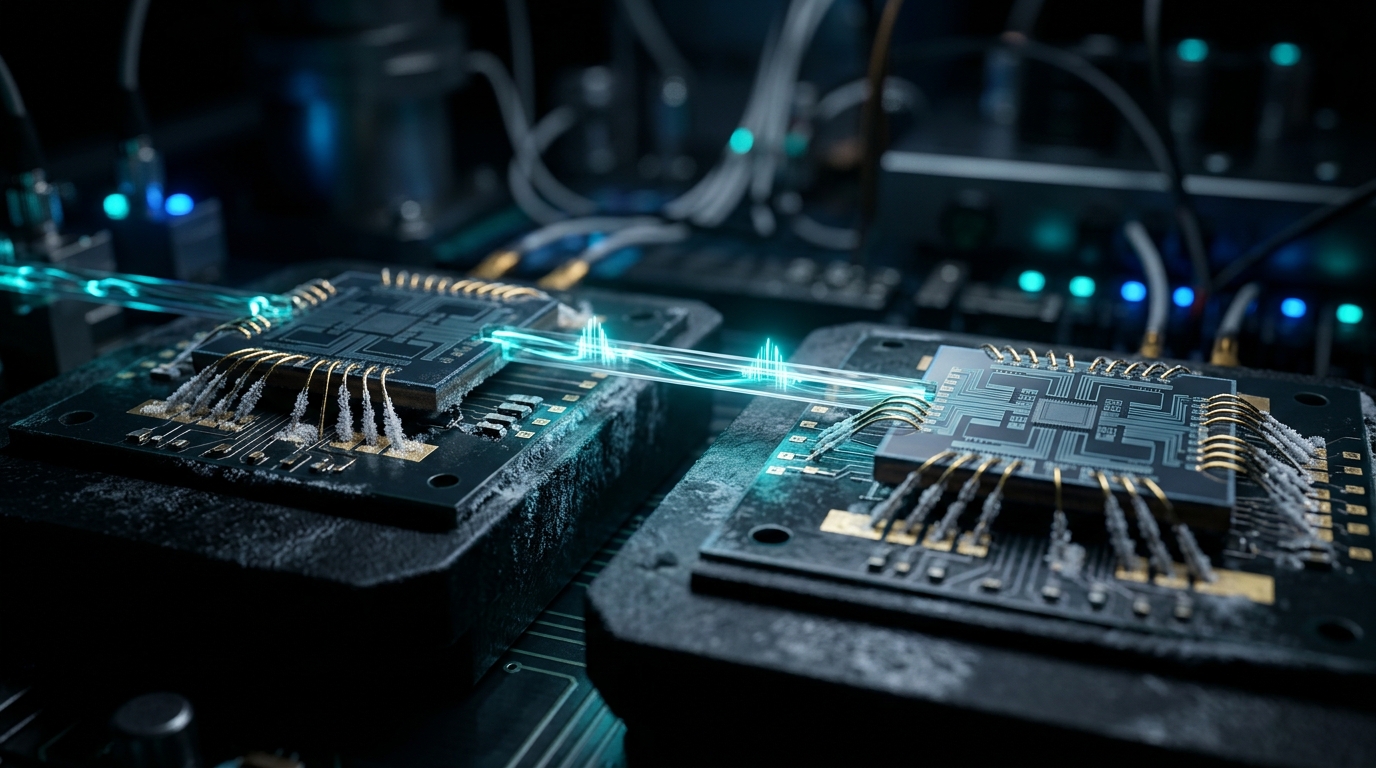
[IMAGE: Two cryogenic quantum processor modules joined by a glowing photonic link, faint entangled light beams bridging two surface-code lattices]
The mechanism in plain terms
Lattice surgery is the operation that merges and splits patches of a surface code — the dominant error-correction scheme — to perform logical operations at the boundary between two encoded qubit patches. In a distributed machine, that boundary is exactly where two separate processors meet over a photonic link. So the fidelity you need at the link is set by how much error lattice surgery can absorb at that boundary.
The prior consensus assumed the boundary was fragile: remote Bell pairs had to be distilled to high fidelity before use, paying the distillation tax on every link operation. The new result challenges that premise directly.
“Recent results show lattice-surgery operations at logical qubit boundaries tolerate significantly higher error rates than previously assumed.” — arXiv:2603.06513v2
If the boundary is more tolerant than believed, distillation is sometimes wasted effort — you are paying to clean up noise the error-correction layer would have absorbed anyway.
The crossover point
The paper quantifies the trade-off between distillation overhead and surface-code distance under realistic constraints: entanglement that is generated probabilistically (you do not get a Bell pair on demand) and quantum memory that decoheres while you wait. Those two constraints are what separate a whiteboard result from a buildable system.
The finding is a fidelity crossover point that cleanly partitions the design space into two regimes:
“Below this threshold, the distillation strategy dominates, reducing resource overhead by up to two orders of magnitude. Above it, no-distillation becomes the more efficient choice, reducing resource overhead by more than half.” — Abstract, arXiv:2603.06513v2
In plain terms: if your physical link is poor, distill — the cleanup pays for itself roughly 100x over. If your link is already good, distillation is counterproductive; skip it and reclaim more than half your overhead. There is no single correct answer, only a correct answer per link quality.
Comparison: the two regimes
| Dimension | Distillation strategy | No-distillation strategy |
|---|---|---|
| Best when | Link fidelity is below the crossover point | Link fidelity is above the crossover point |
| Resource-overhead effect | Reduces overhead up to ~100x (two orders of magnitude) | Reduces overhead >50% |
| What you spend | Many raw Bell pairs consumed to purify one | Raw pairs used directly at the boundary |
| Surface-code distance | Can run at lower distance given high post-distillation fidelity | May need higher distance to absorb link noise |
| Main risk | Overhead explosion if raw fidelity is very low | Logical error rate if link noise exceeds boundary tolerance |
| Hardware fit | Ion-trap and neutral-atom platforms | Ion-trap and neutral-atom platforms |
The practical payload is a set of joint design guidelines: link engineers (photonic interconnects) and error-correction architects (fault-tolerant code distance) can co-optimize instead of each over-provisioning in isolation. That co-design is how the overhead numbers above get realized rather than theorized.
Industry Context: What Moves and What Doesn’t
The regulatory clock is already running
Standards bodies have stopped hedging. NIST finalized its first post-quantum standards — FIPS 203 (ML-KEM), FIPS 204 (ML-DSA), and FIPS 205 (SLH-DSA) — in August 2024. NIST transition guidance (IR 8547, draft) signals that 112-bit-strength classical algorithms such as RSA-2048 should be deprecated after 2030 and disallowed after 2035. Those dates were set against an expected hardware trajectory. Research that de-risks distributed scaling is precisely the kind of input that keeps regulators from relaxing those deadlines.
What this paper changes — and what it doesn’t
What changes: the engineering bar for networking quantum processors drops, because one expensive subsystem (universal distillation) becomes optional across part of the design space. If validated experimentally, that nudges modular ion-trap and neutral-atom machines along faster.
What does not change: nothing here is a cryptographic capability. The source reports only relative overhead reductions, gives no absolute qubit counts, no numerical value for the crossover threshold itself, and no deployment timeline. Treat any headline linking this single paper to quantum breaking encryption as unsupported by the material.
The cost of inaction is asymmetric. Migrating cryptography is a multi-year program you control; a decryption event on harvested data is a breach you discover after the fact. The rational response to a faster scaling roadmap is to compress your migration schedule, not to wait for proof.
The BeQuantum Perspective
We read architecture papers like this one as schedule intelligence. When a structural bottleneck in quantum scaling loosens, the prudent assumption is that the window for completing a clean cryptographic migration narrows — even when the paper itself, correctly, claims nothing about cryptography.
That shapes how we build. Our PQC Layer deploys NIST-standardized ML-KEM and ML-DSA in hybrid mode alongside classical algorithms, so traffic is protected against harvest-now-decrypt-later capture today while preserving interoperability with systems that have not yet migrated. The goal is crypto-agility: when a threshold result like this one shifts the timeline, you change a policy, not a protocol stack.
Our Digital Notary anchors signed attestations so the provenance and integrity of records stay verifiable across an algorithm transition — the moment you rotate signature schemes, you need proof that what was signed under the old scheme has not been altered. And IceCase keeps long-lived key material in hardware isolation, shrinking the attack surface during the most exposed phase of any migration: the cutover. None of this requires betting on a specific quantum milestone. It requires assuming the milestones keep arriving — which is exactly what steady architecture progress like this implies.
What You Should Do Next
- Within 90 days, complete a cryptographic inventory. Map every TLS certificate chain, code-signing key, VPN tunnel, and data-at-rest scheme to its algorithm and key length. You cannot migrate what you have not enumerated, and harvest-now-decrypt-later already taxes data with a long confidentiality lifetime.
- Pilot hybrid PQC on one externally-facing service this quarter. Deploy ML-KEM in hybrid key exchange on a non-critical endpoint, measure the handshake latency delta, and document the operational playbook before you need it at scale.
- Set your internal deadline ahead of NIST’s. Treat 2030 as the disallow date, not the start date. Back-plan a migration that finishes with margin, and revisit the schedule whenever scaling research — like this lattice-surgery result — signals the hardware curve is steepening.
FAQ
Q: Does this research mean quantum computers can break encryption sooner? A: Not directly. The paper optimizes how to network quantum processors and makes no claim about breaking RSA, ECC, or any cipher, and gives no timeline for cryptographically-relevant scale. Its relevance is indirect: by easing a scaling bottleneck, it supports — rather than weakens — the assumption that capable hardware keeps advancing on schedule.
Q: What is entanglement distillation, and why would you skip it? A: Distillation consumes many noisy remote Bell pairs to produce one high-fidelity pair, at heavy overhead. The paper shows that when physical link fidelity is already above the crossover point, lattice surgery tolerates the raw noise, so skipping distillation cuts resource overhead by more than half. Below that point, distillation still wins by up to ~100x.
Q: Should CISOs act on a single preprint? A: Act on the trend, not the paper. No PQC migration decision should hinge on one arXiv preprint, but a steady stream of results lowering the cost of quantum scaling is the signal to keep your migration timeline aggressive and your cryptography crypto-agile.
Last updated: 2026-05-25. Primary source: “Remote Entanglement in Lattice Surgery: To Distill, or Not to Distill,” arXiv:2603.06513v2.