
- A Digital Annealer (DA)-assisted transpilation framework cuts CNOT gate counts by an average of 13.7% — up to 57.4% — versus Qiskit’s highest optimization level (arXiv:2605.11500v1).
- In “Full DA” mode, it outperforms the ISAAQ baseline by 23.1% on average and 90.8% at peak on structured circuits.
- Fewer CNOT errors mean more usable quantum hardware — a leading indicator on the “harvest now, decrypt later” clock that should pace your post-quantum migration.
Why Quantum Gate Fidelity Belongs on Your Risk Register
The encrypted records you cannot afford to leak in 2035 are being collected today. Adversaries run “harvest now, decrypt later” operations: capture RSA- and ECC-protected traffic now, archive it, and decrypt it once a cryptographically-relevant quantum computer exists. Effectively all public-key infrastructure in production relies on RSA or elliptic-curve cryptography, and Shor’s algorithm breaks both in principle. The variable that sets the timeline is quantum hardware fidelity — how accurately a processor executes a deep circuit before noise corrupts the result.
The research in arXiv:2605.11500v1 does not address cryptography. It attacks the layer beneath it: compiling a quantum algorithm onto noisy hardware with the fewest error-prone operations. That problem sits directly upstream of the threat security teams track, which is why the result deserves a CISO’s attention even though the paper never mentions a cipher.
In the Noisy Intermediate-Scale Quantum (NISQ) era, the two-qubit CNOT gate is the dominant error source. Limited qubit counts and high gate error rates cap how complex a circuit can run before its output degrades into noise. The paper frames CNOT minimization as the central lever: cut the CNOT count, and you raise the fidelity ceiling of every algorithm the hardware runs — including, eventually, the algorithms that threaten public-key cryptography.
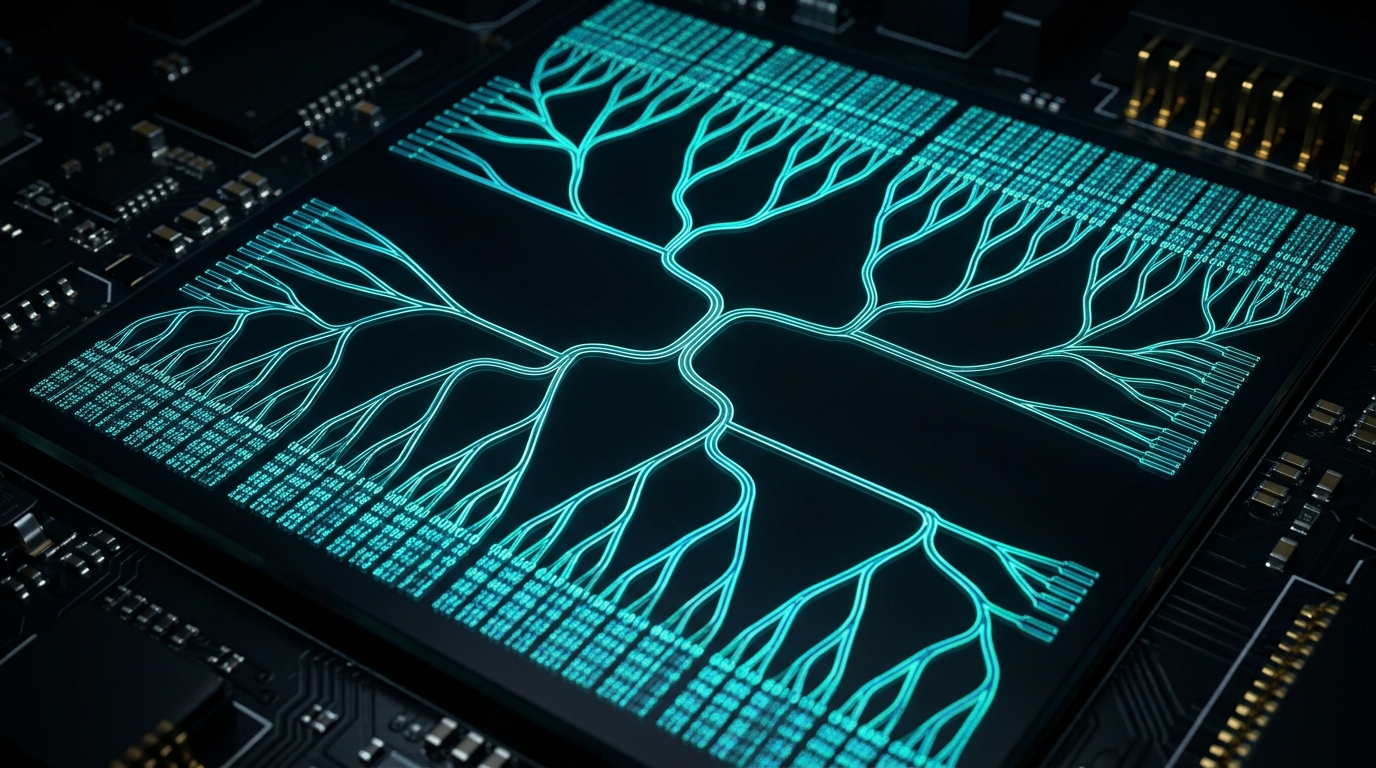
[IMAGE: macro view of a superconducting quantum processor lattice with glowing interconnect paths being rerouted, faint entangled light threads thinning out to represent reduced CNOT gates]
How Digital Annealer-Assisted Transpilation Works
Quantum circuit transpilation rewrites an abstract algorithm into an equivalent circuit that respects a specific processor’s physical constraints — its qubit connectivity (coupling map) and native gate set. Two stages dominate: mapping assigns logical qubits to physical qubits, and routing inserts SWAP operations so interacting qubits become physically adjacent. Each SWAP decomposes into three CNOT gates, so weak mapping and routing inflate the CNOT count and erode fidelity.
The framework reformulates this as a QUBO problem. QUBO (Quadratic Unconstrained Binary Optimization) expresses a task as minimizing a quadratic function over binary variables. The Digital Annealer is dedicated hardware that searches QUBO solution spaces far faster than a general-purpose CPU, which lets the method evaluate global placements that heuristic compilers skip.
Two strategies, one trade-off
The framework deploys the Digital Annealer through two complementary strategies:
- Hybrid — the DA computes a global initial mapping, then Qiskit’s high-speed heuristic router handles SWAP insertion. The expensive global search runs once, where it pays off most.
- Full DA — both mapping and routing are encoded as separate DA-assisted QUBO subproblems inside an iterative workflow, pushing global optimization deeper into the pipeline.
The Hybrid strategy achieves an average CNOT reduction of 13.7% — and as much as 57.4% — against Qiskit’s highest optimization level, with the largest gains on structured circuits such as GHZ and ASP where the initial layout is decisive.
The Full DA strategy matches Hybrid on those structured circuits and outperforms the ISAAQ baseline by 23.1% on average, reaching 90.8% at peak. The catch is stated plainly: Full DA degrades on circuits with random or concentrated connectivity, and encoding an entire circuit in a single annealing pass forces a trade-off between QUBO size and solution quality. Global optimization also costs more compute time than pure heuristics.
Why structured circuits win
GHZ circuits build a maximally entangled state across all qubits; ASP (adiabatic state preparation) circuits encode a regular, structured interaction pattern. Both have predictable connectivity, so a single well-chosen global layout pays dividends across the entire circuit — exactly the regime where the Digital Annealer’s global search beats greedy heuristics. Random or concentrated connectivity offers no such global structure to exploit, which is why Full DA’s advantage collapses there. The method is sharp, not universal.
Comparison table
| Strategy | Mechanism | Benchmark result | Best for | Trade-off |
|---|---|---|---|---|
| Qiskit (highest opt level) | Heuristic mapping + routing | Baseline | General circuits | Misses globally optimal layouts |
| Hybrid (DA + Qiskit) | DA global initial mapping, Qiskit routing | 13.7% avg CNOT reduction (max 57.4%) vs Qiskit | Structured circuits (GHZ, ASP) | Higher compile latency than pure heuristics |
| Full DA | DA-assisted QUBO mapping and routing, iterative | 23.1% avg better than ISAAQ (max 90.8%) | Structured circuits, high-precision runs | Degrades on random/concentrated connectivity; QUBO size vs quality tension |
| ISAAQ | Prior QUBO-based approach | Reference baseline for Full DA | — | Outperformed by Full DA on average |
Note the two baselines: Hybrid’s 13.7% is measured against Qiskit’s strongest preset, while Full DA’s 23.1% is measured against ISAAQ. The paper reports relative reductions only — absolute CNOT counts, the specific backend coupling map, exact gate error rates, and DA timing overhead are not disclosed. Treat the percentages as directional evidence, not procurement specs.
Industry Context: The Accuracy-First Bet
Most production transpilers optimize for speed because compilation sits in a tight developer loop. This work makes the opposite bet — spend more compile time to buy fewer physical errors. The paper’s own framing captures it:
“For high-precision workflows where gate noise is the primary bottleneck, DA-assisted global initial placement provides a practical ‘time-for-quality’ trade-off for enhancing the utility of near-term quantum hardware.” — Abstract, arXiv:2605.11500v1
That trade-off only makes sense for a specific class of workload: error-bound circuits where a 10–50% CNOT cut is the difference between a usable result and noise. It is the wrong tool for fast iterative development, and the work does not claim otherwise.
For the regulatory picture, the relevant clock is set elsewhere. NIST finalized its first post-quantum cryptography standards — ML-KEM (FIPS 203), ML-DSA (FIPS 204), and SLH-DSA (FIPS 205) — in August 2024, and has signaled deprecation of RSA-2048 and 128-bit elliptic-curve security by the early 2030s. Hardware fidelity research like this paper does not move those dates by itself, but it is exactly the kind of incremental gain that, compounded across the field, determines whether the deprecation timeline holds or accelerates.
The economics favor early movers. Migration is a multi-year program touching every certificate, library, and protocol; teams that start after a mandate face the same work compressed into a compliance sprint — higher cost, higher misconfiguration risk. The cost of inaction stays off the balance sheet until a breach or an audit puts it there.
[IMAGE: aerial perspective of a sprawling data center floor dissolving into a quantum coupling-map grid, cyan light tracing rerouted qubit connections]
The BeQuantum Perspective
Read this paper for what it is: an advance in NISQ hardware utility, not a cryptographic event. A more efficient transpiler does not deliver Shor’s algorithm at scale — that requires fault-tolerant machines with error correction and orders of magnitude more qubits than today’s devices expose. Anyone selling panic over a 57% CNOT reduction is selling fear, not analysis.
The disciplined read is that gate-fidelity research is a sensor on the quantum timeline. We track results like this the way a risk desk tracks leading indicators — not because any single data point forces action, but because the slope of the curve sets migration urgency. When global QUBO optimization squeezes real fidelity gains out of fixed hardware, the field is extracting more capability per qubit, and the runway to cryptographically-relevant machines shortens at the margin.
That sensor feeds how organizations like ours operate. Our PQC Layer is built for crypto-agility, so swapping classical algorithms for NIST-standardized ones becomes a configuration change rather than a re-architecture. Our Digital Notary anchors document and key provenance on-chain, so signatures created today stay independently verifiable even if their underlying algorithm is later deprecated. And IceCase hardware keeps long-lived key material inside a tamper-isolated boundary, shrinking the pool of secrets a future quantum adversary could ever act on. None of these depend on predicting an exact arrival date — they are designed so the date does not have to be predicted.
What You Should Do Next
- Within 90 days, complete a cryptographic inventory. Map every system using RSA, ECC, and Diffie-Hellman — across TLS certificate chains, code-signing, VPNs, and data at rest. You cannot migrate what you have not catalogued, and harvest-now-decrypt-later exposure is highest on long-retention data.
- Within 6 months, prioritize by data lifetime. Rank assets by how long their confidentiality must hold. Records that must stay secret past 2035 move to the front of the PQC queue; ephemeral session data can wait.
- Adopt crypto-agility now, not at standards freeze. Architect for algorithm swaps via configuration so you can deploy ML-KEM and ML-DSA without re-engineering. Treat quantum hardware milestones — including transpilation and fidelity results like this one — as quarterly-reviewed inputs to your migration cadence.
FAQ
Q: Does a 57% CNOT reduction mean quantum computers can break encryption sooner? A: Not directly. The reduction improves the fidelity of near-term NISQ circuits, while breaking RSA or ECC requires fault-tolerant machines that do not yet exist. It is a leading indicator of hardware progress, not a cryptographic break.
Q: What are CNOT gates, and why minimize them? A: The CNOT (controlled-NOT) is a two-qubit entangling gate and the dominant error source on current hardware. Each routing SWAP costs three CNOTs, so cutting the CNOT count raises the complexity of circuits that can run before noise takes over.
Q: Should this paper change my PQC timeline today? A: No single hardware result should. Use it as one input to a quarterly review of quantum progress while you continue a data-lifetime-driven migration to NIST’s finalized PQC standards.
Sources
Last updated: 2026-05-26