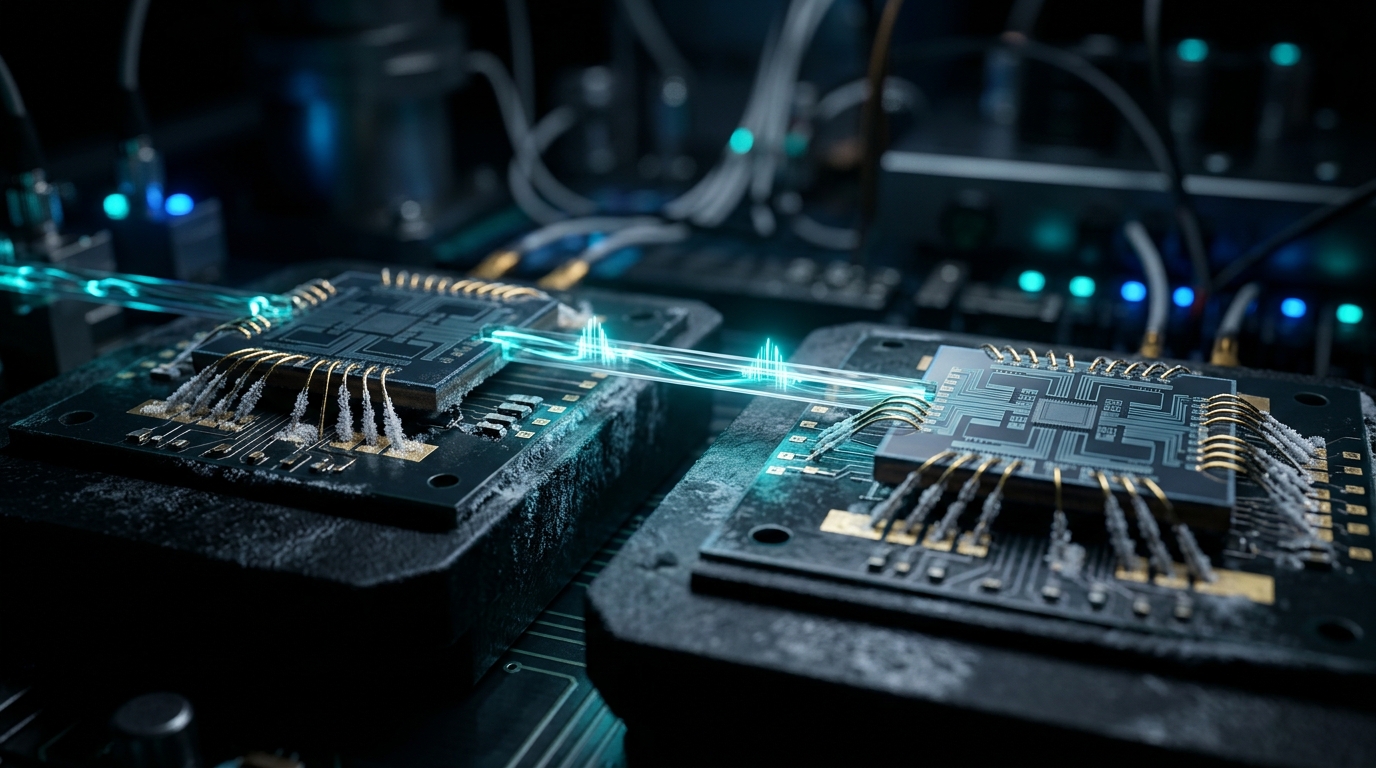

- CIFOLD, a graph-based circuit-folding framework published as arXiv:2412.18705v2, reduces required quantum circuit cuts by an average of 31.6% versus state-of-the-art cutting techniques.
- The same framework lowers classical sampling overhead by 3.55×10⁹, directly shrinking the post-processing cost of hybrid quantum-classical execution on NISQ hardware.
- For security architects tracking the quantum timeline, more efficient circuit partitioning accelerates the arrival of cryptographically relevant workloads — and compresses your window to deploy post-quantum controls.
Why Quantum Circuit Cutting Became a Security Problem
CISOs tracking the tend to watch qubit counts. That’s the wrong metric. The practical threat surface expands when researchers learn to run bigger circuits on the same hardware — and circuit cutting is the technique making that happen right now.
Noisy Intermediate-Scale Quantum (NISQ) devices cannot host the deep, wide circuits required for cryptanalytic workloads. Circuit cutting partitions a large quantum circuit into smaller subcircuits, executes them on available hardware, and reconstructs results classically. The catch: each cut multiplies the classical sampling overhead exponentially. A circuit requiring ten cuts can demand sampling costs in the billions of shots to reconstruct a usable result.
That overhead is the dam holding back larger quantum workloads. CIFOLD drills a 31.6% hole in it.
The Technical Deep-Dive: How CIFOLD Folds Circuits
The Limitation of Prior Graph-Based Cutters
Recent circuit-cutting approaches model quantum circuits as graphs and focus exclusively on either gate cuts or wire cuts. The CIFOLD authors identify the core failure mode bluntly: identifying optimal cutting locations using graph representation often results in prohibitively high computational complexity under realistic hardware constraints.
Translation for your architecture team: the tools meant to make quantum workloads tractable were themselves becoming intractable at scale.
The Folding Primitive
CIFOLD exploits a structural property most real quantum algorithms share — repetitive modular structures. Variational eigensolvers, QAOA layers, Trotterized simulations, and quantum arithmetic routines all reuse gate sequences across entangled qubits. CIFOLD identifies those common sequences and merges them into compact meta-graphs before any cutting decision is made.
The framework defines two metrics to govern this compression:
- Folding factor — quantifies how aggressively the circuit has been compressed into reusable modules.
- Variance — ensures folding remains balanced so that no single meta-node becomes a partitioning bottleneck.
Once the meta-graph exists, cut locations are identified locally rather than through exhaustive global graph searches. The search space collapses, and the partition quality improves simultaneously.
Head-to-Head: Traditional Cutting vs. CIFOLD
| Dimension | Traditional Gate/Wire Cutting | CIFOLD (arXiv:2412.18705v2) |
|---|---|---|
| Graph representation | Full circuit graph | Folded meta-graph |
| Cut location search | Exhaustive global search | Local, structure-aware |
| Cut targets | Gate cuts OR wire cuts | Modular sequences across entangled qubits |
| Required cuts (average) | Baseline | −31.6% |
| Sampling overhead reduction | Baseline | 3.55×10⁹ lower |
| Scalability under realistic hardware constraints | Prohibitively high complexity | Bounded by folding factor |
“CIFOLD achieves superior partition quality and computational efficiency, reducing the number of required cuts by an average of 31.6% and lowering the sampling overhead substantially by 3.55×10⁹.” — arXiv:2412.18705v2
[IMAGE: abstract macro view of a quantum circuit folding into a dense modular meta-graph, cyan entanglement lines collapsing inward]
Industry Context: Why This Accelerates the Quantum Clock
Hybrid Quantum-Classical Is the Operational Reality
Fault-tolerant quantum computing remains a multi-year horizon. Every enterprise quantum workload deployed between now and that horizon runs on hybrid quantum-classical architectures — quantum processors executing subcircuits, classical systems reconstructing results. Circuit cutting is the membrane between the two.
Reducing cuts by 31.6% and sampling overhead by 3.55×10⁹ changes the economics of that membrane. Workloads that were previously uneconomical — because shot counts ran into the billions — become viable on existing NISQ fleets.
The Compliance Angle
NIST finalized its first post-quantum cryptography standards — ML-KEM, ML-DSA, and SLH-DSA — in August 2024, and federal agencies are under directive to begin migration. The usual CISO pushback is that “cryptographically relevant quantum computers” remain theoretical. Research like CIFOLD erodes that position.
Any technique that lets researchers run larger circuits on today’s hardware compresses the migration window. Your compliance timeline is not set by qubit-count headlines; it’s set by circuit-depth efficiency.
The Asymmetric Cost Argument
Migration to post-quantum cryptography is a capital expense measured in quarters. The cost of inaction — harvest-now-decrypt-later attacks against long-lived data (M&A records, health data, state secrets, blockchain ledgers) — is measured in decades of exposure. Circuit folding tilts that ratio further against inaction.
The BeQuantum Perspective
Research like CIFOLD reinforces the thesis behind BeQuantum’s architecture: the quantum threat model is not a single future event, it’s a sliding scale that advances with every efficiency gain in hybrid execution.
Our Digital Notary stack treats quantum readiness as a layered control rather than a one-time swap. Signatures generated today are anchored with post-quantum-resilient primitives alongside classical ones, so content authenticity proofs remain verifiable even as the feasible circuit depth on NISQ hardware expands. The line applies the same principle at the edge — root-of-trust material never sits exposed to a future attacker who has learned to fold bigger circuits onto today’s processors.
The practical implication: organizations building verification infrastructure should assume every year of delay raises the effective attack budget by a non-linear factor, because techniques like CIFOLD improve the denominator (cost per useful quantum computation) faster than hardware alone would suggest.
What You Should Do Next
- Within 90 days: Audit your TLS certificate chain and long-lived signing keys for quantum exposure. Flag any asset with a retention requirement extending past 2030 as harvest-now-decrypt-later risk.
- Within 180 days: Inventory cryptographic dependencies in your software supply chain (code signing, firmware updates, document notarization). Map each to a post-quantum equivalent in the NIST PQC standards.
- Within 12 months: Pilot hybrid classical-plus-PQC signatures on the highest-value verification pathway in your stack. Hybrid deployment de-risks algorithm agility in case any single PQC candidate is broken later.
Frequently Asked Questions
Q: Does CIFOLD mean quantum computers can now break RSA? A: No. CIFOLD is a circuit-partitioning framework, not a cryptanalytic algorithm. It makes larger quantum workloads more tractable on NISQ hardware, which indirectly shortens the research runway to cryptographically relevant circuits — but it does not itself execute Shor’s algorithm at scale.
Q: Should we wait for fault-tolerant quantum hardware before migrating to PQC? A: No. Harvest-now-decrypt-later attacks are already economically rational for high-value long-lived data. Efficiency gains in hybrid execution — the 3.55×10⁹ sampling-overhead reduction reported in arXiv:2412.18705v2 is one example — continuously lower the bar. Waiting optimizes for the wrong variable.
Q: How does circuit folding differ from standard circuit optimization passes in a compiler? A: Standard optimization passes simplify gate sequences within a fixed execution target. CIFOLD operates a level up: it restructures the circuit into a meta-graph of reusable modules specifically to guide partitioning decisions for hybrid quantum-classical execution, minimizing the number of cuts needed to fit available hardware.
Last updated: 2026-04-19. Primary source: Circuit Folding: Modular and Qubit-Level Workload Management in Quantum-Classical Systems (arXiv:2412.18705v2).