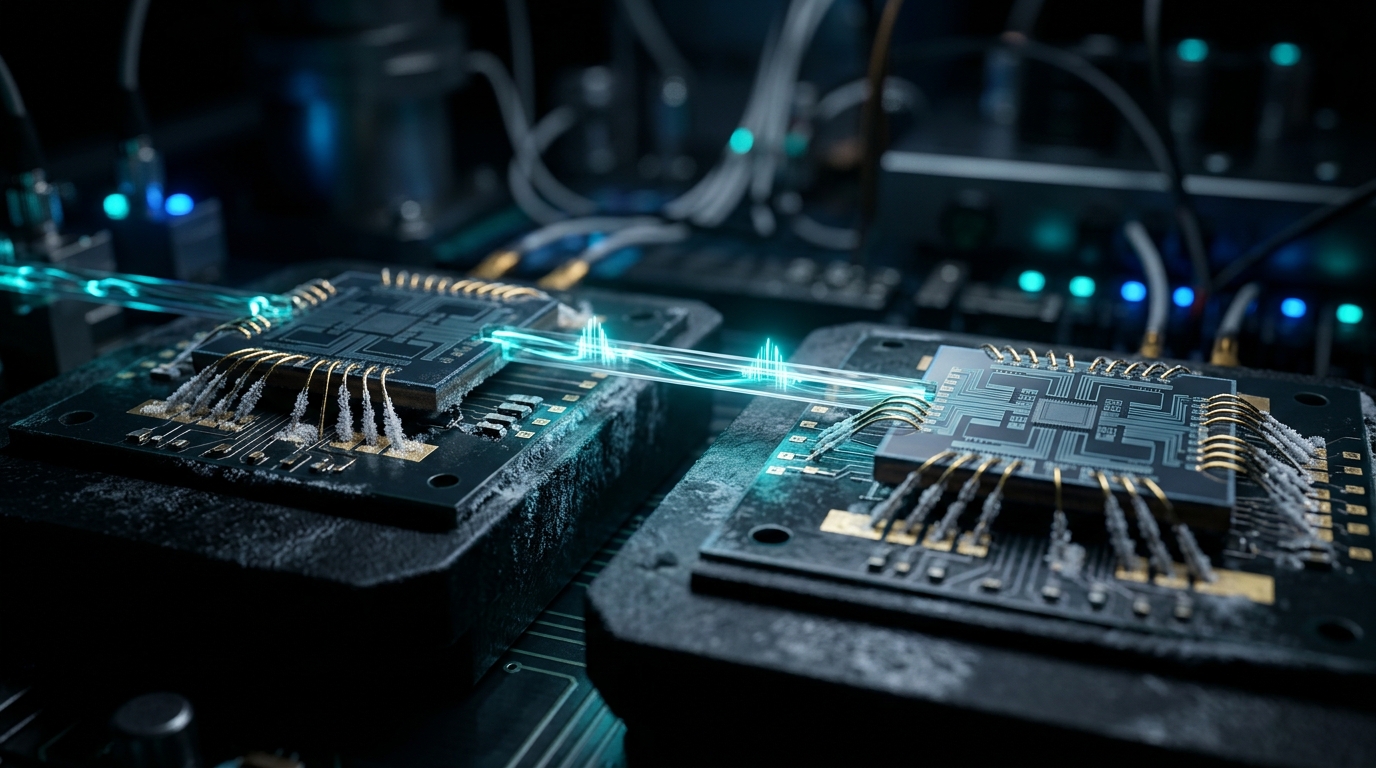
- A June 2024 arXiv preprint (2406.14330) introduces the first provably-guaranteed approximate compilation scheme for QAOA Max-Cut on trapped-ion simulators.
- Worst-case Ising Hamiltonian pulses drop from O(n²) to O(n log(n/ε)); Pauli-X bit flips drop from O(n²) to O(n log(n/ε)/ε²), at a (1−ε) approximation cost.
- For security architects tracking quantum timelines, this compresses the gap between theoretical NISQ workloads and executable optimization — which directly affects migration planning for PQC-dependent infrastructure.
Why a Compilation Paper Belongs on Your Threat Radar
Security leaders tend to file quantum optimization research under “not my problem.” That instinct is outdated. The same trapped-ion platforms that run Quantum Approximate Optimization Algorithm (QAOA) experiments are the hardware lineage advancing toward cryptographically-relevant quantum computers. Every compilation efficiency gain shortens the runway between “interesting benchmark” and “credible threat to RSA-2048.”
The arXiv:2406.14330 preprint demonstrates a concrete efficiency gain: the authors cut worst-case pulse requirements by an asymptotic factor of n/log(n). On a 100-qubit ion-trap simulator, that difference separates a hopeless noise budget from a usable one. CISOs tracking the Harvest-Now-Decrypt-Later (HNDL) threat should treat this as one more data point confirming the NIST PQC migration timeline is real, not theoretical.
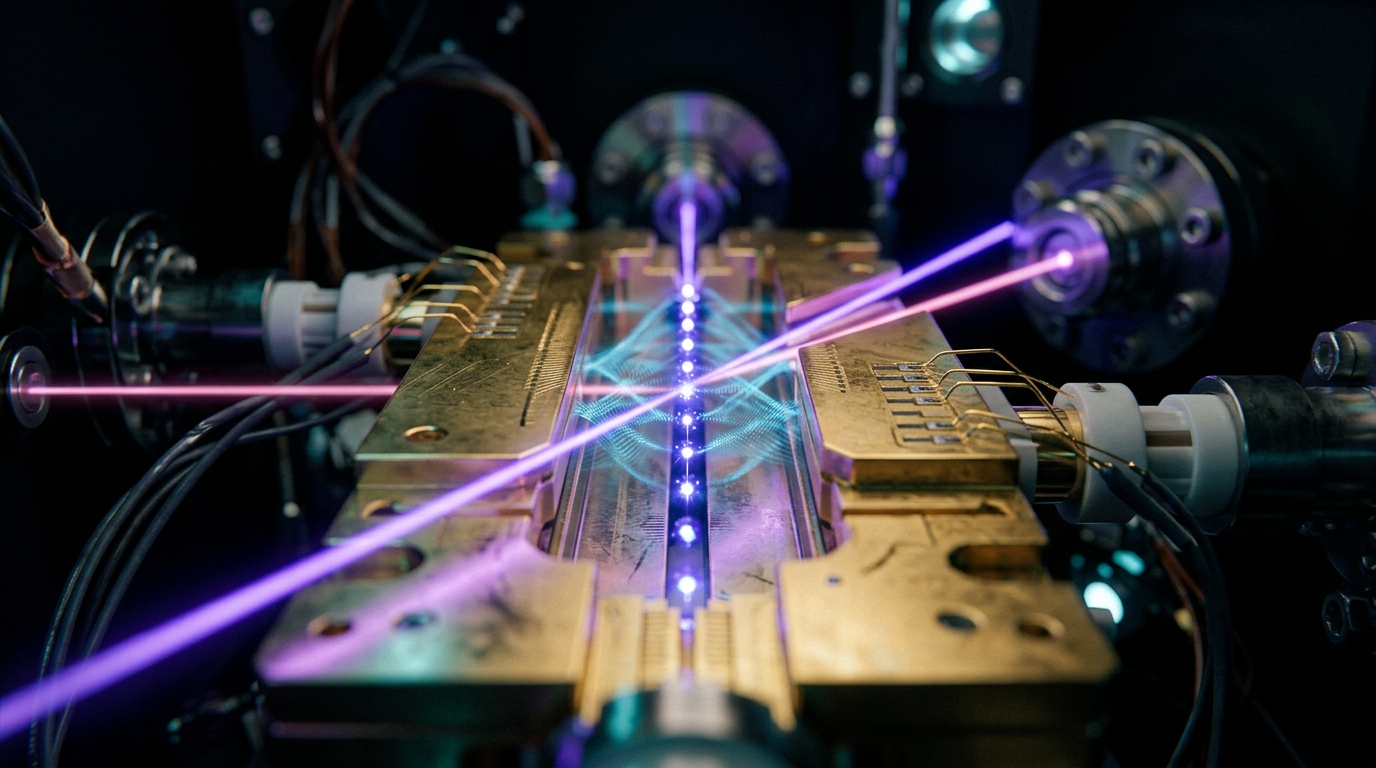
[IMAGE: Macro photograph of a trapped-ion quantum processor with laser beams converging on a chain of suspended ions, cyan interference patterns visible]
The Technical Deep-Dive: Sparsification Meets Decomposition
QAOA solves combinatorial optimization problems by alternating between a problem Hamiltonian and a mixing Hamiltonian. For Max-Cut on trapped-ion hardware, the problem Hamiltonian is an all-to-all Ising interaction — implemented natively via Mølmer–Sørensen gates and optical dipole force interactions. The mixing layer uses single-qubit Pauli-X rotations.
The compilation bottleneck is brutal: encoding an arbitrary weighted graph into these native operations historically requires O(n²) Ising pulses — one per potential edge — plus matching Pauli-X overhead. On a noisy device, that quadratic pulse budget destroys the signal before measurement.
The Two Primitives
Graph sparsification reduces the number of edges while preserving the cut structure to within a (1−ε) factor. Instead of compiling every edge, the compiler targets a provably-representative subgraph.
Graph decomposition breaks a weighted graph into a small number of unweighted graphs, each of which compiles more efficiently into native ion-trap operations.
This work provides the first provable guarantees using sparsification and decomposition to improve quantum noise resilience and reduce quantum circuit complexity. — arXiv:2406.14330
Before vs. After: Compilation Costs
| Metric | Standard Compilation | Sparsification + Decomposition | Reduction Factor |
|---|---|---|---|
| Worst-case H_Ising pulses | O(n²) | O(n log(n/ε)) | ~n/log n |
| Worst-case Pauli-X bit flips | O(n²) | O(n log(n/ε)/ε²) | ~n ε²/log n |
| Max-Cut approximation | Exact edge-by-edge | (1−ε) factor | Tunable via ε |
| Provable guarantee | Heuristic | Theoretical bound | First of its kind |
The ε parameter is a knob: tighten it for closer approximation, loosen it for fewer pulses. For near-term experiments where decoherence dominates, trading a few percent of solution quality for an order-of-magnitude pulse reduction is an obvious win.
Industry Context: Why This Accelerates the PQC Clock
NIST finalized its first three post-quantum cryptography standards (FIPS 203, 204, 205) in August 2024. The migration mandate landed because compilation and error-correction progress keep compounding. Every paper that tightens a constant factor — or, as here, an asymptotic factor — tightens the window enterprises have to rotate their cryptographic infrastructure.
Trapped-ion vendors like IonQ and Quantinuum market their roadmaps in “algorithmic qubit” terms rather than raw qubit counts. Algorithmic qubits are a function of gate fidelity and circuit depth — exactly the quantities this compilation scheme improves. A technique that cuts pulse count by n/log n effectively multiplies the usable algorithmic qubit count on the same hardware.
The economic impact cuts both ways. For quantum hardware operators, this lowers the bar to claiming near-term quantum advantage on optimization workloads. For defenders, it shortens the timeline to hardware that could credibly attack Shor-vulnerable systems. The US National Security Memorandum NSM-10 set 2035 as the cryptographic migration deadline; every compilation breakthrough pressures that date earlier.
The BeQuantum Perspective: What Compilation Progress Means for Cryptographic Inventory
Organizations tracking their PQC migration face a planning problem: how much schedule buffer do you hold against unexpected quantum progress? Papers like this one argue for less buffer, not more.
The approach we see working in enterprise engagements treats compilation research as a leading indicator. When asymptotic improvements land on native hardware primitives — not just abstract circuit models — the effective capability curve steepens. Teams building long-lived infrastructure (identity certificates, firmware signing chains, notarized archives) should plan for crypto-agility as a first-class architectural property, not a retrofit.
The BeQuantum Digital Notary treats every signed artifact as a dated commitment to a cryptographic assumption. Pair that with a PQC Layer that abstracts the signature suite, and the question shifts from “when do we migrate?” to “how quickly can we rotate?” The second question is answerable with engineering; the first depends on papers like arXiv:2406.14330.
The compilation gap between theoretical QAOA and executable QAOA just narrowed by an asymptotic factor. Treat every such narrowing as a subtraction from your migration runway.
[IMAGE: Aerial perspective of parallel ion-chain processors emitting synchronized laser pulses, dark void background with teal accent lighting]
What You Should Do Next
Within 30 days — Audit your cryptographic inventory for RSA, ECC, and Diffie-Hellman dependencies with archival exposure. HNDL-vulnerable assets (legal records, IP, health data) should be tagged for priority rotation.
Within 90 days — Benchmark your signature and key-exchange surface against the NIST FIPS 203/204/205 suites. If you cannot swap algorithms behind a stable API, your architecture is not crypto-agile and compilation progress like this paper’s is a direct business risk.
Within 12 months — Validate that every long-lived signed artifact (code-signing, document notarization, supply-chain attestations) can be re-anchored under a PQC scheme without re-signing history. Hybrid signatures and notarization layers solve this; ad-hoc certificate rotation does not.
FAQ
Q: Does a QAOA compilation result affect RSA or ECC security directly? A: Not directly — QAOA is an optimization algorithm, not a factoring algorithm. But trapped-ion platforms are the same hardware lineage pursuing Shor’s algorithm at scale. Progress on native-gate compilation raises the effective qubit count for every algorithm running on that hardware, including cryptanalytic ones.
Q: Is the O(n²) to O(n log n) reduction purely theoretical? A: The preprint provides theoretical bounds and numerical validation for trapped-ion hardware. Specific experimental validation on platforms like IonQ or Quantinuum is not detailed in the available source material — a gap worth tracking as follow-up work emerges.
Q: Should this paper change our PQC migration timeline? A: On its own, no single paper should. But the cumulative trend of compilation, error-correction, and qubit-count progress has consistently tightened, not loosened, expert estimates for cryptographically-relevant quantum computers. Plan for crypto-agility regardless of which paper lands next.