Last updated: June 2025
Key Takeaways
- A new non-linear sigma model framework (arXiv:2603.25665) identifies two qualitatively distinct non-decodable phases in surface codes — one under incoherent Pauli errors, one under coherent rotations — with direct consequences for decoder engineering
- Suboptimal decoders (those operating without precise knowledge of the coherent rotation angle) can enter a “thermal-metal” phase that optimal decoders cannot reach, meaning decoder choice is not a performance trade-off — it is a correctability boundary
- For security architects planning fault-tolerant quantum infrastructure, this research redraws the threshold map: the rotation angle you assume in your decoder design determines whether your quantum memory is recoverable at all
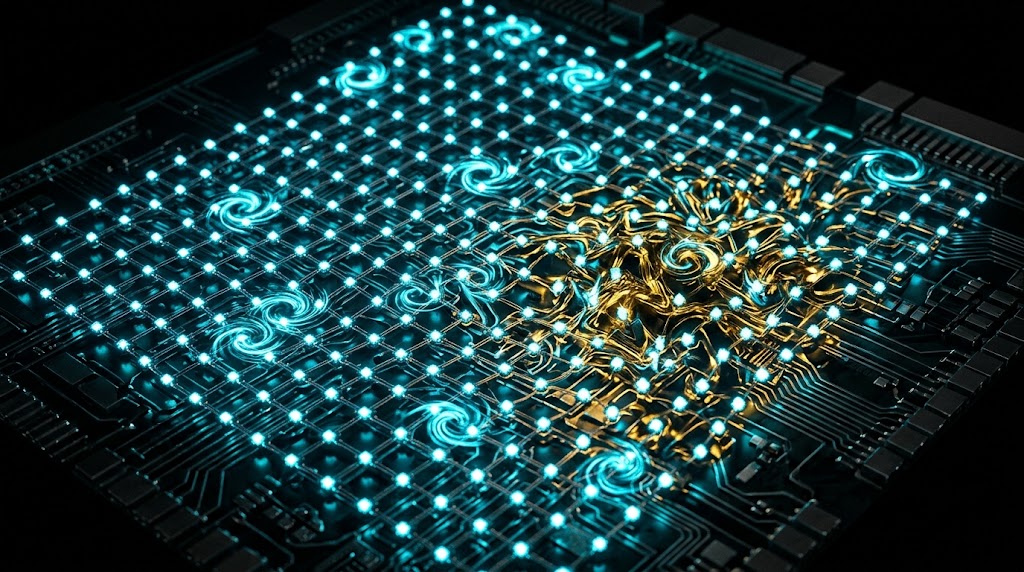
[IMAGE: A square lattice of glowing qubits rendered in deep black with cyan anyon excitations propagating across the surface, dramatic macro perspective showing the lattice warping near a thermal-metal phase boundary, cinematic 8K lighting with teal energy fields threading between nodes]
The Hidden Failure Mode Inside Your Quantum Error Correction Stack
Picture this: your organization deploys a surface-code-based quantum memory module as part of a post-quantum key management system. Your decoder is well-tested against depolarizing noise. Your error rates sit comfortably below threshold. Then a systematic calibration drift introduces a small, consistent single-qubit rotation — coherent, not random. Your decoder, unaware of the exact rotation angle, keeps running. The logical error rate climbs. You are not approaching the familiar error threshold you benchmarked against. You have entered a qualitatively different non-decodable regime — one your existing threshold analysis never modeled.
This is not a hypothetical edge case. It is the central finding of “Non-linear Sigma Model for the Surface Code with Coherent Errors”, a theoretical and numerical study that derives the effective long-distance theory of the surface code decoding problem under coherent single-qubit unitary rotations. The research identifies a “thermal-metal” phase — a failure mode with a distinct physical character from anything the standard Pauli error model predicts.
For CISOs and security architects evaluating quantum hardware for cryptographic key storage, quantum random number generation, or fault-tolerant computation, this matters now. The threshold of the surface code under coherent errors remains incompletely understood, and the decoder you select determines which phase boundaries you are even capable of avoiding.
What the Sigma Model Actually Tells Us About Decodability
Defining the Framework
The non-linear sigma model is a field-theoretic tool that captures the universal long-distance behavior of a system near a phase transition. In this context, the researchers derive a sigma model with target space SO(2n)/U(n) as the effective theory governing the decoding problem for the square-lattice surface code under coherent errors — specifically, single-qubit unitary rotations that generate electric anyon excitations rather than the incoherent Pauli bit-flip and phase-flip errors that dominate most error correction literature.
The target space SO(2n)/U(n) is not an arbitrary choice. It encodes the symmetry structure of the replicated decoding problem, and critically, that symmetry structure depends on the lattice geometry of the surface code itself. Change the lattice — move from a bipartite to a non-bipartite structure — and the universality class shifts.
Definition: A coherent error in a quantum system is a systematic, unitary rotation applied to qubits — as opposed to incoherent (probabilistic, Pauli-type) errors. Coherent errors preserve quantum superposition and can accumulate constructively across a code block, making them harder to decode than their incoherent counterparts at equivalent error rates.
Two Replica Limits, Two Decoder Regimes
The sigma model analysis separates into two mathematically distinct replica limits, each corresponding to a physically different decoding scenario:
| Parameter | Decoder Type | Information Assumed | Phase Structure |
|---|---|---|---|
| n → 1 replica limit | Optimal (maximum-likelihood) decoder | Exact coherent rotation angle known | No thermal-metal phase accessible |
| n → 0 replica limit | Suboptimal decoder | Rotation angle imperfectly known | Thermal-metal phase exists and is stable |
This table is not a performance comparison. It is a map of what is physically possible. The metallic fixed point — the mathematical signature of the thermal-metal phase — becomes unstable in the n→1 limit. Optimal decoding, by construction, cannot enter this phase. Suboptimal decoding can, and under realistic operating conditions where rotation angles drift or are never precisely characterized, suboptimal decoding is what most deployed systems run.
Critical Finding: “The suboptimal decoder supports a ‘thermal-metal’ phase, a non-decodable regime that is qualitatively distinct from the conventional non-decodable phase of the surface code under incoherent Pauli errors.” — arXiv:2603.25665
Decoding Fidelity as a Topological Observable
The sigma model framework connects decoding fidelity directly to twist defects of the order-parameter field — a topological characterization that yields quantitative predictions for how fidelity scales with system size near the metallic fixed point. This is not merely theoretical elegance. It means the sigma model can generate testable, system-size-dependent predictions for both decoder types, which the authors examine against extensive numerical simulations.
For engineers sizing quantum memory modules, this provides a principled basis for extrapolating small-system benchmark results to production-scale deployments — something empirical threshold estimates alone cannot reliably do.
Why Lattice Geometry Changes Your Attack Surface
One finding from this research deserves particular attention from architects designing quantum error correction systems: the symmetry and target space of the sigma model depend on the lattice structure of the surface code.
On a bipartite lattice (the standard square lattice), the thermal-metal phase is inaccessible to optimal decoders. On a non-bipartite lattice, the analysis shows a stable thermal-metal phase can arise even under optimal decoding. This means the lattice geometry of your surface code implementation is not a neutral engineering choice — it determines whether optimal decoding can guarantee decodability up to the maximally-coherent rotation angle, or whether a new class of failure exists regardless of decoder quality.
For organizations procuring quantum hardware or evaluating quantum error correction IP, the lattice structure of the underlying code should appear on your technical due diligence checklist alongside qubit count and gate fidelity.
[IMAGE: Side-by-side comparison of bipartite square lattice and non-bipartite lattice qubit arrays rendered in dark teal and black, with phase boundary regions highlighted in amber, macro perspective, 8K cinematic quality]
Industry Context: Where This Research Lands on the Quantum Security Timeline
Near-Term Impact (1–2 Years): Decoder Engineering Decisions
Quantum memory is moving from laboratory demonstration toward early commercial deployment. Systems targeting cryptographic applications — long-lived key storage, quantum-secured communication channels — will implement surface codes as their primary error correction layer. The distinction between optimal and suboptimal decoders identified in this research has direct engineering consequences today.
Any decoder that does not have access to precise, continuously updated coherent rotation angle information is operating in the n→0 regime. That includes most hardware implementations where calibration runs periodically rather than continuously. The thermal-metal phase is not a theoretical curiosity for these systems — it is a reachable failure mode.
Medium-Term Impact (3–5 Years): Reshaping Decoder Design Strategy
The identification of the thermal-metal phase as qualitatively distinct from the Pauli-error non-decodable phase will force a reassessment of how decoder thresholds are specified and validated across the quantum computing industry. Current industry practice benchmarks decoders against depolarizing or Pauli noise models. The sigma model framework establishes that this benchmark misses an entire class of failure behavior under coherent errors.
Standards bodies and procurement frameworks — including those emerging from NIST’s ongoing quantum information science programs — will need to incorporate coherent error thresholds alongside incoherent ones as quantum hardware matures toward fault-tolerant operation.
Long-Term Impact (5+ Years): A New Theoretical Paradigm
The sigma model framework derived here for the square-lattice surface code is not inherently specific to that code. The methodology — deriving an effective field theory for the replicated decoding problem and analyzing its phase structure — may generalize to other quantum error-correcting codes and lattice geometries. If it does, it establishes a systematic theoretical tool for mapping decodability limits across the broader landscape of fault-tolerant quantum computing architectures.
Regulatory Note: NIST’s post-quantum cryptography standardization process (FIPS 203, 204, 205, finalized August 2024) addresses classical cryptographic migration. Fault-tolerant quantum hardware standards — including error correction thresholds — remain an open standardization gap. Organizations building quantum infrastructure today are operating ahead of formal compliance frameworks.
The BeQuantum Perspective: What This Means for Quantum-Secured Infrastructure
At BeQuantum, our PQC Layer and Digital Notary infrastructure operate at the intersection of classical post-quantum cryptography and emerging quantum hardware verification. The sigma model research on surface code coherent errors is directly relevant to how we think about the verification layer for quantum key management systems.
The core operational lesson from arXiv:2603.25665 is that decoder fidelity guarantees are conditional on rotation angle knowledge — and that conditionality is not a small correction to existing threshold estimates. It determines which phase of the system you occupy. Organizations integrating quantum memory into their key management architecture need to treat coherent error characterization as a first-class security control, not an afterthought to hardware calibration.
Our approach to this problem focuses on three principles drawn directly from the sigma model framework:
1. Continuous angle tracking as a security primitive. If your decoder requires rotation angle information to remain in the optimal decoding regime, then the pipeline that delivers that angle information is part of your security architecture. It needs the same integrity guarantees as your key material.
2. Lattice geometry as a procurement criterion. The finding that non-bipartite lattices expose optimal decoders to the thermal-metal phase means lattice structure belongs in hardware security specifications. BeQuantum’s IceCase hardware evaluation framework now includes lattice geometry as an explicit parameter in quantum memory assessments.
3. System-size scaling as a validation requirement. The sigma model’s quantitative predictions for fidelity scaling near the metallic fixed point give organizations a principled way to validate that small-scale benchmark results extrapolate correctly to production system sizes. Demand this scaling data from hardware vendors.
What You Should Do Next
Within 30 days: Audit your quantum hardware vendor’s error characterization documentation. Specifically, determine whether their published error thresholds are derived under incoherent (Pauli) noise models only, or whether coherent error thresholds are separately characterized. If coherent error thresholds are absent, request them explicitly — and ask which decoder regime (optimal vs. suboptimal) those thresholds assume.
Within 90 days: Map your decoder implementation against the two regimes identified in this research. If your system does not have access to real-time coherent rotation angle information — which most periodic-calibration systems do not — document that you are operating in the suboptimal decoder regime and assess whether your operating point could approach the thermal-metal phase boundary under plausible drift scenarios.
Within 6 months: Incorporate lattice geometry into your quantum hardware procurement criteria. For any surface-code-based system, confirm whether the underlying lattice is bipartite or non-bipartite, and understand the phase structure implications for your target operating regime. If you are evaluating non-bipartite implementations, require vendor demonstration that optimal decoding thresholds account for the stable thermal-metal phase that can arise in those geometries.
Frequently Asked Questions
Q: Is the thermal-metal phase a problem for current quantum hardware, or only for future fault-tolerant systems?
A: The thermal-metal phase is relevant to any surface-code implementation operating under coherent errors with imperfect rotation angle knowledge — which describes most near-term quantum memory demonstrations. It is not a distant concern. Systems that benchmark only against Pauli noise models may be operating closer to this phase boundary than their threshold estimates suggest, particularly under calibration drift.
Q: Can switching to a different quantum error-correcting code (e.g., toric code, color code) avoid the thermal-metal phase?
A: The sigma model framework derived in this research is specific to the surface code, and the research does not provide direct comparisons to other code families. However, the methodology — analyzing the replicated decoding problem via an effective field theory — is potentially generalizable. Whether other codes exhibit analogous phases under coherent errors is an open research question. Organizations should not assume that code substitution eliminates coherent error failure modes without code-specific analysis.
Q: What is the difference between a coherent error threshold and the standard depolarizing noise threshold for the surface code?
A: The standard depolarizing noise threshold characterizes the maximum incoherent error rate below which the surface code can reliably protect logical information. The coherent error threshold — still incompletely understood, as this research explicitly notes — characterizes the maximum coherent rotation angle below which decoding remains possible. These are distinct boundaries in different error model spaces. A system operating below its depolarizing threshold can still fail under coherent errors if the rotation angle exceeds the coherent threshold, particularly under suboptimal decoding.
Source: “Non-linear Sigma Model for the Surface Code with Coherent Errors,” arXiv:2603.25665v2