- Downlink LEO configurations deliver lower Quantum Bit Error Rates (QBER) and higher secure key rates than uplinks across all four protocols analyzed (arXiv:2308.01036).
- BB84 consistently outperforms B92 in prepare-and-measure schemes; BBM92 beats E91 in entanglement-based approaches.
- CISOs evaluating quantum-secure architectures should anchor satellite QKD pilots on downlink BB84 or BBM92, not legacy uplink designs.
Why Satellite QKD Protocol Selection Just Got Concrete
Fiber-based Quantum Key Distribution (QKD) dies at roughly 100 kilometers without trusted-node repeaters. That constraint has blocked intercontinental quantum-secure links for two decades. Satellite QKD over Low Earth Orbit (LEO) sidesteps the fiber attenuation problem — but only if you pick the right protocol, the right link direction, and the right operating window.
A peer-reviewed analysis published on arXiv (2308.01036) benchmarks four QKD protocols — BB84, B92, BBM92, and E91 — across uplink and downlink LEO configurations, under day and night conditions, as a function of zenith angle. The results are unambiguous enough to shape procurement decisions today.
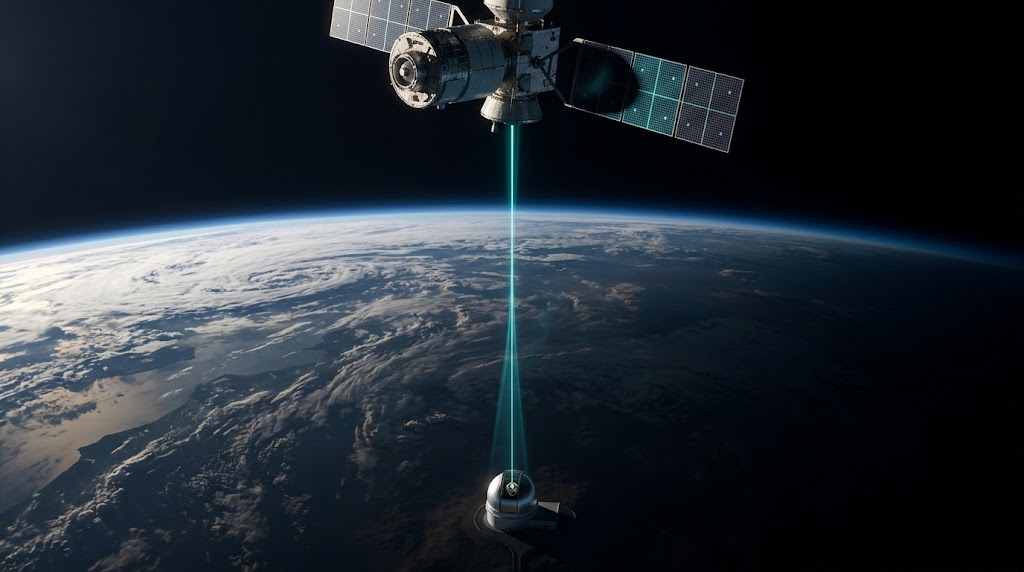
[IMAGE: LEO satellite emitting a narrow photon beam through atmospheric turbulence toward a ground telescope, cinematic cyan-lit aerial perspective]
For enterprise security architects tracking the timeline, satellite QKD is no longer a theoretical hedge. It is a deployable complement to NIST’s lattice-based standards — provided the engineering trade-offs are understood.
The Problem: Fiber QKD Cannot Scale to Global Reach
Terrestrial fiber QKD loses photons exponentially with distance. A standard telecom fiber at 1550 nm attenuates signal at roughly 0.2 dB per kilometer, meaning a 500 km link arrives with less than 1% of the original photon flux. Trusted-node relays introduce classical security assumptions that defeat the purpose of using QKD in the first place.
Satellite-to-ground links operate in a fundamentally different loss regime. Most atmospheric attenuation occurs in the lower 10 km of the troposphere, so photons traveling through vacuum for hundreds of kilometers before entering the atmosphere experience minimal loss compared to an equivalent fiber path. That physical asymmetry is what makes LEO QKD the leading candidate for global quantum-secure key exchange.
“Satellite-based free-space quantum key distribution (QKD) provides a practical framework for achieving secure global communication beyond the limitations of optical fibers.” — arXiv:2308.01036
The operational question for security teams is no longer whether satellite QKD works. It is which protocol-and-link combination delivers enough secure key rate, at acceptable QBER, to justify integration into a production key management system.
Technical Deep-Dive: Four Protocols, Two Link Directions, One Clear Winner per Class
The arXiv:2308.01036 analysis models the optical channel using Gaussian beam formalism and incorporates four real-world loss contributors: diffraction, pointing errors, atmospheric turbulence, and background noise. Each protocol is evaluated across day and night conditions as the zenith angle changes — a critical variable, because a satellite near the horizon forces photons through a much longer atmospheric slant path.
The Four Protocols in Scope
- BB84 (Bennett-Brassard 1984): Prepare-and-measure, four polarization states, two bases. The industry reference.
- B92 (Bennett 1992): Simplified prepare-and-measure using only two non-orthogonal states. Lower implementation complexity, weaker performance.
- BBM92 (Bennett-Brassard-Mermin 1992): Entanglement-based analog of BB84. Security derived from Bell-state correlations.
- E91 (Ekert 1991): Entanglement-based using Bell inequality violations as the security witness.
Uplink vs. Downlink: The Decisive Trade-Off
Uplink sends photons from a ground station up to the satellite. Downlink sends them from satellite to ground. They are not symmetric.
In an uplink, atmospheric turbulence acts on the beam at the start of its path, causing beam wander and broadening that persists across the full propagation distance. By the time the photon reaches the satellite receiver aperture, the geometric loss is severe.
In a downlink, turbulence acts on the beam only in the final 10–20 km — after the photons have already traveled through vacuum in a well-collimated state. Diffraction-limited spot sizes at the ground station are dramatically smaller, and ground-based adaptive optics can compensate for residual wavefront distortion.
Comparison Table: Protocol Performance in LEO QKD
| Protocol | Class | Link Direction Preference | Relative Secure Key Rate | Relative QBER |
|---|---|---|---|---|
| BB84 | Prepare-and-measure | Downlink | Highest in class | Lowest in class |
| B92 | Prepare-and-measure | Downlink | Lower than BB84 | Higher than BB84 |
| BBM92 | Entanglement-based | Downlink | Highest in class | Lowest in class |
| E91 | Entanglement-based | Downlink | Lower than BBM92 | Higher than BBM92 |
All four protocols perform better on downlink than uplink under both day and night conditions. Performance degrades as zenith angle increases due to longer atmospheric slant paths. Source: arXiv:2308.01036.
The practical takeaway: a downlink BB84 or BBM92 deployment is the rational default for any organization piloting satellite QKD in 2026. Uplink architectures and B92/E91 protocols should only be selected when specific hardware or security-model constraints demand them.
Why Daylight Operation Matters
Background solar photons collected at the ground receiver create noise counts that inflate QBER. Night-time operation drops this noise floor by orders of magnitude, but restricting QKD to a 12-hour window halves the available key-generation budget for any given satellite pass. Spectral filtering, narrow time gating, and small field-of-view receivers are the engineering levers that push daytime operation toward parity — and the arXiv analysis confirms that all four protocols remain functional under daylight, with measurable but not prohibitive performance degradation.
Industry Context: Regulatory Pressure Meets Orbital Reality
NIST finalized the first post-quantum cryptography standards — ML-KEM (FIPS 203), ML-DSA (FIPS 204), and SLH-DSA (FIPS 205) — in August 2024. Federal civilian agencies face binding migration deadlines under that extend through 2035. Satellite QKD is not a replacement for PQC. It is a complementary layer for the highest-assurance use cases where information-theoretic security — not computational hardness — is the requirement.
The operational context matters for procurement planning:
- China has operated the Micius satellite since 2016 and demonstrated intercontinental QKD with Austria in 2017.
- The European Space Agency is advancing the EAGLE-1 satellite for the EuroQCI initiative, targeting launch in the late 2020s.
- Commercial operators including SpeQtral, Arqit, and Quantum Space are building LEO constellations aimed at enterprise and government customers.
Security teams responsible for data with long confidentiality horizons — banking transaction records, genomic data, classified government communications, intellectual property with multi-decade value — face the harvest now, decrypt later threat model explicitly. An adversary recording today’s TLS traffic can decrypt it once a cryptographically relevant quantum computer exists. Layering satellite QKD over PQC eliminates the computational-security assumption for root key material.
The BeQuantum Perspective: QKD as One Layer in a Defense-in-Depth Architecture
Organizations evaluating satellite QKD should resist the temptation to treat it as a drop-in replacement for classical key exchange. The arXiv:2308.01036 results make clear that key generation rates depend on orbital geometry, weather, and time of day — none of which an enterprise controls. A production architecture must buffer QKD-generated keys, verify their provenance cryptographically, and fall back gracefully to PQC when satellite passes are unavailable.
The architectural pattern we see working: satellite QKD generates symmetric key material during scheduled passes, those keys are notarized via a tamper-evident ledger, and the resulting key envelope is wrapped with a PQC KEM for distribution to endpoints. BeQuantum’s and are designed around this composite model — QKD provides the information-theoretic foundation, PQC provides the operational flexibility, and blockchain-anchored attestation provides the audit trail regulators will eventually require.
The IceCase hardware module handles the key-buffer management and the high-assurance handoff between the QKD receiver telescope and the enterprise KMS, ensuring that satellite-derived key material never transits through untrusted memory regions.
What You Should Do Next
-
Within 90 days: Inventory all data flows protected by Diffie-Hellman, ECDH, or RSA key exchange that carry information with a confidentiality requirement exceeding 10 years. These are your harvest now, decrypt later exposure points and the first candidates for QKD-plus-PQC layering.
-
Within 6 months: Evaluate satellite QKD providers against a concrete scorecard — downlink-only architectures, BB84 or BBM92 protocol support, decoy-state implementation, night-and-day operation, and integration APIs for enterprise KMS platforms. Reject vendors who cannot demonstrate published QBER and secure key rate figures under defined operating conditions.
-
Within 12 months: Pilot a composite key-distribution workflow on a non-critical but representative data flow. Measure the real key-buffer depletion rate across weather events and satellite pass gaps. The operational telemetry from this pilot will drive your production architecture far more than any vendor datasheet.
FAQ
Q: Does satellite QKD replace post-quantum cryptography? A: No. QKD provides information-theoretic security for symmetric key material but cannot replace digital signatures, code signing, or authenticated key exchange in most enterprise workflows. PQC standards like ML-KEM and ML-DSA remain essential. Satellite QKD is a complementary layer for the highest-assurance use cases.
Q: Why is downlink QKD better than uplink? A: Atmospheric turbulence acts on the photon beam at the start of its path. In an uplink, this distortion propagates across the full satellite-to-ground distance, severely degrading the beam profile. In a downlink, turbulence only affects the final 10–20 km after the photons have traveled through vacuum. The result is measurably lower QBER and higher secure key rates on downlink, as confirmed across all four protocols in arXiv:2308.01036.
Q: Is BB84 still the right choice in 2026? A: For prepare-and-measure satellite QKD, yes. The arXiv analysis confirms BB84 consistently outperforms B92 across all tested conditions. For entanglement-based architectures, BBM92 is the stronger choice over E91. Emerging protocols like measurement-device-independent QKD and twin-field QKD are promising but remain less mature for satellite deployment.
Last updated: April 21, 2026