Key Takeaways
- A neural network approach to unit disk graph embedding outperforms the Gurobi commercial solver at mapping QUBO problems onto neutral Rydberg atom quantum hardware (arXiv:2605.04736v1)
- The Rydberg blockade mechanism — which prevents simultaneously excited qubit pairs within a blockade radius — creates a hardware-native connectivity constraint that classical solvers struggle to satisfy efficiently
- For security and optimization teams evaluating neutral-atom quantum platforms, AI-driven embedding pipelines could eliminate the primary bottleneck between problem formulation and quantum execution
Last updated: June 2025
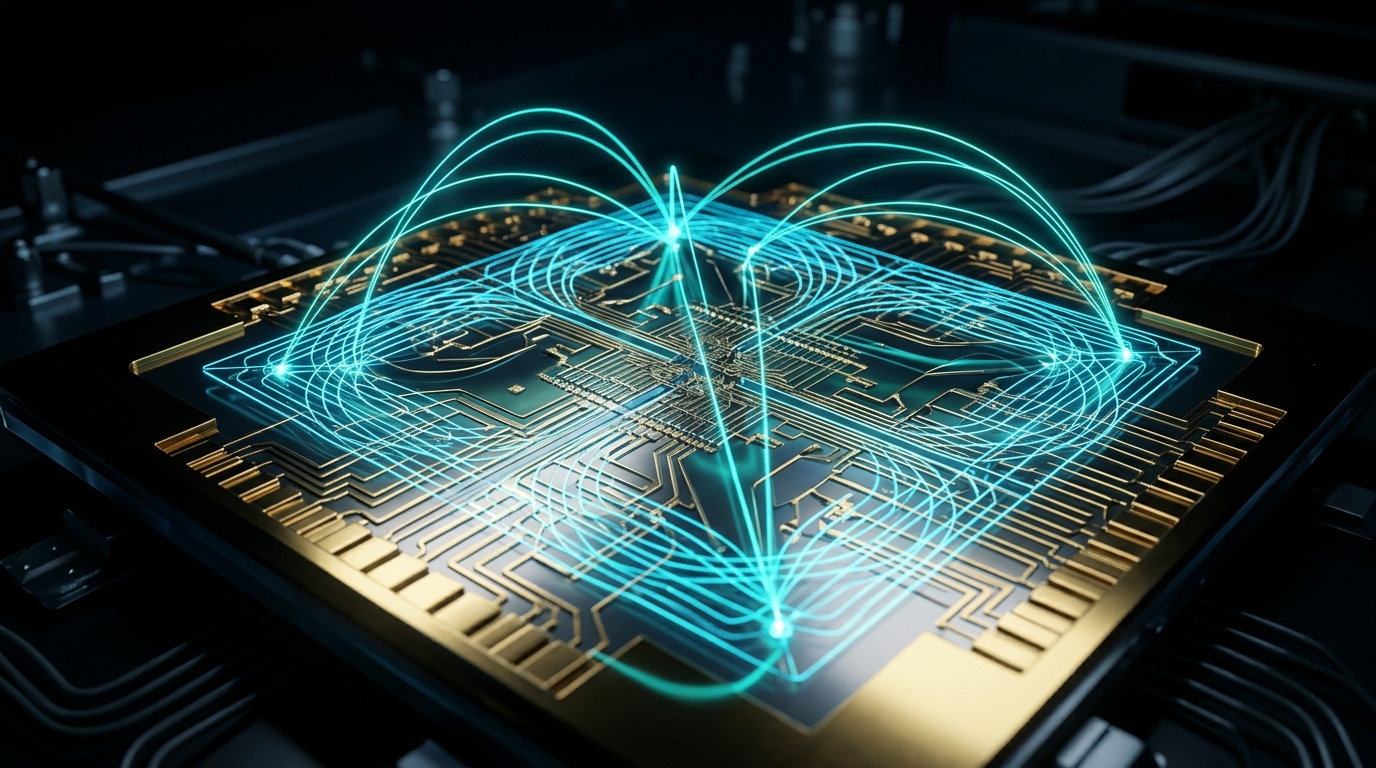
[IMAGE: Macro-cinematic view of a neutral-atom quantum processor array with glowing cyan laser pulses exciting individual atoms arranged in a 2D grid pattern, deep black background with teal entanglement arcs connecting adjacent atom pairs, 8K photorealistic render]
Why QUBO Embedding Is the Quantum Bottleneck Your Team Isn’t Talking About
Your organization’s quantum roadmap likely focuses on algorithm selection and hardware access. The problem that actually stalls deployment sits one layer below: getting your optimization problem physically onto the machine.
Quadratic Unconstrained Binary Optimization (QUBO) is the standard mathematical framework for encoding combinatorial problems — portfolio optimization, network routing, cryptographic key scheduling — onto quantum hardware. But encoding a QUBO formulation is not the same as running it. Quantum annealers and neutral-atom processors impose strict physical connectivity constraints. Every qubit has neighbors it can interact with, and only those neighbors. If your problem’s interaction graph doesn’t match the hardware’s adjacency pattern, you cannot run the problem directly.
For neutral Rydberg atom hardware specifically, this constraint is geometric: two qubits can only interact if the physical distance between their atoms falls within the blockade radius. Atoms closer than this radius become entangled through the Rydberg blockade mechanism, which prevents both from occupying the excited state simultaneously. Atoms farther apart don’t interact at all. The result is a unit disk graph — a connectivity pattern determined entirely by spatial placement in a 2D or 3D register.
Finding a physical atom arrangement that reproduces the interaction pattern your QUBO matrix requires is, as researchers at arXiv:2605.04736v1 document, a substantially harder problem than it appears. Computing adjacency from known coordinates is trivial. Inverting that process — finding coordinates that produce a target adjacency — is not.
The Rydberg Blockade: What Makes Neutral-Atom Connectivity Unique
How Neutral-Atom Qubits Actually Work
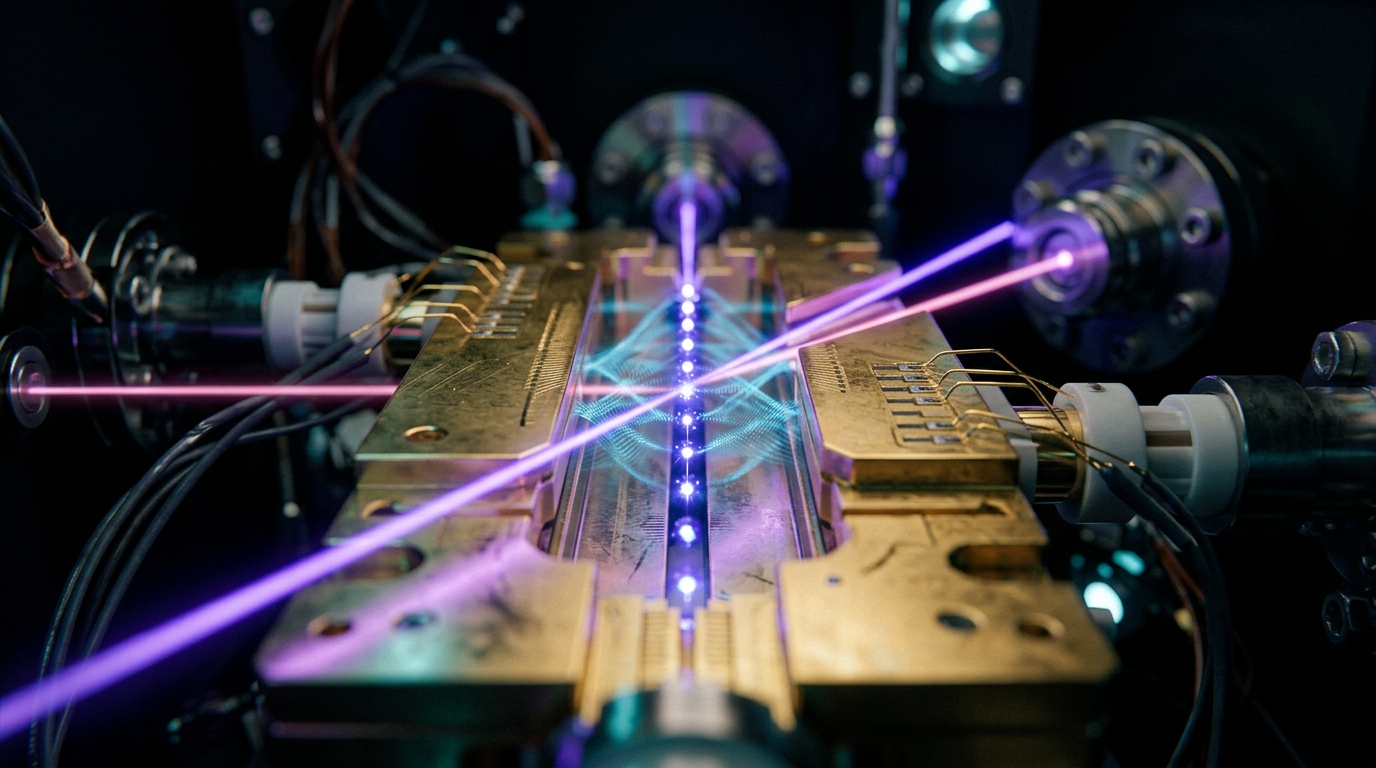
Neutral Rydberg atom quantum processors represent qubits as individual atoms excited to the Rydberg state via laser pulses. Unlike superconducting qubits with fixed chip-level wiring, neutral atoms can be repositioned — which sounds like a flexibility advantage until you realize that repositioning must satisfy the blockade radius constraint for every interaction your problem requires.
The Rydberg blockade mechanism works as follows: when two atoms are placed within the blockade radius of each other, exciting one atom to the Rydberg state shifts the energy levels of its neighbor, preventing simultaneous excitation. This conditional behavior is the physical substrate of two-qubit entanglement on these platforms. The hardware’s native Hamiltonian is Ising-like — meaning it naturally encodes pairwise interactions between adjacent qubits, which maps cleanly to QUBO structure.
The Embedding Problem, Precisely Stated
Given a QUBO problem with $n$ variables and a specific interaction matrix $Q$, the embedding task requires finding 2D or 3D coordinates for $n$ atoms such that:
- Atom pairs with non-zero $Q_{ij}$ entries are placed within the blockade radius (so they interact)
- Atom pairs with zero $Q_{ij}$ entries are placed outside the blockade radius (so they don’t)
This is a constraint satisfaction problem over continuous spatial coordinates. The feasibility space is non-convex, the constraints are geometric, and the problem scales poorly with graph density. Classical solvers like Gurobi — which excel at mixed-integer linear programs — face structural disadvantages here because the unit disk constraint doesn’t decompose cleanly into linear inequalities.
Critical finding from arXiv:2605.04736v1: “Experimental results show that this new approach overcomes in performance Gurobi solver” — establishing that learned spatial optimization outperforms commercial mathematical programming on this class of geometric constraint problem.
Neural Network Embedding: Technical Architecture and Approach
Transforming Infeasible Configurations Into Valid Placements
The research proposes a neural network that takes an initial embedding configuration — one that does not yet satisfy the unit disk constraints for the target QUBO matrix — and transforms it into a feasible placement. This is a learned correction process, not a search process.
The distinction matters operationally. Classical solvers like Gurobi approach embedding as a search over feasible configurations, applying branch-and-bound or similar strategies. The neural approach instead learns the mapping from infeasible-to-feasible configurations directly from training data, allowing it to generalize across problem instances without re-solving from scratch each time.
The system supports both 2D and 3D qubit registers, which is significant: 3D atom arrays are an active area of neutral-atom hardware development, and embedding approaches that handle both geometries will have longer useful lifespans as hardware evolves.
Comparison: Classical Solver vs. Neural Embedding for QUBO Placement
| Dimension | Gurobi (Classical MIP Solver) | Neural Network Embedding |
|---|---|---|
| Approach | Branch-and-bound search over feasible space | Learned infeasible-to-feasible transformation |
| Hardware constraint handling | Unit disk constraints linearized (approximation) | Natively encodes geometric constraints in training |
| Per-instance solve time | Scales with problem complexity; re-solves each instance | Inference after training; generalizes across instances |
| 2D/3D register support | Geometry-agnostic (requires re-formulation) | Explicitly supports both 2D and 3D registers |
| Performance vs. baseline | Baseline reference | Outperforms Gurobi (arXiv:2605.04736v1) |
| Interpretability | Full solution trace available | Black-box transformation |
| Training cost | None (no training phase) | Upfront training cost (details not yet published) |
Note: Specific benchmark metrics (runtime, success rate, problem scale) are not yet available in the v1 submission. Quantitative comparison awaits extended publication.
What the Data Gap Tells You
The v1 submission establishes directional superiority over Gurobi but does not yet publish specific runtime figures, graph sizes tested, or neural architecture details. For security architects evaluating this for production quantum pipelines, this means the approach is promising but not yet procurement-ready. The absence of scale data — number of qubits, edge density, blockade radius values — is the primary open question before enterprise adoption.
For quantum security teams: The significance is not the specific benchmark numbers (which will come in follow-on work) but the architectural insight — that geometric constraint satisfaction of this type is learnable, and learned approaches generalize in ways that solver-based approaches cannot.
Industry Context: Where This Fits in the Quantum Security Landscape
The NIST PQC Timeline Creates Urgency for Quantum-Ready Infrastructure
NIST finalized its first post-quantum cryptographic standards in August 2024 — ML-KEM (CRYSTALS-Kyber), ML-DSA (CRYSTALS-Dilithium), and SLH-DSA (SPHINCS+). The compliance mandate for federal systems runs through 2030, with private sector pressure following immediately behind. This timeline is driving enterprise investment in quantum-capable infrastructure across two parallel tracks:
- Defensive PQC: Replacing classical cryptographic primitives with quantum-resistant algorithms
- Offensive quantum capability assessment: Understanding what quantum hardware can actually solve, and when
The QUBO embedding research sits squarely in track two. Organizations that understand the practical limits of neutral-atom quantum hardware — including the embedding bottleneck — are better positioned to assess realistic quantum threat timelines for their cryptographic assets.
Who Is Moving on Neutral-Atom Quantum Hardware
Neutral-atom platforms from vendors including QuEra Computing and Pasqal have demonstrated 1,000+ qubit arrays in research settings as of 2024. The embedding problem described in arXiv:2605.04736v1 becomes more acute at scale: larger qubit counts mean larger, denser QUBO interaction graphs, which are harder to embed under unit disk constraints. Neural embedding approaches that scale with qubit count would directly unlock the optimization potential of these larger arrays.
For logistics, financial portfolio optimization, and network scheduling — all domains with direct security implications — the ability to run larger QUBO instances on neutral-atom hardware represents a meaningful capability threshold.
Economic Impact: The Cost of the Embedding Bottleneck
Every hour a quantum optimization pipeline spends on embedding is an hour it isn’t running the target problem. For organizations paying for quantum cloud access (currently priced per shot or per runtime hour on most platforms), embedding overhead translates directly to cost. A neural embedding approach that generalizes across problem instances — solving embedding once during training rather than per-instance — could reduce quantum compute costs for repeated optimization workloads by a material fraction, though exact figures depend on problem class and hardware platform.
The BeQuantum Perspective: Embedding Intelligence as Security Infrastructure
At BeQuantum, our PQC Layer and Digital Notary infrastructure operate at the intersection of cryptographic algorithm selection and hardware execution. The QUBO embedding problem is directly relevant to how we think about quantum-assisted cryptographic verification at scale.
Here is the operational reality: post-quantum cryptographic schemes like lattice-based algorithms involve optimization problems — shortest vector problems, closest vector problems — that have QUBO-compatible formulations. As neutral-atom quantum hardware matures, the ability to run these optimization problems efficiently on quantum processors becomes a factor in both attack surface assessment and defensive algorithm validation.
The neural embedding approach described in arXiv:2605.04736v1 represents exactly the kind of infrastructure abstraction that makes quantum hardware accessible to security workloads. When embedding is automated and AI-driven, security engineers can focus on problem formulation — what cryptographic structure to probe — rather than hardware-specific placement constraints.
Our IceCase hardware architecture is designed with this abstraction layer in mind: the physical qubit connectivity constraints of any target quantum platform should be handled by the infrastructure layer, not by the security analyst running the workload. Neural embedding pipelines are the mechanism that makes this separation of concerns possible.
What Your Team Should Do in the Next 90 Days
Step 1: Audit your QUBO problem inventory (Days 1-30) Identify which optimization problems in your security and operations stack have existing QUBO formulations or could be reformulated as QUBO. Network topology optimization, key distribution scheduling, and anomaly detection threshold tuning are common candidates. Document the interaction graph density for each — this determines embedding difficulty on neutral-atom hardware.
Step 2: Benchmark your current embedding approach (Days 30-60) If your team is already using quantum annealing (D-Wave) or neutral-atom platforms, measure the time your current embedding pipeline consumes per problem instance. If you’re using Gurobi or similar for embedding, this is your baseline to beat. If you have no current quantum hardware pipeline, establish which neutral-atom platforms your cloud providers offer access to and what their blockade radius specifications are.
Step 3: Track arXiv:2605.04736 for the extended publication (Days 60-90) The v1 submission establishes the approach; the follow-on publication will provide benchmark data, architecture details, and scale results. Assign a team member to monitor for the extended version. When specific performance metrics are available, re-evaluate against your Step 2 baseline to determine whether neural embedding warrants integration into your quantum pipeline.
Frequently Asked Questions
Q: Does the QUBO embedding problem affect post-quantum cryptography implementations directly?
A: Not directly — PQC standards like ML-KEM and ML-DSA run on classical hardware and don’t require quantum embedding. The relevance is indirect: QUBO embedding determines how efficiently quantum hardware can probe the mathematical structures that PQC algorithms rely on for security. Organizations assessing long-term cryptographic risk need to understand what quantum hardware can realistically execute, and embedding efficiency is a key variable in that assessment.
Q: Why can’t classical solvers like Gurobi handle unit disk graph embedding efficiently?
A: Gurobi excels at problems with linear or mixed-integer linear structure. Unit disk graph embedding requires satisfying geometric distance constraints over continuous 2D or 3D coordinates — a non-convex constraint satisfaction problem. Linearizing these constraints introduces approximation error and scaling penalties. Neural networks trained on the geometric structure of the problem can learn feasibility boundaries directly, avoiding the linearization overhead that disadvantages classical MIP solvers on this specific problem class.
Q: What is a unit disk graph in the context of quantum hardware?
A: A unit disk graph is a graph where each node corresponds to a point in 2D or 3D space, and two nodes share an edge if and only if the distance between their corresponding points falls below a fixed threshold — the blockade radius in neutral-atom hardware. In Rydberg atom quantum processors, the unit disk graph structure emerges from the physics of the Rydberg blockade: only atom pairs within the blockade radius can become entangled and therefore interact in the computation. The QUBO interaction matrix must match this unit disk adjacency pattern for the problem to run natively on the hardware.