Last updated: July 2025
[IMAGE: A quantum dot photonic chip with entangled light beams threading through waveguides, deep black background with cyan and teal optical interference patterns, macro lens perspective showing nanoscale emitter arrays, cinematic 8K render]
Key Takeaways
- Researchers published a fault-tolerant photonic quantum computing blueprint (arXiv:2507.16152) achieving logical error-correction cycles within microseconds — a concrete hardware roadmap, not a theoretical exercise
- The architecture eliminates the two blockers that have stalled photonic quantum computing for a decade: probabilistic photon sources and massive multiplexing overhead
- If this blueprint reaches hardware realization within 3–5 years, RSA and ECC encryption face credible, scalable attack vectors — organizations without an active PQC migration plan are already behind
The Clock Is Running on Your Public-Key Infrastructure
Picture your organization’s TLS certificate chain, your VPN tunnels, your code-signing infrastructure. Every one of those trust anchors rests on the assumption that factoring large integers or solving elliptic-curve discrete logarithms takes longer than the universe has existed — on classical hardware.
A photonic quantum computer changes that assumption. And as of July 2025, the engineering path to building one just got significantly clearer.
Researchers published a detailed fault-tolerant architecture for photonic quantum computing using quantum dots (arXiv:2507.16152v2). This is not a proof-of-concept paper. It delivers exact resource estimates, experimental pulse sequences, and hardware specifications for resource-state generation. The gap between “theoretically possible” and “here is what you need to build it” just narrowed.
For security architects still treating harvest-now-decrypt-later attacks as a distant concern: adversaries collecting your encrypted traffic today will have a decryption roadmap within the same planning horizon as your next infrastructure refresh cycle.
Why Photonic Quantum Computing Stalled — And Why This Blueprint Changes That
Fusion-based quantum computing executes computation through linear-optics operations and photon measurements on entangled resource states. The approach is architecturally attractive: photons travel at the speed of light, operate at room temperature in principle, and don’t require the dilution refrigerators that make superconducting qubit systems expensive to scale.
Two engineering walls blocked progress:
Wall 1 — Probabilistic photon sources. Spontaneous parametric down-conversion sources, the workhorse of photonic quantum experiments, emit photons randomly. You cannot schedule a computation around a source that may or may not produce a photon when you need one. Scaling this approach demands massive multiplexing — thousands of parallel optical channels to guarantee photon availability — which explodes hardware complexity and optical loss.
Wall 2 — Photon loss sensitivity. Every beamsplitter, waveguide, and detector junction introduces loss. In a probabilistic-source architecture, loss compounds across the multiplexing layers until error rates become unmanageable.
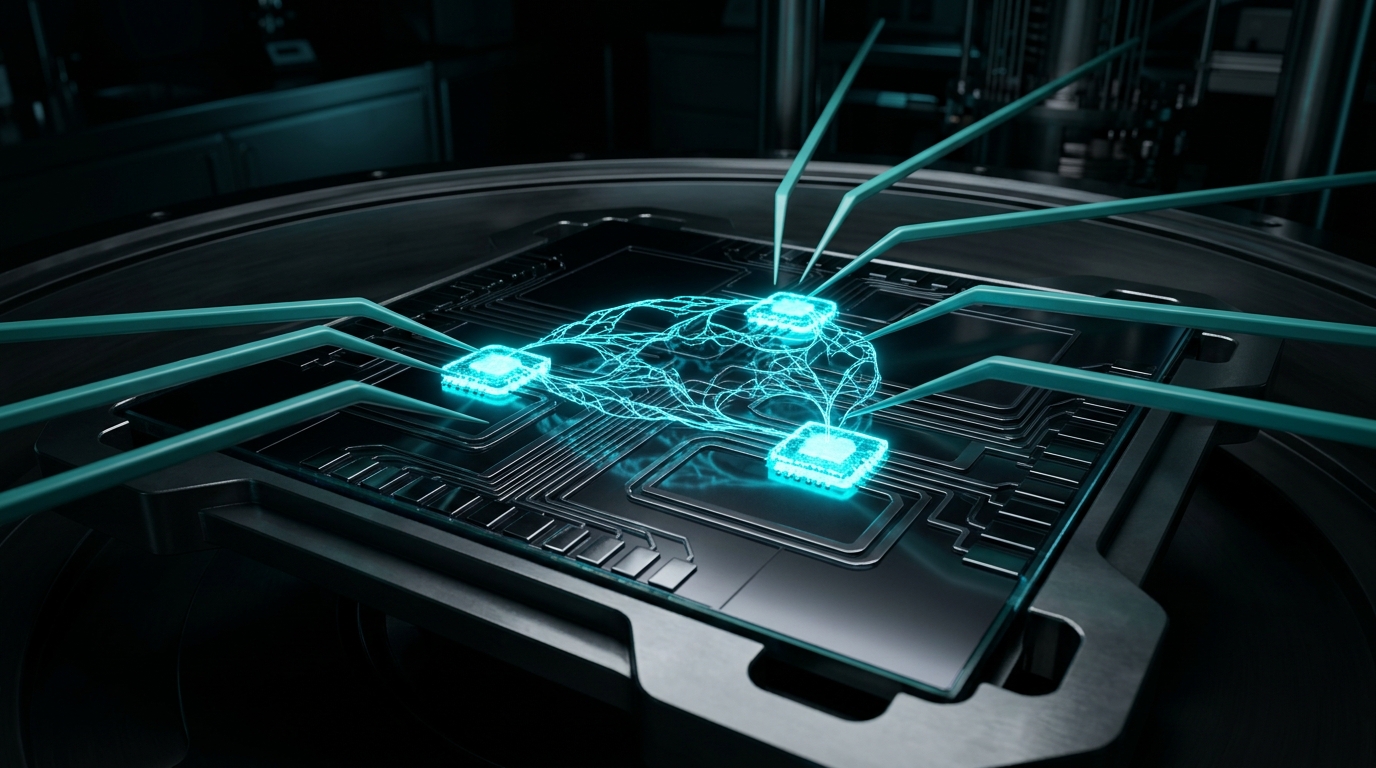
The blueprint from arXiv:2507.16152 attacks both walls simultaneously by replacing probabilistic sources with deterministic photon emission from quantum dots. Quantum dots emit single photons on demand. Pair that with adaptive repeat-until-success fusion operations and an optimized low-optical-connectivity architecture, and the resource overhead drops to a level where fault-tolerant operation becomes an engineering problem rather than a physics miracle.
“We estimate that one logical clock cycle of error correction can be executed within microseconds, which scales linearly with the code distance.” — arXiv:2507.16152v2, Practical Blueprint for Low-Depth Photonic Quantum Computing with Quantum Dots
Microseconds. For context: a single RSA-2048 decryption on a classical server takes roughly 1–2 milliseconds. A fault-tolerant quantum computer running logical cycles in microseconds operates at a clock rate that makes cryptanalytic workloads tractable at scale.
Technical Architecture: What the Blueprint Actually Specifies
The paper’s contribution is specificity. It doesn’t gesture at quantum dots as a promising direction — it provides the engineering stack.
Core Architectural Components
Time-bin qubit encoding encodes logical information in the arrival time of photons rather than polarization or path. This choice reduces sensitivity to certain optical imperfections and integrates naturally with fiber-optic infrastructure — relevant for anyone thinking about quantum network interconnects.
Reconfigurable entangled-photon sources allow the architecture to adapt resource-state generation dynamically, supporting the repeat-until-success fusion strategy that compensates for imperfect operations without requiring perfect hardware.
Low optical connectivity is the architectural decision with the largest practical impact. Fewer optical connections per node means fewer loss points, simpler fabrication, and lower error accumulation per logical operation. The blueprint explicitly optimizes for reduced optical depth per photon — the number of optical elements a photon must traverse before measurement.
Error threshold simulation covers the full catalogue of intrinsic error sources found in real quantum dot devices — not idealized noise models. This is the detail that separates a hardware roadmap from a theoretical exercise. The thresholds were validated against realistic device imperfections.
Photonic vs. Competing Quantum Computing Approaches
| Dimension | Superconducting Qubits | Trapped Ion | Photonic (This Blueprint) |
|---|---|---|---|
| Operating temperature | ~15 millikelvin | Room temp (vacuum) | Room temp (chip) |
| Photon source type | N/A | N/A | Deterministic (quantum dot) |
| Logical clock cycle | ~1–10 microseconds | ~1–100 milliseconds | Microseconds (linear w/ code distance) |
| Multiplexing overhead | Moderate | Low | Significantly reduced vs. prior photonic |
| Loss sensitivity | Low (electrical) | Low (laser-cooled) | Reduced via low optical depth |
| Fault-tolerance roadmap | Mature (Google, IBM) | Maturing (IonQ, Quantinuum) | Concrete blueprint now published |
| Primary cryptographic threat vector | RSA, ECC | RSA, ECC | RSA, ECC |
Sources: Published vendor roadmaps and arXiv:2507.16152v2. Logical clock cycle figures are architecture-dependent estimates.
Critical finding: The blueprint provides exact resource estimates for preparing a logical qubit, including hardware specifications for resource-state generation units and experimental pulse sequences. This level of engineering detail signals the field has crossed from theoretical architecture into pre-implementation planning.
Industry Context: Where This Lands on the Cryptographic Threat Timeline
NIST Has Already Answered the Policy Question
NIST finalized its first three post-quantum cryptographic standards in August 2024: ML-KEM (CRYSTALS-Kyber), ML-DSA (CRYSTALS-Dilithium), and SLH-DSA (SPHINCS+). The agency set a deprecation target for RSA and ECC: organizations should complete migration by 2030 for most use cases, with some high-assurance environments targeted for 2035.
The photonic blueprint doesn’t change those dates — NIST set them based on conservative threat modeling. What it does is validate that the threat modeling was correct. A concrete fault-tolerant architecture with microsecond clock cycles and realistic error thresholds is exactly the class of development NIST anticipated when it set 2030 as the migration deadline.
Who Is Moving — and Who Is Exposed
Google reported migrating Chrome’s TLS stack to support hybrid classical/post-quantum key exchange in 2023, protecting connections for hundreds of millions of users. The U.S. National Security Agency issued guidance in 2022 requiring National Security Systems to begin PQC migration planning immediately. The European Union Agency for Cybersecurity (ENISA) published a PQC migration roadmap in 2024.
The organizations lagging are mid-market enterprises, critical infrastructure operators, and any organization running custom PKI implementations. These environments typically carry 3–5 year certificate lifecycle management cycles and legacy systems that cannot be patched to support new key exchange algorithms without application-layer changes.
The economic asymmetry is stark: a PQC migration project for a mid-sized enterprise typically runs $500K–$2M depending on PKI complexity. A post-breach remediation after encrypted data is retroactively decrypted — covering regulatory fines, customer notification, litigation, and reputational damage — routinely exceeds $10M for regulated industries. The cost of inaction compounds annually as the threat timeline shortens.
The BeQuantum Perspective: What Microsecond Clock Cycles Mean for Digital Trust
At BeQuantum, we track photonic quantum computing developments specifically because our Digital Notary and PQC Layer products sit directly in the path of the threat this blueprint describes.
The arXiv:2507.16152 blueprint matters to our customers for one concrete reason: it demonstrates that fault-tolerant photonic quantum computing is now an engineering problem with a published solution path, not a physics problem awaiting a breakthrough. The timeline for “cryptographically relevant quantum computer” just compressed.
Our PQC Layer implements NIST-standardized algorithms at the TLS termination point, meaning organizations using it today are already protected against harvest-now-decrypt-later collection. But the Digital Notary use case — timestamped, cryptographically signed content authenticity records — requires long-term signature validity. A document notarized today with RSA-2048 needs its signature to remain verifiable in 2035. That’s the window this blueprint threatens.
Here’s how we’re addressing this internally and for customers: all Digital Notary signatures now use ML-DSA (CRYSTALS-Dilithium) as the primary algorithm with classical ECDSA as a fallback for legacy verifier compatibility. This hybrid approach maintains interoperability today while ensuring the signature remains quantum-resistant across the 10-year validity window that enterprise compliance frameworks typically require.
For organizations evaluating IceCase hardware security modules: the photonic blueprint’s use of time-bin encoding is architecturally compatible with fiber-optic key distribution channels. As photonic quantum networks mature, HSMs that support quantum key distribution interfaces will have a migration path that purely software-defined PQC implementations cannot match.
What Your Security Team Should Do in the Next 90 Days
Step 1 — Audit your cryptographic inventory (Days 1–30). Map every system that uses RSA or ECC for key exchange, digital signatures, or certificate validation. Prioritize by data sensitivity and retention period. Any encrypted data with a retention requirement beyond 2030 is a harvest-now-decrypt-later target today. Tools like NIST’s National Cybersecurity Center of Excellence migration guides provide structured inventory frameworks.
Step 2 — Classify your migration risk by system type (Days 30–60). Separate your inventory into three buckets: (a) TLS endpoints that can be migrated via certificate replacement, (b) application-layer signing systems requiring code changes, and (c) HSM-dependent systems requiring firmware or hardware upgrades. Bucket (c) carries the longest lead time — HSM vendors typically require 12–18 months from procurement to production deployment for new algorithm support.
Step 3 — Deploy hybrid PQC for highest-risk channels (Days 60–90). Don’t wait for a complete migration plan before protecting your most sensitive channels. Hybrid key exchange — combining classical ECDH with ML-KEM — provides immediate quantum resistance without breaking compatibility with systems that haven’t yet migrated. Major TLS libraries including OpenSSL 3.x and BoringSSL support hybrid modes today.
Frequently Asked Questions
Q: Does this photonic blueprint mean quantum computers can break encryption now?
A: No. The blueprint provides a hardware roadmap and architecture specification — it does not describe a working machine. Significant engineering work remains between a published blueprint and a cryptographically relevant quantum computer. However, the publication of exact resource estimates and experimental pulse sequences means the remaining work is implementation, not invention. Security teams should treat this as a 3–7 year threat horizon, not an immediate one.
Q: If I’ve already deployed TLS 1.3, am I protected against quantum attacks?
A: TLS 1.3 with classical ECDHE key exchange is not quantum-resistant. TLS 1.3 improves forward secrecy against classical adversaries, but a sufficiently powerful quantum computer running Shor’s algorithm can still break the underlying elliptic-curve key exchange. Protection requires replacing or augmenting the key exchange algorithm with a NIST-standardized PQC algorithm like ML-KEM, not just upgrading the TLS version.
Q: What is fusion-based quantum computing, and why does it matter for cryptography?
A: Fusion-based quantum computing is an approach where computation proceeds by performing linear-optics operations and photon measurements on pre-prepared entangled resource states. It matters for cryptography because it offers a scalable path to fault-tolerant quantum computation using photonic hardware — the same hardware that underpins fiber-optic communications infrastructure. A fault-tolerant quantum computer of sufficient scale can execute Shor’s algorithm to factor RSA keys and solve elliptic-curve discrete logarithm problems, breaking the public-key cryptographic systems that secure most of the internet today.
Sources: Practical blueprint for low-depth photonic quantum computing with quantum dots (arXiv:2507.16152v2). NIST PQC standardization timeline references from NIST.gov. Migration cost estimates based on industry analyst data.