- A new study (arXiv:2606.10150) builds a working binary quantum classifier using a parameterized quantum circuit (Ansatz) on two datasets: MNIST handwritten digits and Large Hadron Collider (LHC) collision data, where events are encoded either as 32x32 images or as just six high-level features.
- The authors benchmark the quantum model directly against a classical convolutional neural network (CNN) on the hardest task — distinguishing LHC collisions “with pile-up” from “without pile-up” — using ROC curves, AUC scores, confusion matrices, and test accuracy.
- For security leaders: this is a feasibility proof, not a production tool. The same hardware curve that makes quantum classifiers viable is the curve that will eventually break RSA and ECC — making it a leading indicator for your post-quantum migration timeline, not a near-term operational threat.
Why a Classifier Demo Belongs on Your Threat Radar
Most CISOs file “quantum machine learning” under research curiosities — interesting, irrelevant, ignore until 2035. That reflex is a mistake, and the reason is structural.
The paper “Towards the implementation of a quantum classifier” does not break encryption. It teaches a quantum circuit to tell a handwritten zero from a one, and to separate clean particle-physics collisions from noisy ones. But the capability it demonstrates — encoding real-world data into qubits, training the circuit, and extracting a usable decision — runs on the exact same physical substrate that Shor’s algorithm needs to factor your TLS keys.
Every published result that shows a parameterized quantum circuit doing useful supervised learning on non-trivial data is a data point on the maturity curve of programmable quantum hardware. When you track “who can run a non-trivial circuit and get a correct answer back,” you are tracking the same engineering progress that determines when attacks shift from theoretical to economically rational. A classifier that works today signals controllability that becomes cryptanalysis tomorrow.
That is the lens for this article: not “can quantum AI replace your fraud model,” but “what does a credible, peer-reviewed quantum classifier actually achieve in 2026, and what does that tell me about my migration window.”
Technical Deep-Dive: How a Binary Quantum Classifier Is Built
Definition
A binary quantum classifier is a quantum circuit used as a two-class machine-learning model. Input data is encoded into the circuit, a quantum circuit Ansatz (a circuit template with trainable parameters) transforms that state, a loss function scores the output against the true label, and a classical optimizer (minimizer) adjusts the parameters until the loss converges. The result is a model that maps an input — an image or a feature vector — to one of two classes.
The study implements exactly this pipeline using Qibo, an open-source framework for quantum simulation and hardware control. The four building blocks the authors specify are:
- Data encoding — loading classical data into the quantum circuit.
- The Ansatz — a quantum circuit with trainable parameters, whose depth (number of layers) is varied deliberately.
- A loss function — the training objective.
- Multiple minimizers — several classical optimizers, compared to find the best performer.
Two datasets, two difficulty levels
The authors validate on a deliberately staged pair of problems:
| Dimension | MNIST task | LHC collision task |
|---|---|---|
| Source | Handwritten digits | High-energy proton-proton collisions (CERN / LHC) |
| Classes | Handwritten 0 vs handwritten 1 | Without pile-up vs with pile-up |
| Data representation | Reduced digit images | 32x32 images or six high-level features |
| Real-world noise | Low | High — in-time proton-proton interactions (pile-up) contaminate signals |
| Classical baseline | — | Small convolutional neural network (CNN) |
| Evaluation | Accuracy, ROC, AUC, confusion matrix | Accuracy, ROC, AUC, confusion matrix |
MNIST is the warm-up: reduce the dataset to only zeros and ones, and confirm the circuit can learn a clean separation. The LHC task is where the work earns its weight. “Pile-up” is the physics term for multiple simultaneous proton-proton interactions polluting a single recorded event — a genuinely hard, noisy classification problem that CERN’s detectors face every collision. Encoding each event as either a 32x32 image or a compact six-feature vector lets the authors test how data representation affects a quantum model’s reach.
What was measured — and what was held constant
The authors studied minimizer behavior by increasing the number of Ansatz layers, then searched for the best optimizer by scaling both the training-set size and the Ansatz depth. For the “with pile-up” images, they put the quantum classifier head-to-head with a small CNN on identical metrics: ROC curve, AUC score, confusion matrices, and test-set accuracy.
“We conclude that is possible to build a binary quantum classifier with a quantum circuit and we highlight its performances and limitations in comparison with classical technologies.” — Towards the implementation of a quantum classifier (arXiv:2606.10150)
Read that conclusion precisely. The deliverable is feasibility plus a candid limitations comparison — not a claim of quantum advantage over the CNN. That honesty is exactly what makes the paper a useful gauge rather than a press release.
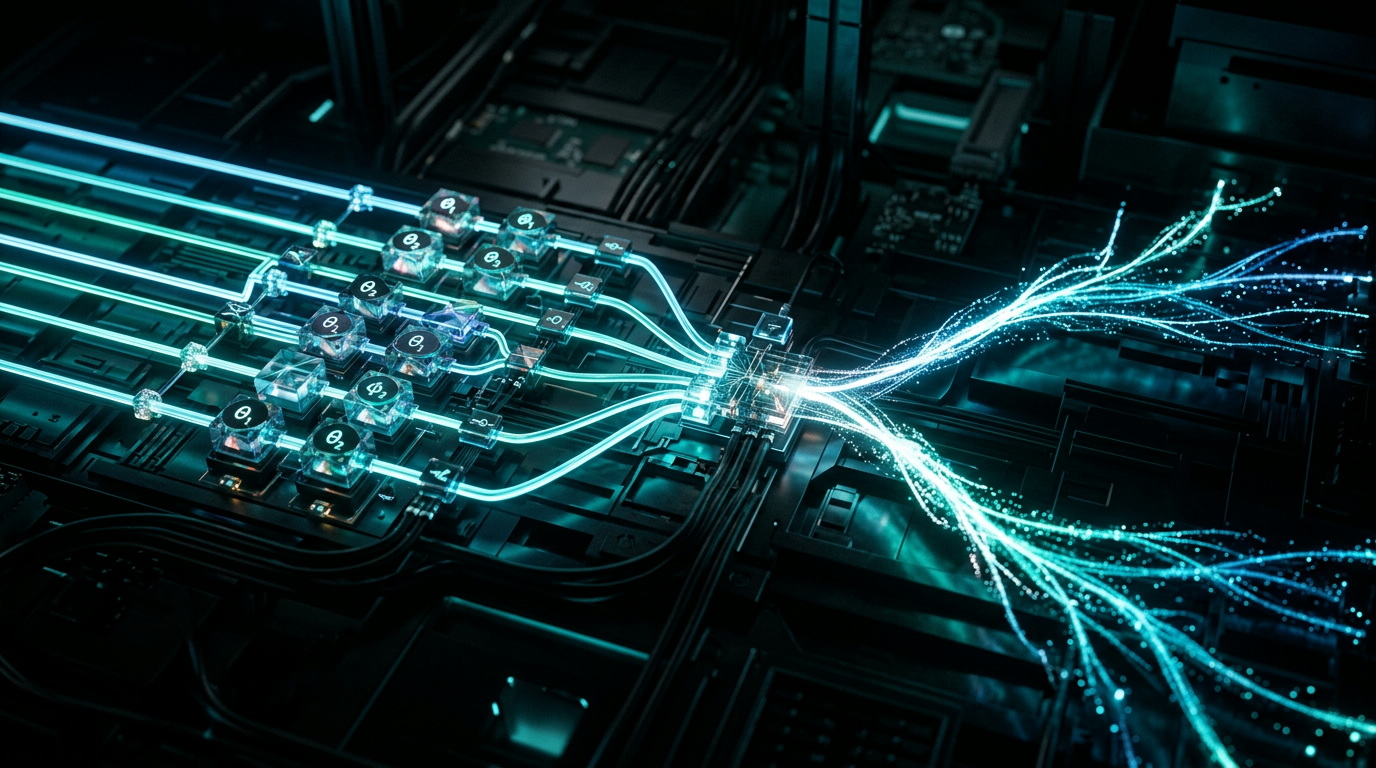
[IMAGE: a parameterized quantum circuit rendered as layered qubit lines feeding into a two-branch decision node, glowing teal against deep black]
Industry Context: Reading the Hardware Curve
The signal under the noise
The study sits in a research lineage — quantum models trained on Qibo, validated against CERN-relevant data — that exists because programmable quantum circuits are now controllable enough to attempt real supervised learning. NIST finalized its first (ML-KEM, ML-DSA, SLH-DSA) in August 2024, and its guidance points enterprises toward deprecating RSA-2048 and ECC well before 2035. The connective tissue between that mandate and a quantum classifier paper is circuit controllability: the engineering that lets researchers reliably train and read out a circuit is the same engineering that, scaled up with error correction, runs cryptanalytic algorithms.
A quantum classifier that correctly separates noisy LHC events is not a cryptographic threat. But it is a thermometer. When the demos stop being toy problems and start matching classical baselines on hard, noisy data, your harvest-now-decrypt-later exposure window is closing faster than the headlines suggest.
Where the picture is still incomplete
Responsible analysis means naming what the source does not establish. The abstract reports no numerical accuracy, AUC, or ROC values; no qubit count or hardware specification; no named optimizers or winning minimizer; no training/test split sizes; and no runtime, cost, or scalability benchmarks. The quantitative quantum-vs-CNN comparison exists in the full paper but is not quantified in the material summarized here.
For a decision-maker, that absence is itself information: the field is at the “it works” stage, not the “it wins” stage. Treat any vendor claiming production-grade quantum classification advantage in 2026 as a sales pitch, not a benchmark — and ask them for the exact AUC delta against a classical CNN baseline.
The BeQuantum Perspective
We track papers like this not for their machine-learning results but as maturity telemetry for the quantum threat landscape — the same way our research team treats every advance in qubit count, gate fidelity, and circuit controllability.
The practical link to our platform is the migration timeline. BeQuantum’s PQC Layer is built to let an organization run NIST-standardized algorithms (ML-KEM for key exchange, ML-DSA for signatures) alongside classical crypto in a hybrid configuration, so you are protected the moment the hardware curve crosses a threshold — without a disruptive cutover. Our Digital Notary anchors cryptographic proofs of data and model provenance, which matters precisely because quantum-capable adversaries will be able to forge classically-signed artifacts retroactively; provenance you commit today must survive a future signature break.
The approach we advocate is unglamorous: assume the demos in papers like this keep improving on schedule, and make sure your crypto-agility — not your encryption — is the thing you can swap. You cannot predict the exact year a quantum classifier becomes a quantum cryptanalyst. You can make that year irrelevant to your risk posture.
What You Should Do Next
- Within 90 days — inventory your cryptographic dependencies. Audit your TLS certificate chains, code-signing keys, and any long-lived data encrypted with RSA or ECC. Tag anything that must stay confidential beyond 2030 as harvest-now-decrypt-later exposure. You cannot migrate what you have not mapped.
- Within 6 months — pilot hybrid PQC on one non-critical service. Deploy a NIST-standardized hybrid key exchange (classical + ML-KEM) on a low-risk endpoint to surface integration friction — latency, library maturity, certificate handling — before it is on your critical path.
- Ongoing — treat QML feasibility papers as leading indicators. Assign someone to watch when quantum classifiers stop matching toy datasets and start matching classical baselines on hard, noisy, real-world data. That inflection is your migration alarm clock.
FAQ
Q: Does this quantum classifier threaten my encryption today? A: No. The study classifies handwritten digits and particle-collision data — it does not run any cryptanalytic algorithm. Its relevance is as a maturity signal: it demonstrates the circuit controllability that, scaled up over years, underpins quantum attacks on RSA and ECC.
Q: Did the quantum classifier beat the classical CNN? A: The paper does not claim quantum advantage. Its stated conclusion is that building a binary quantum classifier is possible, and it explicitly highlights both performances and limitations versus classical technologies. The summarized material reports no numerical AUC or accuracy comparison.
Q: What is “pile-up” and why does it make the task hard? A: Pile-up refers to multiple simultaneous proton-proton interactions contaminating a single recorded LHC event. Separating “with pile-up” from “without pile-up” is a genuinely noisy classification problem, which is why the authors used it — alongside a CNN baseline — to test the quantum model against realistic difficulty rather than a clean toy dataset.
Last updated: June 11, 2026.