
Last updated: June 2025
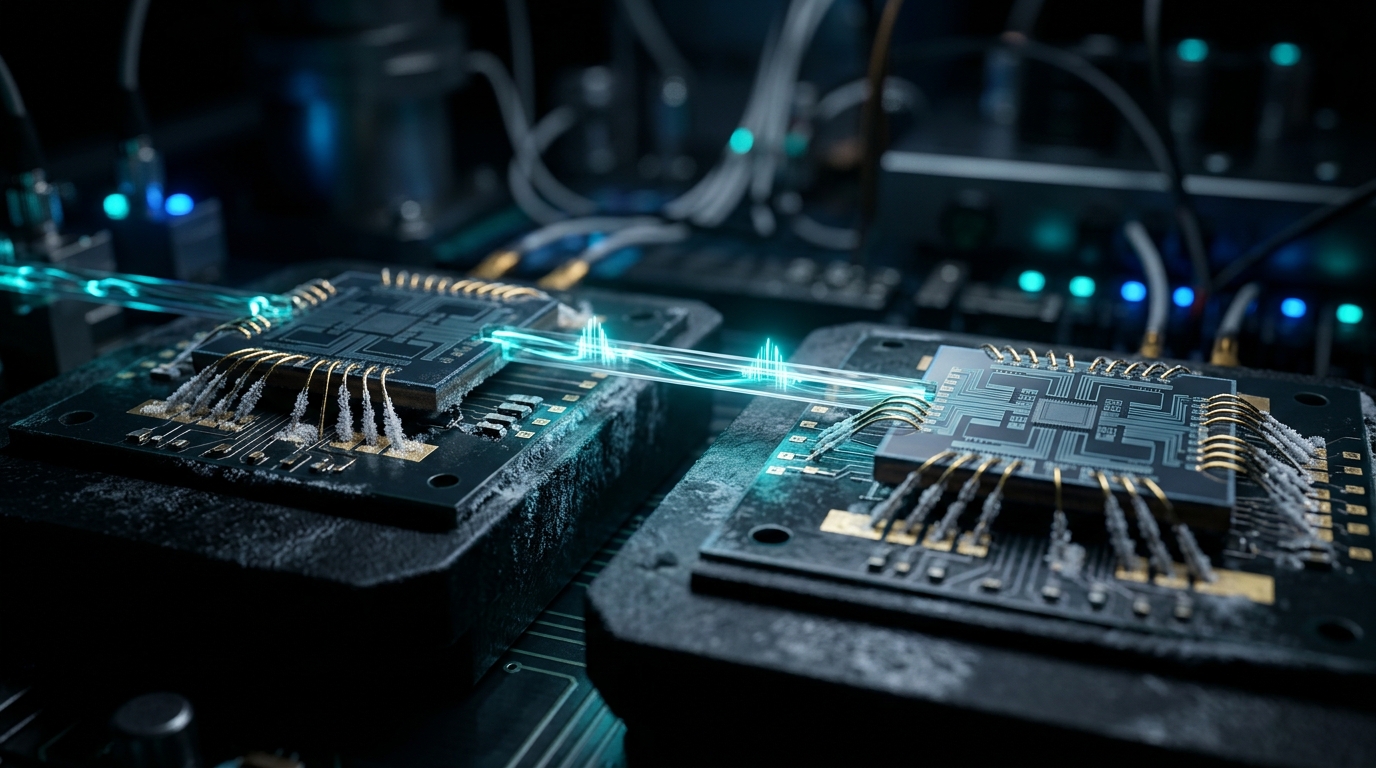
[IMAGE: Macro photograph of a photonic integrated circuit chip with glowing waveguides emitting faint spectral light at diverging wavelengths, deep black background with cyan and amber light separation illustrating a wavelength-splitting side channel, cinematic 8K quality]
Key Takeaways
- Researchers identified that p-n junction-based variable optical attenuators (VOAs) — a standard component in integrated QKD transmitters — emit spontaneous luminescence centered at 1107 nm, spectrally separated from C-band quantum signals (~1530–1565 nm)
- This spectral gap creates a wavelength-resolved side channel that enables potential wavelength-splitting attacks without disturbing the encoded quantum states themselves
- Any enterprise or government deployment running chip-based QKD hardware should treat this as an unaudited attack surface until transmitter hardware is physically verified against this emission profile
The Assumption That Just Broke: QKD Is Not Automatically Secure
The operational promise of quantum key distribution is absolute: an eavesdropper who intercepts the quantum channel disturbs the quantum states, and that disturbance is detectable. Your security team gets an alert. The key is discarded. The session is safe.
That promise holds — when the quantum channel is the only channel leaking information.
A preprint published on arXiv (arXiv:2604.18422v1) documents a scenario where it is not. Researchers conducting what they describe as the first systematic study of this implementation-level vulnerability found that variable optical attenuators embedded in photonic integrated QKD transmitters emit spontaneous luminescence when electrically biased. That emission exits the chip at 1107 nm — a wavelength sitting well outside the C-band window your QKD system uses to transmit quantum keys.
An attacker equipped with a wavelength-selective filter and a single-photon detector does not need to touch your quantum states. They tap the 1107 nm emission on a separate optical path. The quantum channel remains undisturbed. Your error rate stays clean. Your system reports no anomaly.
This is not a theoretical edge case. VOAs are described in the research as ubiquitous components in integrated QKD transmitters. If your organization has deployed or is evaluating chip-based QKD — the compact, scalable form factor increasingly favored for enterprise and metropolitan network deployments — this vulnerability applies to your hardware class.
Technical Deep-Dive: How VOA Luminescence Creates a Side Channel
What VOAs Do — and What They Leak
A variable optical attenuator controls signal intensity within a photonic integrated circuit. In QKD transmitters, VOAs are used to precisely set the mean photon number per pulse — a critical parameter for security proofs that assume weak coherent pulse sources. Without accurate attenuation, the transmitter violates the assumptions underpinning its security model.
The problem: p-n junction-based VOAs achieve attenuation through carrier injection or depletion. Apply a bias voltage, and the junction emits spontaneous luminescence as a physical byproduct. This is not a design flaw unique to one vendor — it is a consequence of the underlying semiconductor physics common to this entire component class.
Researchers used a single-photon-sensitive spectral measurement technique to characterize the emission and pinpoint its wavelength at approximately 1107 nm.
The Wavelength-Splitting Attack Surface
“Even extremely weak emission can lead to non-negligible information leakage.” — arXiv:2604.18422v1, Security Risks of VOA-Induced Luminescence in Chip-Based QKD
The 1107 nm emission is spectrally separated from C-band quantum signals by more than 400 nm. That separation is not a safety margin — it is the attack vector. A wavelength-division multiplexing (WDM) filter can cleanly isolate the 1107 nm band from the quantum channel without introducing measurable crosstalk or disturbance to the quantum states.
This creates a wavelength-resolved side channel: a secondary optical path carrying information correlated with VOA drive signals, which are themselves correlated with the quantum states being encoded. An attacker with fiber access between transmitter and receiver — a realistic assumption for any metropolitan QKD deployment traversing shared infrastructure — can split off the 1107 nm band passively.
| Parameter | C-Band Quantum Channel | VOA Luminescence Side Channel |
|---|---|---|
| Wavelength | ~1530–1565 nm | ~1107 nm |
| Separation | — | >400 nm from quantum channel |
| Detectable by QKD error rate? | Yes (direct interception) | No (separate wavelength) |
| Required attacker equipment | Single-photon detector + beamsplitter | WDM filter + single-photon detector |
| Disturbs quantum states? | Yes | No |
| Covered by standard QKD security proofs? | Yes | No |
Why Security Proofs Don’t Cover This
Conventional QKD security proofs model the transmitter as a black box that emits quantum states with defined statistical properties. They do not model secondary optical emissions from internal components. The VOA luminescence side channel exists outside the security proof boundary — which means no amount of post-processing, privacy amplification, or error correction addresses it. The leakage occurs before the quantum protocol begins.
Industry Context: Why Chip-Based QKD Amplifies This Risk
The Integration Trend Creates Concentrated Exposure
The QKD industry has moved aggressively toward photonic integrated circuits (PICs) for practical reasons: smaller form factor, lower cost per unit, compatibility with existing fiber infrastructure, and easier deployment in enterprise rack environments. Integrated QKD transmitters consolidate components — including multiple VOAs — onto a single chip.
That consolidation means a single chip may contain several p-n junction VOAs, each a potential emission source. The attack surface scales with integration density, not with the number of deployed systems.
Regulatory and Standards Implications
NIST’s post-quantum cryptography standardization process — which finalized ML-KEM (CRYSTALS-Kyber), ML-DSA (CRYSTALS-Dilithium), and SLH-DSA (SPHINCS+) in 2024 — focuses on algorithm-level security. Implementation security for quantum hardware operates under a different standards regime, primarily through ETSI’s QKD standards (ETSI GS QKD 014, ETSI GS QKD 008) and emerging ISO/IEC frameworks.
Neither framework currently addresses VOA luminescence as a defined threat vector. The research paper explicitly frames this as the first systematic study of this vulnerability class, which means standards bodies have not yet incorporated it into conformance testing requirements.
For organizations subject to compliance mandates that reference QKD as a key protection mechanism — particularly in defense, critical infrastructure, and financial services — this creates an unquantified compliance gap: your QKD deployment may satisfy current certification requirements while remaining vulnerable to an attack class those requirements do not test for.
Who Is Moving — and Who Is Exposed
Government and defense agencies in the EU, UK, and Asia-Pacific have made the largest QKD investments to date, with metropolitan QKD networks operational in cities including Tokyo, Beijing, and Geneva. Enterprise adoption remains early-stage in North America, with financial institutions and telecommunications providers running pilot deployments.
All chip-based integrated QKD deployments using p-n junction VOAs fall within the affected hardware class identified by this research. Discrete-component QKD systems — which use bulk optical components rather than integrated photonics — present a different risk profile, though the research does not provide a direct comparison.
The economic calculus is straightforward: the cost of auditing your QKD transmitter hardware today is a fraction of the cost of discovering post-deployment that key material was silently exfiltrated through a side channel your security proofs never modeled.
The BeQuantum Perspective: Implementation Security Is the Actual Attack Surface
The QKD industry has spent two decades hardening the quantum channel. Researchers have characterized photon number splitting attacks, trojan horse attacks, detector blinding attacks, and time-shift attacks. Each discovery produced a countermeasure. Each countermeasure was incorporated into updated security proofs.
The VOA luminescence finding follows this pattern — but with a critical difference. Previous implementation attacks targeted the quantum channel itself or the detection apparatus. This attack targets a secondary emission from a passive component that most security architects would not classify as a cryptographic element at all. VOAs are infrastructure. They attenuate signals. They are not, in the conventional security model, a source of key-correlated information.
That assumption is now falsified.
At BeQuantum, our approach to quantum communication security is built on the premise that the security boundary must encompass the entire physical device, not just the quantum channel. Our Digital Notary framework applies cryptographic attestation at the hardware layer — creating a verifiable record of device state that can flag anomalous emission profiles or component behavior deviating from baseline. For organizations evaluating or operating chip-based QKD infrastructure, this kind of hardware-layer attestation is not optional hardening — it is the mechanism that makes implementation-level vulnerabilities detectable before they become breach events.
The PQC Layer we deploy alongside QKD infrastructure also addresses a related risk: organizations that rely exclusively on QKD for key establishment, without a post-quantum algorithm layer as a fallback, have no cryptographic recourse if a side-channel attack silently compromises key material. Hybrid architectures — QKD plus ML-KEM — maintain security even when one layer is compromised.
What Your Security Team Should Do in the Next 90 Days
Step 1: Inventory your QKD hardware architecture (within 30 days) Determine whether your deployed or evaluated QKD transmitters use photonic integrated circuits with p-n junction-based VOAs. Request component-level documentation from your QKD vendor. If your vendor cannot confirm the VOA implementation type, treat the system as potentially affected.
Step 2: Audit optical fiber access points between transmitter and receiver (within 60 days) The wavelength-splitting attack requires physical access to the optical fiber carrying QKD signals. Map every splice point, patch panel, and co-location facility your QKD fiber traverses. Any point accessible to a third party — including shared carrier infrastructure — is a potential tap location for the 1107 nm side channel.
Step 3: Implement a hybrid key establishment architecture (within 90 days) Do not rely on QKD as your sole key establishment mechanism until this vulnerability class is fully characterized and mitigated by hardware vendors. Deploy ML-KEM (CRYSTALS-Kyber, NIST-standardized 2024) in parallel with your QKD layer. A hybrid architecture ensures that compromise of either layer alone does not expose key material.
Frequently Asked Questions
Q: Does this vulnerability affect all QKD systems, or only chip-based integrated systems?
A: Based on the research (arXiv:2604.18422v1), the vulnerability is specific to QKD transmitters that use p-n junction-based variable optical attenuators in photonic integrated circuits. Discrete-component QKD systems using bulk optical attenuators operate on different physical principles and are not identified as affected by this specific side channel. If your QKD system uses integrated photonics — the compact chip-based form factor — you should verify VOA implementation type with your vendor.
Q: Can standard QKD error rate monitoring detect a wavelength-splitting attack exploiting this side channel?
A: No. The attack operates at 1107 nm, which is spectrally separated from C-band quantum signals by more than 400 nm. A wavelength-selective filter isolates the side channel without introducing any disturbance to the quantum states. Your quantum bit error rate (QBER) remains within normal bounds. Standard QKD security monitoring does not cover secondary optical emissions from transmitter components, which means this attack class is invisible to conventional QKD intrusion detection.
Q: Are there published countermeasures for this vulnerability?
A: The arXiv preprint (arXiv:2604.18422v1) does not describe specific countermeasures in its abstract. The research characterizes the vulnerability and establishes it as a previously overlooked implementation-level risk. Likely mitigation directions include optical filtering at the transmitter output to block the 1107 nm band, security-aware redesign of VOA components to suppress luminescence, and hardware-layer attestation to detect anomalous emission. Organizations should monitor vendor advisories and the ETSI QKD standards working group for formal guidance as this research undergoes peer review and community response.