Last updated: October 2024
Key Takeaways
- Wire codes reduce quantum error-correction interactions to weight-3 and degree-3 — a hardware constraint breakthrough that makes fault-tolerant quantum computing significantly more buildable on near-term processors
- Qubit overhead scales multiplicatively and linearly with input check degree; distance reduction scales linearly with input check weight — meaning the cost of this transformation is bounded and predictable, not exponential
- If wire code frameworks accelerate fault-tolerant quantum computers by even 18–24 months, organizations still running RSA-2048 or ECDH key exchanges face a materially earlier “harvest now, decrypt later” deadline than current NIST migration timelines assume
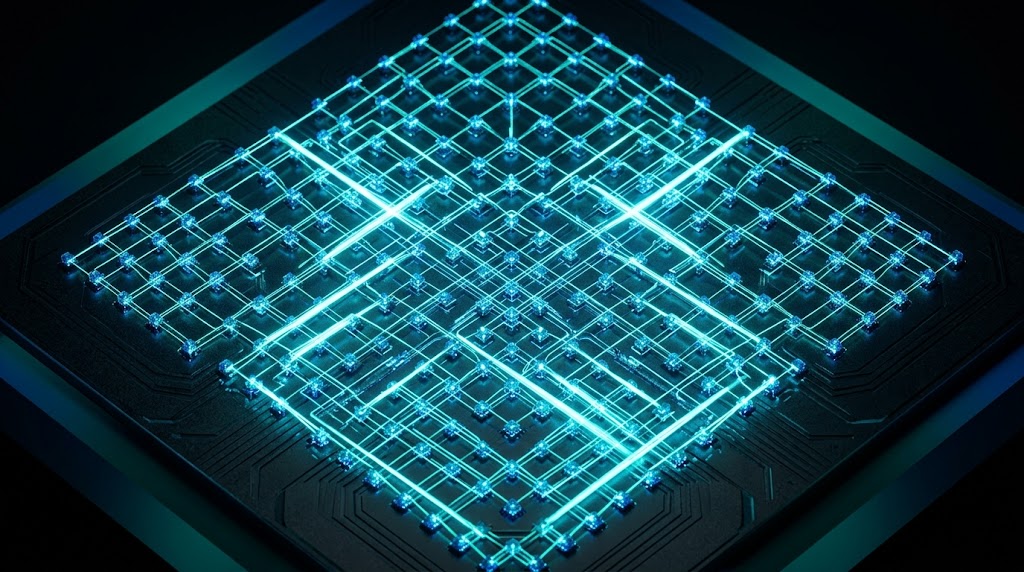
[IMAGE: A quantum processor chip with entangled cyan light beams threading between qubits in a hypercubic lattice pattern, macro lens, cinematic dark background with deep blacks and teal accents, 8K photorealistic]
Why a Theoretical Paper Should Alarm Your Security Team
Picture this: your organization completed a TLS 1.3 upgrade two years ago, your certificates are current, and your CISO signed off on a 36-month PQC migration roadmap. Then a research paper drops that quietly removes one of the core engineering obstacles keeping fault-tolerant quantum computers from scaling.
That paper is Wire Codes, published on arXiv in October 2024.
The obstacle it removes is connectivity. Every physical quantum processor — whether superconducting qubits, trapped ions, or photonic chips — imposes strict limits on which qubits can interact directly. Most quantum error-correcting codes require high-weight interactions (many qubits entangled simultaneously) that simply cannot be implemented on hardware with limited physical connectivity. This mismatch between theoretical codes and physical hardware has been a primary bottleneck slowing fault-tolerant quantum computing.
Wire codes dissolve that bottleneck by transforming any quantum stabilizer code into a subsystem code where every interaction has weight three and degree three — the minimum complexity that still supports full error correction. The primary keyword here for security architects is post-quantum cryptography: the faster fault-tolerant quantum computers become buildable, the shorter your window to complete PQC migration.
The Technical Mechanics: What Weight-3 Interactions Actually Mean
To assess the threat, you need to understand what wire codes actually do — not at a physics PhD level, but at the level of “what engineering barrier just got lowered?”
Stabilizer Codes vs. Subsystem Codes
A quantum stabilizer code encodes logical qubits into a larger physical qubit system and detects errors by measuring stabilizers — multi-qubit operators. The problem: measuring a stabilizer that involves 6, 8, or 10 qubits simultaneously requires those qubits to all interact physically. On real hardware, that’s often impossible without routing through intermediate qubits, introducing additional error sources.
A subsystem code splits the system into logical, gauge, and syndrome qubits. Error correction operates on the gauge and syndrome subsystems using only local measurements. The tradeoff historically was that subsystem codes required custom design — you couldn’t just take an existing high-performance stabilizer code and convert it.
Wire codes eliminate that tradeoff.
“We introduce a general recipe to transform any quantum stabilizer code into a subsystem code that has local interactions, with weight and degree three, on a given graph.” — Wire Codes, arXiv:2410.10194v2
The Transformation Recipe
The wire code construction works as follows:
- Input: Any quantum stabilizer code, represented via its Tanner graph — a bipartite graph connecting physical qubits to parity checks
- Embedding: The Tanner graph is embedded into a host graph (e.g., a hypercubic lattice or an expander graph) with low density
- Output: A subsystem code where all interactions are weight-3 and degree-3 on that host graph
- Cost: Qubit overhead is multiplicative and linear in the input check degree; distance reduction is linear in the input check weight
The overhead is bounded. For a stabilizer code with check degree d, you pay a linear qubit cost — not quadratic, not exponential. That’s the result that matters for hardware engineers trying to build scalable systems.
Optimal Scaling on Hypercubic Lattices and Expander Graphs
The paper demonstrates two particularly significant applications:
- Hypercubic lattices: Applying wire codes here yields local subsystem codes with optimal scaling code parameters in any fixed spatial dimension. This is directly relevant to 2D and 3D superconducting qubit architectures, which are the leading near-term hardware platform.
- Expanding graphs: Applying wire codes to families of expander graphs produces local codes whose parameters depend on the degree of expansion — giving hardware designers a tunable knob between code performance and physical connectivity requirements.
| Parameter | Standard Stabilizer Code | Wire Code Subsystem Output |
|---|---|---|
| Interaction weight | Variable (often 6–10+) | Fixed: 3 |
| Interaction degree | Variable | Fixed: 3 |
| Hardware connectivity required | High (long-range or all-to-all) | Low (local graph neighbors only) |
| Qubit overhead vs. input | Baseline | Multiplicative, linear in check degree |
| Distance vs. input | Baseline | Reduced linearly in check weight |
| Applicable to arbitrary stabilizer codes | N/A | Yes — general recipe |
| Optimal scaling on 2D/3D lattices | Not guaranteed | Achieved via hypercubic embedding |
What the Paper Does Not Yet Provide
Security architects should note the current boundaries of this research:
- Results are purely theoretical — no experimental hardware validation is reported
- No specific
[[n, k, d]]code parameters are benchmarked against existing schemes - No hardware platform (superconducting, trapped ion, photonic) is explicitly targeted
- No implementation timeline or roadmap is discussed
These gaps matter for calibrating urgency. Wire codes lower a theoretical barrier; they do not constitute a working fault-tolerant quantum computer. But theoretical barriers, once removed, tend to fall faster in practice than security planning cycles assume.
Industry Context: Where This Fits in the PQC Timeline
NIST’s Migration Clock Is Already Running
NIST finalized its first three post-quantum cryptographic standards in August 2024: ML-KEM (CRYSTALS-Kyber), ML-DSA (CRYSTALS-Dilithium), and SLH-DSA (SPHINCS+). Federal agencies face binding migration deadlines, and NIST has explicitly recommended that organizations begin deprecating RSA and elliptic-curve cryptography now, not when quantum computers arrive.
The wire codes paper accelerates the urgency of that recommendation. The standard threat model for “harvest now, decrypt later” (HNDL) attacks assumes adversaries are already collecting encrypted traffic today, betting they can decrypt it once a sufficiently powerful quantum computer exists. The question has always been: how long until that computer exists?
Every paper that removes a hardware engineering obstacle — like the connectivity constraint that wire codes address — compresses that timeline estimate. Organizations that built their PQC roadmaps on a 10-year horizon should revisit whether 5–7 years is more defensible.
Who Is Moving and Who Is Lagging
Google, IBM, and Microsoft have all announced active PQC integration programs. Google reported migrating internal systems to hybrid classical/PQC key exchange in 2023. The financial sector, driven by DORA in the EU and SEC cyber disclosure rules in the US, is accelerating cryptographic inventory audits.
The organizations lagging are predominantly mid-market enterprises and critical infrastructure operators who lack dedicated cryptographic agility programs — meaning they have no systematic way to identify which systems use RSA or ECC, let alone replace them on a defined schedule.
The Economic Calculus
Migrating a large enterprise’s cryptographic infrastructure typically costs between $2M and $15M depending on the number of systems, custom integrations, and HSM replacements required. That figure sounds large until you compare it to the regulatory and reputational cost of a post-quantum breach of long-lived sensitive data — patient records, financial transactions, national security communications — that was encrypted today and decrypted in 2030.
The cost of inaction compounds annually as the encrypted data archive grows.
The BeQuantum Perspective: Cryptographic Agility as Infrastructure
At BeQuantum, we track research like wire codes not because a single paper triggers an immediate threat, but because our Digital Notary and PQC Layer are designed around a core principle: cryptographic agility. The ability to swap cryptographic primitives without re-architecting dependent systems.
Here is what wire codes mean in practice for organizations using our platform:
Our PQC Layer already implements ML-KEM and ML-DSA as primary key encapsulation and signature mechanisms. But the deeper value is the abstraction layer — when the quantum computing timeline compresses due to advances like wire codes, our customers do not need to re-engineer their authentication pipelines. They update a configuration parameter, and the underlying primitive rotates.
For blockchain verification specifically, our IceCase hardware module signs transaction hashes using post-quantum signatures at the point of origination. Wire codes research reinforces why this matters: the integrity of a blockchain record created today must be verifiable in 2035, when the threat landscape will look materially different.
The organizations that will navigate the post-quantum transition with the least disruption are those that treat cryptographic agility as infrastructure — not as a one-time migration project.
This means:
- Maintaining a live cryptographic asset inventory (which algorithms, which key lengths, which certificate authorities, which HSMs)
- Deploying hybrid classical/PQC schemes now, so systems are exercising the new code paths before they become mandatory
- Monitoring the research pipeline — papers like wire codes are leading indicators, not lagging ones
What You Should Do in the Next 90 Days
Step 1: Audit your TLS certificate chain and key exchange mechanisms (Days 1–30) Identify every external and internal service using RSA or ECDH for key exchange. Prioritize by data sensitivity and certificate lifetime. Any certificate with a validity period extending past 2028 should be flagged for early replacement with a hybrid or PQC-native alternative.
Step 2: Classify your long-lived sensitive data by HNDL exposure (Days 30–60) Map which data stores contain records that must remain confidential for 5+ years. These are your highest-priority HNDL targets. Encrypted backups, archived communications, and long-term financial records are the most common exposure categories. Quantify the volume — this drives your migration business case.
Step 3: Establish a cryptographic agility baseline (Days 60–90) Document your current cryptographic dependencies in a format that can be updated as standards evolve. If you cannot answer “which systems would break if we deprecated RSA-2048 tomorrow?” within 48 hours, your cryptographic inventory is insufficient. Tools like CBOM (Cryptographic Bill of Materials) frameworks provide a structured starting point.
FAQ: Wire Codes and Post-Quantum Security
Q: Does the wire codes paper mean quantum computers can now break RSA? A: No — wire codes address a hardware engineering constraint (interaction locality) that has slowed the development of fault-tolerant quantum computers. They do not constitute a working quantum computer, and no experimental validation has been reported. However, they remove a theoretical barrier that has been cited as a reason large-scale fault-tolerant quantum computers remain distant, which warrants updating threat timeline assumptions.
Q: Should we accelerate our PQC migration timeline based on this research? A: If your current roadmap extends beyond 2028 for systems handling long-lived sensitive data, yes — revisit it. Wire codes are one of several recent advances (alongside improved magic state distillation and surface code threshold improvements) that collectively suggest the engineering path to fault-tolerant quantum computing is clearing faster than 2020-era estimates assumed. NIST’s PQC standards are finalized; the migration tools exist. The risk of waiting now outweighs the cost of moving.
Q: What is a subsystem code, and why does weight-3 interaction matter for hardware? A: A subsystem code is a quantum error-correcting code that partitions qubits into logical, gauge, and syndrome subsystems, enabling error correction through lower-complexity measurements than standard stabilizer codes. Weight-3 interaction means each error-detection measurement involves exactly three physical qubits — the minimum sufficient for error correction. On real quantum hardware, lower-weight interactions require less physical connectivity between qubits, reducing fabrication complexity, crosstalk errors, and routing overhead. This is why weight-3 local interactions are a hardware-friendly target that wire codes now make universally achievable from any stabilizer code input.