- A new transversal STAR architecture, co-designed with neutral-atom hardware, can simulate local Hamiltonians at a total simulation volume exceeding 600 using approximately 10,000 physical qubits at a 10⁻³ physical error rate (arXiv:2509.18294).
- That 600+ simulation volume is equivalent to a fully-fault-tolerant computation requiring over 10⁶–10⁷ T gates — work that previously demanded far larger, distillation-heavy machines.
- For your security posture: this is a measurable acceleration marker on the fault-tolerance roadmap. It does not break RSA today, but it shortens the runway for “harvest now, decrypt later” attacks and tightens your PQC migration window.
Why a Quantum Simulation Result Belongs on Your Risk Register
Most CISOs file “quantum” under a single threat: a future machine running Shor’s algorithm against RSA-2048 and ECC. That machine needs millions of high-quality physical qubits and remains years out. So quantum risk gets deferred.
That deferral is the vulnerability. The data your organization encrypts today — patient records, financial transactions, signed firmware, intellectual property — has a confidentiality lifetime of 10 to 30 years. An adversary harvesting your TLS-protected traffic now can decrypt it the moment fault-tolerant hardware matures. The attack window is already open; only the decryption step waits.
The relevant question is therefore not “is the cryptographically relevant quantum computer here?” It is “how fast is the gap to fault tolerance closing?” Every architectural result that cuts the physical-qubit and overhead cost of fault-tolerant computation moves that date earlier. The transversal STAR architecture is exactly such a result, and it does so by attacking the single most expensive component in the fault-tolerance stack: magic-state preparation.
Technical Deep-Dive: How Transversal STAR Cuts the Overhead
Fault-tolerant quantum computation splits into two classes of operation. Clifford gates are comparatively cheap to protect. Non-Clifford gates — the ones that make a computation universal — require magic states, special resource states whose preparation has historically dominated the qubit and time budget through a process called magic-state distillation.
The original STAR (space-time efficient analog rotation) approach sidesteps full distillation. Instead of distilling, it uses post-selection to prepare low-noise, small-angle magic states, injecting just enough non-Clifford resource to run analog rotations. The catch in the original design: its physical implementation assumes fixed qubit connectivity, which inflates implementation costs back toward those of leading fully-fault-tolerant approaches. The clever idea was being taxed by rigid hardware assumptions.
The transversal STAR architecture removes that tax by co-designing the logical layout with neutral-atom hardware. Neutral atoms can be physically rearranged, enabling transversal gates — operations applied to all qubits of a code block in parallel — that fixed-lattice platforms cannot perform cheaply. The result is savings across three axes simultaneously: logical layout, time, and space.
The authors back the design with circuit-level simulations that derive the logical noise model for surface-code-based transversal STAR gadgets and verify their composability — meaning the gadgets can be chained into real algorithms without the error budget collapsing.
“At its limit, the transversal STAR architecture can efficiently simulate local Hamiltonians with a total simulation volume exceeding 600. Achieving this limit would require approximately 10,000 physical qubits at a physical error rate of 10⁻³. This is equivalent to a fully-fault-tolerant computation requiring over 10⁶–10⁷ T gates.” — Abstract, arXiv:2509.18294
Critically, the approach is not limited to the surface code. It extends to high-rate quantum codes using a limited set of highly parallel transversal Clifford gates plus generalized small-angle magic injection — pointing toward even lower overhead as encoding efficiency improves.
Original STAR vs. Transversal STAR vs. Fully-Fault-Tolerant
| Dimension | Original STAR | Transversal STAR | Fully-Fault-Tolerant |
|---|---|---|---|
| Magic resource strategy | Post-selected small-angle magic states | Generalized small-angle magic injection | Full magic-state distillation |
| Hardware assumption | Fixed qubit connectivity | Reconfigurable neutral atoms | Typically fixed lattice |
| Effective overhead | Close to fully-FT | Reduced in layout, time, space | Highest (distillation-dominated) |
| Target regime | Partially-fault-tolerant | Early-fault-tolerant, megaquop scale | Large-scale, T-gate-heavy |
| Demonstrated reach | — | Simulation volume >600 @ ~10k qubits, 10⁻³ | >10⁶–10⁷ T-gate equivalent |
Industry Context: Reading the Fault-Tolerance Curve
“Megaquop” denotes roughly one million (10⁶) reliable quantum operations — the threshold where a machine can run useful fault-tolerant algorithms rather than noisy NISQ demonstrations. The transversal STAR architecture explicitly targets this regime, and it does so with a resource budget — ~10,000 physical qubits at a 10⁻³ error rate — that several neutral-atom roadmaps consider reachable rather than speculative.
For cryptographic risk, two facts must be held together honestly. First, ~10,000 qubits aimed at Hamiltonian simulation is not a cryptanalytic machine; breaking RSA-2048 with Shor’s algorithm still requires orders of magnitude more qubits and far more T gates. Second, the engineering techniques that deliver megaquop-scale simulation — composable transversal gadgets, cheaper magic injection, reconfigurable-atom layouts — are the same techniques that compress the cost of every downstream fault-tolerant computation, including cryptanalysis. Progress here is a leading indicator, not the threat event itself.
This aligns with the regulatory direction. NIST finalized its first post-quantum standards — ML-KEM (FIPS 203), ML-DSA (FIPS 204), and SLH-DSA (FIPS 205) — in August 2024, and the broader U.S. federal guidance targets a migration substantially complete by 2035. The cost of inaction is asymmetric: migrating cryptography is a multi-year inventory-and-replace program, while the adversary’s harvesting step requires no fault-tolerant hardware at all today.
The BeQuantum Perspective
We read results like transversal STAR not as a doomsday clock but as a calibration input for crypto-agility planning. The lesson for enterprise architects is structural: the bottleneck that fell here — magic-state overhead — was removed by co-design, by matching the algorithm to the hardware’s real capabilities instead of an idealized lattice. The same discipline applies to defending data against a quantum future.
That is the principle behind BeQuantum’s PQC Layer: rather than hard-coding a single algorithm, it treats cryptographic primitives as swappable so that ML-KEM and ML-DSA can be deployed alongside classical schemes in a hybrid configuration, and rotated as standards evolve. Our Digital Notary addresses the harvest-now-decrypt-later problem at the integrity layer — anchoring quantum-resistant signatures and verifiable timestamps so that the authenticity of records survives even if a future machine compromises the confidentiality of the channel they traveled over. For high-assurance key custody, IceCase hardware keeps long-lived secrets off network-reachable surfaces, shrinking the very harvesting surface this architecture’s progress makes more valuable.
The defensible posture is not predicting the exact year fault tolerance arrives. It is building systems where swapping a broken primitive is a configuration change, not a re-architecture.
What You Should Do Next
- Within 90 days, build a cryptographic inventory. Map every system that uses RSA, ECDH, or ECDSA — TLS certificate chains, code-signing pipelines, VPN tunnels, and database encryption. You cannot migrate what you have not inventoried, and this is the longest-lead task.
- Within 6 months, prioritize by data lifetime. Rank assets by how long their confidentiality must hold. Anything with a 10+ year horizon protected only by classical key exchange is your harvest-now-decrypt-later exposure — migrate those to hybrid PQC first.
- Adopt crypto-agility as an architectural requirement now. Mandate that new systems abstract their cryptographic primitives behind a replaceable interface. Track fault-tolerance milestones like this one as roadmap signals, not as triggers to wait for.
FAQ
Q: Does a 10,000-qubit neutral-atom machine break RSA or ECC? A: No. The transversal STAR result targets simulation of local Hamiltonians, not cryptanalysis. Breaking RSA-2048 with Shor’s algorithm requires far more qubits and a much larger T-gate count than the 10⁶–10⁷ equivalent demonstrated here. It is a milestone on the fault-tolerance roadmap, not a cryptographically relevant quantum computer.
Q: If the threat isn’t here yet, why migrate to PQC now? A: Because of “harvest now, decrypt later.” Encrypted data captured today can be stored and decrypted once fault-tolerant hardware matures. Any data whose confidentiality must outlast the next decade is already exposed, which is why NIST finalized PQC standards in 2024 and federal guidance pushes migration well before 2035.
Q: What does “megaquop” actually mean for risk assessment? A: Megaquop denotes roughly one million reliable quantum operations — the point where fault-tolerant algorithms become practical rather than experimental. It is a leading indicator: the overhead reductions that enable it (cheaper magic injection, composable transversal gadgets) compound across all future fault-tolerant computation, including cryptanalysis.
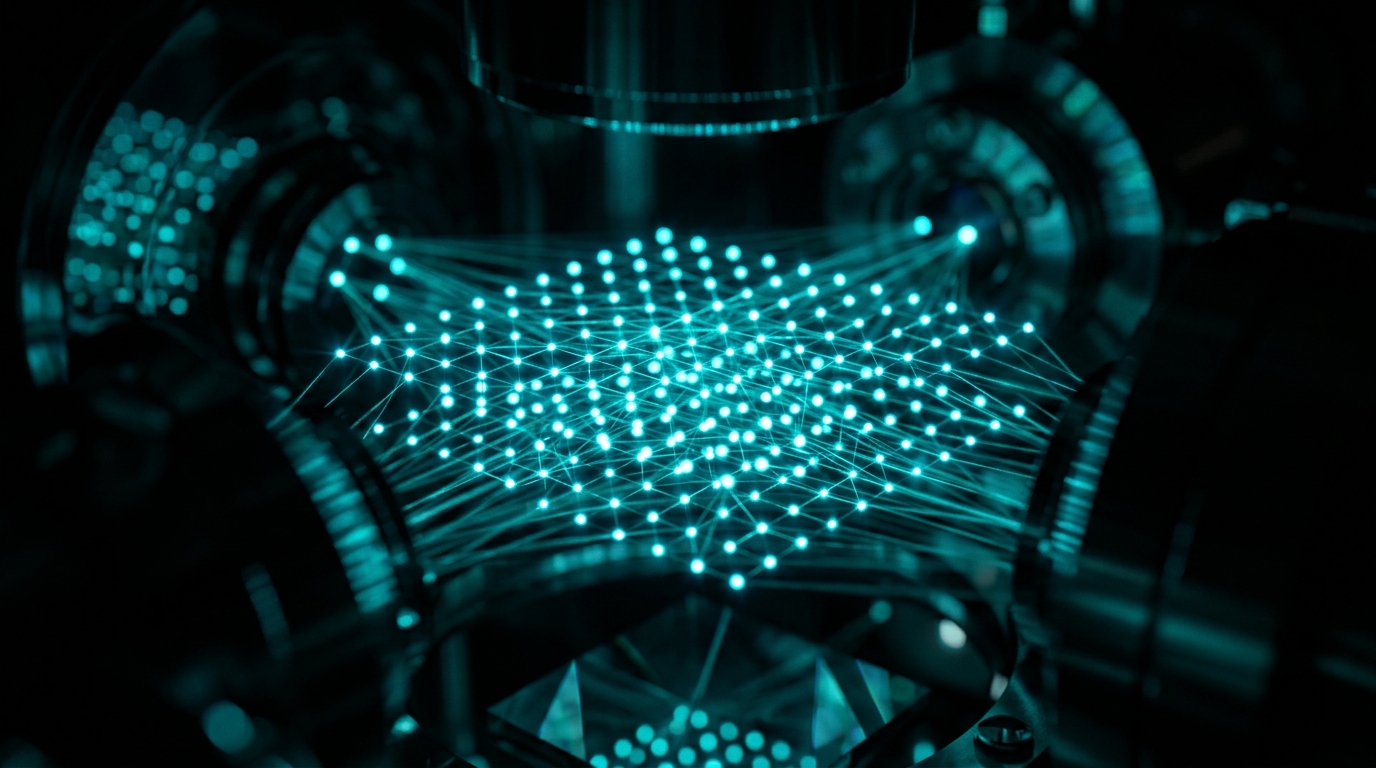
[IMAGE: A cluster of neutral atoms held in a reconfigurable optical-tweezer lattice, glowing points of light arranged into a quantum error-correction code block, with faint entangling beams connecting them against deep black]
Last updated: 2026-06-02. Primary source: Transversal architecture for megaquop-scale quantum simulation with neutral atoms, arXiv:2509.18294.