Last updated: June 2025
[IMAGE: A dark fiber optic cable cross-section with quantum light pulses visualized as entangled cyan and teal photon streams propagating through turbulent geometric distortions, macro lens perspective, cinematic 8K lighting with deep blacks]
Key Takeaways
- A new Correlated Twirling protocol mathematically suppresses MDI-QKD channel noise by a factor of 2/3 — with zero additional hardware required
- The protocol extends angular misalignment tolerance from 38.7° to 47.9°, keeping secure key distillation viable in fiber environments where standard MDI-QKD architectures fail entirely
- For security architects planning quantum-secured fiber deployments, this removes the most expensive operational barrier: continuous hardware-based polarization recalibration
The Deployment Problem That’s Been Blocking Enterprise MDI-QKD
Picture your organization’s quantum-secured fiber link between two data centers. The hardware is installed, the MDI-QKD architecture is configured, and your security team has validated the theoretical security guarantees. Then, six months into operation, thermal cycling in the conduit shifts the fiber geometry by a few degrees. Hong-Ou-Mandel interference — the physical phenomenon that makes MDI-QKD work — degrades. Your secure key generation rate drops below the 11% security threshold. The link goes dark.
This isn’t a hypothetical edge case. Optical fibers in real-world deployments experience continuous, arbitrary polarization drift driven by temperature fluctuations, mechanical stress, and asymmetric geometric rotations along the fiber path. For standard QKD architectures, this is manageable. For Measurement-Device-Independent QKD — the protocol specifically designed to eliminate detector-side attack surfaces — polarization stability is existential. MDI-QKD’s security proof depends on high-visibility Hong-Ou-Mandel interference at a central relay node. When polarization drifts asymmetrically between Alice’s and Bob’s channels, that interference degrades, and with it, the entire security guarantee.
The conventional solution has been hardware: active polarization controllers, feedback loops, and dedicated stabilization equipment that adds cost, complexity, and new failure modes to every deployment. A research paper published on arXiv (identifier: 2605.07229) proposes eliminating that hardware dependency entirely through a classical post-processing protocol called Correlated Twirling.
What Correlated Twirling Actually Does (Technical Mechanics)
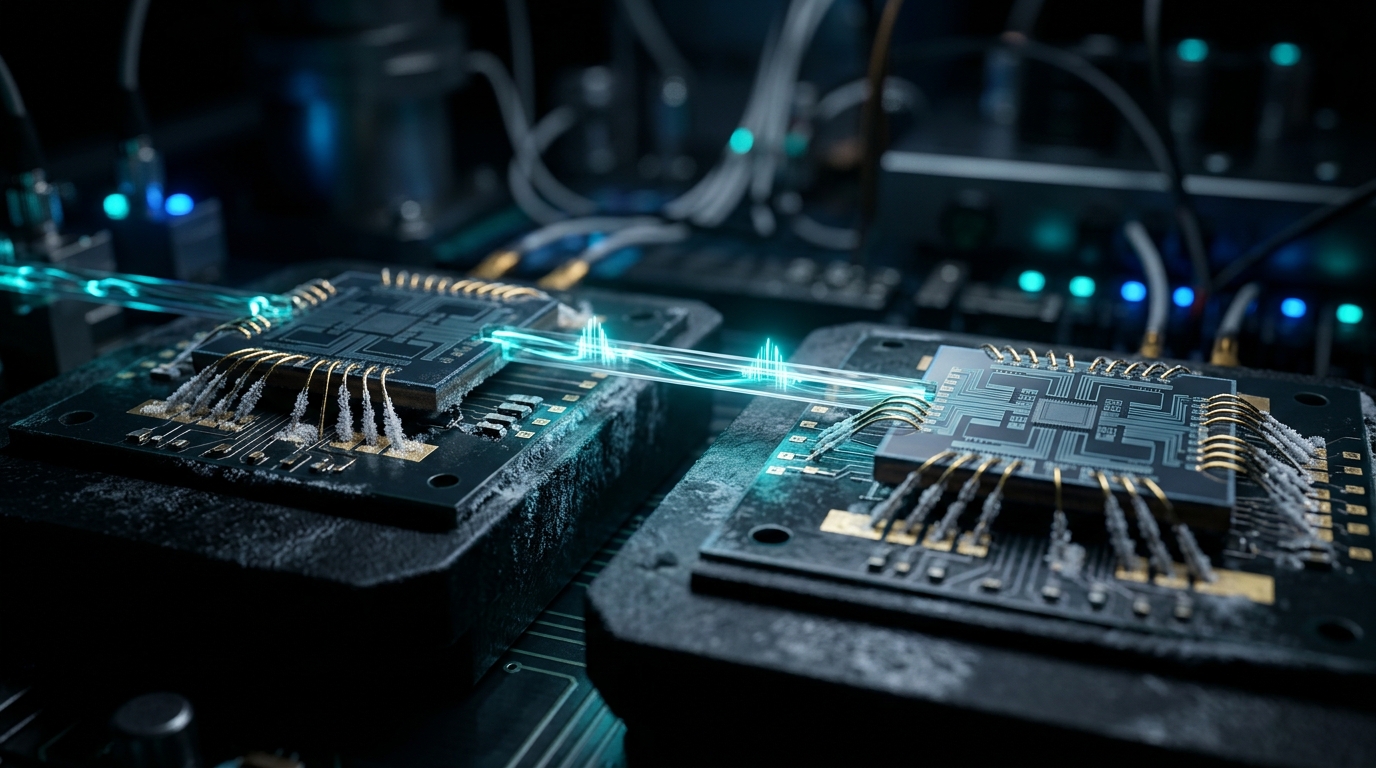
Measurement-Device-Independent Quantum Key Distribution (MDI-QKD) is a QKD architecture in which both communicating parties — Alice and Bob — send quantum states to an untrusted central relay, which performs Bell-state measurements. Because neither party’s detector is trusted, the protocol eliminates the entire class of detector-side-channel attacks that have compromised earlier QKD implementations. The security guarantee is unconditional with respect to detector vulnerabilities.
The Correlated Twirling protocol addresses MDI-QKD’s polarization sensitivity through a mathematically elegant mechanism: it doesn’t fight the channel noise — it transforms it into a form the protocol can tolerate.
The Core Mechanism: Turning Asymmetric Rotations Into Symmetric Noise
In a real fiber deployment, polarization drift is deterministic and asymmetric. Alice’s channel rotates by one geometric transformation; Bob’s channel rotates by a different one. This asymmetry is what destroys Hong-Ou-Mandel interference — the two photons arriving at the relay no longer share compatible polarization states.
Correlated Twirling works by having Alice and Bob apply a synchronized, public twirling supermap — a mathematical operation drawn from a unitary 2-design — to their transmitted states during the classical sifting phase. The key insight, drawn directly from the research:
“By applying a synchronized, public twirling supermap, Alice and Bob mathematically transform deterministic, asymmetric geometric rotations into an isotropic Pauli depolarizing channel.”
A Pauli depolarizing channel is symmetric, predictable, and — critically — already accounted for in MDI-QKD’s security framework. The protocol doesn’t eliminate noise; it converts hostile, asymmetric noise into a form the existing security proof can handle.
What This Looks Like in Practice
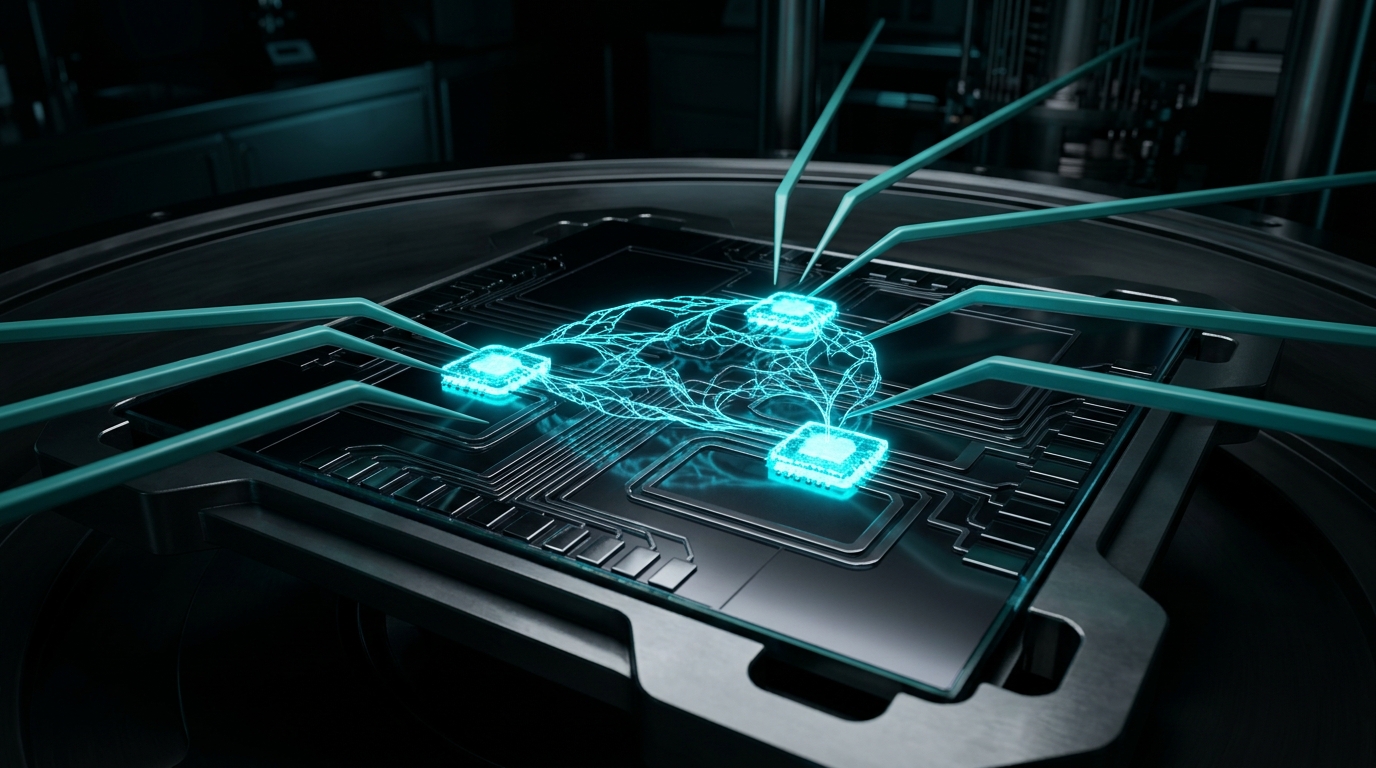
The entire protocol executes as a virtual post-processing step during classical sifting. No optical components are added. No feedback hardware is installed. Alice and Bob coordinate their twirling operations over the classical authenticated channel they already use for sifting — the same channel that carries basis reconciliation data.
The measured outcomes from the research (via exact quantum state simulations):
- Channel noise suppression: factor of 2/3
- Y-bias tolerance: extended from 0.68 radians to 0.84 radians
- Absolute angular misalignment tolerance (at the 11% security threshold): extended from 38.7° to 47.9°
- Hardware requirement: none
- Compatibility: inherently compatible with decoy-state weak coherent pulse implementations
Comparison: Standard MDI-QKD vs. Correlated Twirling MDI-QKD
| Parameter | Standard MDI-QKD | MDI-QKD + Correlated Twirling |
|---|---|---|
| Polarization stabilization method | Hardware (active controllers) | Software post-processing only |
| Y-bias tolerance | 0.68 radians | 0.84 radians |
| Angular misalignment tolerance (11% threshold) | 38.7° | 47.9° |
| Channel noise suppression | Baseline | 2/3 factor improvement |
| Decoy-state compatibility | Yes | Yes (inherent) |
| Additional hardware cost | High | Zero |
| Failure modes introduced | Optical hardware failures | None |
| Performance in high-turbulence fiber | Fails below threshold | Sustains secure key distillation |
Critical finding: The 9.2° extension in angular misalignment tolerance (38.7° → 47.9°) represents the difference between a link that survives seasonal thermal cycling and one that requires manual recalibration every quarter. For enterprise deployments spanning multiple sites, that operational delta translates directly to uptime and staffing costs.
Industry Context: Why This Research Lands Now
The NIST PQC Timeline Is Forcing Quantum Network Planning
NIST finalized its first three post-quantum cryptographic standards in August 2024 — ML-KEM, ML-DSA, and SLH-DSA. The accompanying guidance establishes 2030 as the target for deprecating RSA and elliptic-curve cryptography in federal systems, with CISA’s quantum readiness roadmap pushing enterprises to begin migration planning immediately.
This timeline creates a two-track problem for security architects. Track one: migrate classical cryptographic infrastructure to NIST PQC algorithms. Track two: evaluate whether quantum key distribution — which offers information-theoretic security rather than computational hardness — belongs in your long-term architecture. MDI-QKD is the only QKD variant that eliminates detector-side vulnerabilities, making it the most credible candidate for high-assurance environments.
The deployment barrier has always been operational: MDI-QKD requires polarization stability that real-world fiber infrastructure doesn’t reliably provide. Correlated Twirling directly addresses that barrier.
Who’s Moving on Quantum Networks
China’s quantum communication backbone — spanning over 4,600 kilometers as of 2021 according to Nature — demonstrated that long-distance QKD is physically achievable. European initiatives under the EuroQCI program are targeting quantum-secured government communications infrastructure by 2027. In the United States, the Department of Energy’s quantum network testbeds have been operational since 2020.
The common thread across all these deployments: polarization management is cited as a primary operational challenge. A software-layer solution that requires no hardware modification is directly applicable to every one of these existing and planned deployments.
The Cost of Hardware-Based Stabilization
Active polarization controllers for fiber QKD links typically add $15,000–$40,000 per node in hardware costs, plus ongoing maintenance, calibration labor, and the operational risk of hardware failure introducing downtime in a security-critical link. For a multi-site enterprise quantum network with 10 relay nodes, that’s a $150,000–$400,000 hardware line item that Correlated Twirling eliminates entirely — while simultaneously improving tolerance margins.
The BeQuantum Perspective: Software-Layer Security Is the Right Architecture
The Correlated Twirling research validates a design philosophy that shapes how BeQuantum approaches quantum-secured infrastructure: physical channel impairments should be addressed at the algorithmic layer wherever possible, not by adding hardware complexity that expands your attack surface and maintenance burden.
BeQuantum’s PQC Layer applies this same principle to classical cryptographic migration. Rather than requiring organizations to replace hardware endpoints to achieve post-quantum security, the PQC Layer intercepts and re-wraps key exchange at the software layer — inserting ML-KEM key encapsulation into existing TLS handshakes without requiring firmware updates across your endpoint fleet.
The parallel to Correlated Twirling is direct: both approaches take a physical or protocol-level vulnerability and resolve it through mathematical transformation at the classical processing layer. Neither requires you to touch hardware that’s already deployed.
For organizations evaluating MDI-QKD as part of a long-term quantum network strategy, the Correlated Twirling result means the operational feasibility calculus has shifted. The question is no longer “can we maintain the hardware stability MDI-QKD requires?” — it’s “what fiber infrastructure do we already have, and what key rates do we need?”
BeQuantum’s Digital Notary service, which provides cryptographic timestamping and content authenticity verification, is designed to operate over both classical PQC-secured channels and future quantum-secured links. As MDI-QKD deployment becomes more operationally viable, the verification chain that Digital Notary establishes can extend into quantum-secured infrastructure without architectural redesign.
What Your Security Team Should Do in the Next 90 Days
Step 1: Audit your quantum network roadmap against MDI-QKD feasibility (0–30 days) If your organization has evaluated QKD and deprioritized it due to operational complexity, revisit that assessment. The Correlated Twirling result changes the deployment calculus specifically for fiber environments with polarization instability — which describes most enterprise fiber infrastructure. Map your existing fiber routes and identify segments where polarization drift has been a documented concern.
Step 2: Evaluate your current polarization stabilization spend (30–60 days) For organizations already running QKD pilots, quantify what you’re spending on hardware-based polarization management — equipment, calibration labor, and downtime costs. This establishes the baseline against which a software-only approach should be evaluated when Correlated Twirling moves from arXiv preprint to peer-reviewed implementation.
Step 3: Track the protocol’s path to standardization (60–90 days) The Correlated Twirling paper (arXiv:2605.07229) is currently a preprint without peer review confirmation. Assign a team member to monitor its progression through peer review and watch for experimental validation results — particularly key generation rate comparisons against standard MDI-QKD architectures and real-world fiber distance testing. Those data points will determine whether this protocol belongs in your deployment timeline.
Frequently Asked Questions
Q: Does Correlated Twirling work with existing MDI-QKD hardware deployments, or does it require new equipment?
A: The protocol executes entirely as a classical post-processing step during sifting — the phase where Alice and Bob already exchange basis information over an authenticated classical channel. It requires no optical hardware modifications and is inherently compatible with decoy-state weak coherent pulse sources, which are the dominant hardware platform in current MDI-QKD deployments. Organizations with existing MDI-QKD infrastructure could potentially implement this as a software update to their sifting layer.
Q: What are the current limitations of this research that security architects should know about?
A: The results published in arXiv:2605.07229 are based on exact quantum state simulations, not experimental fiber deployments. Key data points that remain unquantified include: maximum secure range over real fiber, key generation rate impact versus standard MDI-QKD, computational overhead of the post-processing step, and performance under non-geometric polarization noise sources such as birefringence. The paper has not yet completed peer review. Security architects should treat this as a promising research result requiring experimental validation before inclusion in deployment planning.
Q: How does MDI-QKD’s security model differ from NIST PQC algorithms, and should enterprises pursue both?
A: NIST PQC algorithms — ML-KEM, ML-DSA, SLH-DSA — provide computational security: they’re secure because no known algorithm can break them in polynomial time, including quantum algorithms. MDI-QKD provides information-theoretic security: it’s secure regardless of computational power, based on the laws of physics rather than mathematical hardness assumptions. For most enterprises, NIST PQC migration is the immediate priority given the 2030 deprecation timeline. MDI-QKD is the appropriate long-term complement for high-assurance links — classified communications, financial settlement infrastructure, critical national infrastructure — where information-theoretic security justifies the deployment complexity.
Source: “Hardware-Free Polarization Stabilization for Measurement-Device-Independent Quantum Key Distribution via Correlated Twirling”, arXiv:2605.07229v1