- NIST selected HQC (Hamming Quasi-Cyclic) as a code-based key-encapsulation mechanism, giving enterprises a non-lattice fallback if lattice schemes are ever broken.
- Researchers offloaded HQC decoding to the Qualcomm Hexagon Vector eXtensions (HVX) backend on a Snapdragon 8 Gen 2 and improved energy efficiency by up to 18.13× while removing the workload from the host CPU (arXiv:2606.01968).
- For your security posture, this signals that post-quantum key exchange on phones, IoT gateways, and embedded fleet hardware no longer has to drain battery or stall the main processor — making PQC rollout to the edge defensible on a cost and performance basis.
The Problem: Post-Quantum Crypto Hits a Mobile Power Wall
A quantum-capable adversary does not need to wait for a cryptographically relevant quantum computer to hurt you. The “harvest now, decrypt later” threat is active today: encrypted sessions captured in 2026 can be archived and decrypted the moment RSA and ECC fall. Any data with a confidentiality lifetime past 2030 — health records, financial ledgers, signing keys, defense telemetry — is already exposed.
The defensive answer is to migrate key exchange to post-quantum algorithms now. The friction is where that migration meets constrained hardware. Lattice-based schemes dominate the standardized set, but algorithmic monoculture is a strategic risk: a single cryptanalytic break against the lattice family would strand every device that relied on it. Code-based cryptography like HQC exists precisely to hedge that risk — but code-based decoding is computationally heavy, and on a battery-powered handset or an embedded sensor, every millijoule of CPU work translates into shorter runtime and thermal throttling.
That is the bind security architects face: the algorithm you want for diversity is the one that taxes your most resource-starved devices the hardest.
Technical Deep-Dive: Reshaping HQC Decoding for the Hexagon NPU
HQC is a key-encapsulation mechanism (KEM) whose decapsulation step runs a concatenated error-correcting decoder. In HQC’s construction that decoder pairs a Reed-Muller inner code with a Reed-Solomon outer code, and those two stages dominate the entire computational cost of decoding. Speed up the decoder and you speed up the whole KEM.
The research team’s key observation is that HQC decoding is not scalar-bound drudgery — it is vector-structured by nature. The work exposes several inherently parallel data shapes:
- Reed-Muller reliability vectors
- Hadamard-transform coefficients
- Reed-Solomon syndrome vectors
- Finite-field products
- Packed support-point evaluations
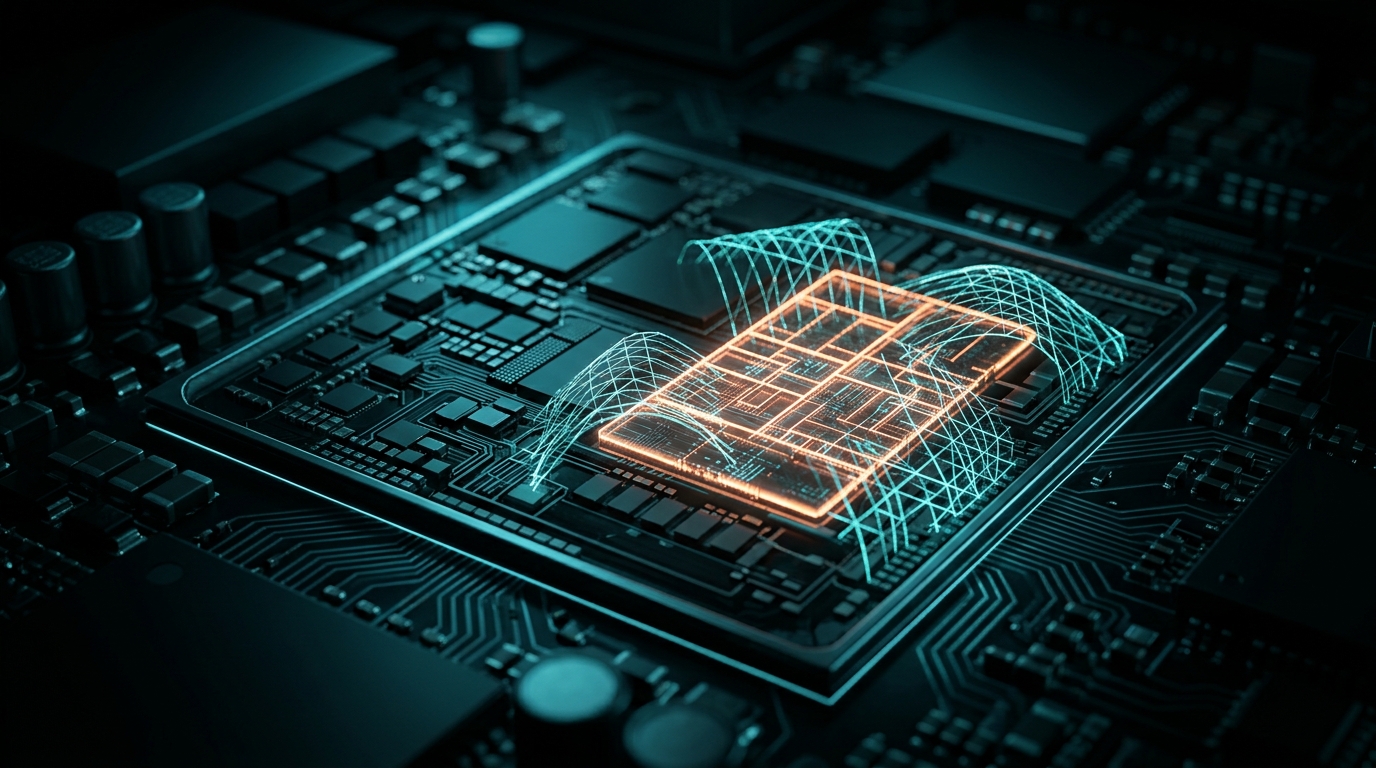
[IMAGE: macro view of a Snapdragon mobile system-on-chip die with the Hexagon NPU block isolated under cyan rim lighting]
Rather than route this through a tensor-inference engine — the path most people assume when they hear “NPU” — the authors target the HVX backend directly, treating the Hexagon’s wide vector units as a general-purpose SIMD coprocessor for cryptographic kernels. Each dominant decoding kernel was redesigned around HVX-friendly data layouts and execution patterns:
- A vectorized Reed-Muller Hadamard transform instead of a scalar butterfly
- Scalar-equivalent peak selection so the parallel path produces bit-identical results to the reference
- HVX-oriented finite-field arithmetic for the field products
- Vectorized syndrome computation for the Reed-Solomon stage
- Shortened-support locator-root evaluation for error location
The team validated against both a Hexagon simulator and a real Snapdragon 8 Gen 2 hardware development kit, so the headline figure is grounded in silicon, not just a model.
Hexagon/HVX-assisted decoding substantially reduces latency and energy consumption, improving energy efficiency by up to 18.13× while significantly offloading host CPU work. — Implementation and Optimization of HQC Decoding on NPU-Integrated Devices (arXiv:2606.01968v1)
The second-order benefit is architectural. Offloading decode work to the Hexagon frees the application processor to keep serving the user-facing workload, which matters as much for sustained throughput as the raw energy number does.
Comparison: Host-CPU Decoding vs. HVX-Assisted Decoding
| Dimension | Conventional CPU decoding | HVX/NPU-assisted decoding |
|---|---|---|
| Execution unit | Scalar application processor | Hexagon vector units (HVX) |
| Energy efficiency | Baseline | Up to 18.13× better |
| Host CPU load | Full decode burden on CPU | Significantly offloaded |
| Kernel data layout | Scalar butterflies / loops | Vectorized, HVX-friendly layouts |
| Result fidelity | Reference output | Scalar-equivalent (bit-identical peak selection) |
| Validation | — | Simulator and Snapdragon 8 Gen 2 device |
Note: the 18.13× figure is a relative energy-efficiency improvement; the paper does not publish absolute latency or joule baselines, and does not break out simulator versus on-device deltas.
Industry Context & Implications
NIST’s selection of HQC is the structural driver here. After standardizing lattice-based primitives first, NIST moved to add HQC as a code-based KEM specifically to provide algorithmic diversity — a second mathematical foundation so the post-quantum ecosystem does not rest on a single hardness assumption. That decision turns HQC from an academic curiosity into something procurement teams will eventually need to support.
The practical adoption gap has always been the edge. Server-side PQC is comparatively easy — datacenter CPUs have cycles to spare. The hard frontier is the fleet of phones, payment terminals, automotive control units, and industrial sensors where code-based decoding looked too expensive to justify. This work reframes that calculation. Because modern application processors already ship with NPU and vector backends like Hexagon, the hardware needed to make code-based PQC cheap is already in the field — it just was not being used for cryptography.
The likely trajectory:
- Near term (1–2 years): Mobile and embedded enterprise devices offload HQC decoding to NPU/Hexagon backends, cutting CPU load and energy on Snapdragon-class hardware.
- Medium term (3–5 years): NPU-integrated platforms become a mainstream backend for structured code-based PQC industry-wide, operationalizing NIST’s diversity mandate.
- Long term (5+ years): Reformulating cryptographic kernels around vector/NPU execution becomes a standard deployment paradigm for code-based PQC on resource-constrained devices.
The economic read is straightforward: the cost of inaction is a future forced migration under breach pressure, while the cost of adopting NPU-assisted HQC is largely a firmware and integration effort against hardware you have already paid for.
The BeQuantum Perspective
This research lands directly on a problem our PQC Layer was built to solve: making post-quantum key exchange viable on hardware that was never designed with a power budget for it. The 18.13× energy result confirms the architectural bet — that the right place to run heavy cryptographic kernels on an edge device is the vector coprocessor, not the application core.
For organizations like ours operating a Digital Notary that anchors authenticity proofs, the HVX approach matters because it lets a constrained client perform code-based key encapsulation without becoming the bottleneck in a verification handshake. The same principle extends to IceCase hardware: when the decoder is expressed as vectorized Hadamard transforms and finite-field products mapped onto a dedicated backend, you get deterministic, scalar-equivalent output — a non-negotiable property for a notarization or signing path where a single flipped bit invalidates a proof.
The broader lesson we apply: PQC migration is not only about which algorithm you adopt, but where you execute it. Treating the NPU as a cryptographic accelerator rather than only a machine-learning unit is the design move that makes algorithmic diversity affordable at the edge.
What You Should Do Next
- Within 90 days — inventory your edge crypto. Audit every device class that performs key exchange (mobile apps, IoT gateways, terminals) and record the SoC and whether it exposes a vector/NPU backend such as Hexagon HVX. You cannot plan an offload strategy without knowing which hardware can host one.
- Within 6 months — pilot algorithmic diversity. Stand up a hybrid key-establishment test combining a lattice KEM with HQC, so a future break in either family does not strand you. Measure energy and CPU load on real devices, not just servers.
- Ongoing — make NPU support a procurement requirement. Add “vector/NPU-accessible cryptographic acceleration” to hardware purchasing criteria so the next refresh cycle ships devices that can run code-based PQC cheaply by default.
FAQ
Q: Does running HQC decoding on the NPU change the cryptographic result compared to a CPU? A: No. The optimization uses scalar-equivalent peak selection, meaning the vectorized path produces bit-identical output to the reference decoder. You gain energy efficiency and CPU offload without altering correctness or security.
Q: Why pursue HQC at all when lattice-based PQC is already standardized? A: NIST selected HQC specifically for algorithmic diversity. It rests on code-based hardness assumptions independent from lattices, so a cryptanalytic break against the lattice family would not compromise systems that also support HQC. It is a hedge, not a replacement.
Q: Is the 18.13× improvement a latency or an energy number? A: It is a relative energy-efficiency improvement measured on a Snapdragon 8 Gen 2 development kit and a Hexagon simulator. The paper reports substantial latency reduction as well but does not publish absolute milliseconds or joule baselines.
Last updated: June 3, 2026. Source: Implementation and Optimization of HQC Decoding on NPU-Integrated Devices.