- Researchers published a dual graph neural network framework that automates quantum kernel design against real NISQ hardware constraints (arXiv:2506.21161v3)
- The method encodes candidate quantum circuits as directed acyclic graphs and predicts two surrogate metrics — Probability of Successful Trials (PST) and Kernel-Target Alignment (KTA) — to evaluate fidelity before expensive hardware runs
- Security architects tracking the quantum timeline now have concrete evidence that machine-learning-designed circuits outperform hand-crafted ansätze on noisy devices, accelerating the window to practical quantum advantage
Why Quantum Kernel Design Matters for Your Threat Model
A quantum computer capable of breaking RSA-2048 does not arrive overnight. It arrives through incremental engineering wins that compound. Hardware-aware quantum kernel design is one of those wins — and it directly compresses the timeline security teams use to plan post-quantum migrations.
Here is the concrete scenario. Your organization runs TLS 1.3 with ECDHE-P256 today. Your 2035 compliance roadmap assumes NIST-standardized post-quantum algorithms will be fully deployed by then. That roadmap rests on an assumption: that quantum hardware cannot reliably execute deep circuits with high fidelity within the next decade. Every advance that squeezes more useful computation out of noisy devices invalidates that assumption by a few months.
The paper published by researchers on arXiv (2506.21161v3) is exactly that kind of advance. It does not break cryptography. It makes noisy quantum devices more productive — which is how the first cryptographically relevant quantum computer will actually arrive.
The Problem: NISQ Devices Fight Their Own Designers
Noisy Intermediate-Scale Quantum (NISQ) devices — the machines available from IBM, Google, IonQ, and others today — share three punishing constraints:
- Limited qubits that cap circuit width
- Gate errors that accumulate with every operation
- Restricted connectivity that forces expensive SWAP gates between non-adjacent qubits
Quantum machine learning (QML) promises computational advantages for classification tasks, but only when feature maps — the circuits that embed classical data into quantum states — are both expressive enough to capture structure and shallow enough to survive the noise. Hand-crafted circuits rarely hit both targets. A circuit that works on IBM’s heavy-hex topology may collapse on a linear-chain device. A circuit optimized for 20 qubits may be unusable on 127.
“Quantum kernels hold significant promise for achieving computational advantages in quantum machine learning (QML), yet their effectiveness critically depends on the design of expressive and hardware-compatible feature maps, a challenge that is particularly pronounced on Noisy Intermediate-Scale Quantum (NISQ) devices with limited qubits, gate errors, and restricted connectivity.” — arXiv:2506.21161v3
The practical consequence: research groups burn enormous compute budgets running candidate circuits on real hardware to find one that works. Every failed evaluation costs queue time and calibration cycles.
Technical Deep-Dive: Encoding Circuits as Graphs
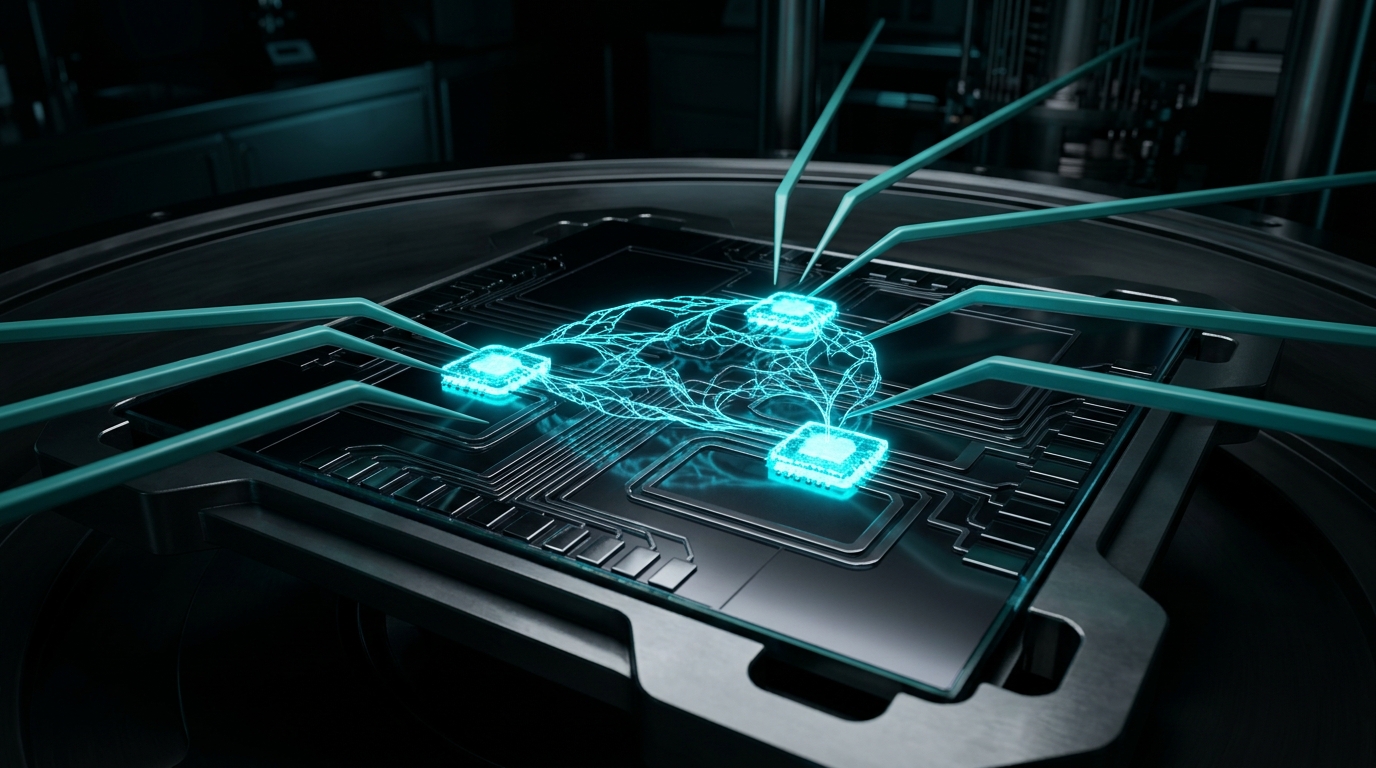
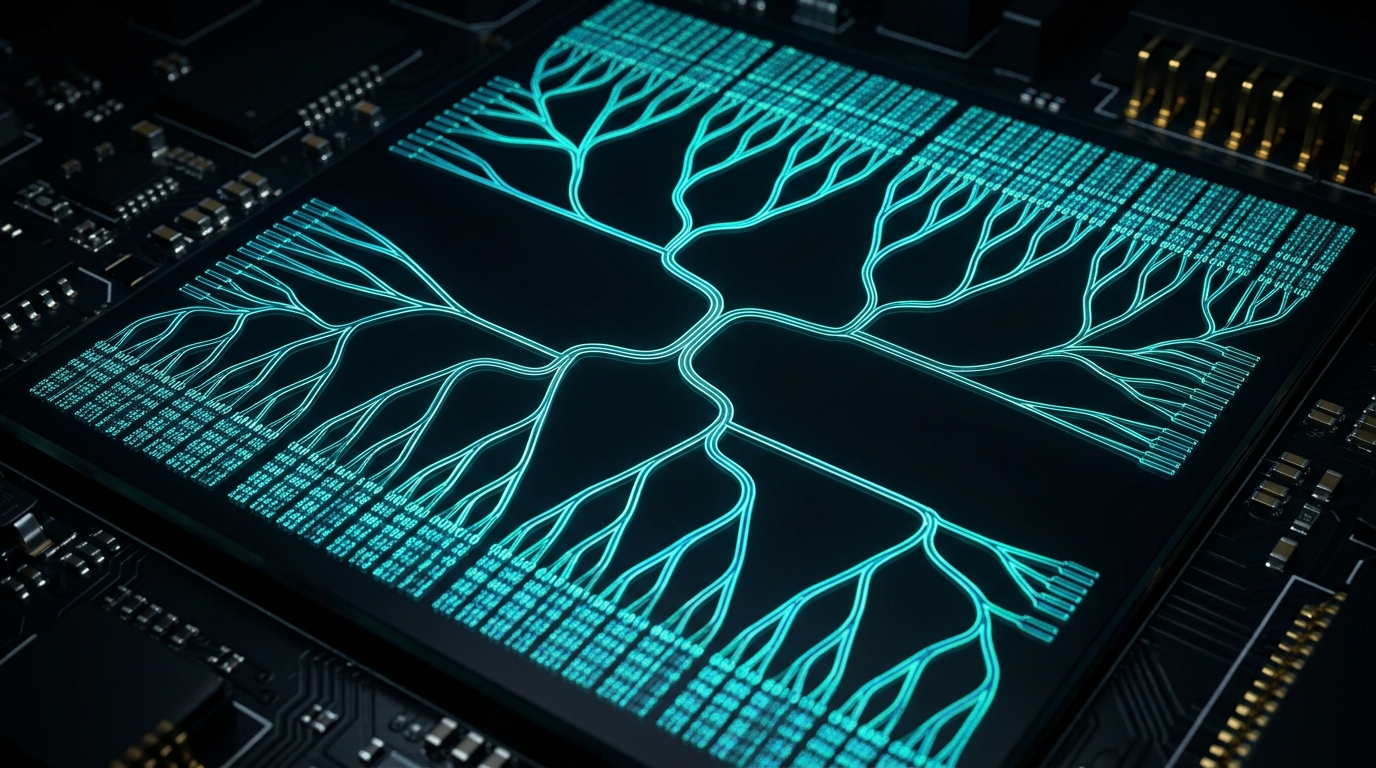
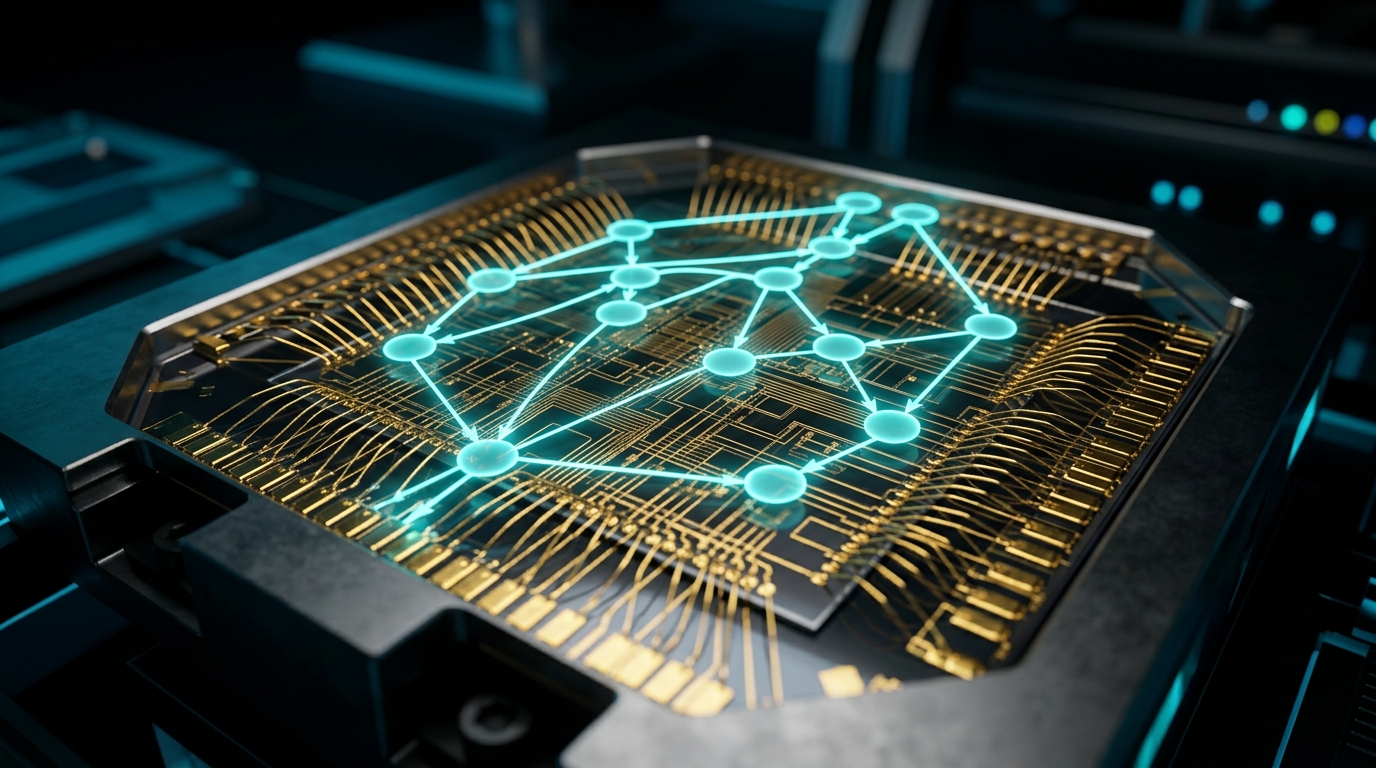
The framework treats each candidate quantum circuit as a directed acyclic graph (DAG). Every node encodes a gate operation; every edge encodes a qubit interaction or dependency. Critically, the DAG representation carries hardware-specific metadata — noise properties, connectivity constraints, and gate-level error characteristics — directly into the learned representation.
A dual graph neural network predictor then estimates two surrogate metrics without executing the circuit on real hardware:
- Probability of Successful Trials (PST) — a fidelity proxy that estimates whether the circuit can be executed reliably under device noise
- Kernel-Target Alignment (KTA) — a performance proxy that estimates how well the resulting kernel will discriminate between classes in the target classification task
The dual structure matters. PST alone would select trivially shallow circuits that survive noise but learn nothing. KTA alone would select expressive circuits that collapse on real hardware. Optimizing both in tandem is the mechanism that delivers the reported accuracy gains.
Feature selection is folded into the pipeline to reduce input dimensionality — a necessary concession for near-term qubit counts.
Comparison: Hand-Crafted vs. GNN-Designed Quantum Kernels
| Dimension | Hand-Crafted Ansatz | GNN-Designed Kernel |
|---|---|---|
| Hardware awareness | Manual topology mapping | Encoded in DAG, learned by GNN |
| Noise modeling | Post-hoc characterization | Integrated in surrogate predictor |
| Evaluation cost | Hardware runs per candidate | Surrogate inference per candidate |
| Generalization across devices | Rewrite required | Retrain GNN on new topology |
| Search space coverage | Limited by designer intuition | Limited by GNN training data |
| Reported accuracy on CC, MNIST-5, FMNIST-4 | Baseline | Consistently outperforms |
The paper reports evaluation across three benchmark datasets — Credit Card (CC), MNIST-5, and FMNIST-4 — and states the method consistently outperforms existing baselines in classification accuracy. The specific accuracy percentages, baseline method names, and hardware platform used are not extracted from the source and should be verified directly against the paper.
Industry Context: What Regulators and Procurement Teams Should Watch
NIST finalized its first post-quantum standards — ML-KEM, ML-DSA, and SLH-DSA — in August 2024. The agency’s transition guidance assumes classical systems remain secure through a defined migration window. That window is partly a function of how fast quantum hardware matures for any useful task, not just cryptanalysis.
QML advances like this one shift the calculus for enterprise procurement in three ways:
-
Quantum cloud service selection. Hardware-aware circuit design means vendor differences (topology, error rates, native gate sets) now translate more directly into application performance. Procurement teams evaluating AWS Braket, Azure Quantum, or IBM Quantum will need topology-aware benchmarks — not generic qubit counts.
-
Compliance documentation. Organizations in regulated sectors (finance, healthcare, defense) that are piloting QML for fraud detection or anomaly detection will face audit questions about model reproducibility across hardware generations. A GNN-designed kernel that depends on specific noise characteristics introduces a new class of model-risk documentation.
-
Talent pipeline. Hand-crafting variational circuits is a specialized skill held by a small population of researchers. Automated kernel design lowers the barrier — but raises the bar on the adjacent skill of validating learned circuit designs against hardware. Expect the role of “quantum MLOps engineer” to materialize within 18 months.
The BeQuantum Perspective
The paper is about making noisy quantum devices more useful for classification. The adjacent concern for every CISO reading this: every efficiency gain in quantum computation moves the cryptographically-relevant threshold closer, even when the research itself has nothing to do with breaking cryptography.
Organizations that treat post-quantum migration as a 2030-and-later problem are making a bet against the rate of progress across all quantum engineering disciplines — circuit design, error mitigation, qubit fabrication, compiler optimization. A breakthrough in any one of those, like the dual-GNN kernel design above, marginally compresses the timeline.
BeQuantum’s approach — which pairs hybrid classical/post-quantum signatures in our Digital Notary layer with hardware-rooted attestation in IceCase — is built on the assumption that the right question is not when will quantum break current cryptography, but whether your data-at-rest and signed records today will still be verifiable in 2035. For signed blockchain records, regulated financial transactions, and long-retention healthcare data, the answer has to hold regardless of which specific quantum milestone arrives first.
The technical approach matters here. Store-now-decrypt-later attacks against captured TLS traffic from 2024 are already a concern. The same logic applies to any digital signature that must remain verifiable for a decade or more.
What You Should Do Next
1. Within 90 days — inventory long-lived signatures. Identify every digital signature your organization produces that must remain verifiable beyond 2032. Software signing keys, code-signing certificates, notarized contracts, and audit trails are the typical surface. Classical-only signatures on these artifacts are the first thing a future quantum adversary renders worthless.
2. Within 180 days — establish a crypto-agility baseline. Audit how many of your production systems can swap cryptographic primitives without a full release cycle. Systems with hard-coded algorithm choices (common in embedded, IoT, and legacy enterprise software) are where migration cost compounds.
3. Within 12 months — run a hybrid pilot. Deploy ML-KEM alongside classical ECDH in at least one production TLS path. The hybrid approach costs roughly 1-2 KB of additional handshake data and negligible CPU in modern implementations. It buys optionality against both quantum attacks and unexpected weaknesses in either algorithm family.
FAQ
Q: Does this paper mean quantum computers can now break encryption?
A: No. The research advances quantum machine learning for classification tasks on noisy hardware. It does not implement Shor’s algorithm or any cryptanalytic primitive. The relevance to cybersecurity is indirect: every improvement in getting useful computation out of NISQ devices shortens the engineering distance to a cryptographically relevant quantum computer.
Q: Should we delay post-quantum migration until quantum hardware is more mature?
A: No. Store-now-decrypt-later attacks mean data encrypted today with classical algorithms may be harvested and decrypted years later once quantum capability arrives. For any data with a retention requirement or confidentiality lifetime beyond five years, migration planning should already be underway. NIST’s finalized ML-KEM and ML-DSA standards (August 2024) provide production-ready targets.
Q: How does hardware-aware kernel design affect our choice of quantum cloud provider?
A: Hardware topology, native gate sets, and error rates now translate more directly into application performance for QML workloads. If your organization is piloting quantum for machine learning applications, evaluate providers on topology-specific benchmarks rather than headline qubit counts. Expect procurement-grade benchmarks to emerge from academic groups and independent evaluators over the next 12-24 months.
Last updated: 2026-04-22. Source: Hardware-Aware Quantum Kernel Design Based on Graph Neural Networks, arXiv:2506.21161v3.