- A geometric-phase compensation scheme achieves fidelity exceeding 95% and reduces quantum bit error rate (QBER) below the critical 11% security threshold in entanglement-based QKD (arXiv:2604.12272)
- The technique eliminates unwanted relative phases in Bell states without the hardware complexity of conventional birefringent crystal or interferometric stabilization methods
- Organizations planning quantum-safe communication infrastructure gain a simpler, more deployable path to entanglement-based key distribution
Last updated: April 2025
Why Bell State Phase Drift Threatens Your QKD Deployment
Entanglement-based quantum key distribution — specifically the BBM92 protocol — promises information-theoretic security grounded in the laws of physics rather than computational hardness assumptions. But there is an engineering problem that rarely makes it into vendor slide decks: Bell state phase drift.
Bell states are the maximally entangled quantum states that serve as the backbone of entanglement-based QKD. When two photons share a Bell state, measuring one instantly constrains the other, enabling two parties to generate a shared secret key that any eavesdropper provably disturbs. The theory is elegant. The fiber-optic cable between your data center and your disaster recovery site is not.
Unwanted relative phases accumulate in Bell states from multiple physical sources: birefringence in optical fiber, pump-beam contributions in the photon-pair source, imperfections in spontaneous parametric down-conversion (SPDC) generation, transmission through physical channels, and collection optics at the receiver. These phase shifts degrade interference visibility, inflate QBER, and directly limit how many secure key bits you can extract per second.
The security mathematics are unforgiving. BBM92 requires QBER to stay below 11% for the generated key to be provably secure. Push above that threshold, and your quantum channel becomes a very expensive random number generator with no security guarantee. Phase drift in deployed fiber can push QBER past this boundary within hours as environmental conditions shift.
How Geometric Phase Compensation Works
Geometric phase — also called Berry phase — is a phase shift that a quantum state acquires when its parameters are cycled along a closed path in parameter space. Unlike dynamic phase (which depends on time and energy), geometric phase depends only on the geometry of the path traversed. This distinction is what makes it useful for compensation: it provides a controllable, topology-dependent phase knob that is inherently robust against certain types of noise.
The researchers behind arXiv:2604.12272 exploited this property to build a compensation scheme that eliminates arbitrary relative phases in Bell states. The core insight: rather than fighting phase drift with brute-force interferometric stabilization or stacking birefringent crystals, apply a geometric phase rotation that cancels the accumulated unwanted phase.
Definition: Geometric Phase Compensation for QKD
Geometric phase compensation is a technique that corrects unwanted relative phase shifts in entangled photon pairs (Bell states) by applying a controlled geometric (Berry) phase rotation, restoring the entanglement fidelity required for secure quantum key distribution without the hardware complexity of conventional interferometric stabilization methods.
Key Technical Properties
The scheme has several properties that matter for deployment planning:
- Dual-point implementation: The compensation can be applied at either the entangled photon source or the receiver, giving network architects flexibility in where to place correction hardware
- Protocol compatibility: Demonstrated on the BBM92 protocol, the most widely studied entanglement-based QKD scheme
- Extension path: The authors describe how the approach maps to time-bin QKD via time-polarization mapping, opening applicability to long-distance fiber networks where polarization-mode dispersion makes polarization encoding impractical
“In a proof-of-concept experiment using a nondegenerate polarization Bell state, we achieve a fidelity exceeding 95% and reduce QBER below the 11% security threshold required for secure QKD.” — arXiv:2604.12272v1
Conventional vs. Geometric Phase Compensation
| Parameter | Conventional Compensation | Geometric Phase Compensation |
|---|---|---|
| Mechanism | Birefringent crystals, interferometric stabilization, spatial light modulators | Berry phase rotation via closed-path parameter cycling |
| Hardware complexity | High — requires precision alignment of multiple optical elements | Lower — single compensation stage at source or receiver |
| Real-world practicality | Often impractical in deployed fiber links due to environmental sensitivity | Designed for deployment flexibility |
| Fidelity achieved | Varies by implementation; typically 90-97% in lab settings | Exceeding 95% (proof-of-concept) |
| QBER performance | Implementation-dependent | Below 11% security threshold |
| Adaptability to drift | Requires active feedback loops | Geometric robustness to certain noise types |
| Time-bin QKD extension | Requires separate compensation architecture | Mappable via time-polarization conversion |
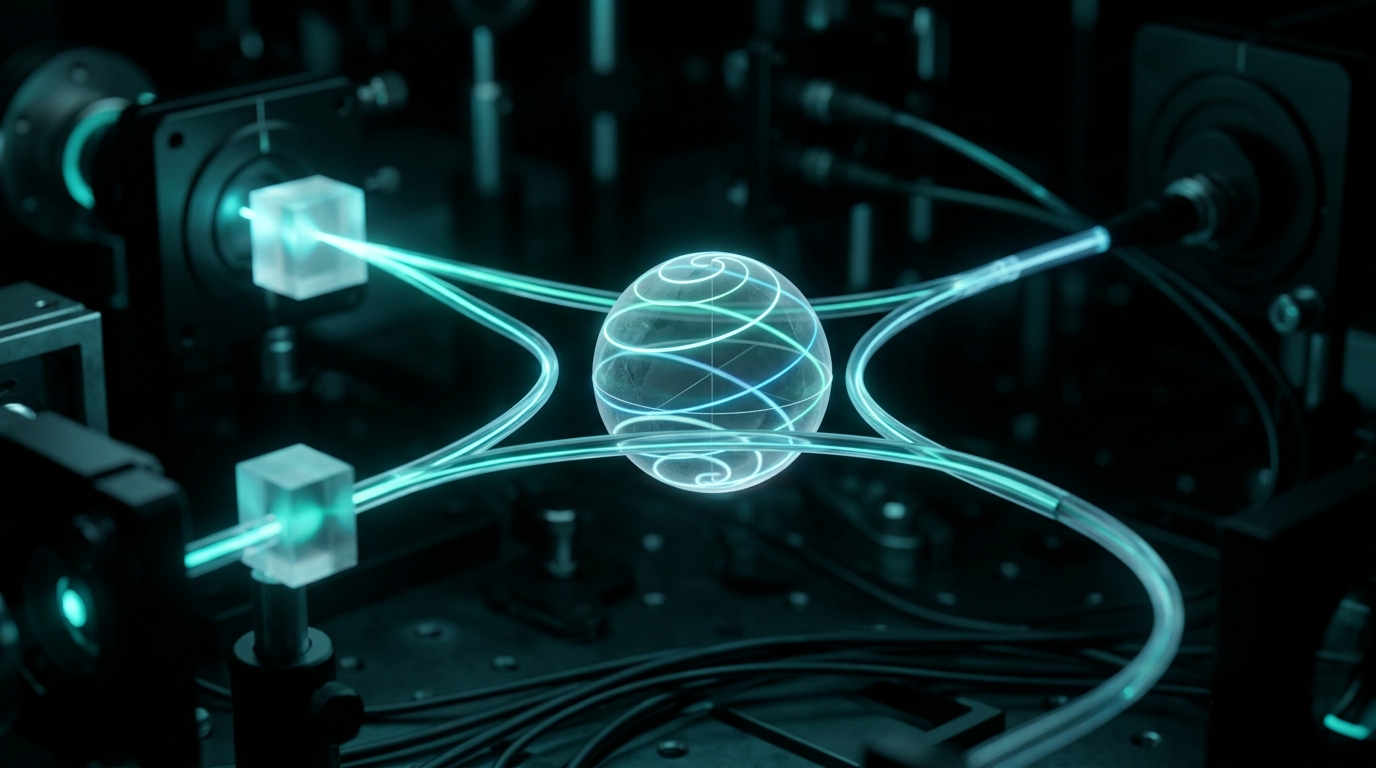
[IMAGE: A photon pair emerging from an SPDC crystal, with geometric phase rotation visualized as a helical path on a Bloch sphere, cyan and teal light beams diverging through a fiber-optic channel against a dark laboratory background]
What the Experiment Proved — and What It Did Not
The proof-of-concept delivered two headline numbers: fidelity exceeding 95% and QBER below 11%. Both cross the thresholds required for secure key generation under BBM92. This validates the core physics claim — geometric phase compensation restores entanglement quality sufficiently for cryptographic use.
But several gaps remain before this moves from arxiv preprint to your procurement shortlist:
- No key generation rate data: The paper reports fidelity and QBER but does not disclose bits-per-second throughput. For enterprise deployments, key generation rate determines whether a QKD link can sustain AES-256 rekeying at operationally useful intervals.
- No channel distance or loss figures: The experiment validated the compensation physics but did not characterize performance over realistic fiber distances (10-100+ km) or at typical metropolitan fiber loss budgets (0.2 dB/km at 1550 nm).
- No head-to-head comparison: The authors did not benchmark geometric phase compensation against conventional techniques under identical experimental conditions, making direct performance comparison impossible from this data alone.
- Preprint status: arXiv:2604.12272 has not undergone peer review. The results should be treated as preliminary until independently validated.
- No environmental stress testing: Real fiber networks experience temperature fluctuations, mechanical vibration, and polarization-mode dispersion. The paper does not report performance under these conditions.
Critical gap for enterprise planning: Without key generation rates, channel distance data, and environmental resilience testing, this technique cannot yet be compared against commercially available QKD systems on the metrics that drive procurement decisions.
Where This Fits in the QKD Landscape
Entanglement-based QKD (BBM92, E91) has always held a theoretical advantage over prepare-and-measure protocols (BB84): it does not require a trusted source. Both communicating parties can verify entanglement through Bell inequality violations, closing a class of attacks that prepare-and-measure systems must address through device characterization. The practical disadvantage has been complexity — entangled photon sources are harder to build, maintain, and stabilize than laser-based BB84 transmitters.
Geometric phase compensation attacks this complexity gap directly. If the technique scales beyond proof-of-concept, it removes one of the most persistent engineering barriers to entanglement-based QKD deployment: the need for elaborate phase stabilization hardware that works reliably outside a controlled laboratory.
The regulatory timeline adds urgency. NIST’s post-quantum cryptography standards (ML-KEM, ML-DSA, SLH-DSA) address the algorithmic layer, but QKD addresses the key distribution layer — a complementary defense. Organizations building defense-in-depth against harvest-now-decrypt-later attacks need both. A more deployable entanglement-based QKD makes the quantum communication layer of that defense stack more accessible.
Near-Term Adoption Trajectory
Within 1-2 years, geometric phase compensation could reduce hardware complexity and cost for entanglement-based QKD links connecting high-security facilities — financial data centers, government classified networks, and critical infrastructure control systems. The dual-point implementation flexibility (source-side or receiver-side) is particularly relevant for hub-and-spoke quantum network topologies where centralizing compensation at the source reduces per-node cost.
Over 3-5 years, if validated at metropolitan fiber distances and under environmental stress, the technique could become a standard component in deployed QKD networks. The extension to time-bin encoding via time-polarization mapping opens long-distance fiber applications where polarization encoding alone fails.
The BeQuantum Perspective
Geometric phase compensation addresses a problem we encounter directly in our quantum-readiness assessments: the gap between QKD’s theoretical security guarantees and deployable engineering reality. Our Digital Notary architecture already assumes that quantum-safe key material will eventually flow through entanglement-based channels for the highest-assurance use cases. Techniques that simplify the physical layer — reducing the stabilization hardware stack from multiple precision-aligned optical elements to a single geometric phase compensation stage — directly affect the timeline and cost at which entanglement-based QKD becomes viable for enterprise integration.
Our PQC Layer currently secures data using lattice-based and hash-based algorithms aligned with NIST standards. QKD provides a complementary, physics-based key distribution mechanism. As geometric phase compensation and similar engineering advances mature, we are evaluating how entanglement-based key material can feed into our existing cryptographic pipeline — specifically, how QKD-derived keys can seed the key hierarchy that protects content authenticity attestations in IceCase hardware modules.
The critical integration question is not whether entanglement-based QKD will become practical, but when the key generation rates and channel distances reach the thresholds our enterprise customers require. Geometric phase compensation moves one variable — deployment complexity — in the right direction.
What You Should Do Next
-
Within 30 days — Audit your quantum communication roadmap. If your security architecture includes QKD as a future key distribution layer, update your technology watch to track geometric phase compensation alongside conventional stabilization approaches. The technique’s dual-point implementation flexibility may change your network topology assumptions.
-
Within 90 days — Request distance and throughput data. Before adjusting procurement timelines, require that any QKD vendor claiming geometric phase compensation provide key generation rates at operationally relevant fiber distances (minimum 10 km for campus, 50+ km for metropolitan). The arXiv:2604.12272 results are necessary but not sufficient for deployment decisions.
-
Within 6 months — Evaluate hybrid architectures. Map how QKD-derived key material would integrate with your existing PQC migration. Entanglement-based QKD and algorithmic PQC (ML-KEM, ML-DSA) protect against different threat vectors. Your defense-in-depth strategy should define how both layers interoperate, including key hierarchy, rekeying intervals, and failover when the quantum channel is unavailable.
Frequently Asked Questions
Q: Does geometric phase compensation make QKD ready for production deployment?
A: Not yet. The proof-of-concept demonstrates that geometric phase compensation restores Bell state fidelity above 95% and pushes QBER below the 11% security threshold, which validates the core physics. However, production readiness requires key generation rate data, performance over realistic fiber distances, and environmental stress testing — none of which this preprint provides. Treat this as a significant engineering advance, not a deployable product.
Q: How does this relate to post-quantum cryptography algorithms like ML-KEM?
A: They solve different problems. ML-KEM (formerly CRYSTALS-Kyber) provides computational key encapsulation that resists quantum computer attacks. QKD provides physics-based key distribution where security derives from quantum mechanics, not computational hardness. A defense-in-depth architecture uses both: PQC algorithms for broad network encryption, QKD for the highest-assurance key distribution channels. Geometric phase compensation makes the QKD layer more practically deployable.
Q: Can this technique work over existing fiber infrastructure?
A: The technique is designed for compatibility with standard optical fiber channels, and the extension to time-bin encoding specifically targets long-distance fiber networks. However, the proof-of-concept did not report channel distance or loss figures, so performance over existing metropolitan or long-haul fiber remains uncharacterized. The dual-point implementation (source or receiver) does offer flexibility for integration into existing fiber plant topologies.