
Last updated: June 2025
Key Takeaways
- Research published as arXiv:2411.01880v2 demonstrates that magic state operations are not the dominant qubit resource cost in concatenated error-correction schemes — overturning a widely held assumption that shaped hardware roadmaps and threat timelines
- Optimizations targeting all gate operations can reduce qubit resource requirements by several orders of magnitude; optimizations targeting only magic operations yield only marginal reductions
- For enterprise security teams, this means fault-tolerant quantum computing may arrive on a different architectural path — and a different timeline — than current threat models assume
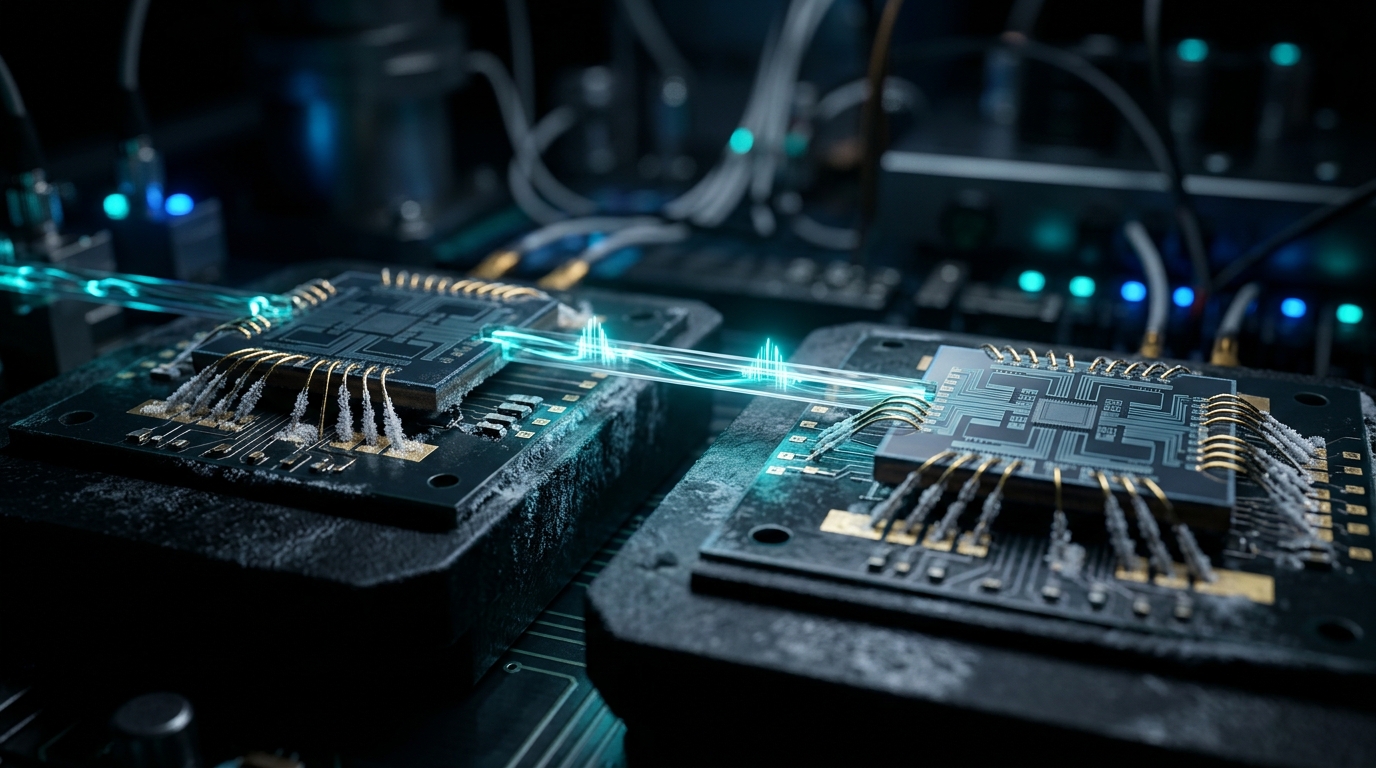
[IMAGE: A macro-scale visualization of a quantum processor chip with layered error-correction lattice structures glowing in cyan and teal, deep black background, entangled light paths connecting qubit nodes in a concatenated tree pattern, cinematic 8K lighting with dramatic perspective angle]
The Assumption That Has Been Shaping Your Quantum Threat Model
Picture your organization’s quantum risk register. Somewhere in it, a timeline exists — probably sourced from NIST guidance, vendor briefings, or analyst reports — that estimates when a cryptographically relevant quantum computer (CRQC) will threaten your RSA-2048 or ECC-256 infrastructure. That timeline almost certainly rests on assumptions about how hard it is to build a fault-tolerant quantum computer.
One of the most persistent of those assumptions: that magic state operations represent the dominant resource bottleneck in fault-tolerant quantum architectures. If magic states are expensive, fault tolerance is expensive, CRQCs are far away, and your migration window is longer than you think.
New analytical research — arXiv:2411.01880v2, “Magic states are rarely the best resource to optimize” — directly challenges that assumption. The implications ripple outward from quantum hardware labs into enterprise security planning, procurement decisions, and post-quantum cryptography (PQC) migration urgency.
What Magic States Actually Are — and Why They Matter to Security Teams
Magic states are a specific quantum resource required to complete the universal set of logical operations in a fault-tolerant quantum computer. Standard fault-tolerant gate sets — built on operations like Clifford gates — are not computationally universal on their own. Injecting magic states into a quantum circuit enables the non-Clifford operations (specifically the T-gate) that make a quantum computer capable of running Shor’s algorithm, the threat to public-key cryptography.
In practical terms: no magic states, no cryptographically relevant quantum computation. This is why the cost of preparing, distilling, and injecting magic states has been treated as the central engineering challenge — and the central bottleneck — in fault-tolerant quantum computing.
The research under review builds an analytical tool using closed-form equations that estimates qubit resource requirements across an arbitrary number of concatenation levels in concatenated error-correction schemes. Unlike numerical simulations, closed-form equations scale cleanly and allow direct comparison across architectural choices — making this tool practically useful for benchmarking.
The Technical Finding: Where the Real Bottleneck Lives
The paper evaluates the 7-qubit concatenated code — a well-studied fault-tolerant architecture — using two distinct error-correction gadget types: Steane error-correction gadgets and flag-qubit gadgets. It also examines how concatenated schemes perform when combined with high-rate Quantum Low Density Parity Check (QLDPC) codes, positioning concatenated architectures as potentially competitive with the currently dominant surface code approach.
The central finding inverts conventional wisdom:
“Magic operations are rarely the dominant cost of concatenated schemes, mirroring similar conclusions from past work for surface codes. Optimizations affecting all operations naturally have more impact than those on magic operations alone, yet we unexpectedly find that the former can reduce qubit resources by a few orders of magnitude while the latter give only marginal reductions.” — arXiv:2411.01880v2
Translated for security architects: the engineering community has been optimizing the wrong variable. Reducing magic state overhead in isolation produces marginal gains. Reducing overhead across all gate operations — a fundamentally different engineering target — produces reductions of several orders of magnitude in qubit requirements.
Concatenated Codes vs. Surface Codes: Architecture Comparison
| Dimension | Surface Codes | Concatenated Codes |
|---|---|---|
| Current industry adoption | Dominant architecture (Google, IBM roadmaps) | Historically considered less competitive |
| Magic state cost assumption | Previously assumed dominant; now challenged by this research | Confirmed non-dominant by arXiv:2411.01880v2 |
| Analytical tooling | Mature numerical simulation ecosystem | New closed-form tool enables rapid benchmarking |
| QLDPC compatibility | Active research area | Concatenated + QLDPC combination shows competitive potential |
| Optimization target | All-operation optimization most impactful | All-operation optimization most impactful (consistent finding) |
| Qubit overhead reduction potential | Orders of magnitude via broad optimization | Orders of magnitude via broad optimization |
| Hardware validation | Experimental demonstrations exist | Primarily theoretical/analytical at this stage |
The consistency of the “magic states are not dominant” finding across both surface codes and concatenated codes is the most significant data point here. This is not an artifact of one architecture — it appears to be a structural property of fault-tolerant quantum computing broadly.
What the Closed-Form Tool Changes
Previous resource estimation for concatenated codes required numerical simulation — computationally expensive, architecture-specific, and difficult to generalize. The closed-form equations in arXiv:2411.01880v2 remain tractable across an arbitrary number of concatenation levels. This matters because:
- Security researchers can now run comparative benchmarks across fault-tolerant architectures without bespoke simulation infrastructure
- Hardware vendors can use the tool to evaluate concatenated code competitiveness against surface codes on standardized metrics
- Enterprise security teams commissioning quantum threat assessments can demand more rigorous, analytically grounded resource estimates from vendors
The availability of closed-form analytical tools for qubit resource estimation may accelerate comparative benchmarking across fault-tolerant architectures — directly influencing which error-correction schemes the industry standardizes on over the next three to five years.
Industry Context: What This Means for Your PQC Migration Timeline
Near-Term (12–24 Months): Reassess Your Quantum Threat Assumptions
Enterprise security teams that built quantum threat timelines on the assumption that magic state overhead makes fault-tolerant quantum computing distant should revisit those models. The finding that magic states are not the dominant bottleneck — and that broad optimization can reduce qubit requirements by orders of magnitude — suggests the engineering path to a CRQC may be less obstructed than previously modeled.
This does not mean a CRQC is imminent. The research is purely analytical; no hardware validation data accompanies it. Absolute qubit counts and specific noise thresholds are not provided. But the directional signal is clear: prior resource estimates for concatenated schemes may have been systematically pessimistic, and organizations that used those estimates to justify delayed PQC migration should reconsider.
Medium-Term (3–5 Years): Architectural Standardization Risk
NIST finalized its first three PQC standards in August 2024 — ML-KEM, ML-DSA, and SLH-DSA — and the broader industry is in active migration. The question of which fault-tolerant architecture the quantum computing industry converges on matters for threat modeling because different architectures carry different resource requirements and therefore different timelines to cryptographic relevance.
If concatenated codes — particularly in combination with QLDPC codes — prove competitive with surface codes, the architectural landscape shifts. Hardware procurement decisions at major quantum computing organizations could pivot. That pivot would affect the timeline assumptions embedded in every enterprise quantum risk register built today.
The regulatory angle compounds this: NIST’s guidance calls for organizations to complete PQC migration for high-value systems by 2030. That deadline was set with a particular view of quantum computing progress. If architectural efficiency improves faster than modeled, the margin for delay shrinks.
Long-Term (5+ Years): Paradigm Shift in Fault-Tolerant Architecture
The long-term scenario — concatenated codes becoming the dominant fault-tolerant paradigm — remains speculative given the absence of experimental validation in this research. But the analytical groundwork now exists to evaluate that scenario rigorously. Organizations building 10-year cryptographic agility strategies should treat concatenated code competitiveness as a live variable, not a settled question.
The BeQuantum Perspective: Why Architectural Uncertainty Demands Cryptographic Agility
The finding in arXiv:2411.01880v2 illustrates a challenge that BeQuantum’s approach is built to address: the threat model for quantum computing is not static. Assumptions about which architectures will dominate, which bottlenecks will be solved first, and which timelines are realistic shift as research progresses.
Organizations that hard-coded a specific quantum threat timeline into their security architecture — rather than building cryptographic agility — are exposed every time a paper like this one revises the underlying assumptions.
BeQuantum’s PQC Layer is designed around this uncertainty. Rather than betting on a single timeline, it implements NIST-standardized PQC algorithms (ML-KEM for key encapsulation, ML-DSA for digital signatures) as a cryptographic layer that operates independently of quantum hardware progress. When the threat timeline shifts — as this research suggests it might — the cryptographic posture does not need to be rebuilt from scratch.
The Digital Notary function applies the same principle to data integrity: content signed and timestamped today carries a verifiable chain of custody that remains valid regardless of which fault-tolerant architecture eventually achieves cryptographic relevance. The architectural uncertainty documented in arXiv:2411.01880v2 is precisely why cryptographic agility — not timeline prediction — is the defensible enterprise strategy.
What You Should Do Next
Within 30 days: Audit your quantum threat timeline assumptions. Identify which documents — risk registers, board presentations, vendor contracts — contain specific timeline estimates for cryptographically relevant quantum computing. Flag any that assume magic state overhead is the primary bottleneck. Those estimates need to be revisited against the findings in arXiv:2411.01880v2 and similar recent research.
Within 90 days: Demand analytically grounded resource estimates from quantum vendors. If your organization has engaged quantum computing vendors for threat briefings or hardware roadmap discussions, request that their resource estimates account for concatenated code architectures and QLDPC combinations — not only surface code assumptions. The closed-form tool described in arXiv:2411.01880v2 provides a benchmark framework for those conversations.
Within 180 days: Validate your PQC migration covers high-value systems before 2030. Regardless of which fault-tolerant architecture dominates, NIST’s 2030 guidance for high-value system migration remains the operative deadline. Use the architectural uncertainty surfaced by this research as justification — internally and with leadership — for accelerating migration rather than waiting for the threat timeline to clarify.
FAQ
Q: Does this research mean fault-tolerant quantum computers are closer than we thought?
A: Not necessarily — but it means prior resource estimates for concatenated error-correction schemes may have been systematically pessimistic. The research is purely analytical with no hardware validation, and no absolute qubit counts or noise thresholds are specified. What it does establish is that the engineering bottleneck is not where the field assumed it was, which should prompt organizations to treat their quantum threat timelines as less certain than previously modeled.
Q: Should this change our PQC migration priority?
A: It should increase urgency, not decrease it. If the path to fault-tolerant quantum computing is less obstructed than assumed, the case for completing PQC migration before 2030 — particularly for high-value systems protecting long-lived data — becomes stronger. NIST’s finalized standards (ML-KEM, ML-DSA, SLH-DSA) provide a clear migration target; the architectural uncertainty documented here is an argument for moving faster, not for waiting.
Q: What is a concatenated error-correction scheme, and how does it differ from a surface code?
A: Both are approaches to fault-tolerant quantum computing — methods for protecting quantum information from errors well enough to run useful computations. Surface codes arrange qubits in a 2D lattice and have dominated recent hardware roadmaps at Google and IBM. Concatenated codes recursively encode logical qubits inside other logical qubits, building up error protection through layers of encoding. The research in arXiv:2411.01880v2 argues that concatenated schemes — especially combined with QLDPC codes — may be more competitive with surface codes than previously recognized, and provides an analytical tool to evaluate that competitiveness directly.