- A new framework (arXiv:2606.06442) estimates that simulating four electrons in a double quantum dot takes ~24 hours on 226,000 physical qubits at a 10⁻³ noise rate — concrete numbers, not loose theoretical bounds.
- Scaling to eight electrons costs 3.4 days and 314,000 physical qubits, showing how steeply resource demands climb as electron count rises.
- For security leaders, this is a calibration signal: early fault-tolerant quantum computers remain far from the millions of logical qubits that threaten RSA-2048 — but the engineering curve is now measurable, and your migration clock should track it.
Why a Quantum-Dot Simulation Belongs on Your Risk Radar
Most CISOs track quantum risk through one number: the logical qubit count needed to break 2048-bit RSA — roughly 20 million physical qubits by widely cited estimates. That single threshold is a poor instrument. It tells you nothing about the trajectory of fault-tolerant hardware, and trajectory is what determines whether your post-quantum migration has 5 years of runway or 15.
The paper “Nanostructure modelling with early fault tolerant quantum computers” supplies a missing data point on that trajectory. It asks a narrow, answerable question — how much quantum hardware does it take to compute the ground-state energy of electrons trapped in a semiconductor double quantum dot? — and answers it with resource estimates grounded in a realistic surface-code error-correction model rather than asymptotic worst-case bounds.
That distinction matters. Resource estimates derived from theoretical error bounds routinely overstate requirements by an order of magnitude or more. When a framework instead folds in insights from classical simulation to tighten those bounds, the resulting qubit and runtime figures become something you can actually plot against vendor roadmaps. A defensible migration timeline is built from credible data points, and loose bounds are not credible data points.
Technical Deep-Dive: What 226,000 Qubits Actually Buys
The framework targets multi-electron double quantum dots — paired semiconductor nanostructures that confine electrons and form the physical basis for spin-qubit processors, quantum sensors, and quantum-dot solar cells. Classical methods handle these systems until the dynamics involve more than two interacting electrons, the point where electron-electron correlation overwhelms conventional approximation techniques.
To cross that threshold, the authors adopt an efficiently scaling first-quantised representation of the system and build two algorithmic paths on top of it:
- Trotterisation — approximating time evolution by decomposing the Hamiltonian into a product of simpler, sequentially applied terms.
- Qubitisation — encoding the Hamiltonian into a quantum walk operator, generally offering better asymptotic scaling for precision-sensitive tasks.
The resource estimates assume a standard surface code with a physical noise rate of 10⁻³ — a demanding but plausible target for maturing hardware. The headline results:
Definition: Early Fault-Tolerant Quantum Computer
An early fault-tolerant quantum computer is a machine with enough physical qubits and low enough physical error to run shallow, error-corrected logical circuits — hundreds of thousands of physical qubits, not the millions needed for cryptographically relevant tasks. It can solve specific, structured scientific problems while remaining incapable of breaking modern public-key cryptography.
Comparison Table: Simulation Cost by System Size
| Parameter | 4-electron double quantum dot | 8-electron system |
|---|---|---|
| Estimated runtime | ~24 hours | 3.4 days |
| Physical qubits | 226,000 | 314,000 |
| Physical noise rate | 10⁻³ | 10⁻³ |
| Error-correction model | Standard surface code | Standard surface code |
| Classically tractable? | No (>2 interacting electrons) | No |
Doubling the electron count from four to eight raised the qubit budget by roughly 39% (226k → 314k) but the runtime by 3.4× (24 hours → 3.4 days). Runtime, not qubit count, is the binding constraint for this class of problem — and the authors note runtimes “fall dramatically when more qubits are available,” exposing a direct time-for-space tradeoff.
The authors are explicit that these are not floor values. Incorporating dense surface code architectures (Low et al., arXiv:2605.30455) may reduce the costs significantly further — though the paper does not quantify by how much. The figures above should be read as a snapshot of today’s best engineering estimate, not a permanent ceiling.
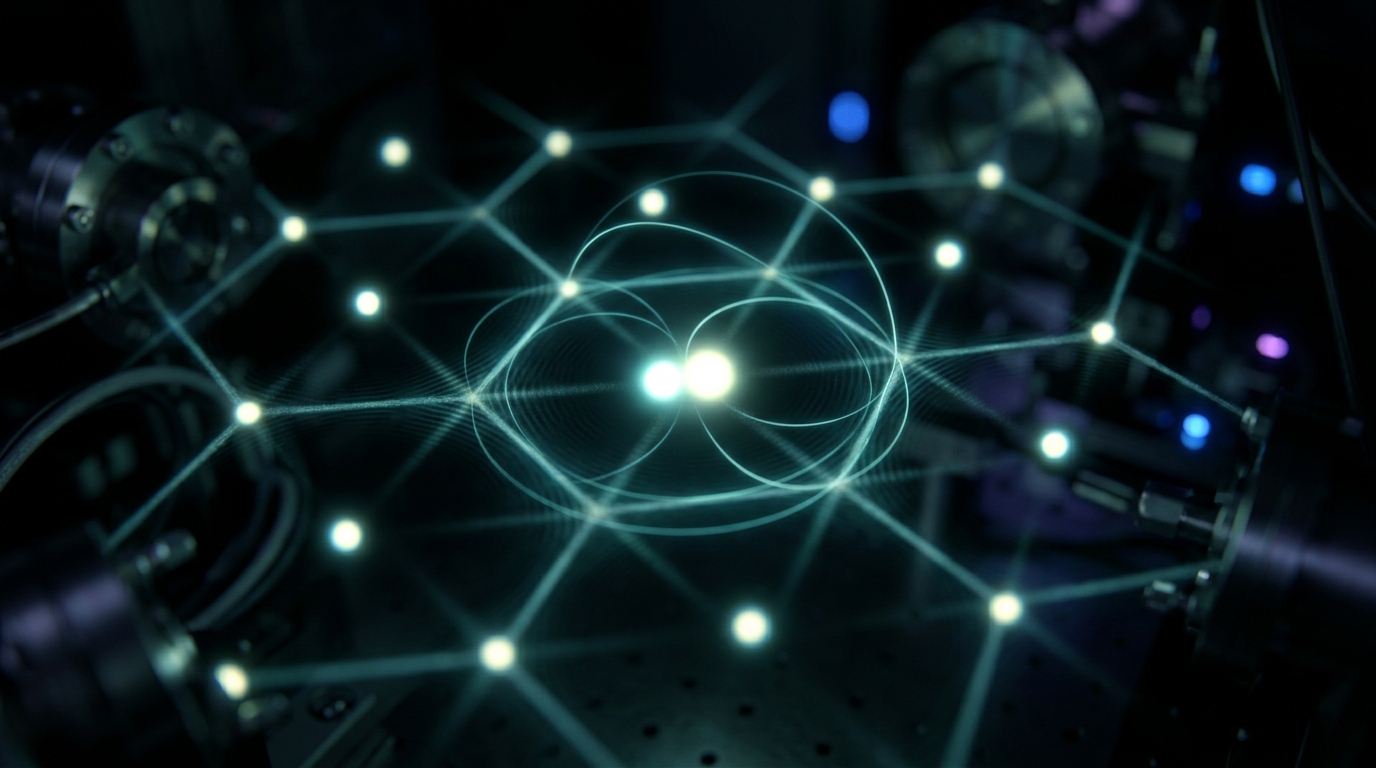
[IMAGE: macro view of a semiconductor double quantum dot with two electrons confined in adjacent potential wells, cyan energy contours]
Industry Context: Where This Sits on the Quantum Threat Curve
The practical takeaway for security architects is one of scale separation. The 226,000–314,000 physical-qubit estimates for a modest materials-science problem sit one to two orders of magnitude below the millions of physical qubits credibly required to run Shor’s algorithm against RSA-2048 or 256-bit elliptic curves. A machine that can model an eight-electron quantum dot in 3.4 days is not a machine that can forge your TLS certificates.
That gap is your runway — but it is a runway with a known slope. Regulators have already priced in the eventual arrival of cryptographically relevant machines:
- NIST finalised its first post-quantum standards — FIPS 203 (ML-KEM), FIPS 204 (ML-DSA), and FIPS 205 (SLH-DSA) — in August 2024, and has signalled deprecation of RSA and ECC by 2030 with full disallowance by 2035.
- The U.S. CNSA 2.0 suite mandates post-quantum algorithms for national security systems on a phased schedule running through the early 2030s.
The economic asymmetry favours early movers. “Harvest now, decrypt later” attacks mean data exfiltrated today against long-lived secrets — health records, state secrets, financial keys with 20-year sensitivity — is already exposed, regardless of when a cryptographically relevant quantum computer arrives. The cost of migration is a planned capital expense; the cost of inaction is an unbounded liability that compounds with every day of harvested ciphertext.
The BeQuantum Perspective: Resource Estimates as a Planning Instrument
We treat papers like this one as telemetry, not headlines. A single defensible qubit estimate for a structured problem is worth more to a migration plan than a dozen breathless predictions of “quantum supremacy,” because it lets us anchor assumptions to engineering reality.
Three practical lenses we apply:
Trajectory over threshold. Rather than asking “when does RSA break,” we track the delta between demonstrated early-fault-tolerant capability (hundreds of thousands of qubits, structured problems) and cryptographically relevant capability (millions of qubits, Shor’s algorithm). This paper widens our confidence that the gap remains substantial today while confirming the curve is now measurable — exactly the input a phased migration needs.
Crypto-agility as the hedge against estimate error. The authors openly flag that dense surface codes could cut costs “significantly further” without quantifying the reduction. Resource estimates move. The correct architectural response is not to bet on a specific date but to make algorithm substitution cheap — which is why BeQuantum’s PQC Layer abstracts algorithm identity behind stable key identifiers, so a future acceleration in fault-tolerant hardware becomes a policy change, not a re-engineering project.
Provable record-keeping for long-lived assets. When the harvest-now threat means today’s signatures must survive a multi-decade horizon, the integrity of the audit trail matters as much as the cipher. BeQuantum’s Digital Notary anchors document and key-rotation events to a tamper-evident, blockchain-verified ledger, so an organisation can later prove which algorithm protected which asset at which time — the evidentiary backbone of any defensible PQC transition.
We are candid that this specific paper addresses materials modelling, not cryptanalysis. Its value to a security program is calibration: it sharpens the denominator in every “how long do we have” calculation.
What You Should Do Next
- Within 90 days, complete a cryptographic inventory. Map every system using RSA, ECC, or Diffie-Hellman, and tag each by data-sensitivity lifetime. Anything protecting secrets that must remain confidential past 2035 is already in the harvest-now blast radius and belongs at the top of your migration queue.
- Within 6 months, pilot a hybrid PQC deployment. Stand up ML-KEM (FIPS 203) alongside your existing key exchange in a non-critical TLS path. Hybrid mode preserves classical security guarantees while you validate performance and interoperability against real traffic.
- Quarterly, re-baseline your quantum threat assumptions. Track fault-tolerant resource estimates like this one against vendor roadmaps. Treat any sustained drop in the qubit-or-runtime cost of structured simulation problems as a leading indicator that cryptanalytic capability is also accelerating, and compress your timeline accordingly.
FAQ
Q: Does a 226,000-qubit quantum computer threaten my encryption? A: No. Simulating a four-electron quantum dot at that scale is a structured materials-science problem, not cryptanalysis. Breaking RSA-2048 with Shor’s algorithm requires credible estimates in the millions of physical qubits — one to two orders of magnitude beyond the machines described here. The result is a calibration signal about hardware trajectory, not an imminent cryptographic threat.
Q: Why care about a materials-science paper as a security leader? A: Resource estimates grounded in a realistic surface-code model (rather than loose theoretical bounds) let you plot fault-tolerant hardware progress against your post-quantum migration timeline. Trajectory data is what turns “someday” into a planning horizon you can defend to your board and auditors.
Q: If hardware costs could fall “significantly,” should I accelerate migration? A: Treat downward revisions as a reason to invest in crypto-agility now, not to predict a specific break date. An architecture that makes algorithm substitution a policy change — rather than a code rewrite — absorbs estimate volatility in either direction and is the most defensible hedge.
Last updated: 2026-06-15. Primary source: “Nanostructure modelling with early fault tolerant quantum computers,” arXiv:2606.06442. Referenced: Low et al., arXiv:2605.30455.