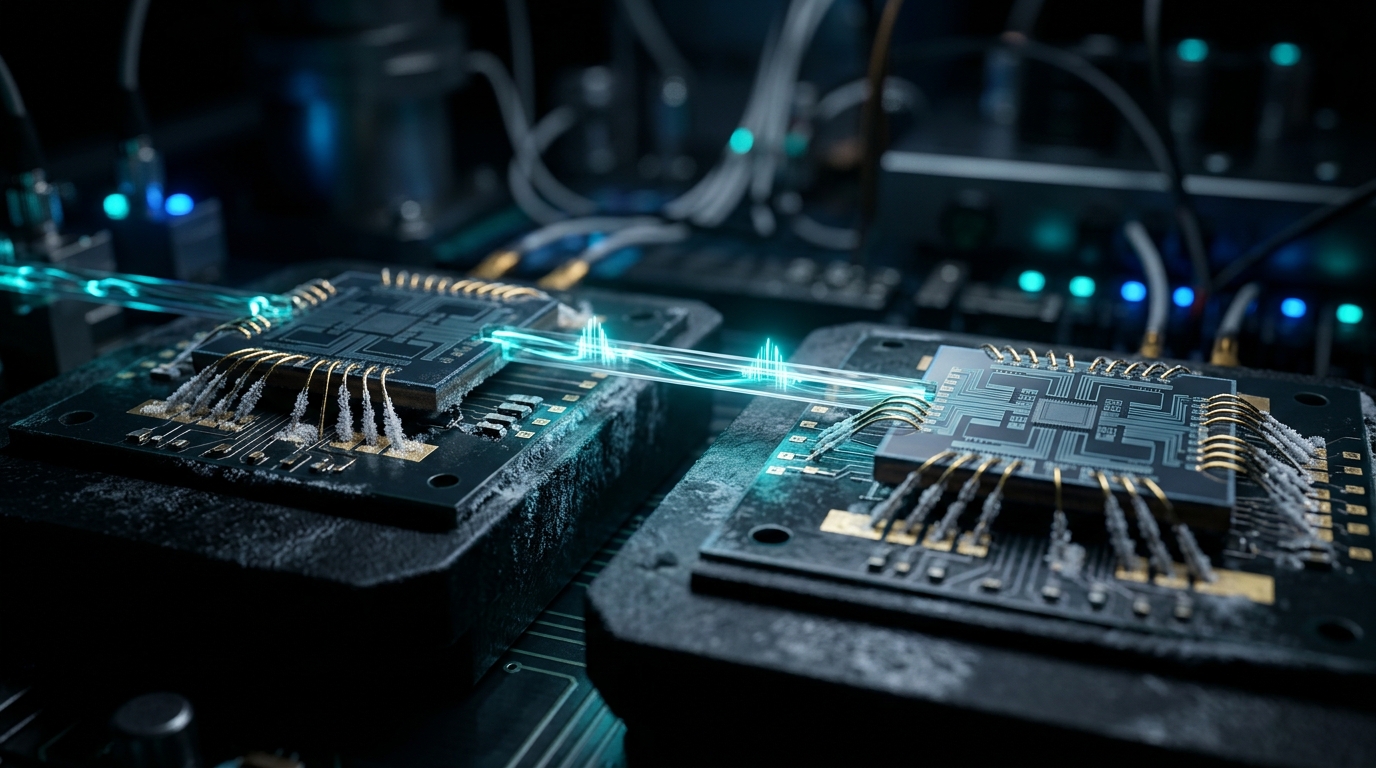

- A new result (arXiv:2511.11404) gives an exact formula for expressing any two-body Hamiltonian as a sum of local unitary transformations of an Ising Hamiltonian, using at most O(n²) terms—quadratic, not exponential, in system size.
- The method cuts the classical preprocessing cost of building digital-analog quantum circuits from exponential to polynomial time, removing a numerical-optimization bottleneck that previously throttled scaling.
- For security teams, this is a leading indicator: efficiency advances in quantum simulation shorten the runway to cryptographically relevant quantum hardware, which directly governs your post-quantum migration deadline.
Why a Quantum Simulation Paper Belongs on Your Risk Radar
Your TLS certificates, your code-signing keys, your VPN handshakes—every RSA and elliptic-curve key your organization deploys today carries an expiration date set not by your PKI policy, but by the pace of quantum hardware. The threat model is harvest-now-decrypt-later: an adversary captures encrypted traffic today and waits for a quantum computer capable of running Shor’s algorithm at scale to decrypt it retroactively. Data with a 10-year confidentiality requirement—health records, financial contracts, state secrets—is already exposed if a capable machine arrives within that window.
The question every security architect needs answered is when. And the honest answer depends less on press-release qubit counts than on the unglamorous engineering work that makes quantum machines actually usable: how efficiently you can compile a problem onto the hardware, how much classical computation that compilation costs, and whether the whole pipeline scales.
That is exactly the bottleneck the work in arXiv:2511.11404 attacks. It is not a cryptography paper. It will not break RSA tomorrow. But it removes a concrete scaling obstacle in one of the more hardware-friendly approaches to quantum computation—and scaling obstacles are precisely what stand between today’s laboratory devices and the machine that ends classical public-key cryptography.
Technical Deep-Dive: What Digital-Analog Quantum Computing Actually Does
A Working Definition
Digital-analog quantum computing (DAQC) is a hybrid model that uses the natural interaction Hamiltonian of a physical system—the always-on coupling between qubits—as its entangling resource, and combines it with single-qubit gates to implement universal quantum operations. Instead of decomposing every operation into a long sequence of discrete two-qubit gates (the purely digital, gate-based approach), DAQC lets the hardware’s intrinsic physics do the heavy entangling work, steered by simple local rotations.
The appeal is practical. Two-qubit gates are the noisiest, slowest, error-prone primitives in most quantum architectures. By leaning on a system’s natural multi-qubit dynamics—frequently an Ising-type Hamiltonian—DAQC can reduce the number of fragile digital operations while preserving universality.
The Bottleneck: Exponential Preprocessing
The catch has always been compilation. To run a target computation, you must express the operation you want in terms of the analog resource you have. Designing digital-analog circuits that use optimal quantum resources has historically required numerical optimization over an exponentially large parameter space—classical computation that blows up as the system grows. A protocol that is elegant on 4 qubits becomes intractable to even design at the scale where quantum advantage lives.
The Result: A Polynomial-Time Exact Formula
The contribution of arXiv:2511.11404 is to trade a small amount of optimality for an enormous amount of scalability. Rather than searching for the optimal decomposition, the authors derive an explicit, exact construction that is provably good enough and cheap to compute.
“In particular, we provide an exact solution for the problem of expressing arbitrary two-body Hamiltonians as the sum of local unitary transformations of an arbitrary Ising Hamiltonian, with the total number of required terms being at most quadratic in system size.” — arXiv:2511.11404, abstract
Two numbers carry the significance. First, at most quadratic—O(n²)—terms are needed to represent an arbitrary two-body Hamiltonian. Second, the preprocessing that produces these terms runs in polynomial time, replacing the exponential numerical optimization that the optimal approach demands. The protocol sidesteps the search over a large parameter space at the design stage entirely.
The shift from exponential to polynomial preprocessing is the headline. A simulation protocol that you cannot compile at scale is not a simulation protocol at scale—the classical design cost was the true ceiling, and explicit formulas raise it.
Optimal vs. Suboptimal: The Honest Trade-off
The solution is described as suboptimal: it does not use the theoretical minimum of quantum resources. The paper does not quantify how far from optimal it sits. What it offers instead is determinism and tractability—a closed-form recipe rather than an open-ended search. For engineering systems that must scale, a known-good answer you can always compute beats an optimal answer you can never reach.
Current Standard vs. The Digital-Analog Approach
| Dimension | Purely Digital (Gate-Based) | Digital-Analog (This Work) |
|---|---|---|
| Entangling resource | Discrete two-qubit gates | Natural Ising Hamiltonian + single-qubit gates |
| Compilation strategy | Gate decomposition | Local unitary transforms of an Ising Hamiltonian |
| Preprocessing cost (optimal) | — | Exponential numerical optimization |
| Preprocessing cost (this method) | — | Polynomial time |
| Terms to represent a two-body Hamiltonian | — | At most O(n²) (quadratic) |
| Optimality | — | Suboptimal but exact and explicit |
| Primary advantage | Mature tooling, universality | Fewer fragile two-qubit operations, scalable design |
Note: the source addresses the digital-analog compilation problem specifically and does not benchmark wall-clock runtime against prior digital-analog methods; the comparison above reflects qualitative structure, not measured speedups.
Industry Context and Implications
The Regulatory Clock Is Already Running
While this paper concerns simulation efficiency, the regulatory response to quantum risk is concrete and dated. In August 2024, NIST finalized its first post-quantum cryptography standards: FIPS 203 (ML-KEM, based on CRYSTALS-Kyber), FIPS 204 (ML-DSA, based on CRYSTALS-Dilithium), and FIPS 205 (SLH-DSA, based on SPHINCS+). NIST has signaled deprecation of 112-bit-strength classical algorithms such as RSA-2048 around 2030, with disallowance targeted for 2035. Those dates are your compliance horizon regardless of when a cryptographically relevant quantum computer actually appears.
Why Hardware Efficiency News Moves the Threat Estimate
The gap between today’s noisy devices and a Shor-capable machine is an engineering gap, not a theoretical one. Results that make quantum computation cheaper to compile, less reliant on noisy two-qubit gates, and easier to scale all compress that gap incrementally. No single paper—including this one—delivers the cryptographically relevant machine. But security planning that waits for the breakthrough announcement has already lost the harvest-now-decrypt-later race. The rational posture treats steady efficiency gains as cumulative evidence to migrate now, not later.
The Economics of Inaction
Crypto-agility is cheap to design in and expensive to retrofit under deadline. An organization that inventories its cryptographic dependencies today and builds a migration path spends predictably. An organization that waits until a quantum milestone forces an emergency rip-and-replace pays a premium—and remains exposed to retroactive decryption of everything captured in the interim.
The BeQuantum Perspective
The lesson security architects should extract from work like arXiv:2511.11404 is structural, not academic: quantum capability advances through compounding efficiency wins, so your defenses must be capability-agnostic. You cannot price the threat to the day, which means your cryptographic posture has to survive an uncertain timeline.
This is the design principle behind BeQuantum’s PQC Layer, which wraps existing transport and data-at-rest protections in NIST-standardized algorithms (ML-KEM for key establishment, ML-DSA for signatures) so that migration is a configuration change rather than a re-architecture. It is also why our Digital Notary anchors integrity proofs using post-quantum signature schemes—so that a document or transaction signed today remains verifiable even after classical signatures become forgeable. For organizations with long-lived key material, IceCase hardware isolates root keys so that crypto-agility extends to the most sensitive layer of the stack.
The approach is deliberately conservative: assume the efficiency curve continues, assume the timeline is shorter than comfortable, and make the cryptographic substrate swappable before you are forced to swap it.
What You Should Do Next
- Within 90 days, complete a cryptographic inventory. Audit your TLS certificate chains, code-signing infrastructure, VPN configurations, and data-at-rest encryption to map every dependency on RSA and elliptic-curve cryptography. You cannot migrate what you have not located.
- Prioritize by confidentiality lifetime. Rank assets by how long their data must stay secret. Anything with a 7+ year requirement is already in the harvest-now-decrypt-later blast radius and should move to ML-KEM hybrid key exchange first.
- Pilot a hybrid post-quantum deployment this fiscal year. Stand up a NIST-standardized hybrid (classical + ML-KEM) handshake on one non-critical service to surface integration issues—certificate sizing, handshake latency, library maturity—before they become production blockers under a 2030 deadline.
FAQ
Q: Does digital-analog quantum computing make my encryption breakable sooner? A: Not directly or imminently. This research improves how efficiently certain quantum computations can be compiled and scaled; it does not run Shor’s algorithm or break RSA. Its relevance to security is as a leading indicator—efficiency gains like this incrementally shorten the engineering path to a cryptographically relevant quantum computer, which is why the prudent response is to migrate to post-quantum cryptography now rather than wait for a single breakthrough.
Q: What does “at most quadratic in system size” actually mean for scalability? A: It means the number of terms required to represent an arbitrary two-body Hamiltonian grows as O(n²)—proportional to the square of the qubit count—rather than exponentially. Quadratic growth is tractable for classical computers to handle even at large scale, whereas exponential growth becomes impossible to compute past a few dozen qubits. That difference is what turns a method from a small-scale curiosity into a candidate for real hardware.
Q: Should I wait for clearer quantum timelines before starting PQC migration? A: No. NIST finalized post-quantum standards (FIPS 203/204/205) in August 2024 and targets deprecation of RSA-2048-class algorithms around 2030, with disallowance by 2035—those compliance deadlines apply regardless of the quantum hardware timeline. Combined with the harvest-now-decrypt-later threat to long-lived data, the cost-rational move is to build crypto-agility today.
Last updated: 2026-06-05. Primary source: “Hamiltonian simulation with explicit formulas for Digital-Analog Quantum Computing” (arXiv:2511.11404). This analysis distinguishes between claims made in the source (the polynomial-time, O(n²) Hamiltonian decomposition result) and broader industry context (NIST timelines, threat-model framing) supplied for reader relevance; the source itself does not address cryptography or enterprise security.