- Researchers present the first systematic framework for dynamical decoupling in arbitrary-dimension qudit systems, moving quantum error correction beyond binary qubits (arXiv:2604.05871v1)
- The symmetry-based approach unifies two previously separate quantum error suppression techniques, potentially shortening the timeline to fault-tolerant quantum computers capable of breaking current encryption
- Organizations that haven’t begun post-quantum cryptography migration planning face compounding risk as each advance in quantum error correction narrows the window for safe transition
Why Quantum Error Correction Advances Threaten Your Encryption Faster Than You Think
Every enterprise CISO tracking the quantum threat focuses on qubit counts. That metric is incomplete. A quantum computer doesn’t crack RSA-2048 by adding more qubits alone — it needs those qubits to maintain coherence long enough to execute Shor’s algorithm across millions of gate operations. Quantum error correction is the bottleneck, and a new paper published on arXiv (identifier 2604.05871v1) just removed a significant obstacle.
The research presents a general framework for suppressing noise in qudit systems — quantum processors that operate in dimensions beyond the binary qubit. Where a qubit stores two states (0 and 1), a qutrit stores three, and a general qudit stores d states. Qudit architectures pack more computational power per physical unit, but until now, they lacked the error correction protocols that qubit systems have enjoyed for decades.
That gap just closed.
The Technical Breakthrough: Unifying Noise Suppression Through SU(d) Symmetry
Dynamical decoupling is a technique that applies carefully timed pulse sequences to a quantum system to cancel out unwanted environmental noise — analogous to noise-canceling headphones, but for quantum states. Quantum error-correcting codes detect and correct errors after they occur, using redundant encoding of quantum information. These two approaches developed independently, each with its own mathematical machinery.
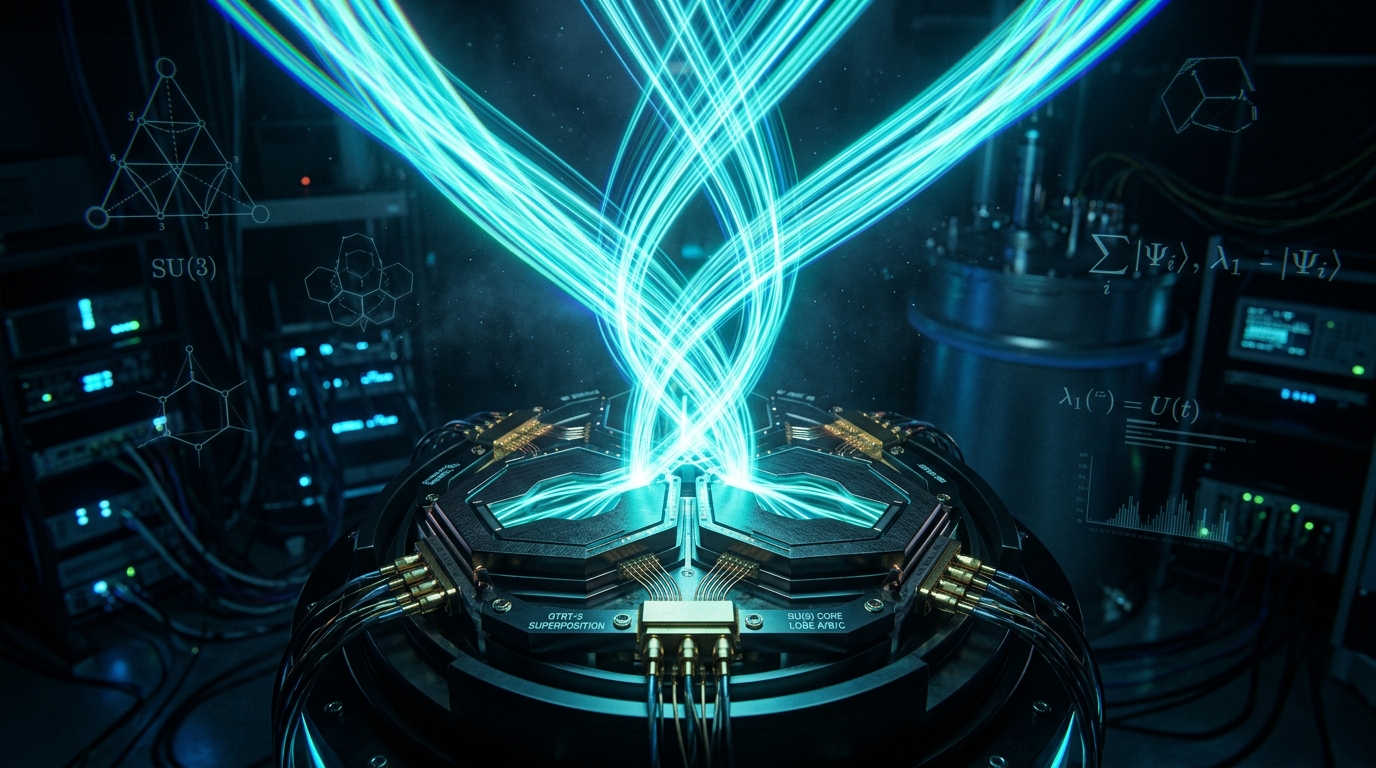
The new framework unifies them under a single mathematical structure: the representation theory of Lie groups, specifically the special unitary group SU(d).
Here is the core mechanism: the researchers analyze how finite subgroups of SU(d) interact with the operator space of a qudit system. By decomposing this operator space into irreducible representations of a chosen subgroup, they can systematically identify which subgroups serve as decoupling groups — sets of operations that, when applied in sequence, average out all unwanted interactions.
“We further show that the same symmetry-based framework yields quantum error-correcting codes: whenever a finite subgroup of SU(d) acts as a decoupling group for the relevant error algebra, the associated one-dimensional symmetry sectors define codespaces satisfying the Knill-Laflamme conditions, thereby unifying dynamical decoupling and quantum error correction in multi-level quantum systems.” — arXiv:2604.05871v1
The Knill-Laflamme conditions are the mathematical criteria that a quantum code must satisfy to guarantee perfect error correction. A codespace meeting these conditions can detect and reverse any error from the specified error set. The fact that the same finite subgroups that enable dynamical decoupling automatically produce valid error-correcting codes is not an incremental improvement. It means engineers building qudit processors get two protection mechanisms from one design decision.
Qutrit Pulse Sequences: From Theory to Hardware
The paper constructs concrete new pulse sequences for qutrit systems (dimension d=3, the SU(3) group), with specific focus on interacting spin-1 systems that exhibit large zero-field splitting. These are not hypothetical — spin-1 systems exist in nitrogen-vacancy (NV) centers in diamond and certain molecular magnets, both active platforms in quantum sensing and computing research.
By exploiting subgroup factorizations and group orientations within SU(3), the researchers derive shorter pulse sequences than brute-force approaches would require. Shorter sequences mean fewer operations, lower cumulative error, and faster cycle times — all critical for experimental viability.
Qubits vs. Qudits: Why Higher Dimensions Matter
| Property | Qubit (d=2) | Qutrit (d=3) | General Qudit (d) |
|---|---|---|---|
| States per unit | 2 | 3 | d |
| Information density | 1 bit/unit | log₂(3) ≈ 1.58 bits/unit | log₂(d) bits/unit |
| Gate complexity | Well-characterized | Rapidly developing | Framework-dependent |
| Error correction protocols | Mature (surface codes, etc.) | Previously limited | Now systematic via SU(d) framework |
| Symmetry group | SU(2) | SU(3) | SU(d) |
| Hardware platforms | Superconducting circuits, trapped ions | NV centers, trapped ions, photonic systems | Platform-dependent |
The information density advantage compounds. A register of n qutrits accesses a 3ⁿ-dimensional Hilbert space versus 2ⁿ for qubits. For a 50-unit register, that is 7.18 × 10²³ versus 1.13 × 10¹⁵ — a factor of 635 million more computational states from the same number of physical units.
What This Means for the Quantum Threat Landscape
The cryptographic implications are indirect but consequential. No one is running Shor’s algorithm on a qutrit processor today. But the trajectory matters for three reasons.
1. Error Correction Is the Pacing Constraint
Current estimates suggest that breaking RSA-2048 requires roughly 4,000 logical qubits running for hours — which translates to millions of physical qubits under today’s error rates and correction overhead. Every advance in error correction efficiency reduces that physical-to-logical ratio. A unified framework that works natively in higher dimensions could reduce overhead more aggressively than qubit-only approaches.
2. Hardware-Efficient Encoding Compresses Timelines
If qudit processors achieve native error correction through this SU(d) framework, they bypass the massive overhead of encoding each logical qubit into dozens or hundreds of physical qubits. A single qutrit with native error protection replaces multiple physical qubits. NIST’s post-quantum migration timeline assumes certain hardware development rates — native qudit error correction could accelerate those rates.
3. The “Harvest Now, Decrypt Later” Clock Is Already Running
Adversaries are already collecting encrypted traffic for future decryption. Every month that fault-tolerant quantum computing arrives sooner than projected is a month of additional exposed data. Organizations handling classified, financial, or health data with decryption-sensitive lifespans of 10+ years face the most acute risk.
For any organization whose encrypted data retains value beyond 2030, the question is no longer whether to migrate to post-quantum cryptography but how fast the migration can execute before quantum error correction matures enough to enable practical cryptanalysis.
Regulatory and Market Context
NIST finalized its first post-quantum cryptographic standards (ML-KEM, ML-DSA, SLH-DSA) in 2024 and continues expanding the suite. The U.S. National Security Memorandum NSM-10 mandates federal agencies inventory cryptographic systems and develop migration plans. The European Union’s cybersecurity agency ENISA has issued similar guidance.
Yet adoption lags. Most enterprises remain in the assessment phase, cataloging where vulnerable algorithms exist across their infrastructure. Advances like the SU(d) framework don’t change the recommendation — migrate to PQC — but they do increase the urgency by signaling that fault-tolerant quantum hardware may arrive on a compressed schedule.
| Migration Phase | Typical Enterprise Status (2026) | Risk Level if Delayed |
|---|---|---|
| Cryptographic inventory | 40-60% complete at large enterprises | Medium — can’t protect what you haven’t mapped |
| Algorithm selection | Evaluating NIST standards | Low — standards are stable |
| Testing & integration | Early pilots in non-critical systems | High — integration complexity scales with delay |
| Production deployment | <5% of TLS endpoints migrated | Critical — each month adds exposure |
| Certificate chain migration | Largely not started | Critical — long certificate lifespans create inertia |
The BeQuantum Perspective: Building for a Multi-Dimensional Quantum Future
The SU(d) unification underscores a principle BeQuantum’s architecture anticipated: quantum threats won’t arrive from a single direction. Our PQC Layer implements lattice-based and hash-based algorithms from the NIST standard suite, but the design assumes the threat landscape will shift as quantum hardware evolves beyond qubit-only architectures.
BeQuantum’s Digital Notary service creates cryptographic attestations of content authenticity using algorithms selected specifically for long-horizon security — documents notarized today must remain verifiable even if quantum computers capable of attacking current signature schemes come online within the document’s legal lifetime. The SU(d) research reinforces that timeline compression is a real engineering trend, not speculation.
Our approach to IceCase hardware security modules incorporates algorithm agility by design: the ability to swap underlying cryptographic primitives without re-architecting the trust chain. As qudit-based quantum computers mature and potentially alter which key lengths and algorithm families remain secure, organizations using agile cryptographic infrastructure avoid the costly rip-and-replace cycles that rigid implementations demand.
What You Should Do in the Next 90 Days
1. Complete your cryptographic inventory. Identify every system, protocol, and certificate that relies on RSA, ECDSA, ECDH, or other quantum-vulnerable algorithms. Automated scanning tools exist — deploy them before manual audits. Prioritize systems handling data with sensitivity lifespans exceeding 7 years.
2. Run a PQC integration pilot. Select one non-critical internal service and migrate its TLS certificate chain to ML-KEM (for key encapsulation) and ML-DSA (for digital signatures). Measure the performance impact: key exchange latency, certificate size increase, and client compatibility. These numbers will drive your production migration budget.
3. Establish a quantum threat monitoring function. Assign a team member or subscribe to a curated intelligence feed that tracks quantum error correction milestones — not just qubit counts. Papers like arXiv:2604.05871 signal capability shifts that headline qubit announcements often miss. When error correction efficiency doubles, your migration deadline effectively halves.
Frequently Asked Questions
Q: Does this paper mean quantum computers can break encryption now?
A: No. This research advances the theoretical framework for error correction in multi-level quantum systems. No experimental hardware results are reported. However, it removes a significant theoretical barrier that previously slowed qudit-based quantum processor development. The cryptographic threat remains years away, but that window is narrowing with each such advance.
Q: What is the difference between a qubit and a qudit, and why does it matter for cybersecurity?
A: A qubit is a two-level quantum system (dimension d=2), while a qudit generalizes to d levels. A qutrit (d=3) stores approximately 58% more information per physical unit than a qubit. Higher-dimensional quantum processors could achieve fault tolerance with fewer physical units, potentially accelerating the timeline to cryptographically relevant quantum computers. For CISOs, this means threat models based solely on qubit roadmaps may underestimate the pace of quantum capability development.
Q: Should we wait for qudit-based threats to materialize before migrating to PQC?
A: Waiting is the highest-risk option. NIST’s post-quantum standards are finalized and ready for deployment. Migration takes years for large enterprises due to certificate chain dependencies, protocol negotiation complexity, and vendor ecosystem readiness. Starting now provides the buffer needed regardless of which quantum architecture — qubit, qutrit, or general qudit — reaches cryptographic relevance first.
Last updated: April 2026. Based on research published as arXiv:2604.05871v1.