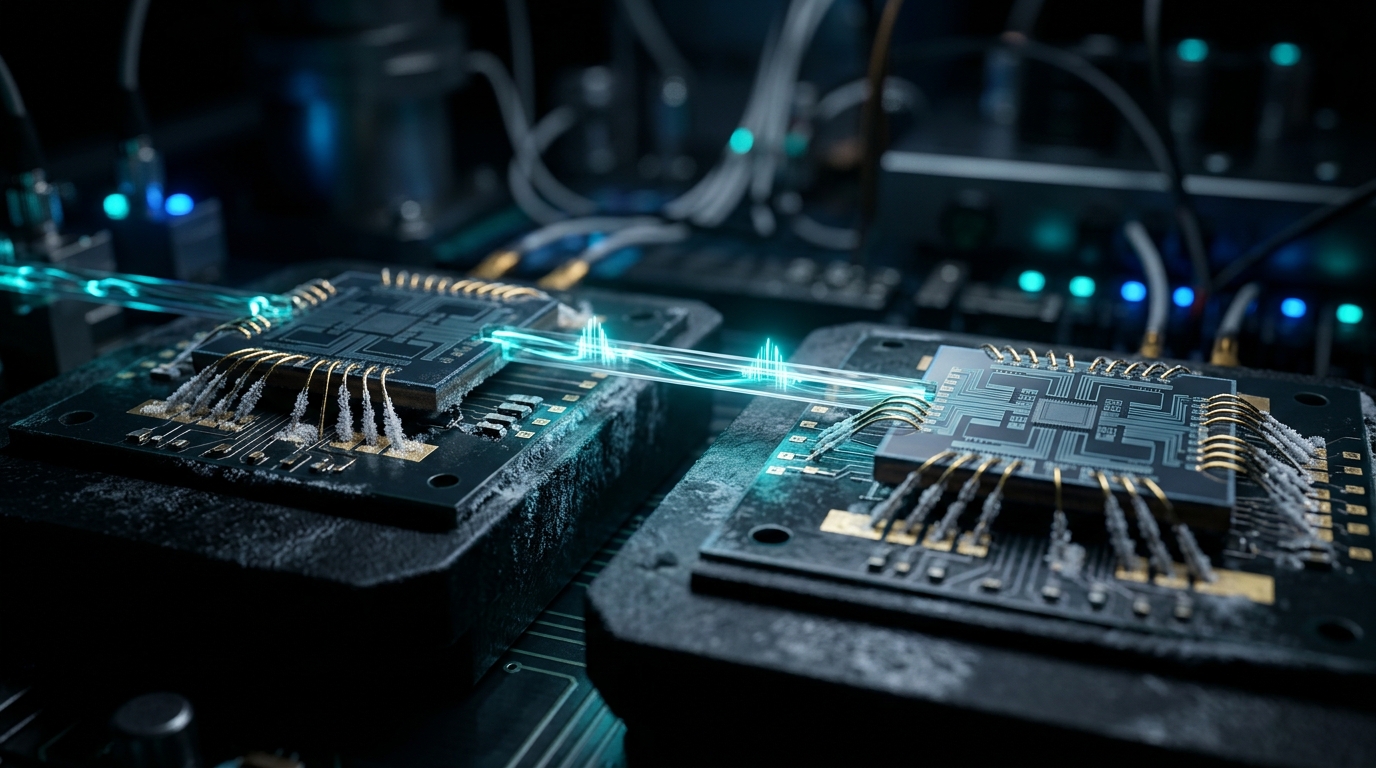

- Researchers demonstrated a native three-qubit entangling gate — “Parity Cross-Resonance” — that performs control-control-target and control-target-target operations in a single coherent step instead of decomposing into multiple two-qubit gates (arXiv:2508.10807).
- The gate implements a controlled-ZZ (CZZ) operation that maps the parity of two data qubits onto one measurement qubit directly, enabling faster, higher-fidelity stabilizer measurements in surface-code error correction.
- The advance targets the error-correction overhead that stands between today’s noisy hardware and a fault-tolerant machine — the same machine that will eventually break RSA and ECC, making your post-quantum migration window the real variable to watch.
Why a Hardware Paper Belongs on Your Risk Radar
Most CISOs file quantum computing under “someday.” That instinct is wrong for one specific reason: the threat is not a working quantum computer today — it is the rate at which one becomes buildable. Adversaries already run “harvest now, decrypt later” campaigns, capturing encrypted traffic and archives today to decrypt once a cryptographically relevant quantum computer (CRQC) exists. Every datum with a confidentiality lifetime past the CRQC arrival date is already exposed.
The bottleneck to that machine is not qubit count. It is error correction. Physical superconducting qubits are noisy; a fault-tolerant logical qubit requires thousands of physical qubits stitched together by surface-code error correction, with stabilizer measurements running continuously to catch errors before they cascade. Every gain in the speed and fidelity of those measurements compresses the timeline to a CRQC.
That is why a control-hardware preprint matters to a security architect. A 2025 result from the Parity Cross-Resonance paper attacks the stabilizer-measurement overhead at its root. It does not break cryptography. It shortens the runway.
The source makes no cryptographic claim whatsoever. The connection to your risk posture is the engineering chain: better native multiqubit gates → cheaper error correction → faster path to fault tolerance → an earlier “break date” for classical public-key crypto.
Technical Deep-Dive: What “Native Three-Qubit” Actually Means
Definition: A native multiqubit gate is a quantum operation that entangles three or more qubits through a single, directly engineered physical interaction — rather than being synthesized from a sequence of one- and two-qubit gates. Native execution avoids the accumulated error and time cost of decomposition.
Conventional architectures build a three-qubit operation such as a Toffoli (controlled-controlled-NOT) by chaining six or more two-qubit gates plus single-qubit rotations. Each two-qubit gate contributes its own infidelity and duration. The Parity Cross-Resonance approach instead realizes control-control-target and control-target-target operations in one coherent step.
The authors classify the gate as a cross-resonance gate and use a hybrid optimization approach that selectively amplifies the desired interactions while suppressing unwanted couplings. The reported behavior is robust across the computational subspace and beyond — verified by testing under increasing total excitation numbers, meaning fidelity holds as more of the Hilbert space is populated rather than degrading outside a narrow operating point.
Three demonstrated applications anchor the result:
- GHZ triplet state preparation — generating a maximally entangled three-qubit state in one shot.
- Toffoli-class logic with many-body interactions — universal reversible logic primitives.
- A controlled-ZZ (CZZ) gate that maps the parity of two data qubits directly onto a measurement qubit.
That third application is the one that touches your timeline.
The CZZ Parity Trick and Why It Speeds Error Correction
Surface-code error correction works by repeatedly measuring the parity (combined even/odd state) of neighboring data qubits using ancillary measurement qubits. Detecting a parity flip flags an error without disturbing the encoded logical information. The faster and more accurately you can extract parity, the tighter your error-correction cycle and the lower your logical error rate.
The standard route accumulates parity onto an ancilla through a sequence of two-qubit CNOTs. The CZZ gate collapses that sequence: it writes the two-data-qubit parity onto the single measurement qubit in one native operation.
“This work lays the foundation for co-designing circuit architectures and control protocols that leverage native multiqubit interactions as core elements of next-generation superconducting quantum processors.” — arXiv:2508.10807v2, abstract
Decomposed vs. Native: The Structural Comparison
| Dimension | Conventional decomposed approach | Native Parity Cross-Resonance (CZZ) |
|---|---|---|
| Parity extraction | Sequence of two-qubit CNOTs onto ancilla | Single native three-qubit step |
| Qubits per operation | Two at a time | Three (2 data + 1 measurement) |
| Error accumulation | Compounds per gate in the chain | Confined to one coherent operation |
| Toffoli / GHZ build | 6+ two-qubit gates + rotations | One engineered interaction |
| Robustness tested | Typically near computational subspace | Across Hilbert space, rising excitation numbers |
| Stated fidelity figures | — | Not quantified in preprint (see gaps) |
Note the last row. The preprint reports robustness qualitatively and does not publish gate fidelity numbers, gate duration, processor scale, or whether results are experimental or simulation-only. Treat the magnitude of the advance as unconfirmed pending peer review; treat the direction as real.
Industry Context: Where This Sits in the PQC Mandate
The regulatory clock is already running independent of any single hardware result. NIST finalized its first post-quantum standards — ML-KEM (FIPS 203), ML-DSA (FIPS 204), and SLH-DSA (FIPS 205) — in August 2024, and U.S. federal guidance targets broad migration of public-key systems by 2035. Those deadlines were set against conservative CRQC estimates. Error-correction advances like native multiqubit gates are exactly the kind of development that can pull conservative estimates forward.
The asymmetry is the point. Migrating a large enterprise’s cryptographic estate — certificate chains, VPNs, code-signing, hardware roots of trust, archived data — takes years. A meaningful compression of the CRQC timeline does not give you those years back. Organizations that treat 2035 as a comfortable horizon are betting that no chain of incremental hardware wins compounds faster than expected. This paper is one link in exactly that chain.
The economics favor early movers. The cost of crypto-agility retrofitted under deadline pressure — emergency certificate reissuance, rushed library swaps, untested rollback paths — dwarfs the cost of a planned, inventoried migration. Inaction is not free; it is deferred and inflated.
The BeQuantum Perspective
The lesson security teams should draw from native-gate research is not “panic about qubits.” It is that the threat timeline is governed by engineering variables you do not control and cannot reliably forecast. The only defensible posture is one that does not depend on knowing the break date.
That principle shapes how we build. BeQuantum’s PQC Layer is designed for crypto-agility first: cryptographic primitives sit behind an intent-based interface so that swapping ML-KEM parameter sets — or migrating off a primitive entirely if a future result weakens it — is a configuration change, not a re-architecture. When the timeline moves, your migration path should not require re-engineering.
For data with long confidentiality lifetimes, our Digital Notary anchors integrity and timestamp proofs that survive the transition. The threat that error-correction advances accelerate is decryption of harvested data; provenance and tamper-evidence that hold across a cryptographic regime change protect the records whose value outlasts today’s algorithms. And for keys that must never leave a trusted boundary, IceCase hardware keeps root key material in a controlled enclave so that even a future CRQC cannot retroactively compromise what was never transmitted.
The through-line: build so that a faster-than-expected quantum timeline is an inconvenience, not a breach.
What You Should Do Next
- Within 90 days, complete a cryptographic inventory. Catalog every system using RSA, ECC, or Diffie-Hellman — TLS certificate chains, code-signing keys, VPN tunnels, database encryption, and especially long-lived archives. You cannot migrate what you cannot see.
- Classify data by confidentiality lifetime. Flag anything that must stay secret past ~2032 as harvest-now-decrypt-later exposure and prioritize it for PQC protection now, not at the 2035 deadline.
- Pilot a hybrid PQC deployment this fiscal year. Stand up ML-KEM in hybrid mode (classical + post-quantum) on one non-critical service to validate performance and operational impact before it becomes mandatory.
[IMAGE: macro photograph of a superconducting quantum processor chip with three coupled transmon qubits linked by glowing cyan microwave resonator lines, dark cryogenic backdrop]
FAQ
Q: Does this three-qubit gate mean my encryption is at risk today? A: No. The result is a quantum control and error-correction advance with no demonstrated cryptographic capability. Its relevance is indirect: more efficient error correction shortens the path toward a fault-tolerant machine that could eventually threaten RSA and ECC. The risk is to your migration timeline, not your current traffic.
Q: Why does faster error correction matter more than adding qubits? A: A fault-tolerant logical qubit requires thousands of physical qubits held stable by continuous stabilizer measurements. Error correction — not raw qubit count — is the dominant bottleneck. Native multiqubit gates that extract stabilizer parity faster and with fewer operations attack that bottleneck directly, which is why they can move CRQC estimates.
Q: How should this change my PQC planning? A: It reinforces urgency without changing the playbook. Inventory your cryptography, prioritize long-lifetime data, and adopt crypto-agile architectures now. The defensible strategy assumes the break date is uncertain and possibly earlier than headline forecasts suggest.
Last updated: June 18, 2026. Primary source: “Parity Cross-Resonance: A Multiqubit Gate,” arXiv:2508.10807. Note: the preprint does not report quantitative fidelity, gate duration, or experimental-vs-simulation status; quantitative claims await peer review.