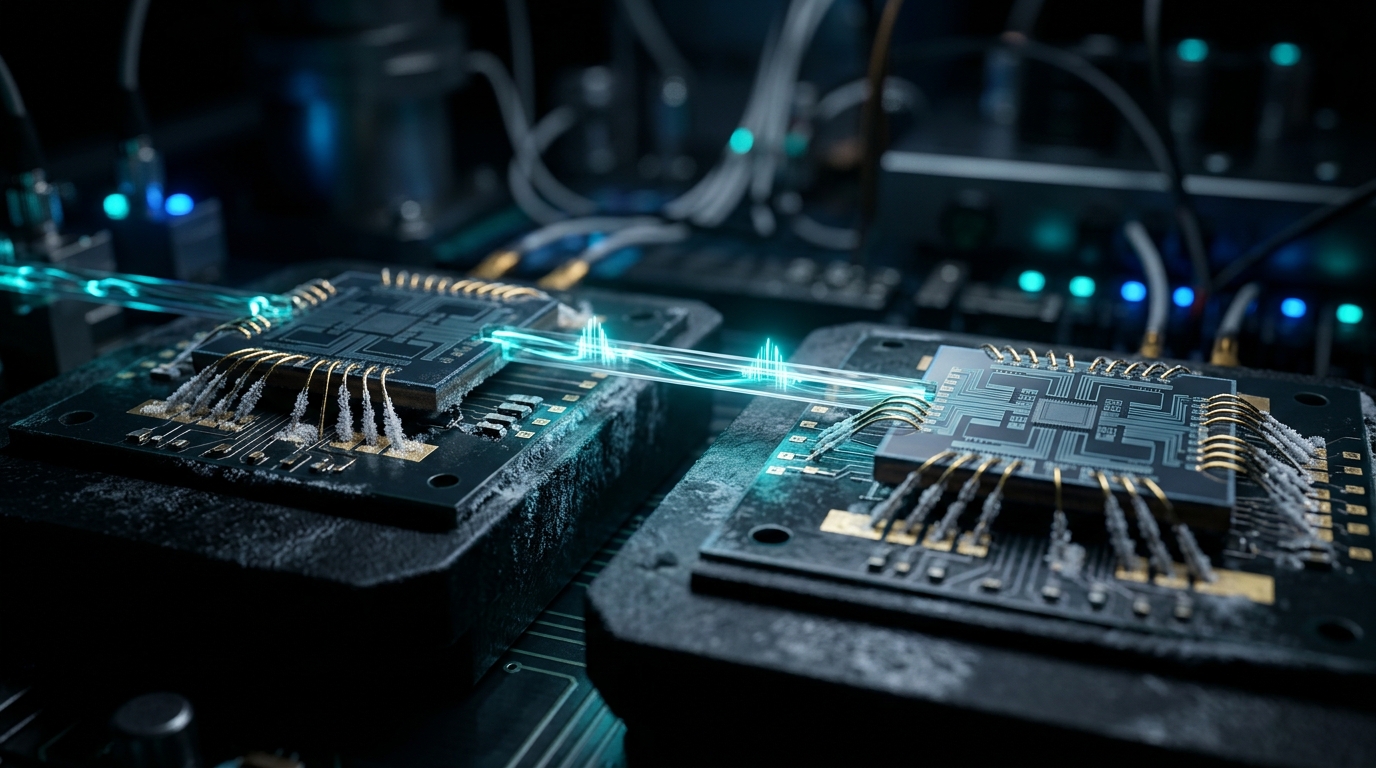

- A new arXiv paper (2605.15098v1) demonstrates state-vector quantum simulation running 5.88x faster on Apple M1 Pro integrated GPUs than on CPU, using cache-locality optimization
- Intel Core i5 integrated GPUs flipped from a 0.95x deficit to 1.89x speedup — a 99% improvement on identical 28-qubit Quantum Phase Estimation workloads
- For CISOs: quantum algorithm prototyping no longer requires $10K+ data-center GPU infrastructure, accelerating internal PQC validation timelines
The Hidden Bottleneck Slowing Your Quantum Readiness Program
Your security team needs to validate post-quantum cryptographic primitives before NIST’s 2030 deprecation deadlines for RSA-2048 and ECC. The standard playbook says: provision NVIDIA A100 instances, license vendor-specific simulators, train engineers on CUDA. Total cost to stand up a meaningful quantum simulation environment: $50,000-$200,000 annually before a single qubit gets simulated.
Meanwhile, every engineer on your team already owns the hardware needed to do this work — they just can’t use it efficiently. Integrated GPUs on Intel, AMD, and Apple consumer laptops have sat idle for quantum workloads because state-vector simulation hits a memory bandwidth wall the moment qubit counts climb past 20. The arithmetic is brutal: each additional qubit doubles the state vector size, and integrated GPUs share memory with the CPU, making cache thrashing the dominant performance killer.
A paper published on arXiv (ID 2605.15098v1) under the title “Accelerating State-Vector Quantum Simulation on Integrated GPUs via Cache Locality Optimization” attacks this bottleneck directly. The results matter for any security organization trying to compress the timeline between PQC research and production deployment.
Why State-Vector Simulation Breaks Integrated GPUs
State-vector simulation tracks the complete probability amplitude of every possible quantum state simultaneously. For an n-qubit system, this requires storing 2^n complex numbers. At 28 qubits — a common benchmark for serious algorithm validation — the state vector consumes roughly 4 GB of memory, with each gate operation touching the entire vector in patterns that defeat traditional caching strategies.
The authors identify the core problem with surgical precision:
“State-vector simulation has inherently poor spatial locality, creating a memory bandwidth bottleneck. Baseline implementations experience severe degradation in relative GPU speedup as qubit count increases.”
On discrete data-center GPUs with dedicated HBM2 memory delivering 1+ TB/s bandwidth, this bottleneck gets masked by raw throughput. On integrated GPUs sharing 50-100 GB/s DDR5 memory with the CPU, it dominates everything. The result: vendors like NVIDIA dominated quantum simulation tooling, while the integrated GPUs in 2 billion+ consumer devices remained quantum-blind.
The Cache-Locality Solution
The paper’s contribution is a state partitioning technique that reorganizes the quantum state vector to maximize last-level cache (LLC) locality. Rather than streaming through the entire 2^n state vector for each gate application, the algorithm partitions the state into blocks sized to fit within LLC, applies gate operations on each block while it remains cache-resident, then advances to the next partition.
The approach is vendor-agnostic — a critical design choice. Existing high-performance simulators like NVIDIA cuQuantum or Intel Quantum Simulator target vendor-specific instruction sets and memory hierarchies. The partitioning algorithm in this paper adapts to whatever cache topology the host architecture provides, whether that’s Intel’s inclusive L3, AMD’s victim-cache L3, or Apple Silicon’s unified memory architecture.
Benchmark Results: The Numbers That Matter
The authors evaluated their approach using the Quantum Phase Estimation (QPE) algorithm — a foundational primitive in Shor’s algorithm and quantum chemistry simulations — across three consumer architectures. The 28-qubit benchmark provides apples-to-apples comparison.
| Platform | Baseline GPU Speedup vs CPU | Optimized GPU Speedup vs CPU | Improvement |
|---|---|---|---|
| Intel Core i5 (integrated GPU) | 0.95x (slower than CPU) | 1.89x | +99% |
| Apple M1 Pro (integrated GPU) | 3.71x | 5.88x | +59% |
| AMD architecture | Not disclosed | Not disclosed | N/A |
The Intel result deserves special attention. Without optimization, the integrated GPU actually ran slower than the CPU — meaning developers had no rational reason to use it. The optimization didn’t just improve performance; it converted unusable hardware into a meaningful accelerator. Apple’s M1 Pro, with its unified memory architecture already favoring cache-coherent workloads, gained an additional 59% on top of an already-strong baseline.
“For a 28-qubit simulation, the optimization reversed a performance deficit on an Intel Core i5, improving the GPU speedup over the CPU from 0.95x to 1.89x, and increased the Apple M1 Pro speedup from 3.71x to 5.88x.”
The paper omits absolute execution times, AMD-specific benchmark numbers, and head-to-head comparisons against cuQuantum or Qiskit Aer. These gaps matter for procurement decisions but don’t undermine the core architectural insight: cache-locality optimization, not raw FLOPS, governs integrated-GPU quantum simulation performance.
Industry Context: Why This Lands Now
NIST’s PQC standardization finalized FIPS 203 (ML-KEM), FIPS 204 (ML-DSA), and FIPS 205 (SLH-DSA) in August 2024. Federal agencies operating under CNSA 2.0 face hard deadlines: software signing must transition to PQC by 2030, with full deprecation of classical algorithms by 2035. Private-sector organizations following NIST guidance face parallel pressure.
The operational consequence: every CISO needs internal teams capable of validating PQC implementations, evaluating performance trade-offs, and stress-testing hybrid cryptographic schemes. That validation work historically required either expensive cloud GPU instances or specialized hardware most security teams don’t own.
The cost differential is significant. A single NVIDIA A100 instance on AWS (p4d.24xlarge) costs approximately $32/hour, or $23,000/month for continuous availability. A team of five engineers running quantum simulations on their existing MacBook Pros costs zero incremental dollars. For organizations running PQC validation as a recurring practice — not a one-time project — the economics fundamentally shift.
Market Adoption Patterns
Vendor-specific quantum simulation toolchains have created a structural moat favoring organizations with cloud-scale budgets. Google, IBM, and Microsoft built internal quantum software practices on top of their own hardware investments. Mid-market enterprises and security consultancies have largely outsourced this work or deferred it entirely.
Vendor-agnostic, integrated-GPU simulation changes the staffing calculus. A senior security engineer with a $3,000 laptop can now prototype quantum algorithms, validate cryptographic primitives against quantum attacks, and contribute to internal PQC roadmaps without requesting cloud resources or coordinating with platform teams. Decision latency drops from weeks to hours.
The BeQuantum Perspective: Simulation as Validation Infrastructure
Our Digital Notary and PQC Layer products rest on a foundation that most security vendors gloss over: continuous validation that the cryptographic primitives we deploy actually resist the quantum attacks they claim to resist. That validation requires running real quantum algorithms — Shor’s, Grover’s, QPE — against the lattice-based and hash-based schemes underpinning ML-KEM and SLH-DSA.
We’ve structured our internal validation pipeline around exactly the constraint this paper addresses: we can’t afford to gate every cryptographic update behind a cloud GPU provisioning request. Engineers validating new key encapsulation parameters need to run quantum attack simulations on their development hardware, iterate quickly, and merge changes with confidence that the primitives hold up under realistic adversarial models.
Cache-locality optimization for integrated GPUs maps directly to this workflow. It means our security engineers can run meaningful QPE workloads against candidate cryptographic constructions during normal development cycles, not as a separate quarterly audit exercise. The same pattern applies to any organization deploying PQC at scale: validation infrastructure that runs on engineering laptops becomes part of CI/CD, not a separate workstream.
What You Should Do Next
Within 30 days: Audit your current PQC validation tooling. If your team relies exclusively on cloud GPU instances or vendor-specific simulators, identify the workflows that could migrate to local integrated-GPU simulation. Quantum Phase Estimation against your current TLS certificate chain is a reasonable starting benchmark.
Within 90 days: Build a competency matrix for your security engineers. The skill gap between “understands PQC theoretically” and “can validate PQC implementations against quantum attacks” is wider than most CISOs realize. Local simulation capabilities collapse the cost of building that competency from $50K+ in cloud spend per engineer to roughly zero.
Within 180 days: Integrate quantum simulation into your secure development lifecycle. Any cryptographic change — key rotation policies, TLS cipher suite updates, hash function selection — should run through quantum-attack simulation before deployment. This becomes economically feasible only when the simulation infrastructure runs on hardware your engineers already own.
Frequently Asked Questions
Q: Can a 28-qubit simulation actually validate production cryptographic systems?
A: 28 qubits represents a benchmark scale, not the boundary of useful work. Many PQC validation workflows — testing key encapsulation correctness, validating signature scheme parameters, exercising hybrid classical-quantum protocols — operate at qubit counts well within the 20-30 range. Larger validation tasks still benefit from cloud infrastructure, but the bulk of day-to-day cryptographic engineering fits within consumer-hardware limits.
Q: How does this compare to NVIDIA cuQuantum or Qiskit Aer on data-center GPUs?
A: The paper doesn’t provide direct head-to-head benchmarks. Data-center GPUs will remain faster in absolute terms — that’s not the relevant comparison. The relevant comparison is cost-per-simulation-hour and time-to-result for engineering teams. A 5.88x speedup on an existing M1 Pro laptop beats a 50x speedup on a cloud GPU that takes three days to provision and approval-gate.
Q: Does this change BeQuantum’s recommended PQC migration timeline?
A: The migration timeline is driven by NIST deadlines and adversarial threat models, not simulation tooling. What changes is the cost and speed of validation work supporting that migration. Organizations that previously deferred internal PQC validation due to infrastructure costs can now bring that work in-house, which we recommend as a defense-in-depth measure beyond vendor-provided assurances.
Last updated: 2026-05-27. Source: arXiv preprint 2605.15098v1.