
Last updated: 2025
Key Takeaways
- Researchers encoded the NP-hard minimum distance problem of quantum stabilizer codes as a QUBO, introducing only logarithmic multiplicative overhead in variable count — a meaningful efficiency gain over brute-force classical approaches
- D-Wave Advantage 4.1 hardware connectivity constraints currently limit scalability, but the solver-independent formulation runs on any compatible annealing or hybrid platform
- For security architects planning fault-tolerant quantum infrastructure, this method offers a near-term path to certifying code quality on existing quantum annealers — before large-scale fault-tolerant systems arrive
Why Your Quantum Infrastructure Roadmap Has a Blind Spot
Most enterprise security teams are focused on the right threat: harvest-now-decrypt-later attacks that make today’s RSA and ECC keys a liability. NIST finalized its first post-quantum cryptographic standards in August 2024, and the migration clock is running. But there is a second, less-discussed risk sitting underneath PQC migration — the quality of the quantum error-correcting codes (QECCs) that will underpin the fault-tolerant quantum computers your adversaries will eventually operate.
If those quantum computers run on poorly certified error-correcting codes, their cryptanalytic power is constrained. If they run on optimally certified codes, the threat to your infrastructure accelerates. The ability to evaluate and certify QECC quality is therefore not an academic exercise — it is a capability race.
The central bottleneck in that race is the minimum distance problem: determining the minimum distance of a quantum stabilizer code, which directly measures how many errors the code can detect and correct. This problem is formally NP-hard. Until recently, solving it at scale meant throwing classical compute at an exponentially hard search. A paper published on arXiv (ID: 2404.17703) proposes a different path — reformulating the problem as a Quadratic Unconstrained Binary Optimization (QUBO) and running it on a D-Wave Advantage 4.1 quantum annealer.
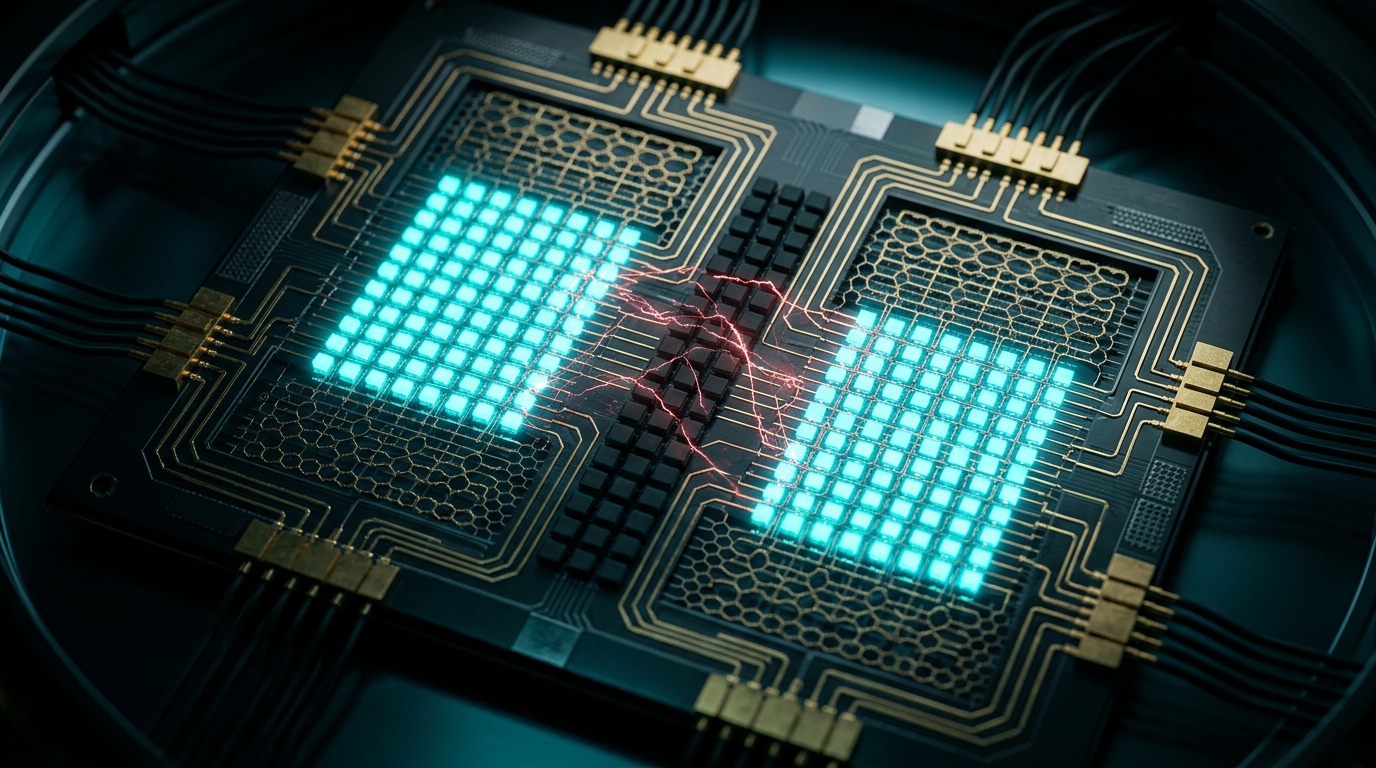
[IMAGE: A D-Wave quantum annealing processor chip under extreme macro photography, superconducting loops visible, illuminated by deep cyan light against a black background, 8K cinematic quality, no text or human faces]
What the Minimum Distance Problem Actually Means
Definition: The minimum distance of a quantum error-correcting code is the smallest weight of any undetectable error operator — the fewest physical qubit errors required to corrupt encoded information without triggering the code’s detection mechanism. A higher minimum distance means a more robust code. For quantum stabilizer codes, computing this value exactly is NP-hard, meaning no known classical algorithm solves it efficiently as code size grows.
For security architects, the practical translation is straightforward: a quantum computer built on a code with an uncertified or suboptimal minimum distance has a known, exploitable weakness. Certifying minimum distance is the quality assurance step for quantum hardware — equivalent to validating a cryptographic primitive before deploying it in production.
The challenge is that classical certification methods hit a wall as code parameters scale. The QUBO reformulation described in arXiv:2404.17703 attacks this wall directly.
The QUBO Reformulation: Technical Architecture
From NP-Hard Search to Optimization Problem
The research team reformulated the minimum distance problem of quantum stabilizer codes as a Quadratic Unconstrained Binary Optimization (QUBO) instance. QUBO is the native problem format for quantum annealers — it maps directly onto the energy minimization dynamics of hardware like D-Wave’s Advantage series.
The critical efficiency result: the reformulation introduces only a logarithmic multiplicative overhead in the number of required binary variables. For an NP-hard problem, this is a significant structural property. It means the QUBO instance does not balloon in size relative to the original code parameters — the variable count grows slowly, keeping the problem tractable on near-term hardware for moderate code sizes.
The formulation is explicitly solver-independent. The same QUBO instance can be submitted to:
- A quantum annealer (D-Wave Advantage 4.1, tested in this work)
- A hybrid quantum-classical solver (Qbsolv, tested in this work)
- A classical simulated annealing (SA) engine
- Future gate-based quantum optimization solvers
This portability matters operationally. Organizations do not need to commit to a single hardware platform to benefit from the method.
Hardware Benchmark: D-Wave Advantage 4.1 vs. Simulated Annealing
| Dimension | Quantum Annealing (D-Wave Advantage 4.1) | Simulated Annealing (Classical) | Hybrid Qbsolv |
|---|---|---|---|
| Problem format | Native QUBO | QUBO (software) | QUBO (hybrid) |
| Performance vs. specialized classical | Broadly comparable | Broadly comparable | Broadly comparable |
| Primary limitation | Hardware connectivity / minor embedding | Compute time at scale | Decomposition overhead |
| Scalability ceiling (current) | Constrained by qubit connectivity graph | Constrained by exponential search space | Intermediate |
| Solver independence | Yes | Yes | Yes |
| Near-term availability | D-Wave cloud access | Standard HPC | D-Wave Leap platform |
Critical finding: Connectivity and minor embedding — the process of mapping a logical QUBO graph onto D-Wave’s physical qubit topology — are identified as the central bottlenecks limiting current quantum annealing performance on this problem. This is not a flaw in the QUBO formulation; it is a hardware generation constraint that shrinks as qubit connectivity improves.
The benchmark comparison against specialized classical distance-finding methods shows broadly comparable performance across QA, SA, and hybrid approaches at current code sizes. This parity result carries a specific implication: quantum annealing does not yet outperform classical methods for this problem, but the solver-independent QUBO framework positions organizations to capture quantum advantage automatically as hardware matures — without reformulating the problem.
The Recursive Capability: Quantum Platforms Designing Quantum Platforms
The paper’s authors frame their contribution with a precise observation worth quoting directly:
“We propose to harness the power of contemporary quantum platforms to address this question, and in this way help design quantum platforms of the future.”
This is not rhetorical flourish. It describes a recursive engineering capability: using today’s quantum annealers to certify the error-correcting codes that will run on tomorrow’s fault-tolerant quantum computers. As those fault-tolerant systems mature, they could in turn certify codes for the generation after them — a compounding capability loop.
For security architects, this loop has a threat-modeling implication. The adversaries who invest earliest in QUBO-based code certification will build fault-tolerant quantum systems with higher-quality error correction, faster. That accelerates their cryptanalytic timeline against organizations still running classical public-key infrastructure.
Industry Context: Where This Fits the PQC Compliance Landscape
NIST Timelines and the Quantum Readiness Gap
NIST finalized FIPS 203 (ML-KEM), FIPS 204 (ML-DSA), and FIPS 205 (SLH-DSA) in August 2024, establishing the first mandatory PQC migration targets for U.S. federal systems. The Cybersecurity and Infrastructure Security Agency (CISA) has directed agencies to inventory cryptographic assets and begin migration planning. For private sector organizations in regulated industries — financial services, healthcare, critical infrastructure — equivalent mandates are following.
These standards address the near-term threat: protecting classical communications against future quantum decryption. The QUBO-based minimum distance work addresses the layer beneath: the quality of the quantum hardware that will eventually execute those attacks or defenses.
Who Is Moving, Who Is Lagging
Google, IBM, and Microsoft have each published quantum error correction milestones in 2023-2024, demonstrating below-threshold logical qubit operation. Each of those milestones depends on certified error-correcting codes. The QUBO approach described in arXiv:2404.17703 offers a path for organizations outside the hyperscaler tier — quantum hardware vendors, national laboratories, and defense contractors — to run their own code certification workloads on accessible quantum annealing hardware rather than waiting for proprietary internal tools.
The compliance burden for organizations building or procuring quantum systems will eventually include code quality certification. Establishing internal capability now, using solver-independent QUBO methods on D-Wave cloud access, reduces that future compliance burden.
Economic Impact: Cost of Inaction
The cost of deploying a fault-tolerant quantum system built on uncertified or suboptimal error-correcting codes is not theoretical. A code with an unverified minimum distance may fail to detect error patterns that a certified code would catch — meaning logical qubit fidelity degrades unpredictably under load. For organizations using quantum systems in cryptographic key generation or secure computation, that fidelity gap is a direct attack surface.
The cost of running QUBO-based certification on D-Wave Leap cloud access is measurable in compute-hours. The cost of discovering a code quality defect after deployment is measured in system redesign cycles and potential cryptographic exposure.
The BeQuantum Perspective: Certifying the Infrastructure Beneath PQC
At BeQuantum, our PQC Layer is designed around a core principle: cryptographic assurance requires verified primitives at every layer of the stack. Most PQC migration discussions focus on algorithm selection — ML-KEM vs. Classic McEliece, lattice vs. hash-based signatures. Fewer focus on the hardware substrate that will eventually execute attacks against those algorithms.
The QUBO-based minimum distance approach matters to our technical roadmap for a specific reason: it makes code quality certification accessible on near-term hardware without requiring a proprietary gate-based quantum system. Our Digital Notary infrastructure, which provides tamper-evident verification of cryptographic operations, benefits directly from advances in certifiable quantum error correction — because the long-term integrity of quantum-backed verification depends on the quality of the underlying codes.
Here is how organizations at our tier are approaching this practically: rather than waiting for fault-tolerant quantum systems to arrive fully formed, they are building evaluation pipelines now — using QUBO solvers on accessible quantum annealing platforms to benchmark candidate stabilizer codes against classical specialized methods. The solver-independent formulation means those pipelines do not become obsolete when hardware generations change.
For IceCase hardware deployments, where physical key material security intersects with quantum-resistant cryptographic operations, understanding the minimum distance properties of the error-correcting codes in adjacent quantum systems is part of a complete threat model — not an academic footnote.
What You Should Do Next
Within 30 days: Map your organization’s exposure to quantum error correction decisions. If you procure quantum computing services, request documentation of the error-correcting codes in use and their certified minimum distances. If your vendor cannot provide this, treat it as an unquantified risk in your threat model.
Within 90 days: Evaluate D-Wave Leap cloud access for internal QUBO experimentation. The solver-independent formulation in arXiv:2404.17703 means your team can begin running minimum distance evaluations on stabilizer codes relevant to your quantum infrastructure without waiting for gate-based hardware. Assign a quantum security engineer to benchmark the QUBO approach against any classical distance-finding tools already in your stack.
Within 12 months: Incorporate quantum code quality certification into your quantum vendor assessment framework. As NIST and CISA expand quantum readiness guidance beyond algorithm selection, organizations with existing internal certification capability will face lower compliance burden and shorter audit cycles than those building from scratch.
Frequently Asked Questions
Q: Does this QUBO approach replace classical methods for finding minimum distances of quantum codes?
A: Not yet — and the paper does not claim otherwise. Benchmarks on D-Wave Advantage 4.1 show broadly comparable performance between quantum annealing, simulated annealing, and hybrid Qbsolv approaches at current code sizes. The value of the QUBO formulation today is its solver independence and logarithmic variable overhead, which position it to capture quantum advantage as hardware connectivity improves without requiring problem reformulation.
Q: What is a quantum stabilizer code, and why does its minimum distance matter for security?
A: A quantum stabilizer code is a class of quantum error-correcting code defined by a set of commuting Pauli operators (stabilizers) that protect encoded quantum information from decoherence and gate errors. The minimum distance determines the code’s error-correction capacity — specifically, a code with minimum distance d can correct up to ⌊(d−1)/2⌋ arbitrary errors. For security architects, this translates directly to the reliability of any cryptographic operation executed on a quantum system using that code: a lower minimum distance means higher logical error rates under adversarial or noisy conditions.
Q: How does hardware connectivity limit quantum annealing performance on this problem?
A: D-Wave’s quantum annealer uses a sparse qubit connectivity graph (Pegasus topology in the Advantage 4.1). When a QUBO problem’s variable interaction graph is denser than the hardware graph, a process called minor embedding maps multiple physical qubits to represent a single logical variable. This increases the effective qubit count required and introduces chain-break errors. For the minimum distance QUBO, the authors identify this embedding overhead as the primary scalability constraint — a hardware generation problem, not a formulation problem.
Source: “A quantum annealing approach to the minimum distance problem of quantum codes”, arXiv:2404.17703v4